
US Data Center Busbar Market (2026-2031)

The US Data Center Busbar Market was valued at $656.7 Million in 2026 and projected to reach to $1351.8 Million by 2031, representing a compound annual growth rate of 12.8%. The US data center busbar market is positioned for sustained growth through 2031, driven by the nation's dominance as a global data center hub and continuous infrastructure investments by major cloud providers.


| Market Size in | USD 26.32 MN |
| Market Forecast in | |
| CAGR | |
| Forecast Period | |
| Units Considered | Value (USD MN) |
US Data Center Busbar Market Trends and Insights
- This expansion reflects the US's critical role as a global data center hub, driven by surging demand for cloud infrastructure, artificial intelligence workloads, and edge computing facilities.
- The US market's 12.8% compound annual growth rate underscores accelerating investments in power distribution infrastructure across hyperscale and enterprise data centers throughout the country. US data center operators are increasingly adopting advanced busbar systems to enhance energy efficiency, reduce operational costs, and support higher power densities required by modern computing demands.
- Between 2026 and 2031, the US market will benefit from substantial capital expenditures in data center construction and retrofitting, particularly in regions like Northern Virginia, Texas, and California.
- The US busbar market's growth trajectory reflects both the expansion of existing facilities and the emergence of new data center clusters responding to domestic and international connectivity needs..
Key Market Statistics
- CAGR (2026-2031) 12.8% CAGR
- Market Size, 2026 ~USD 656.7 Million
- Forecast, 2031 ~USD 1351.8 Million
- Country US
US Data Center Busbar Market Overview
Market Valuation Growth :
The US data center busbar market is valued at $656.7 million in 2026 and is projected to reach $1,351.8 million by 2031, representing a 106% increase over the five-year forecast period.
Strong CAGR Performance :
The US market is growing at a 12.8% CAGR, slightly below the global rate of 14%, reflecting steady domestic demand driven by hyperscaler investments and data center expansion across major metropolitan areas.
AI and Cloud Infrastructure Demand :
Surging demand for artificial intelligence workloads and cloud computing infrastructure is propelling busbar adoption in US data centers, as operators require advanced power distribution solutions to support high-density computing environments.
Edge Computing Expansion :
The proliferation of edge computing facilities across the US is creating incremental demand for busbars, as distributed data center architectures require efficient power management solutions at multiple geographic locations.
US Data Center Busbar Market Dynamics
- Increasing power density requirements in modern data centers, coupled with the transition to renewable energy sources, are creating opportunities for innovative busbar solutions that enhance efficiency and sustainability.
- The market will benefit from ongoing digital transformation initiatives, 5G deployment, and the proliferation of AI applications across enterprises.
- Regional concentration in tech hubs like Northern California, Virginia, and Texas will continue to drive localized demand, while competition among data center operators will incentivize adoption of advanced power distribution technologies..
Market Ecosystem

DATA CENTER BUSBAR MARKET: COMMERCIAL USE CASES ACROSS INDUSTRIES
| COMPANY | USE CASE DESCRIPTION | BENEFITS |
|---|---|---|
 |
Uses copper or aluminum busbars within switchgear and power distribution equipment serving data centers, including low- and medium-voltage switchgear and distribution assemblies. ABB’s data center electrical portfolio includes switchgear with high-current busbar configurations for mission-critical power distribution. | Enables high-current power distribution | Supports reliable and redundant electrical architectures | Provides high short-circuit withstand capability | Supports compact and space-efficient distribution equipment |
 |
Integrates busbar conductors into electrical power distribution equipment and data center power-distribution architectures, where busbars provide internal current paths between incoming power, protection devices, and outgoing circuits. | Supports high-current electrical distribution | Reduces wiring complexity within equipment | Improves space utilization | Enables organized and reliable power connections |
 |
Uses busbars in switchboards, switchgear, power distribution units, and other electrical installations that supply data centers. Busbar arrangement forms the electrical paths for power distribution from feeders to the circuits. | Enhances power distribution with large capacity | Achieves compact equipment | Provides reliable electrical supply | Enables scalable distribution networks in data centers. |
 |
Uses copper and aluminum busbar conductors within switchboards, panelboards, power distribution equipment, and data center electrical systems. Its data center power-distribution portfolio incorporates busbar-based architectures for distributing power to critical IT loads. | Provides efficient high-current conduction | Reduces cable requirements and equipment footprint | Enables flexible power distribution | Supports modular expansion and high-density data center applications |
 |
Incorporates busbar conductors into power distribution and electrical infrastructure used in data centers, including power distribution equipment serving high-density IT loads. Copper and aluminum busbar configurations can be used to provide high-current pathways within distribution assemblies. | Supports high-density power distribution | Provides efficient current conduction | Reduces connection complexity | Enables compact and reliable electrical equipment designs |
Logos and trademarks shown above are the property of their respective owners. Their use here is for informational and illustrative purposes only.
Related Ecosystem
Key Takeaways
- The US data center busbar market will double from $656.7M (2026) to $1,351.8M (2031), representing a 12.8% CAGR.
- US hyperscale data center investments and AI infrastructure expansion are primary drivers of busbar system demand.
- The US market benefits from geographic concentration of data centers in high-demand regions requiring advanced power distribution solutions.
- US operators prioritize energy-efficient busbar technologies to meet sustainability goals and reduce total cost of ownership through 2031.
Data Center Busbar Market Report Scope
| Report Metric | Details |
|---|---|
| Base Year | 2026 |
| Fastest Growing Segment | DC (Power Source) |
| Forecast Period | 2026-2031 |
| Growth Rate | CAGR of 14% from 2026 to 2031 |
| Largest Segment | AC (Power Source) |
| Market Size Base Year (Billions) | ~USD 1.37 (2026) |
| Revenue Forecast (Billions) | ~USD 2.64 (2031) |
| Segments Covered | Conductor Type, Space Type, Power Ampacity, It Load, Power Source, Data Center Type |
US Data Center Busbar Market Report Segmentation
6 segment dimensions are covered across the global market.
By Conductor Type
- Aluminum & Hybrid
- Copper
By Space Type
- Gray
- White
By Power Ampacity
- High Ampacity
- Low Ampacity
- Medium Ampacity
By It Load
- AI
- Non-AI
By Power Source
- Ac
- Dc
By Data Center Type
- Colocation
- Enterprise
- Hyperscale
Target Audience
- Data Center Operators : US-based data center operators need this market intelligence to understand busbar technology adoption trends, competitive offerings, and investment requirements to optimize their power distribution infrastructure and maintain operational efficiency.
- Busbar Manufacturers : Equipment manufacturers targeting the US market require detailed sizing and growth forecasts to guide product development, capacity planning, and sales strategy in this high-growth segment dominated by hyperscalers.
- Cloud Service Providers : Major cloud providers expanding US data center footprints need market insights to evaluate busbar technology options, supplier capabilities, and cost structures as they scale infrastructure to support AI and edge computing workloads.
- Infrastructure Investors : Private equity and infrastructure funds investing in US data center assets require market data to assess growth potential, technology trends, and capital expenditure requirements for power distribution modernization.
- Electrical Equipment Distributors : US distributors and system integrators need market forecasts and demand drivers to optimize inventory, identify growth opportunities, and develop partnerships with data center operators and manufacturers in this expanding sector.
Reasons to Buy this Report
- Precise US Market Sizing : Obtain accurate valuation data specific to the United States market, with detailed 2026-2031 forecasts enabling precise budget allocation and investment planning for US-focused business strategies.
- Regional Growth Drivers Analysis : Understand the unique factors driving the 12.8% CAGR in the US, including AI adoption, cloud infrastructure expansion, and edge computing proliferation, to identify market entry and expansion opportunities.
- Competitive Landscape Intelligence : Gain insights into the competitive dynamics specific to the US market, including key players, market consolidation trends, and differentiation strategies relevant to American data center operators and busbar manufacturers.
- Investment Decision Support : Make informed capital allocation decisions with comprehensive US market data, including growth projections, technology trends, and customer demand patterns essential for venture capital and strategic investment evaluation.
- Strategic Planning Resources : Develop targeted go-to-market strategies for the US with actionable insights on regional demand hotspots, customer segments, and emerging opportunities in hyperscaler facilities and edge computing deployments.
Frequently asked questions
What is the current size of the US data center busbar market?
The US data center busbar market is valued at $656.7 million in 2026 and is expected to grow to $1,351.8 million by 2031.
What is the growth rate of the US data center busbar market?
The US market is projected to grow at a compound annual growth rate (CAGR) of 12.8% from 2026 to 2031.
Which regions in the US are driving data center busbar demand?
Key US regions include Northern Virginia, Texas, and California, where major hyperscale data center clusters and enterprise facilities are concentrated.
What factors are accelerating busbar adoption in US data centers?
Cloud infrastructure expansion, artificial intelligence workloads, edge computing deployment, and energy efficiency requirements are primary drivers of US busbar market growth.
Why are US data center operators investing in advanced busbar systems?
US operators adopt advanced busbars to enhance power distribution efficiency, support higher power densities, reduce operational costs, and meet sustainability objectives.
RESEARCH METHODOLOGY
The study involved four major activities in estimating the current size of the data center busbar market. Exhaustive secondary research was conducted to gather information on the market, peer markets, and the parent market. The next step was to validate these findings, assumptions, and sizing with industry experts across the data center busbars value chain through primary research. Both top-down and bottom-up approaches were employed to estimate the complete market size. Thereafter, market breakdown and data triangulation were used to estimate the market size of segments and subsegments.
Secondary Research
Secondary sources for this research study include annual reports, press releases, and investor presentations of companies; white papers; certified publications; articles by recognized authors; gold- and silver-standard websites; data center busbar manufacturing companies; regulatory bodies; trade directories; and databases. Secondary research was mainly used to obtain key information on the industry’s supply chain, the total pool of key players, market classification, and segmentation by industry trends down to the most granular level and by region. It has also been used to obtain information about key developments from a market-oriented perspective.
Primary Research
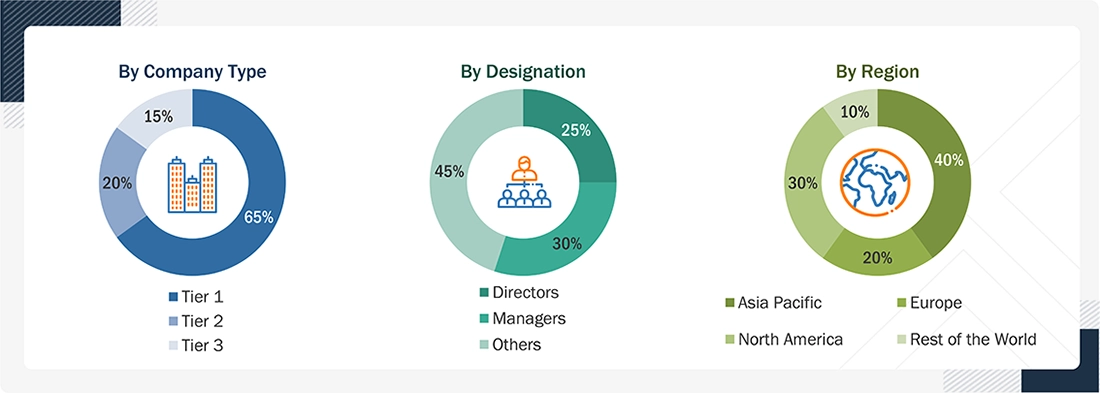
The data center busbar market comprises several stakeholders, such as raw material suppliers, technology support providers, data center busbar manufacturers, and regulatory organizations in the supply chain. Various primary sources from both the supply and demand sides of the market were interviewed to obtain qualitative and quantitative information. Primary sources from the supply side included industry experts such as chief executive officers (CEOs), vice presidents, marketing directors, technology and innovation directors, and related key executives from various key companies and organizations operating in the data center busbar market. Primary sources from the demand side included directors, marketing heads, and purchase managers from various sourcing industries. The following is the breakdown of the primary respondents:
To know about the assumptions considered for the study, download the pdf brochure
Market Size Estimation
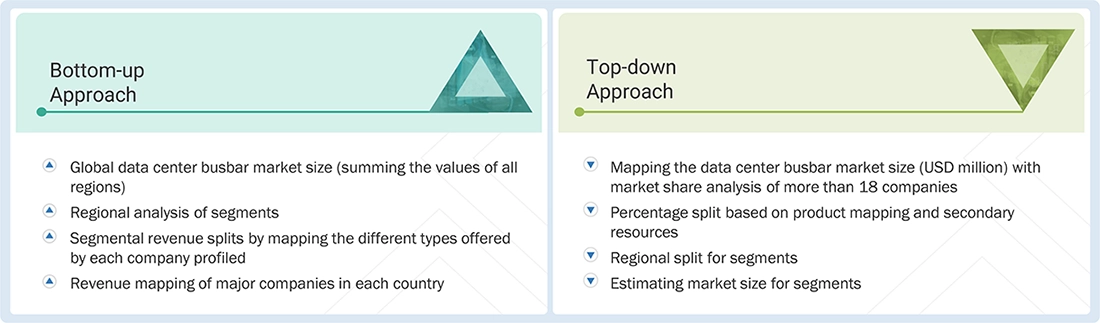
The top-down and bottom-up approaches have been employed to estimate and validate the total size of the data center busbar market. These approaches have also been used extensively to estimate the size of various dependent market subsegments. The research methodology used to estimate the market size included the following:
The following segments provide details about the overall market size estimation process employed in this study:
- Extensive primary and secondary research was done to identify the key players.
- The value chain and market size of the data center busbar market, in terms of value and volume, were determined through primary and secondary research.
- All percentage shares, splits, and breakdowns were collected through secondary sources and verified through primary sources.
- All possible parameters that affect the market were covered in this research study and are viewed in extensive detail, verified through primary research, and analyzed to obtain the final quantitative and qualitative data.
- The study of reports, reviews, and newsletters of top market players, along with extensive interviews for opinions from key leaders, such as CEOs, directors, and marketing executives, is included in this research.
Data Triangulation
After arriving at the overall market size using the market size estimation processes as explained above, the market was split into several segments and subsegments. To complete the overall market engineering process and arrive at the exact statistics of each market segment and subsegment, the data triangulation and market breakdown procedures were employed, wherever applicable. The data was triangulated by studying various factors and trends from both the demand and supply sides.
Market Definition
The data center busbar market comprises busbar-based electrical power distribution systems specifically designed and deployed within data centers to distribute power from upstream equipment such as transformers, switchgear, UPS systems, and power distribution units to IT loads and other facility equipment. These systems primarily use copper or aluminum conductors enclosed within insulated and protective assemblies and may include busbar sections, joints, connectors, and tap-off units. Data center busbars provide compact, modular, scalable, and flexible power distribution, enabling efficient connection of high-density racks and easier capacity expansion compared with conventional cable-based distribution. IEC 61439-6 provides the international framework for busbar trunking systems, covering assemblies incorporating busbars for electrical power distribution.
Key Stakeholders
- Data center busbar manufacturers, processors, and others
- Research institutions, standards organizations, and regulatory agencies such as ASTM, ISO, and others
- NGOs, governments, investment banks, venture capitalists, and private equity firms
Report Objectives
- To define, describe, and forecast the market size of data center busbars in terms of value and volume
- To provide detailed information regarding the key factors, such as drivers, restraints, opportunities, and industry-specific challenges, influencing the growth of the data center busbar market
- To analyze and forecast the global data center busbar market based on IT load, data center type, conductor type, space type, power ampacity, power source, and region
- To analyze the opportunities in the market for stakeholders and provide details of the competitive landscape for market leaders
- To forecast the size of various market segments based on four major regions: North America, Asia Pacific, Europe, and the Rest of the World, along with their respective key countries
- To track and analyze the competitive developments, such as product launches, expansions, and other developments in the market
- To strategically profile the key players and comprehensively analyze their market shares and core competencies
Available customizations:
With the given market data, MarketsandMarkets offers customizations according to the client-specific needs.
The following customization options are available for the report:
- Additional country-level analysis of the data center busbar market
- Profiling of additional market players (up to 5)
Product Analysis
- Product matrix, which provides a detailed comparison of each company's product portfolio.
Get the Full Data Center Busbar Market Report
Full forecast, segment splits, and company analysis for all Data Center Busbar Market.
- China Data Center Busbar Market
- Australia Data Center Busbar Market
- Japan Data Center Busbar Market
- India Data Center Busbar Market
- Germany Data Center Busbar Market
- UK Data Center Busbar Market
- France Data Center Busbar Market
- Netherlands Data Center Busbar Market
- Canada Data Center Busbar Market
- Rest Of Europe Data Center Busbar Market
- Rest Of Asia Pacific Data Center Busbar Market
Need a Tailored Report?
Customize this report to your needs
Get 10% FREE Customization
Customize This Report
