
US Data Center Coolant Distribution Units Market (2025-2030)

The US Data Center Coolant Distribution Units Market was valued at $443.6 Million in 2025 and projected to reach to $3487.4 Million by 2030, representing a compound annual growth rate of 34.3%. The US data center coolant distribution units market is poised for transformative growth through 2030, driven by the nation's dominance in cloud computing, artificial intelligence, and digital infrastructure.


| Market Size in | USD 26.32 MN |
| Market Forecast in | |
| CAGR | |
| Forecast Period | |
| Units Considered | Value (USD MN) |
US Data Center Coolant Distribution Units Market Trends and Insights
- This exceptional growth reflects the US's critical role as a global data center hub, where demand for advanced thermal management solutions is intensifying due to rising computational loads and energy efficiency mandates.
- The US market's 34.3% compound annual growth rate significantly outpaces global trends, driven by hyperscale data center investments and the adoption of liquid cooling technologies across the country. US data center operators are increasingly prioritizing coolant distribution units to optimize operational efficiency and reduce power consumption.
- The market expansion in the US is fueled by major cloud service providers, financial institutions, and AI infrastructure developers seeking innovative cooling solutions.
- Between 2025 and 2030, the US market is expected to nearly eight-fold, reflecting accelerating digital transformation and the nation's competitive positioning in data center infrastructure development..
Key Market Statistics
- CAGR (2025-2030) 34.3% CAGR
- Market Size, 2025 ~USD 443.6 Million
- Forecast, 2030 ~USD 3487.4 Million
- Country US
US Data Center Coolant Distribution Units Market Overview
Explosive US Market Growth :
The US data center coolant distribution units market is projected to grow from $443.6 million in 2025 to $3,487.4 million by 2030, representing a 34.3% CAGR—outpacing the global average of 33%.
Data Center Hub Dominance :
The US maintains its position as the world's largest data center market, with major hyperscalers and cloud providers concentrated across regions, driving unprecedented demand for advanced thermal management solutions.
Energy Efficiency Mandates :
Stricter US federal and state energy efficiency regulations are compelling data center operators to adopt sophisticated coolant distribution units to reduce operational costs and meet sustainability targets.
Rising Computational Demands :
Accelerating AI, machine learning, and high-performance computing workloads in the US are generating extreme heat loads, necessitating next-generation coolant distribution technologies for optimal thermal management.
US Data Center Coolant Distribution Units Market Dynamics
- Major technology companies and data center operators are increasingly investing in advanced thermal management solutions to handle unprecedented computational demands while meeting stringent energy efficiency regulations.
- The convergence of rising power densities, sustainability mandates, and competitive pressure to reduce operational expenses creates a compelling market environment for coolant distribution unit manufacturers and solution providers across the US..
Market Ecosystem
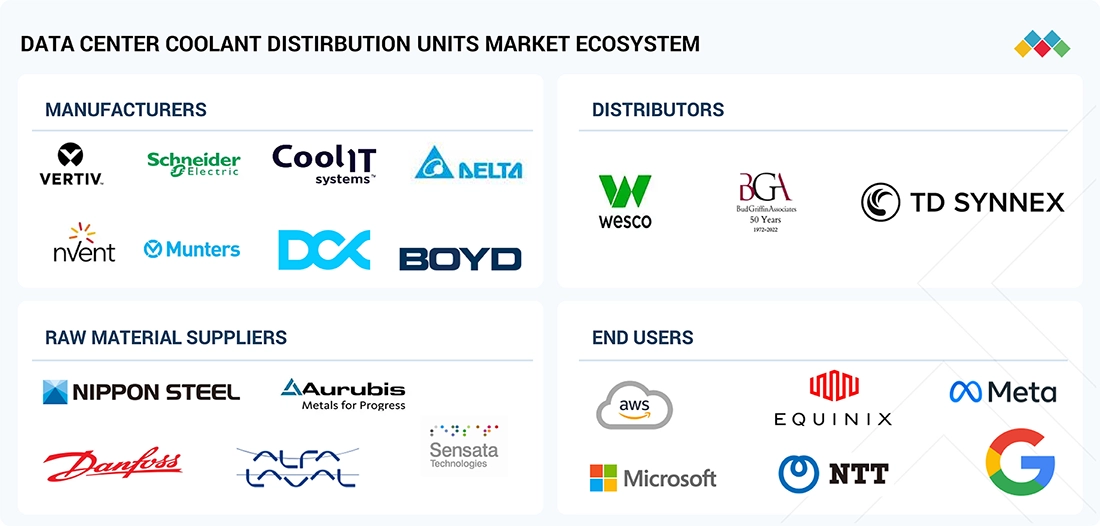
Data Center Coolant Distribution Units Market: COMMERCIAL USE CASES ACROSS INDUSTRIES
| COMPANY | USE CASE DESCRIPTION | BENEFITS |
|---|---|---|
 |
Provides coolant distribution units that integrate with liquid cooling systems for high-density racks, ensuring precise delivery of coolant and real-time monitoring of flow and temperature. | Reliable thermal management for dense workloads, fewer hot spots, and higher overall system uptime. |
 |
Offers modular coolant distribution units designed for scalable data center environments, with remote management features to support edge and hyperscale deployments. | Improved energy efficiency, simplified deployment, and scalable cooling with reduced operational costs. |
 |
Specializes in coolant distribution units optimized for mission-critical environments, featuring leak detection, automatic shutoff, and redundancy to ensure system safety. | Higher operational resilience, minimized downtime risks, and compliance with safety requirements. |
 |
Delivers compact and high-performance coolant distribution units engineered for space-constrained facilities, with integrated heat exchangers for efficient secondary loop cooling. | Maximized rack density, reduced cooling energy use, and flexible retrofitting of existing sites. |
 |
Develops custom coolant distribution units and thermal management systems for hyperscale and colocation providers, integrating advanced monitoring platforms with predictive maintenance capabilities. | Greater sustainability, higher rack power support, and lower total cost of ownership. |
Logos and trademarks shown above are the property of their respective owners. Their use here is for informational and illustrative purposes only.
Related Ecosystem
Equipment Machine And Tooling
- Wastewater Treatment
- Air Cooled Heat Exchangers
- Diaphragm Pumps
- Fiberglass
- HVAC System
- Alfa Laval Corporate AB
- Veolia
- Johnson Controls International plc
- Daikin Industries,Ltd.
- Parker-Hannifin Corporation
Key Takeaways
- The US data center coolant distribution units market will grow from $443.6M (2025) to $3,487.4M (2030), representing a 34.3% CAGR.
- US market growth is driven by hyperscale data center expansion and increased adoption of liquid cooling technologies across the country.
- The US represents a disproportionately high-growth segment compared to global markets, reflecting concentrated data center infrastructure investment.
- AI and cloud computing demand in the US is accelerating coolant distribution unit adoption as operators prioritize thermal efficiency and sustainability.
Data Center Coolant Distribution Units Market Report Scope
| Report Metric | Details |
|---|---|
| Base Year | 2025 |
| Fastest Growing Segment | FACILITY DISTRIBUTION UNITS (Type) |
| Forecast Period | 2025-2030 |
| Growth Rate | CAGR of 33% from 2025 to 2030 |
| Largest Segment | SOLUTION (Component) |
| Market Size Base Year (Billions) | ~USD 1.05 (2025) |
| Revenue Forecast (Billions) | ~USD 4.38 (2030) |
| Segments Covered | Type, Cooling Type, End Use, End-Use, Component |
US Data Center Coolant Distribution Units Market Report Segmentation
5 segment dimensions are covered across the global market.
By Type
- Facility Distribution Units
- In-Rack Cdu
- In-Row Cdu
- Single-Phase Immersion Cooling
- Two-Phase Immersion Cooling
By Cooling Type
- Direct To Chip Cooling
- Immersion Cooling
By End Use
- Colocation Providers
- Enterprises
- Hyperscale Data Centers
By End-Use
- Colocation Providers
- Enterprises
- Hyperscale Data Centers
By Component
- Services
- Solution
Target Audience
- Data Center Operators & Facility Managers : Need detailed market intelligence to evaluate coolant distribution unit investments, optimize thermal management strategies, and ensure compliance with evolving US energy efficiency standards while controlling operational costs.
- Equipment Manufacturers & OEMs : Require comprehensive US market data to guide product development roadmaps, identify emerging technology trends, assess competitive positioning, and capitalize on the 34.3% CAGR growth opportunity through strategic expansion.
- Private Equity & Investment Firms : Seek validated market sizing and growth projections for the US data center cooling sector to evaluate acquisition targets, assess portfolio company performance, and identify high-return investment opportunities in thermal management.
- System Integrators & Solution Providers : Need US-specific market insights to develop integrated cooling solutions, identify customer segments, understand regulatory requirements, and position offerings against competitors in this rapidly expanding market.
- Strategic Consultants & Analysts : Require authoritative US market data and forecasts to support client advisory work, validate business cases, benchmark performance metrics, and provide evidence-based recommendations for data center infrastructure investments.
Reasons to Buy this Report
- Market Size & Growth Validation : Confirm the US market opportunity with precise valuations ($443.6M in 2025, $3,487.4M in 2030) and validate investment decisions against verified 34.3% CAGR projections specific to the American market.
- Competitive Landscape Intelligence : Identify leading US-based and international competitors, their market positioning, product portfolios, and strategic initiatives to benchmark your offerings and capture market share in this high-growth segment.
- Regional Demand Drivers : Understand US-specific factors including hyperscaler expansion, AI infrastructure buildout, federal energy mandates, and regional data center concentration to tailor go-to-market strategies and product development.
- Investment & Partnership Opportunities : Identify acquisition targets, joint venture partners, and technology integration opportunities within the US market to accelerate growth and establish competitive advantages in thermal management solutions.
- Regulatory & Compliance Insights : Navigate US federal, state, and local energy efficiency regulations, environmental standards, and data center operational requirements that directly influence coolant distribution unit specifications and market demand.
Frequently asked questions
What is the current size of the US data center coolant distribution units market?
The US market is valued at $443.6 million in 2025 and is projected to reach $3,487.4 million by 2030.
What is the growth rate of the US data center coolant distribution units market?
The US market is growing at a compound annual growth rate (CAGR) of 34.3% from 2025 to 2030.
Why is the US market growing faster than the global average?
The US market benefits from concentrated hyperscale data center investments, advanced AI infrastructure development, and aggressive adoption of liquid cooling technologies by major cloud providers.
Which industries are driving demand for coolant distribution units in the US?
Cloud computing providers, financial services firms, artificial intelligence developers, and large-scale data center operators are the primary drivers of US market demand.
What factors will influence the US market between 2025 and 2030?
Energy efficiency regulations, data center capacity expansion, AI workload growth, sustainability initiatives, and competition among hyperscalers will shape the US market trajectory through 2030.
RESEARCH METHODOLOGY
The study involved four main activities in estimating the current size of the data center coolant distribution units market: comprehensive secondary research gathered information on the market, peer markets, and parent markets. The next step was to validate these findings, assumptions, and sizing with industry experts across the data center coolant distribution units value chain through primary research. Both top-down and bottom-up approaches were used to estimate the total market size. Then, market breakdown and data triangulation were applied to determine the sizes of segments and subsegments.
Secondary Research
Secondary sources for this research include annual reports, press releases, investor presentations, white papers, certified publications, articles by recognized authors, trusted websites, data center coolant distribution units manufacturing companies, regulatory bodies, trade directories, and databases. The secondary research primarily aimed to gather key information about the industry’s supply chain, main players, market classification, and segmentation based on industry trends and regional markets. It was also used to obtain insights into significant developments from a market-focused perspective.
Primary Research
The data center coolant distribution units market includes several stakeholders, such as raw material suppliers, technology support providers, manufacturers of coolant distribution units, and regulatory organizations within the supply chain. Various primary sources from both the supply and demand sides of the market were interviewed to gather qualitative and quantitative information. On the supply side, primary sources included industry experts such as CEOs, vice presidents, marketing directors, technology and innovation directors, and other key executives from different companies and organizations operating in the data center coolant distribution units market. On the demand side, primary sources included directors, marketing heads, and purchasing managers from various sourcing industries.
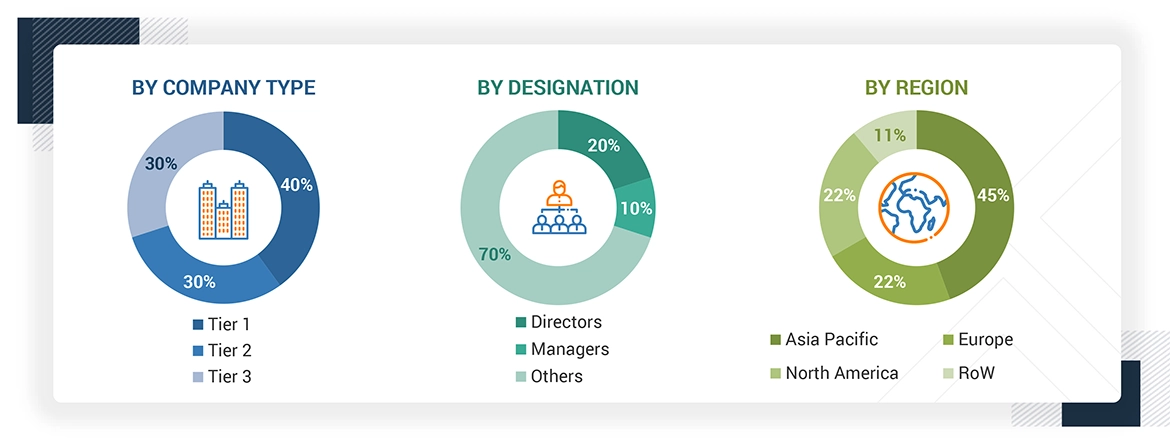
The following is the breakdown of the primary respondents:
To know about the assumptions considered for the study, download the pdf brochure
Market Size Estimation
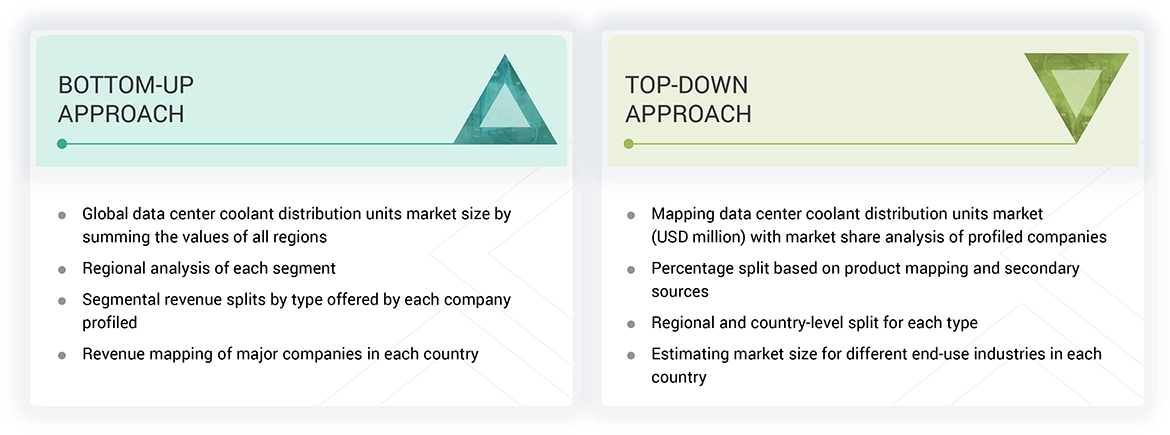
The top-down and bottom-up approaches have been used to estimate and validate the total size of the data center coolant distribution units market. These methods have also been widely employed to determine the size of various related market subsegments. The research methodology used to estimate the market size included the following:
The following segments provide details about the overall market size estimation process employed in this study:
- The key players in the market were identified through secondary research.
- Market shares in each region were determined using both primary and secondary research.
- Primary and secondary research established the value chain and market size of the data center coolant distribution units market in terms of both value and volume.
- All percentage shares, splits, and breakdowns were calculated using secondary sources and verified with primary sources.
- All relevant parameters impacting the market that were covered in this study were thoroughly examined, verified through primary research, and analyzed to produce the final quantitative and qualitative data.
- The research included studying the annual and financial reports of the top market players and interviewing industry experts, such as CEOs, VPs, directors, sales managers, and marketing executives, for key quantitative and qualitative insights.
Global Data Center Coolant Distribution Units Market Size: Bottom-Up Approach and Top-Down Approach
Data Triangulation
After estimating the overall market size using the methods described above, the market was divided into different segments and sub-segments. Data triangulation and market breakdown procedures were used when applicable to finish the overall market analysis and determine the exact data for each segment and subsegment. The data was triangulated by examining various factors and trends from both the demand and supply sides in the steel & iron sector.
Market Definition
Coolant distribution units are specialized subsystems within liquid cooling systems that are essential for managing temperature in high-density IT environments such as data centers, HPC clusters, and AI workloads. Located between IT equipment and the facility’s cooling loop, coolant distribution units control and circulate dielectric or water-based coolants to remove and transfer heat generated by processors, GPUs, and other high-power components. These units keep coolant at designated flow rates and temperatures, ensuring effective heat exchange while protecting IT hardware from thermal stress and potential contamination from untreated facility water.
Coolant distribution units are generally categorized into two configurations: Liquid-to-Liquid CDUs, which transfer heat from the IT loop to a facility water loop through a heat exchanger, and Liquid-to-Air CDUs, which use radiators and fans to dissipate heat into the surrounding air when water infrastructure is unavailable. Equipped with precision sensors, pumps, filters, and control systems, coolant distribution units provide real-time monitoring, leak detection, and redundancy to ensure continuous cooling. As demand for AI and compute-intensive applications increases, coolant distribution units support scalable, energy-efficient, and sustainable cooling solutions, decreasing reliance on traditional CRAC systems and significantly reducing operational carbon footprints.
Stakeholders
- Manufacturers of data center coolant distribution units
- Traders, distributors, and suppliers of data center coolant distribution units
- Government and research organizations
- Associations and industrial bodies
- Research and consulting firms
- R&D institutions
- Environment support agencies
- Investment banks and private equity firms
Report Objectives
- To analyze and forecast the market size of the data center coolant distribution units market in terms of value and volume
- To provide detailed information regarding the major factors (drivers, restraints, challenges, and opportunities) influencing the regional market
- To analyze and forecast the global data center coolant distribution units market based on type, cooling type, process, capacity, data center type, end user, and region
- To analyze the opportunities in the market for stakeholders and provide details of a competitive landscape for market leaders
- To forecast the size of various market segments based on five major regions: Asia Pacific, Europe, North America, South America, and the Middle East & Africa, along with their respective key countries
- To track and analyze the competitive developments, such as product launches, acquisitions, collaborations, partnerships, and expansions, in the market
- To strategically profile the key players and comprehensively analyze their market shares and core competencies
Get the Full Data Center Coolant Distribution Units Market Report
Full forecast, segment splits, and company analysis for all Data Center Coolant Distribution Units Market.
- Canada Data Center Coolant Distribution Units Market
- Mexico Data Center Coolant Distribution Units Market
- Germany Data Center Coolant Distribution Units Market
- UK Data Center Coolant Distribution Units Market
- France Data Center Coolant Distribution Units Market
- Italy Data Center Coolant Distribution Units Market
- Spain Data Center Coolant Distribution Units Market
- China Data Center Coolant Distribution Units Market
- Japan Data Center Coolant Distribution Units Market
- South Korea Data Center Coolant Distribution Units Market
- India Data Center Coolant Distribution Units Market
- Malaysia Data Center Coolant Distribution Units Market
- Singapore Data Center Coolant Distribution Units Market
- Australia Data Center Coolant Distribution Units Market
- South Africa Data Center Coolant Distribution Units Market
- Brazil Data Center Coolant Distribution Units Market
- Rest Of Europe Data Center Coolant Distribution Units Market
- Rest Of Asia Pacific Data Center Coolant Distribution Units Market
- GCC Countries Data Center Coolant Distribution Units Market
- -Rest Of GCC Countries Data Center Coolant Distribution Units Market
- Rest Of South America Data Center Coolant Distribution Units Market
Need a Tailored Report?
Customize this report to your needs
Get 10% FREE Customization
Customize This Report
