
Brazil Data Center Generators Market (2026-2031)

The Brazil Data Center Generators Market was valued at $179.9 Million in 2026 and projected to reach to $327.8 Million by 2031, representing a compound annual growth rate of 12.7%. Brazil's data center generators market is poised for sustained expansion as the country solidifies its position as Latin America's digital infrastructure leader.


| Market Size in | USD 26.32 MN |
| Market Forecast in | |
| CAGR | |
| Forecast Period | |
| Units Considered | Value (USD MN) |
Brazil Data Center Generators Market Trends and Insights
- This 12.7% compound annual growth rate significantly outpaces global trends, reflecting Brazil's accelerating digital infrastructure investments and cloud adoption.
- Brazil's strategic position as Latin America's largest economy drives demand for reliable backup power solutions across hyperscale facilities, financial institutions, and emerging tech hubs. The expansion of Brazil's data center sector is fueled by increasing internet penetration, e-commerce growth, and regulatory requirements for business continuity.
- Brazil's energy infrastructure challenges and grid reliability concerns make backup generators essential for mission-critical operations.
- Between 2026 and 2031, Brazil is expected to see substantial capital deployment in both diesel and alternative fuel generator technologies to support the nation's digital transformation agenda..
Key Market Statistics
- CAGR (2026-2031) 12.7% CAGR
- Market Size, 2026 ~USD 179.9 Million
- Forecast, 2031 ~USD 327.8 Million
- Country Brazil
Brazil Data Center Generators Market Overview
Exceptional Growth Trajectory :
Brazil's data center generators market is expanding at 12.7% CAGR, nearly 5x faster than the global rate of 2.7%, driven by massive digital transformation initiatives across the country's financial and tech sectors.
Latin America's Digital Hub :
As Latin America's largest economy, Brazil is attracting significant cloud infrastructure investments from global hyperscalers, positioning it as the region's primary data center hub and generator demand driver.
Rapid Market Expansion :
Market valuation is projected to grow from USD 179.9 million in 2026 to USD 327.8 million by 2031, representing an 82% increase over five years as enterprises prioritize backup power reliability.
Infrastructure Modernization Wave :
Brazil's accelerating cloud adoption and digital economy growth are spurring investments in mission-critical power solutions, with data centers requiring robust generator capacity to ensure operational continuity.
Brazil Data Center Generators Market Dynamics
- The 12.7% CAGR reflects strong demand from financial institutions, e-commerce platforms, and multinational tech companies establishing regional operations.
- Government initiatives promoting digital economy growth and increasing foreign direct investment in cloud infrastructure are key catalysts. Looking ahead to 2031, the market will benefit from rising data center construction, stricter uptime requirements, and growing adoption of edge computing solutions.
- Energy reliability concerns and regulatory compliance standards will further drive generator adoption.
- Brazil's competitive advantages in cost and strategic location position it to capture significant regional market share, attracting both domestic and international generator manufacturers..
Market Ecosystem

DATA CENTER GENERATORS MARKET: COMMERCIAL USE CASES ACROSS INDUSTRIES
| COMPANY | USE CASE DESCRIPTION | BENEFITS |
|---|---|---|
 |
C7 Data Centers deployed a 13 MW Modular Power System (MPS) from Generac to support its multi-tier colocation facility in Bluffdale, Utah. The project utilized multiple Gemini diesel generators to provide scalable, redundant, and reliable backup power infrastructure capable of supporting continuous data center operations and future expansion requirements. | The deployment enabled C7 Data Centers to achieve high reliability, rapid scalability, and improved operational flexibility without disrupting existing backup power infrastructure. The modular generator configuration also enhanced redundancy, supported continuous uptime requirements, and allowed efficient capacity expansion as customer demand and data center workloads increased. |
 |
Cummins supplied backup power systems for the LG CNS Busan Global Data Center, the largest data center in South Korea. Cummins deployed 12 units of C2250D6A diesel generator sets, delivering 27 MW of standby power to support continuous operations for a facility capable of running 72,000 servers simultaneously. | The deployment provided highly reliable standby power with rapid startup capability within 10 seconds during utility failures, ensuring minimal downtime and uninterrupted service continuity. The solution also improved operational reliability through N+1 redundancy, integrated monitoring, and long-term maintenance support, helping LG CNS maintain high uptime standards for mission-critical cloud and colocation operations. |
 |
Farnam, a major interconnection and colocation data center in Omaha, deployed three Cat 3512C diesel generator sets to provide 4.5 MW of backup power capacity. The generators were installed on a rooftop parking structure to address space constraints while ensuring uninterrupted operations for mission-critical data infrastructure. | The deployment enabled the facility to achieve reliable standby power with rapid 10-second startup capability, ensuring continuous uptime during grid outages. The rooftop modular design optimized limited urban space, reduced operational risk, and supported high reliability while meeting strict noise and maintenance requirements for a dense city environment. |
 |
ABB partnered with Lefdal Mine Datacenter in Norway to provide critical power infrastructure, including a medium-voltage backbone and decentralized UPS systems, for one of Europe’s largest green data centers. Powered entirely by hydropower and wind energy, the facility was designed to scale from 10 MW to 200 MW while maintaining high energy efficiency and operational reliability. | The deployment enabled highly reliable and energy-efficient operations with UPS systems, ensuring an uninterrupted power supply within milliseconds during grid disturbances. The project also achieved significant sustainability benefits through renewable energy integration and advanced cooling systems, delivering a low PUE of 1.08–1.15 and reducing energy consumption by 30–40% compared with conventional data centers. |
Logos and trademarks shown above are the property of their respective owners. Their use here is for informational and illustrative purposes only.
Related Ecosystem
Data Centre And Networking
Key Takeaways
- Brazil's data center generators market will nearly double from USD 179.9M (2026) to USD 327.8M (2031), driven by 12.7% CAGR growth.
- Brazil's energy grid volatility and regulatory compliance mandates position backup generators as critical infrastructure investments.
- Brazil's expanding cloud services and e-commerce sectors are accelerating demand for reliable, scalable power backup solutions.
- Brazil's market growth rate of 12.7% significantly exceeds the global average of 2.7%, reflecting regional digital acceleration.
Data Center Generators Market Report Scope
| Report Metric | Details |
|---|---|
| Base Year | 2026 |
| Fastest Growing Segment | NATURAL GAS GENERATORS (Fuel Type) |
| Forecast Period | 2026–2031 |
| Growth Rate | CAGR of 2.7% from 2026 to 2031 |
| Largest Segment | STANDBY POWER (Application) |
| Market Size Base Year (Billions) | ~USD 8.57 (2026) |
| Revenue Forecast (Billions) | ~USD 9.79 (2031) |
| Segments Covered | Fuel Type, Power Rating, Application, Redundancy Configuration, End User |
Brazil Data Center Generators Market Report Segmentation
5 segment dimensions are covered across the global market.
By Fuel Type
- Bi-Fuel Generators
- Diesel Generators
- Natural Gas Generators
- Other Fuel Types
By Power Rating
- 1 Mw To 2 Mw
- 2 Mw To 3 Mw
- Above 3 Mw
- Up To 1 Mw
By Application
- Continuous Power
- Prime Power
- Standby Power
By Redundancy Configuration
- 2N
- 2N+1
- N
- N+1
By End User
- Colocation Data Center
- Colocation Data Centers
- Edge Data Center
- Edge Data Centers
- Enterprise Data Center
- Enterprise Data Centers
- Hyperscale Data Center
- Hyperscale Data Centers
Target Audience
- Generator & Power Equipment Manufacturers : Manufacturers need Brazil-specific demand forecasts and market sizing to plan production capacity, distribution networks, and product localization strategies for Latin America's fastest-growing data center power market.
- Data Center Operators & Developers : DC operators require detailed market intelligence on Brazil's infrastructure growth, competitive landscape, and power solution trends to optimize facility planning, procurement strategies, and service offerings.
- Private Equity & Infrastructure Investors : Investors evaluating Brazil's digital infrastructure sector need comprehensive market data, growth projections, and regional dynamics to assess investment opportunities in data center and power solution companies.
- IT & Cloud Service Providers : Cloud and IT service providers expanding into Brazil need market insights on data center capacity, power reliability requirements, and infrastructure investment trends to plan regional expansion and partnerships.
- Government & Policy Makers : Brazilian policymakers and economic development agencies require market intelligence on digital infrastructure growth to inform regulatory frameworks, incentive programs, and strategic planning for the tech sector.
Key Companies in the Brazil Data Center Generators Market
| Company | HQ | Ownership | Strongest segments |
|---|---|---|---|
| CATERPILLAR | United States | Public Company | Construction Industries equipment and parts,Resource Industries mining equipment and services,Energy & Transportation engines, turbines, and rail, |
| CUMMINS | United States | Public Company | Engine,Distribution,Components, |
| ROLLS-ROYCE | United Kingdom | Public Company | Civil Aerospace engines and services,Defence aero, naval and submarine power,Power Systems (mtu onsite power and propulsion), |
| GE VERNOVA | United States | Public Company | Power (Gas, Nuclear, Hydro, Steam),Wind (Onshore & Offshore),Electrification (Grid, Power Conversion, Solar & Storage, Software), |
| GENERAC | United States | Public Company | Residential standby generators & transfer switches,Portable & inverter generators and outdoor power equipment,Commercial & industrial generators and mobile solutions, |
| MITSUBISHI HEAVY INDUSTRIES | Japan | Public Company | Thermal Power Generation Systems (gas turbine combined cycle and steam),Nuclear Power Systems and Post-Operational Services,Wind Power and Renewable/Environmental Systems (incl. CO2 capture, exhaust gas treatment), |
| ABB | India | Public Company | Electrification,Motion,Automation, |
| SIEMENS ENERGY | Germany | Public Company | Gas Services (gas and steam turbines, generators, services, digitalization),Grid Technologies (HVDC, transformers, substations, switchgear, digital grid),Transformation of Industry (electrolyzers, industrial turbines, compressors, drives, storage), |
| ATLAS COPCO | Sweden | Public Company | Compressor Technique (air, gas, treatment, medical air),Vacuum Technique (vacuum pumps, abatement, systems),Industrial Technique (assembly tools, machine vision, material removal), |
| PRAMAC | Italy | Private Company | Portable and standby power generators,Material handling equipment (pallet trucks, stackers, small lifters),Aftermarket services, parts, and residual asset sales, |
CATERPILLAR
Caterpillar is a United States-based public company founded in 1925 that employs 118,000 people. The company is a global leader in manufacturing heavy equipment and machinery.
CUMMINS
Cummins is a United States-based public company founded in 1919 with 67,400 employees. The company specializes in engine and power generation technology.
ROLLS-ROYCE
Rolls-Royce is a United Kingdom-based public company founded in 1884 with 43,162 employees. The company is known for manufacturing aerospace engines and power systems.
GE VERNOVA
GE Vernova is a United States-based public company founded in 2023 with 78,000 employees. The company focuses on energy and power generation solutions.
GENERAC
Generac is a United States-based public company founded in 1959 with 9,400 employees. The company manufactures power generation equipment and energy solutions.
MITSUBISHI HEAVY INDUSTRIES
Mitsubishi Heavy Industries is a Japan-based public company founded in 1884 with 78,793 employees. The company operates across multiple sectors including aerospace, energy, and industrial machinery.
ABB
ABB is an India-based public company founded in 1883 with 111,900 employees. The company provides power and automation technologies and solutions.
SIEMENS ENERGY
Siemens Energy is a Germany-based public company founded in 1866 with 98,995 employees. The company specializes in energy generation, transmission, and distribution technologies.
ATLAS COPCO
Atlas Copco is a Sweden-based public company founded in 1873 with 56,473 employees. The company manufactures industrial tools, compressors, and related equipment.
PRAMAC
Pramac is an Italy-based private company founded in 1966 with 130 employees. The company manufactures power generation equipment.
Reasons to Buy this Report
- Market-Specific Growth Intelligence : Gain detailed insights into Brazil's 12.7% CAGR trajectory, understanding the unique drivers differentiating it from global trends and identifying high-growth segments within the Brazilian market.
- Competitive Positioning Strategy : Benchmark your operations against Brazil's market dynamics, identify white-space opportunities in the USD 179.9M-to-USD 327.8M expansion, and develop targeted go-to-market strategies for Latin America's largest economy.
- Investment Decision Support : Make informed capital allocation decisions with comprehensive Brazil-specific forecasts, regional demand patterns, and infrastructure investment trends through 2031 to maximize ROI in this high-growth market.
- Stakeholder-Ready Market Data : Access credible, Brazil-focused market sizing and projections to support board presentations, investor pitches, and strategic planning with region-specific metrics and growth narratives.
- Risk Mitigation & Opportunity Mapping : Identify market entry barriers, regulatory considerations, and competitive landscapes specific to Brazil's data center ecosystem to minimize risks and capitalize on emerging opportunities.
Frequently asked questions
What is the current size of Brazil's data center generators market?
Brazil's data center generators market is valued at USD 179.9 million in 2026, with expectations to reach USD 327.8 million by 2031.
What is driving growth in Brazil's data center generators market?
Brazil's market growth is driven by increasing cloud adoption, e-commerce expansion, regulatory compliance requirements, and concerns about grid reliability in the region.
How does Brazil's market growth compare to global trends?
Brazil's 12.7% CAGR significantly outpaces the global average of 2.7%, making Brazil one of the fastest-growing markets for data center generators.
What types of generators are most in demand in Brazil?
Brazil shows strong demand for both traditional diesel generators and alternative fuel solutions, with preference varying by facility size and sustainability requirements.
Which sectors are the primary consumers of data center generators in Brazil?
Brazil's primary consumers include hyperscale cloud providers, financial institutions, e-commerce platforms, and government agencies requiring mission-critical backup power.
RESEARCH METHODOLOGY
This research study on the data center generators market involved extensive secondary sources, directories, IEEE Communication-Efficient: Algorithms and Systems, International Journal of Innovation and Technology Management, and paid databases. Primary sources included industry experts from core and related industries, third-party service providers, consulting service providers, end users, and other commercial enterprises. In-depth interviews with primary respondents, including key industry participants and subject matter experts, were conducted to obtain and verify critical qualitative and quantitative information and assess the market’s prospects.
Secondary Research
In the secondary research process, various sources were referred to identify and collect information for this study. Secondary sources included annual reports, press releases, and investor presentations of companies; white papers, journals, and certified publications; and articles from recognized authors, directories, and databases. The data was also collected from other secondary sources, such as journals, government websites, blogs, and vendors’ websites.
Primary Research
During the primary research process, interviews were conducted with various sources from both the supply and demand sides to gather qualitative and quantitative information on the market. The primary sources on the supply side included generator manufacturers, engine suppliers, power solution providers, component manufacturers, and industry experts such as chief executive officers (CXOs), vice presidents (VPs), business development managers, and directors involved in power systems, energy infrastructure, and data center operations. It also included key executives from the data center industry, professional service providers, industry associations, and other key opinion leaders.
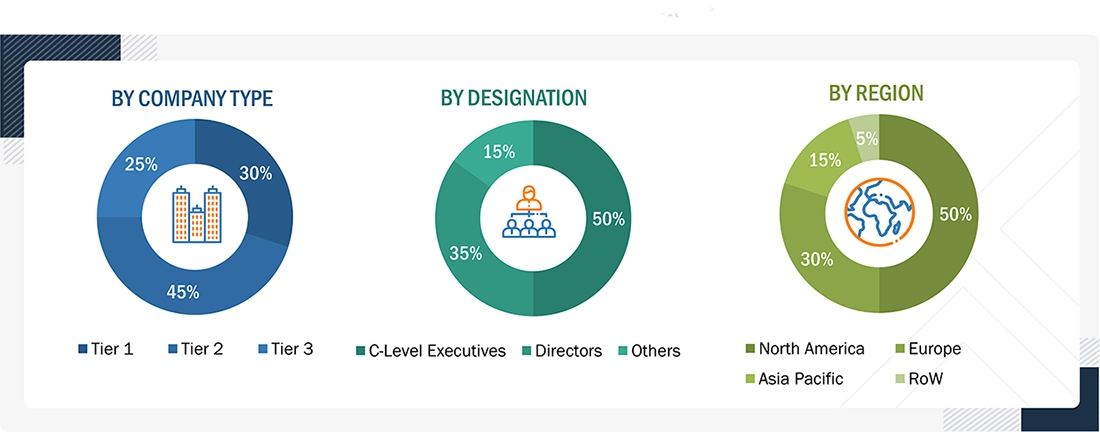
Notes: Tier 1 companies’ revenues are more than USD 1 billion; Tier 2 companies’ revenues range between USD 500 million and USD 1 billion; and Tier 3 companies’ revenues range between USD 50 million and USD 500 million.
Other designations include sales managers, marketing managers, data center procurement managers, and product managers.
To know about the assumptions considered for the study, download the pdf brochure
Market Size Estimation
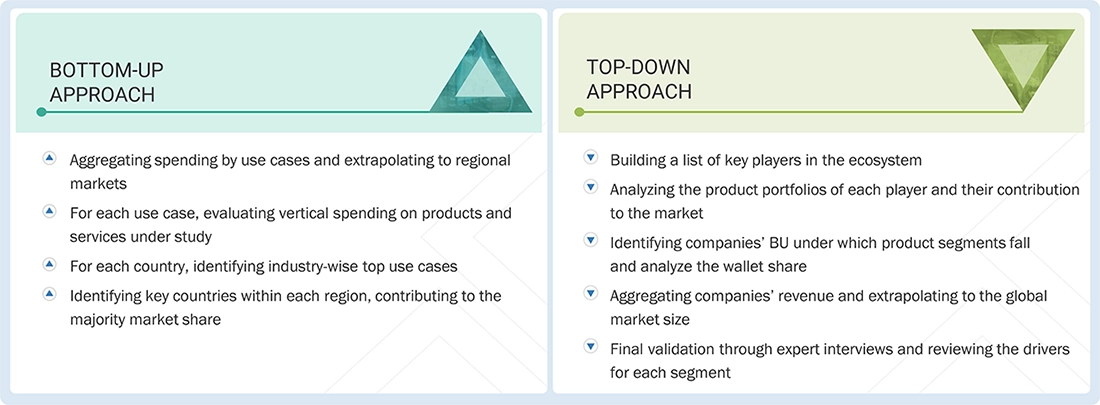
Multiple approaches were adopted to estimate and forecast the data center generators market. The first approach involved estimating the market size based on companies’ revenue from data center generator sales.
Market Size Estimation Methodology: Top-down Approach
The top-down approach estimates the overall data center generators market size by starting with a macro-level view, such as total IT spending or digital transformation expenditures. High-level industry or market values are divided and allocated into segments based on identified proportions by offering, workload type, data center size & capacity, end user, and region using researched splits. This approach uses broad market trends, industry reports, and expert insights to proportionately allocate the total value across sub-markets, regions, and countries. It ensures that the overall estimation remains aligned with recognized industry benchmarks, enabling accurate segmentation and a holistic market perspective.
Market Size Estimation Methodology: Bottom-up Approach
The bottom-up approach for estimating the data center generators market size involves aggregating data at the most granular level, such as company revenues, to build up to the global figure. This process begins by collecting company-level revenue data for data center generators and services. By analyzing the market share and revenue of key players and integrating percentage splits across segments, such as service line or industry, the total market size is calculated. Additional segmentation is performed by region or vertical, ensuring comprehensive coverage. The method then validates market estimates by comparing and consolidating segment results, providing a robust, detailed market-size assessment derived from concrete, ground-level business activity.
Data Center Generators Market : Top-Down and Bottom-Up Approach
Data Triangulation
After determining the overall market size using the market estimation processes described above, the market was segmented and sub-segmented. Data triangulation and market segmentation procedures were employed, where applicable, to complete the overall market engineering process and determine the exact statistics for each market segment and subsegment. The overall market size was then used in the top-down approach to estimate the size of other individual markets by applying percentage splits to the market segmentation.
Market Definition
After determining the overall market size using the market estimation processes described above, the market was segmented and sub-segmented. Data triangulation and market segmentation procedures were employed, where applicable, to complete the overall market engineering process and determine the exact statistics for each market segment and subsegment. The overall market size was then used in the top-down approach to estimate the size of other individual markets by applying percentage splits to the market segmentation.
Key Stakeholders
- Generator manufacturers
- Engine and alternator suppliers
- Hyperscale cloud providers
- Colocation data center operators
- Enterprise data center owners
- Power infrastructure and EPC contractors
- UPS and electrical equipment providers
- Utility and energy providers
- Facility management and maintenance service providers
- Government and regulatory authorities
Report Objectives
- To define, describe, and forecast the data center generators market based on type, power rating, end user, and region
- To forecast the market size of five major regional segments: North America, Europe, the Asia Pacific, the Middle East & Africa, and Latin America
- To strategically analyze the market subsegments with respect to individual growth trends, demand drivers, and their contributions to the overall market
- To provide detailed information regarding the major factors influencing market growth (drivers, restraints, opportunities, and challenges)
- To analyze macro and micro market dynamics, including hyperscale data center expansion, AI and high-performance computing (HPC) adoption, increasing power density, and growing demand for reliable backup power infrastructure
- To analyze technology trends, innovation developments, and operational advancements related to diesel, gas, bi-fuel, and hydrogen-ready generator systems, along with digital monitoring and power management solutions
- To analyze opportunities for stakeholders and provide a detailed competitive landscape of the data center generators market based on product portfolios, strategic developments, regional presence, and service capabilities
- To assess the impact of AI, generative AI, and accelerator-driven workloads on data center generator demand
- To profile key players in the market and comprehensively analyze their market share, product portfolios, and core competencies
- To track and analyze competitive developments such as mergers & acquisitions, product launches, partnerships, collaborations, and capacity expansions in the market
Available customizations:
Based on the given market data, MarketsandMarkets offers customizations tailored to the company’s specific needs. The following customization options are available for the report:
Product Analysis
- The product matrix provides a detailed comparison of the product portfolio of each company.
Geographic Analysis Based on Feasibility
- Further breakup of the North American data center generators market
- Further breakup of the European data center generators market
- Further breakup of the Asia Pacific data center generators market
- Further breakup of the Middle East & African data center generators market
- Further breakup of the Latin American data center generators market
Company Information
- Detailed analysis and profiling of additional market players (up to 5)
Get the Full Data Center Generators Market Report
Full forecast, segment splits, and company analysis for all Data Center Generators Market.
- Canada Data Center Generators Market
- US Data Center Generators Market
- UK Data Center Generators Market
- Germany Data Center Generators Market
- France Data Center Generators Market
- Italy Data Center Generators Market
- China Data Center Generators Market
- Japan Data Center Generators Market
- India Data Center Generators Market
- South Africa Data Center Generators Market
- Mexico Data Center Generators Market
- Rest Of Europe Data Center Generators Market
- Rest Of Latin America Data Center Generators Market
- GCC Countries Data Center Generators Market
Need a Tailored Report?
Customize this report to your needs
Get 10% FREE Customization
Customize This Report
