
India Data Center Insulation Market (2024-2029)

The India Data Center Insulation Market was valued at $22.2 Million in 2024 and projected to reach to $37.6 Million by 2029, representing a compound annual growth rate of 19.2%. India's data center insulation market is poised for exceptional growth as the country emerges as a global data center hub.


| Market Size in | USD 26.32 MN |
| Market Forecast in | |
| CAGR | |
| Forecast Period | |
| Units Considered | Value (USD MN) |
India Data Center Insulation Market Trends and Insights
- This expansion reflects India's rapid digital infrastructure development and increasing demand for energy-efficient cooling solutions in data centers.
- India's market growth rate of 19.2% CAGR significantly outpaces global trends, driven by the country's emergence as a major data center hub in Asia Pacific. The acceleration of India's data center insulation market is fueled by rising investments in cloud computing, artificial intelligence, and edge computing infrastructure.
- India's strategic position as a technology services leader has attracted major global data center operators to establish facilities within the country.
- Between 2024 and 2029, India is expected to see intensified competition among insulation material suppliers as operators prioritize thermal management and operational efficiency. India's market dynamics are shaped by regulatory emphasis on sustainable building practices and the need for advanced thermal insulation to manage tropical climate challenges.
- The country's growing data center footprint in metropolitan areas like Mumbai, Bangalore, and Delhi-NCR is creating sustained demand for high-performance insulation solutions tailored to India's unique environmental conditions..
Key Market Statistics
- CAGR (2024-2029) 19.2% CAGR
- Market Size, 2024 ~USD 22.2 Million
- Forecast, 2029 ~USD 37.6 Million
- Country India
India Data Center Insulation Market Overview
Fastest Growing Market Globally :
India's data center insulation market grows at 19.2% CAGR, significantly outpacing the global rate of 17.2%, positioning it as a key growth engine in the Asia-Pacific region.
Rapid Digital Infrastructure Expansion :
India's booming digital economy, cloud adoption, and government initiatives like Digital India are driving unprecedented demand for new data center facilities requiring advanced insulation solutions.
Energy Efficiency Imperative :
Rising electricity costs and sustainability mandates are pushing Indian data center operators to invest in high-performance insulation materials to reduce cooling expenses and carbon footprints.
Market Valuation Growth :
The Indian market is projected to grow from USD 22.2 million in 2024 to USD 37.6 million by 2029, representing a 69% increase in market value over five years.
India Data Center Insulation Market Dynamics
- Driven by increasing foreign direct investment in cloud infrastructure, rising data consumption, and government support for digital transformation, demand for advanced insulation materials will accelerate.
- Major tech companies and hyperscalers are establishing facilities across India, creating sustained demand for thermal management solutions. The market will be shaped by India's focus on energy efficiency and cost optimization.
- As data center operators face pressure to reduce operational expenses and meet environmental standards, premium insulation materials offering superior thermal performance will gain market share.
- Regional manufacturing capabilities and localized supply chains are expected to develop, further supporting market expansion through 2029..
Market Ecosystem
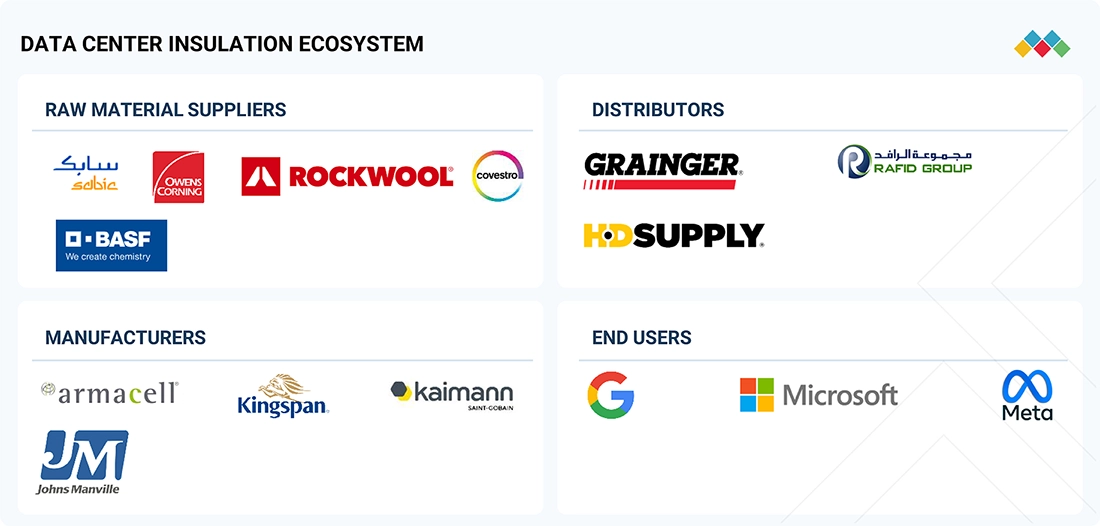
Data Center Insulation Market: COMMERCIAL USE CASES ACROSS INDUSTRIES
| COMPANY | USE CASE DESCRIPTION | BENEFITS |
|---|---|---|
 |
Develops high-performance insulation materials and systems designed for HVAC, ducting, and building envelope applications in data centers. Its solutions help reduce thermal loss, prevent condensation, and enhance energy efficiency in cooling and mechanical systems. | Provides advanced thermal insulation that minimizes energy consumption, improves temperature control, and supports reliable cooling performance in data center environments. |
 |
Manufactures elastomeric foam insulation systems with superior thermal and acoustic properties. These solutions are applied in server rooms, cooling lines, and chilled-water systems for modern data centers requiring precise temperature regulation. | Ensures long-term operational efficiency through reduced thermal bridging, improved system durability, and enhanced environmental performance. |
 |
Produces high-performance insulated panels, building envelopes, and HVAC insulation products used in data center construction and retrofits. Its offerings focus on sustainability, fire safety, and superior energy performance. | Delivers reduced energy usage, high fire resistance, and compliance with global green building standards, supporting sustainable data center operations. |
 |
A global leader in fiberglass insulation for thermal and acoustic control. Its products are widely used in data center walls, ceilings, and mechanical systems to maintain thermal balance and reduce noise. | Offers reliable thermal protection, excellent fire resistance, and energy efficiency, helping data centers lower cooling costs and enhance safety. |
 |
Provides a comprehensive range of insulation materials, including fiberglass, foam, and polyiso boards, for data center infrastructure. The company’s focus on performance and sustainability supports advanced thermal management in large-scale facilities. | Ensures optimal heat containment and energy performance, contributing to consistent temperature stability and long-term sustainability in data center environments. |
Logos and trademarks shown above are the property of their respective owners. Their use here is for informational and illustrative purposes only.
Related Ecosystem
Foam And Insulation
- Fiberglass
- Acoustic Insulation
- Elastomeric Foam
- HVAC System
- Flexible Foam
- Basf se
- Saint-gobain
- ARMACELL INTERNATIONAL
- THE WOODBRIDGE GROUP
- Huntsman Corporation
Building And Construction
- HVAC System
- Acoustic Insulation
- Alkyd Resins
- Fiberglass
- Thermal Insulation
- Snc-lavalin group inc.
- Saint-gobain
- LHOIST S.A
- USG CORPORATION
- Basf se
Key Takeaways
- India's data center insulation market is valued at USD 22.2 million in 2024 and will reach USD 37.6 million by 2029, representing a 19.2% CAGR.
- India's market growth rate outpaces the global average of 17.2%, reflecting accelerated data center infrastructure development across the country.
- India's tropical climate and rapid urbanization drive demand for advanced thermal insulation solutions in data center facilities.
- India's emergence as a regional technology hub is attracting major global data center operators, intensifying competition for specialized insulation materials.
Data Center Insulation Market Report Scope
| Report Metric | Details |
|---|---|
| Base Year | 2024 |
| Fastest Growing Segment | FLEXIBLE ELASTOMERIC FOAM (Material) |
| Forecast Period | 2024–2029 |
| Growth Rate | CAGR of 17.2% from 2024 to 2029 |
| Largest Segment | FLEXIBLE ELASTOMERIC FOAM (Material) |
| Market Size Base Year (Billions) | ~USD 0.45 (2024) |
| Revenue Forecast (Billions) | ~USD 1.61 (2029) |
| Segments Covered | Material |
India Data Center Insulation Market Report Segmentation
1 segment dimensions are covered across the global market.
By Material
- Flexible Elastomeric Foam
- Mineral Wool
- Other Materials
- Polyethylene Foam
- Polystyrene Foam
- Polyurethane Foam
Target Audience
- Data Center Operators & Facility Managers : Need market intelligence to optimize insulation investments, reduce cooling costs, and meet energy efficiency targets across their expanding Indian data center portfolios.
- Insulation Material Manufacturers : Require India-specific market data to assess growth potential, identify customer segments, and develop localized product strategies for the rapidly expanding market.
- Construction & Engineering Firms : Need forecasts and market trends to bid competitively on data center projects in India and specify appropriate insulation solutions for new facility builds.
- Investment & Private Equity Firms : Seek market validation and growth projections to evaluate investment opportunities in Indian data center infrastructure and related supply chain companies.
- Technology & Cloud Service Providers : Need market insights to plan data center expansion strategies in India and understand cost drivers for thermal management and operational efficiency improvements.
Key Companies in the India Data Center Insulation Market
| Company | HQ | Ownership | Strongest segments |
|---|---|---|---|
| KINGSPAN GROUP | Ireland | Public Company | Insulated Panels & Building Envelopes,Insulation Boards & Systems,Advnsys (Data Centre, Ventilation, Daylighting), |
| OWENS CORNING. | United States | Public Company | Roofing (laminate and strip asphalt shingles, roofing components, oxidized asphalt),Insulation (PINK, Next Gen, FIBERGLAS, FOAMULAR, FOAMGLAS, Paroc and related systems),Doors (residential interior and exterior doors and components), |
| SIKA AG | Switzerland | Public Company | Concrete, cement, and mortar admixtures/additives,Waterproofing systems (SikaProof and related solutions),Roofing systems (Sika Sarnafil and accessories), |
| THE SUPREME INDUSTRIES LTD. | India | Public Company | Plastic piping systems (uPVC, CPVC, HDPE, PERT, O-PVC, DWC, fire sprinkler, chambers, manholes, bath fittings, sanitaryware),Industrial products (components, material handling systems, pallets, roto-moulded crates, garbage bins, composite LPG cylinders),Packaging products (flexible films, protective packaging, cross-laminated films and products), |
| BOYD. | Canada | Public Company | Collision repair centers,Retail and mobile auto glass services,Claims administration and roadside services, |
| ROCKWOOL A/S | Denmark | Public Company | Building insulation (roof, façade, internal and external walls, floors, basements),Technical, HVAC, acoustic, and passive fire protection,Ceiling systems, cladding boards, prefab building systems (Rockfon, Rockpanel), |
KINGSPAN GROUP
Kingspan Group is a public company headquartered in Ireland, founded in 1965, with 27,526 employees operating globally in building materials and insulation solutions.
OWENS CORNING.
Owens Corning is a public company founded in the United States in 1938 with 25,000 employees, specializing in insulation, roofing, and fiberglass composites.
SIKA AG
Sika AG is a Swiss public company founded in 1910 with 33,856 employees, providing specialty chemicals and building materials for construction and industrial applications.
THE SUPREME INDUSTRIES LTD.
The Supreme Industries Ltd. is a public company founded in India in 1942 with 6,081 employees, manufacturing plastic pipes, fittings, and related products.
BOYD.
Boyd is a public company headquartered in Canada, founded in 1990 with 13,424 employees, providing engineered materials and adhesive solutions.
ROCKWOOL A/S
Rockwool A/S is a Danish public company founded in 1909 with 11,827 employees, manufacturing stone wool insulation and acoustic products.
Reasons to Buy this Report
- Identify High-Growth Opportunities : Understand India's 19.2% CAGR market dynamics to identify investment and partnership opportunities ahead of competitors in the fastest-growing data center insulation market globally.
- Strategic Market Sizing : Access precise market valuation data (USD 22.2M in 2024, USD 37.6M by 2029) to inform business planning, resource allocation, and revenue forecasting for India operations.
- Competitive Intelligence : Gain insights into India-specific market drivers, customer preferences, and competitive landscape to develop targeted go-to-market strategies and differentiation approaches.
- Regulatory & Sustainability Insights : Understand India's energy efficiency mandates and sustainability requirements shaping insulation material specifications and purchasing decisions in the data center sector.
- Supply Chain & Localization Strategy : Evaluate opportunities for manufacturing partnerships, distribution networks, and localized product development to capitalize on India's emerging data center infrastructure boom.
Frequently asked questions
What is the current size of India's data center insulation market?
India's data center insulation market was valued at USD 22.2 million in 2024 and is projected to grow to USD 37.6 million by 2029.
What is the CAGR for India's data center insulation market?
India's data center insulation market is expected to grow at a compound annual growth rate (CAGR) of 19.2% from 2024 to 2029.
Why is India's market growing faster than the global average?
India's 19.2% CAGR exceeds the global 17.2% rate due to rapid digital infrastructure expansion, increased cloud computing adoption, and India's position as a major data center hub in Asia Pacific.
What factors are driving demand for insulation in India's data centers?
India's tropical climate, rapid urbanization, energy efficiency regulations, and the establishment of major data center facilities in cities like Mumbai, Bangalore, and Delhi-NCR are key growth drivers.
Which regions in India are seeing the most data center development?
Metropolitan areas including Mumbai, Bangalore, and Delhi-NCR are experiencing the most significant data center infrastructure growth and insulation material demand.
RESEARCH METHODOLOGY
The research methodology used to estimate the current size of the data center insulation market consisted of four major activities. Extensive secondary research was performed to acquire detailed information about the market, peer markets, and parent markets. These findings, assumptions, and metrics were verified through primary research with experts from both the demand and supply sides of the data center insulation value chain. Both top-down and bottom-up approaches were used to estimate the total market size. The estimation of market sizes for various segments and subsegments in the market was finalized using full market segmentation and data triangulation techniques.
Secondary Research
The research methodology for estimating and forecasting the data center insulation market begins with gathering data on key vendors' revenues by doing secondary research. The secondary research process involves consulting a range of secondary sources, including Hoover's, Bloomberg Businessweek, Factiva, the World Bank, and industry-specific journals. These secondary sources encompass annual reports, press releases, investor presentations, white papers, certified publications, articles from recognized authors, regulatory notifications, trade directories, and databases. Also, vendor offerings are taken into consideration to inform market segmentation.
Primary Research
The data center insulation market comprises several stakeholders in the supply chain, such as raw material suppliers, manufacturers, distributors, contractors/sub-contractors, infrastructure OEMs, system integrators, and end users. The demand side of this market is defined by the development of information technology, telecommunications, finance and banking, retail and e-commerce, healthcare, government & public sector, and education. Interviews were conducted with a range of primary sources on both the supply and demand sides of the market to gather both qualitative and quantitative data.
The following is the breakdown of the primary respondents:

To know about the assumptions considered for the study, download the pdf brochure
Market Size Estimation
The top-down and bottom-up approaches have been used to estimate and validate the total size of the data center insulation market. These methods have also been widely used to determine the size of various related market subsegments. The research methodology employed to estimate the market size included the following: The following segments provide details about the overall market size estimation process employed in this study:
- Extensive primary and secondary research was done to identify the key players.
- The value chain and market size of the data center insulation market, in terms of value, were determined through primary and secondary research.
- All percentage shares, splits, and breakdowns were collected through secondary sources and verified through primary sources.
- All possible parameters that affect the market were covered in this research study and are viewed in extensive detail, verified through primary research, and analyzed to obtain the final quantitative and qualitative data.
- The study of reports, reviews, and newsletters of top market players, along with extensive interviews for opinions from key leaders, such as CEOs, directors, and marketing executives, is included in this research.
Global data center insulation market Size: Bottom-Up Approach and Top-Down Approach

Data Triangulation
After determining the overall market size using the market size estimation processes explained above, the market was divided into several segments and sub-segments. To complete the overall market engineering process and determine the exact statistics for each market segment and subsegment, data triangulation and market breakdown procedures were employed, as applicable. The data was triangulated by studying various factors and trends from both the demand and supply sides in the data center sector.
Market Definition
The insulation market in data centers already plays a vital role in improving energy efficiency and sustainability, as these data centers consume approximately 1% of the total global energy and emit around 2% of the greenhouse gases. The cooling systems can account for as high as 40% of the total operational cost, primarily driven by the continuous heat generated by the servers. Cooling equipment, piping, and distribution systems should be insulated to prevent heat loss or gain and control condensation, thereby reducing component failures and keeping the environment clean and free of dust. High-quality insulation materials, such as mineral wool and Polyurethane Foam, have beneficial side effects. A positive impact on thermal management and energy waste in data centers has an overall beneficial effect on the carbon footprint of such establishments. Data centers can improve PUE by a high margin to support global sustainability through the implementation of high-level insulation solutions.
Stakeholders
- Data Center Operators and Insulation Material Manufacturers
- Data Center Construction Companies and HVAC and Cooling System Providers
- Engineering and Consulting Firms and Data Center Equipment Manufacturers
- Associations and Industrial Bodies such as the ASHRAE (American Society of Heating, Refrigerating, and Air-Conditioning Engineers), Uptime Institute, The Green Grid, BICSI (Building Industry Consulting Service International), and Others
- NGOs, Governments, Investment Banks, Venture Capitalists, and Private Equity Firms
Report Objectives
- To analyze and forecast the market size of the global data center insulation market in terms of value and volume
- To provide detailed information regarding the major factors (drivers, restraints, challenges, and opportunities) influencing the regional market
- To analyze and forecast the global data center insulation market based on insulation, material, application, and region
- To analyze the opportunities in the market for stakeholders and provide details of a competitive landscape for market leaders
- To forecast the size of various market segments based on five major regions: Asia Pacific, Europe, North America, South America, and the Middle East & Africa, along with their respective key countries
- To track and analyze the competitive developments, such as partnerships and expansions, in the market
- To strategically profile the key players and comprehensively analyze their market shares and core competencies
Get the Full Data Center Insulation Market Report
Full forecast, segment splits, and company analysis for all Data Center Insulation Market.
- US Data Center Insulation Market
- Canada Data Center Insulation Market
- Mexico Data Center Insulation Market
- Germany Data Center Insulation Market
- France Data Center Insulation Market
- Spain Data Center Insulation Market
- UK Data Center Insulation Market
- Italy Data Center Insulation Market
- Russia Data Center Insulation Market
- China Data Center Insulation Market
- Japan Data Center Insulation Market
- South Korea Data Center Insulation Market
- Brazil Data Center Insulation Market
- Argentina Data Center Insulation Market
Need a Tailored Report?
Customize this report to your needs
Get 10% FREE Customization
Customize This Report
