
Asia Pacific Data Center Liquid Cooling Valves Market (2025-2030)

The Asia Pacific Data Center Liquid Cooling Valves Market was valued at $57.3 Million in 2025 and projected to reach to $362.8 Million by 2030, representing a compound annual growth rate of 30.2%. Asia Pacific's data center liquid cooling valves market is positioned for exceptional growth through 2030, driven by the region's transformation into a global hyperscale data center hub.


| Market Size in | USD 26.32 MN |
| Market Forecast in | |
| CAGR | |
| Forecast Period | |
| Units Considered | Value (USD MN) |
Asia Pacific Data Center Liquid Cooling Valves Market Trends and Insights
- This robust growth trajectory reflects Asia Pacific's emergence as a critical hub for hyperscale data center infrastructure, driven by surging demand for advanced cooling solutions in the region's expanding cloud computing and AI ecosystems.
- Asia Pacific's strategic position in global technology supply chains and increasing investments in data center efficiency are propelling adoption of liquid cooling valve technologies across the region. The Asia Pacific market's 30.2% compound annual growth rate significantly outpaces traditional cooling infrastructure upgrades, underscoring the region's commitment to sustainable and high-performance data center operations.
- Asia Pacific's major economies—including China, India, Japan, and Southeast Asian nations—are accelerating digital transformation initiatives that necessitate next-generation thermal management solutions.
- By 2030, Asia Pacific is expected to solidify its position as a dominant market for liquid cooling valve innovations, supported by regulatory pressures for energy efficiency and the region's competitive advantage in manufacturing and deployment capabilities..
Key Market Statistics
- CAGR (2025-2030) 30.2% CAGR
- Market Size, 2025 ~USD 57.3 Million
- Forecast, 2030 ~USD 362.8 Million
- Geography Asia Pacific
Asia Pacific Data Center Liquid Cooling Valves Market Overview
Rapid Market Expansion :
Asia Pacific's data center liquid cooling valves market is surging at 30.2% CAGR, growing from $57.3 million in 2025 to $362.8 million by 2030, outpacing traditional cooling infrastructure investments across the region.
China's Market Dominance :
China leads Asia Pacific with $174.9 million in market valuation, driven by massive hyperscale data center deployments and aggressive AI infrastructure expansion across major tech hubs.
Emerging Hub Status :
Asia Pacific is establishing itself as a critical global hub for advanced cooling solutions, with India ($46.9M), Japan ($27.9M), and Australia ($33.6M) emerging as secondary growth engines.
AI & Cloud Computing Catalyst :
Surging demand for advanced thermal management in cloud computing and artificial intelligence ecosystems is driving adoption of liquid cooling valve technologies across Asia Pacific data centers.
Asia Pacific Data Center Liquid Cooling Valves Market Dynamics
- China's dominance, combined with rapid infrastructure development in India, Japan, and Southeast Asia, creates substantial opportunities for cooling solution providers.
- The convergence of AI adoption, cloud computing expansion, and energy efficiency mandates is accelerating liquid cooling adoption as operators seek to optimize power consumption and thermal management in densely packed data center environments. Regional governments' investments in digital infrastructure and the presence of major technology companies establishing regional data center operations further amplify market potential.
- Competitive pressures to reduce operational costs and environmental footprints are pushing enterprises toward advanced liquid cooling systems.
- Market participants should prioritize localized manufacturing capabilities, partnerships with regional hyperscalers, and compliance with evolving energy efficiency standards to capture growth opportunities across Asia Pacific's diverse markets..
Market Ecosystem

DATA CENTER LIQUID COOLING VALVES MARKET: COMMERCIAL USE CASES ACROSS INDUSTRIES
| COMPANY | USE CASE DESCRIPTION | BENEFITS |
|---|---|---|
 |
The company creates specially engineered valve systems that control the flow of chilled water and liquid cooling systems used in high-density data center environments. The systems operate through their primary and secondary cooling loops, which create controlled fluid movement across their complete system. The solutions become part of both modular data center projects and large-scale data center construction initiatives. The systems enable proper thermal management for essential computing operations in vital mission-critical facilities. | The system increases cooling efficiency by maintaining continuous fluid motion across all network components. The system delivers increased protection against both corrosion and scaling throughout its entire operational lifetime. The system reduces maintenance requirements while essential infrastructure functions continue to operate. The system increases the operational lifespan of its cooling distribution systems. |
 |
The company provides valve systems for closed-loop cooling and fluid transport in modern data centers. The solutions work in temperature-controlled cooling systems, which maintain high-performance computing facilities. The valve systems work with both prefabricated and modular facility designs. The systems enable organizations to develop energy-efficient cooling systems. | The system provides two thermal benefits through its cooling distribution system. The system design allows for installation process with fewer resources to install and it decreases total system weight. The material provides improved chemical defense because it remains intact through extended use. The system enables data center cooling systems to operate at lower energy consumption. |
 |
The company produces valve systems for data center cooling systems that transport fluids and remove heat. The valve system enables the movement of chilled water and the operation of secondary cooling systems. The systems are used in both new data centers and in existing facilities undergoing modernization. The systems provide support for maintaining a steady distribution of cooling fluids throughout the computing centers. | The system enhances valve flow performance by maintaining continuous cooling system operations. The system enables easy installation in advanced structural systems through its lightweight installation features. The system provides better defense against environmental elements and chemical substances. The system decreases maintenance needs while increasing system availability for operations. |
 |
The company designs particular valve networks that enable precise movement of fluids throughout temperature-controlled data center cooling systems. The solutions operate in facilities that require dependable thermal distribution systems for their intense computing operations. The valve networks enable integrated cooling systems to function throughout different facility design areas. The systems maintain operational stability across all data center environments. | The system provides reliable thermal management across its entire cooling system. The system permits designers to implement their required solutions through free design execution. The solution extends product lifespan while maintaining operational reliability during extended time periods. The system enhances cooling network performance while enhancing system capacity to handle unforeseen difficulties. |
 |
The company delivers engineered valve systems, which it manufactures and supplies to support liquid cooling and fluid transport systems used in data center operations. The solutions are used in customized cooling distribution frameworks and retrofit facility upgrades. The valve systems enable multiple cooling loops to operate throughout high-density computing environments. The systems help maintain organized fluid management systems, which modern data centers require to operate effectively. | The system enables both large-scale infrastructure deployment and special requirements that need custom design. The system protects against leaks while maintaining system integrity during its cooling network operations. The system achieves better performance by distributing cooling fluid to multiple sections of complex facilities. The system maintains consistent operation despite its various liquid-cooling system design modifications. |
Logos and trademarks shown above are the property of their respective owners. Their use here is for informational and illustrative purposes only.
Related Ecosystem
Equipment Machine And Tooling
- Wastewater Treatment
- Air Cooled Heat Exchangers
- Diaphragm Pumps
- Fiberglass
- HVAC System
- Alfa Laval Corporate AB
- Veolia
- Daikin Industries,Ltd.
- Johnson Controls International plc
- Parker-Hannifin Corporation
Key Takeaways
- Asia Pacific's data center liquid cooling valves market will grow from $57.3M (2025) to $362.8M (2030), representing a 30.2% CAGR.
- Asia Pacific's hyperscale data center expansion and AI infrastructure investments are primary catalysts for liquid cooling valve adoption across the region.
- Asia Pacific's regulatory focus on energy efficiency and sustainability is accelerating the transition from air cooling to advanced liquid cooling solutions.
- Asia Pacific's manufacturing capabilities and supply chain advantages position the region as both a major market and production hub for cooling valve technologies.
Data Center Liquid Cooling Valves Market Report Scope
| Report Metric | Details |
|---|---|
| Base Year | 2025 |
| Fastest Growing Segment | BUTTERFLY VALVES (Valve Type) |
| Forecast Period | 2025–2030 |
| Growth Rate | CAGR of 30.8% from 2025 to 2030 |
| Largest Segment | DIRECT-TO-CHIP COOLING (Cooling Type) |
| Market Size Base Year (Billions) | ~USD 0.27 (2025) |
| Revenue Forecast (Billions) | ~USD 1.05 (2030) |
| Segments Covered | Valve Type, Cooling Type, Data Center Type |
Asia Pacific Data Center Liquid Cooling Valves Market Report Segmentation
3 segment dimensions are covered across the global market.
By Valve Type
- Ball Valves
- Butterfly Valves
- Check Valves
- Control Valves
- Other Valves
- Pressure Relief Valves
By Cooling Type
- Direct-To-Chip Cooling
- Immersion Cooling
By Data Center Type
- Colocation Providers
- Enterprises
- Hyperscale Data Centers
Target Audience
- Data Center Operators & Hyperscalers : Require detailed market data to evaluate liquid cooling valve suppliers, optimize thermal management strategies, and plan capital expenditures across Asia Pacific facilities.
- Cooling Solution Manufacturers : Need regional market sizing, growth forecasts, and competitive intelligence to prioritize product development, manufacturing investments, and sales expansion in high-growth Asia Pacific markets.
- Private Equity & Investors : Seek comprehensive market analysis to identify acquisition opportunities, assess portfolio company growth potential, and evaluate investment returns in Asia Pacific cooling technology sectors.
- System Integrators & Consultants : Require country-specific market data and trend analysis to advise clients on cooling infrastructure modernization, vendor selection, and technology adoption roadmaps across Asia Pacific.
- Government & Policy Makers : Need market intelligence to inform energy efficiency policies, data center infrastructure planning, and technology adoption incentives aligned with Asia Pacific's digital transformation goals.
Key Companies in the Asia Pacific Data Center Liquid Cooling Valves Market
| Company | HQ | Ownership | Strongest segments |
|---|---|---|---|
| SIEMENS | Germany | Public Company | Digital Industries (automation and industrial software),Smart Infrastructure (electrification and building technologies),Mobility (rail and related digital services), |
| DANFOSS | Denmark | Private Company | Climate Solutions – Cooling (refrigeration, AC, cold chain),Climate Solutions – Heating (hydronic, smart heating, district energy),Power Solutions (mobile hydraulics, steering, cylinders, motors, pumps), |
| EMERSON ELECTRIC CO. | United States | Public Company | Final Control,Measurement & Analytical,Discrete Automation, |
| SCHNEIDER ELECTRIC | France | Public Company | Low- and Medium-Voltage Products & Switchgear,Building Management, Power Metering & Controls,Industrial Automation, Drives & Control Software, |
| IMI | United Kingdom | Public Company | Automation (fluid control, pneumatic and electric motion systems, valves, actuators, digital products),Life Technology (life science fluid control, syringe pumps, detection technologies),Climate control and building heating/cooling systems, |
| PARKER HANNIFIN CORP. | United States | Public Company | Industrial motion and control (hydraulic, pneumatic, electromechanical systems),Filtration, fluid conveyance, and thermal management,Sealing, adhesives, and EMI shielding, |
| WATTS | United States | Public Company | Flow control and protection (backflow, regulators, valves, leak detection, washroom, safety),HVAC and gas (boilers, water heaters, hydronic and electric radiant, gas connectors),Drainage and water reuse (drainage, rainwater harvesting, connected roof drains), |
SIEMENS
Siemens is a German multinational conglomerate founded in 1847 and publicly traded, with 310,312 employees worldwide. The company operates across electrification, automation, and digitalization sectors.
DANFOSS
Danfoss is a privately held Danish engineering company founded in 1933 with 39,360 employees. The company manufactures and supplies components and solutions for refrigeration, air conditioning, heating, and industrial applications.
EMERSON ELECTRIC CO.
Emerson Electric Co. is a publicly traded U.S. company founded in 1890 with 71,000 employees. The company provides process management and climate technologies for industrial, commercial, and residential markets.
SCHNEIDER ELECTRIC
Schneider Electric is a French multinational publicly traded company founded in 1836 with 158,122 employees. The company specializes in energy management and automation solutions across industrial, commercial, and residential sectors.
IMI
IMI is a publicly traded British company founded in 1862 with 10,358 employees. The company manufactures engineered fluid controls and motion systems for industrial applications.
PARKER HANNIFIN CORP.
Parker Hannifin Corp. is a publicly traded U.S. company founded in 1917 with 57,950 employees. The company manufactures motion and control technologies for industrial, aerospace, and mobile markets.
WATTS
Watts is a publicly traded U.S. company founded in 1874 with 5,700 employees. The company manufactures water products and flow control solutions for residential, commercial, and industrial applications.
Countries within Asia Pacific - compare and drill down
| Country | 2025 size (native) |
|---|---|
| China | USD 174.9 Million |
| Japan | USD 27.9 Million |
| India | USD 46.9 Million |
| South Korea | USD 12.1 Million |
| Australia | USD 33.6 Million |
| Singapore | USD 22.5 Million |
| Malaysia | USD 15.4 Million |
| Rest Of Asia Pacific | USD 29.4 Million |
Country market size visualization
Reasons to Buy this Report
- Regional Market Intelligence : Gain detailed insights into Asia Pacific's $57.3M market with country-level breakdowns for China, India, Japan, Australia, and Singapore to identify high-potential investment zones.
- Growth Trajectory Analysis : Understand the 30.2% CAGR drivers specific to Asia Pacific, including hyperscale expansion, AI infrastructure buildout, and energy efficiency regulations shaping market dynamics through 2030.
- Competitive Positioning : Benchmark your cooling valve solutions against regional competitors and identify market gaps in emerging economies like India and Southeast Asia where adoption is accelerating.
- Strategic Expansion Planning : Develop targeted go-to-market strategies for Asia Pacific's diverse markets, from mature Japan to high-growth India, with data-driven insights on customer segments and regional preferences.
- Investment & Partnership Opportunities : Identify acquisition targets, joint venture partners, and distribution channels across Asia Pacific's fragmented market landscape to accelerate regional market penetration.
Frequently asked questions
What is the projected market size for data center liquid cooling valves in Asia Pacific by 2030?
Asia Pacific's data center liquid cooling valves market is projected to reach $362.8 million by 2030, up from $57.3 million in 2025, representing a 30.2% CAGR.
Which countries in Asia Pacific are driving the liquid cooling valves market growth?
Asia Pacific's growth is primarily driven by China, India, Japan, and Southeast Asian nations, where hyperscale data center investments and digital transformation initiatives are accelerating demand for advanced cooling solutions.
What factors are accelerating liquid cooling valve adoption in Asia Pacific data centers?
Asia Pacific's adoption is accelerated by increasing AI and cloud computing workloads, regulatory mandates for energy efficiency, rising operational costs of traditional air cooling, and the region's competitive manufacturing advantages.
How does Asia Pacific's growth rate compare to the global market?
Asia Pacific's 30.2% CAGR is slightly lower than the global 30.8% CAGR, but Asia Pacific represents a significantly larger absolute market opportunity with higher growth potential in absolute dollar terms.
What role does sustainability play in Asia Pacific's liquid cooling valves market expansion?
Asia Pacific's regulatory frameworks and corporate sustainability commitments are driving data center operators to adopt liquid cooling solutions that reduce energy consumption and water usage compared to traditional air cooling systems.
RESEARCH METHODOLOGY
The research methodology used to estimate the current size of the data center liquid cooling valves market consisted of four major activities. Extensive secondary research was conducted to obtain detailed information on the market, peer markets, and parent markets. These findings, assumptions, and metrics were verified through primary research with experts from both the demand and supply sides of the data center liquid cooling valves value chain. Both top-down and bottom-up approaches were used to estimate the total market size. The market sizes for various segments and subsegments were finalized using complete market segmentation and data triangulation.
Secondary Research
The research methodology for estimating and forecasting the Data center liquid cooling valves market begins with gathering secondary data on key vendors' revenues. The secondary research process involves consulting a range of secondary sources, including Hoover's, Bloomberg Businessweek, Factiva, the World Bank, and industry-specific journals. These secondary sources encompass press releases, investor presentations, white papers, certified publications, articles from recognized authors, regulatory notifications, trade directories, and databases. Also, vendor offerings are considered to inform market segmentation.
Primary Research
The data center liquid cooling valves market comprises several stakeholders throughout the supply chain, including raw material suppliers, processors, end-product manufacturers, and regulatory organizations. The demand side of this market is characterized by the development of various industries, including cloud computing and artificial intelligence (AI), among others. The supply side is characterized by advancements in technology and a wide range of diverse applications. Various primary sources from both the supply and demand sides of the market were interviewed to obtain qualitative and quantitative information.
The following is the breakdown of the primary respondents:
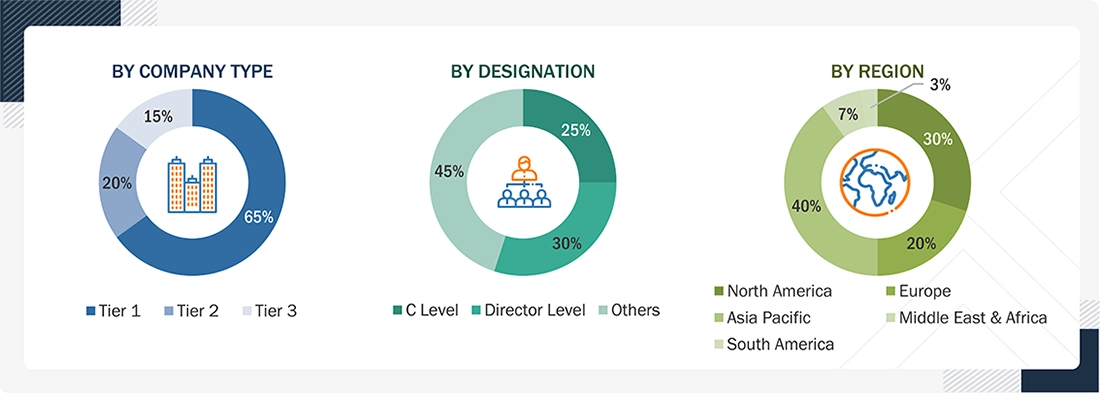
To know about the assumptions considered for the study, download the pdf brochure
Market Size Estimation
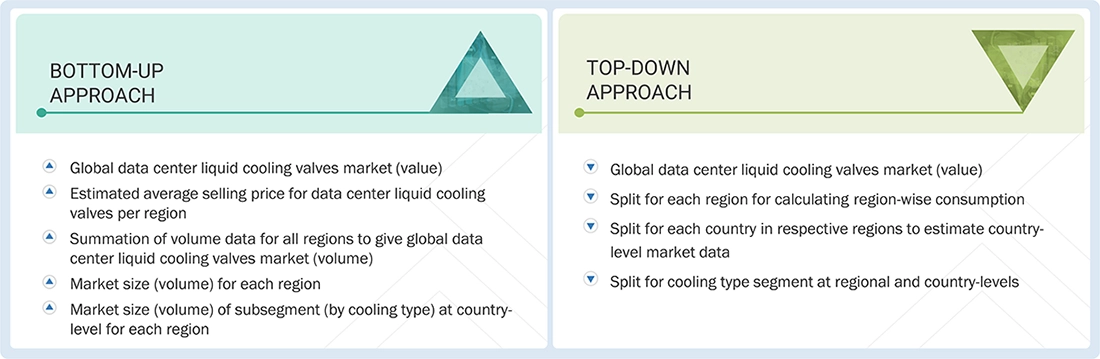
The top-down and bottom-up approaches have been used to estimate and validate the total size of the data center liquid cooling valves market. These approaches have also been used extensively to estimate the size of various dependent market subsegments. The research methodology used to estimate the market size included the following. The following segments provide details about the overall market size estimation process employed in this study:
- Extensive primary and secondary research was done to identify the key players.
- The value chain and market size in terms of value of the data center liquid cooling valves market were determined through primary and secondary research.
- All percentage shares, splits, and breakdowns were collected through secondary sources and verified through primary sources.
- All possible parameters that affect the market were covered in this research study and are viewed in extensive detail, verified through primary research, and analyzed to obtain the final quantitative and qualitative data.
- The study of reports, reviews, and newsletters of top market players, along with extensive interviews for opinions from key leaders, such as CEOs, directors, and marketing executives, is included in this research.
Data Center Liquid Cooling Valves Market Size: Bottom-Up & Top-Down Approach
Data Triangulation
After estimating the overall market size using the above estimation process, the market was split into various segments and subsegments. Data triangulation and market segmentation techniques, along with the market engineering process, were employed to obtain precise market analysis data for each segment and its subsegments.
Research Methodology: The research methodology used to estimate and forecast the global market size began by aggregating data and information from various levels, including country-level data.
Market Definition
Data center liquid cooling valves function as specialized mechanical components that control and direct cooling liquid flow within liquid-based thermal management systems that data centers use. The valves enable proper coolant circulation through cooling loops, which remove heat from servers, processors, and other high-density electronic equipment. The system maintains control over three essential factors: monitors flow rate, pressure, and temperature stability, to ensure efficient coolant delivery to heat-generating components while returning coolant through heat exchange without any leaks or flow problems. Liquid cooling valves operate in various cooling systems, which include direct-to-chip cooling, immersion cooling, and facility-level chilled liquid distribution systems. The system enables maintenance personnel to isolate specific cooling network sections while safely starting up and shutting down operations, and the system maintains balanced coolant distribution to multiple racks and cooling units. The valves perform their functions under extreme conditions, which include nonstop operation and fluctuating thermal loads.
Stakeholders
- Data center liquid cooling valve manufacturers
- Data center liquid cooling valves suppliers
- Data center liquid cooling valve traders, distributors, and suppliers
- Investment banks and private equity firms
- Raw material suppliers
- Government and research organizations
- Consulting companies/consultants in the chemicals and materials sectors
- Industry associations
Report Objectives
- To define, describe, and forecast the size of the data center liquid cooling valves market, in terms of value, based on cooling type, valve type, and region
- To provide detailed information regarding the key factors, such as drivers, restraints, opportunities, and challenges, influencing the growth of the data center liquid cooling valves market
- To strategically analyze micromarkets1 with respect to individual growth trends, prospects, and their contribution to the total market
- To analyze opportunities in the market for stakeholders and provide a competitive landscape of the market leaders
- To project the size of the market and its submarkets, in terms of value, with respect to five main regions (along with their respective key countries), namely, North America, Asia Pacific, Europe, South America, and the Middle East & Africa
- To provide ecosystem analysis, case study analysis, value chain, patent analysis, technology analysis, pricing analysis, Porter's five forces analysis, key stakeholders and buying criteria, investment and funding scenario, trade analysis, impact of AI/Gen AI and 2025 US tariff, key conferences and events, regulatory bodies, government agencies, and regulations pertaining to the market under study
- To strategically profile the key players and comprehensively analyze their core competencies
- To analyze competitive developments such as mergers & acquisitions, product launches, and research & development in the data center liquid cooling valves market
- To provide the macroeconomic outlook for all regions considered under the study
Get the Full Data Center Liquid Cooling Valves Market Report
Full forecast, segment splits, and company analysis for all Data Center Liquid Cooling Valves Market.
- US Data Center Liquid Cooling Valves Market
- Canada Data Center Liquid Cooling Valves Market
- Mexico Data Center Liquid Cooling Valves Market
- UK Data Center Liquid Cooling Valves Market
- Germany Data Center Liquid Cooling Valves Market
- France Data Center Liquid Cooling Valves Market
- China Data Center Liquid Cooling Valves Market
- Japan Data Center Liquid Cooling Valves Market
- India Data Center Liquid Cooling Valves Market
- South Korea Data Center Liquid Cooling Valves Market
- Australia Data Center Liquid Cooling Valves Market
- Singapore Data Center Liquid Cooling Valves Market
- Malaysia Data Center Liquid Cooling Valves Market
- Saudi Arabia Data Center Liquid Cooling Valves Market
- South Africa Data Center Liquid Cooling Valves Market
- Brazil Data Center Liquid Cooling Valves Market
- Rest Of Europe Data Center Liquid Cooling Valves Market
- Rest Of Asia Pacific Data Center Liquid Cooling Valves Market
Need a Tailored Report?
Customize this report to your needs
Get 10% FREE Customization
Customize This Report
