
Brazil Data Center Thermal Management Market (2026-2031)

The Brazil Data Center Thermal Management Market was valued at $457.9 Million in 2026 and projected to reach to $789.3 Million by 2031, representing a compound annual growth rate of 9.5%. Brazil's data center thermal management market is poised for sustained growth as the nation continues to digitalize its economy and expand cloud infrastructure.


| Market Size in | USD 26.32 MN |
| Market Forecast in | |
| CAGR | |
| Forecast Period | |
| Units Considered | Value (USD MN) |
Brazil Data Center Thermal Management Market Trends and Insights
- This growth trajectory reflects Brazil's increasing investment in digital infrastructure and cloud computing capabilities across the region.
- Brazil's market is driven by rising demand for efficient cooling solutions as data centers expand to support e-commerce, financial services, and emerging technologies. The Brazilian market demonstrates resilience with a compound annual growth rate of 9.5% through the forecast period.
- Brazil's thermal management solutions are becoming critical as operators seek to reduce operational costs and environmental impact.
- By 2031, Brazil is expected to solidify its position as a key market for advanced cooling technologies, including liquid cooling systems, air management solutions, and AI-driven thermal optimization platforms. Brazil's competitive landscape includes both multinational thermal management providers and regional specialists adapting solutions to local climate conditions and regulatory requirements.
- Brazil's market growth is supported by government initiatives promoting sustainable data center operations and the country's strategic importance in Latin American digital transformation..
Key Market Statistics
- CAGR (2026-2031) 9.5% CAGR
- Market Size, 2026 ~USD 457.9 Million
- Forecast, 2031 ~USD 789.3 Million
- Country Brazil
Brazil Data Center Thermal Management Market Overview
Market Valuation Growth :
Brazil's data center thermal management market is valued at USD 457.9 million in 2026 and is projected to grow to USD 789.3 million by 2031, representing a robust 9.5% CAGR over the forecast period.
Digital Infrastructure Expansion :
Brazil is experiencing significant investment in digital infrastructure and cloud computing capabilities, driving demand for advanced thermal management solutions across the country's growing data center sector.
Cooling Solution Demand :
Rising operational costs and environmental concerns are pushing Brazilian data center operators to adopt efficient cooling solutions, creating substantial opportunities for thermal management technology providers.
Regional Market Dynamics :
Brazil's market growth outpaces several regional competitors, positioning the country as a key hub for data center thermal management innovation and investment in Latin America.
Brazil Data Center Thermal Management Market Dynamics
- The 9.5% CAGR through 2031 reflects increasing awareness among Brazilian enterprises regarding energy efficiency and operational cost reduction in data center operations.
- Government initiatives supporting digital transformation and foreign investment in tech infrastructure are expected to accelerate market expansion. The market will be shaped by rising electricity costs, stricter environmental regulations, and the need for reliable cooling systems to support mission-critical operations.
- Brazilian data center operators are increasingly prioritizing advanced thermal solutions to enhance performance and sustainability.
- This trend presents significant opportunities for both established thermal management providers and innovative startups entering the Brazilian market..
Market Ecosystem

DATA CENTER THERMAL MANAGEMENT MARKET: COMMERCIAL USE CASES ACROSS INDUSTRIES
| COMPANY | USE CASE DESCRIPTION | BENEFITS |
|---|---|---|
 |
Microsoft deploys advanced thermal management solutions, including direct-to-chip liquid cooling, precision cooling, and AI-driven thermal monitoring, across its Azure data centers to support high-density AI and cloud workloads while maintaining optimal operating temperatures. | Improved cooling efficiency | Reduced Power Usage Effectiveness (PUE) | Higher rack densities | Enhanced server reliability | Lower operating costs |
 |
Meta integrates liquid cooling infrastructure, intelligent airflow management, and heat recovery technologies in its AI data centers to efficiently cool large GPU clusters and improve energy performance. | Enhanced thermal performance | Lower energy consumption | Improved infrastructure scalability | Support for next-generation AI workloads |
 |
Google utilizes AI-powered thermal management systems that dynamically optimize cooling equipment, airflow, and chiller operations across its global data center network to maximize energy efficiency. | Lower cooling energy consumption | Improved equipment reliability | Reduced carbon emissions | Optimized facility performance |
 |
NVIDIA's DGX and AI factory deployments rely on advanced thermal management technologies, including direct-to-chip liquid cooling, CDUs, heat exchangers, and intelligent cooling controls, to manage the high thermal output of GPU-intensive AI systems. | Efficient heat removal | Higher computational performance | Reduced thermal bottlenecks | Support for ultra-high-density GPU deployments |
 |
Equinix provides colocation facilities equipped with advanced thermal management infrastructure, including liquid cooling, precision air cooling, and intelligent environmental monitoring, enabling customers to deploy AI and HPC workloads efficiently. | Enables AI-ready colocation services | Improves cooling reliability | Supports high-density rack deployments | Reduces customers' operational costs |
Logos and trademarks shown above are the property of their respective owners. Their use here is for informational and illustrative purposes only.
Related Ecosystem
Equipment Machine And Tooling
- Wastewater Treatment
- Air Cooled Heat Exchangers
- Diaphragm Pumps
- Fiberglass
- HVAC System
- Alfa Laval Corporate AB
- Johnson Controls International plc
- Daikin Industries,Ltd.
- Veolia
- Carrier Global Corporation
Infrastructure Material
- Alumina Ceramics
- Ceramic Coatings
- Monolithic Ceramics
- Polyphenylene Sulfide (PPS)
- Titanate Ceramics
- Saint-gobain
- Simpson Manufacturing Co., Inc.
- Sika ag
- DOW CHEMICAL COMPANY
- Basf se
Key Takeaways
- Brazil's data center thermal management market will grow from USD 457.9M (2026) to USD 789.3M (2031) at a 9.5% CAGR.
- Brazil's tropical climate and rising data center density drive demand for advanced cooling and heat dissipation technologies.
- Brazil's market is increasingly adopting liquid cooling and AI-powered thermal optimization solutions to enhance efficiency.
- Brazil's regulatory focus on sustainability and energy efficiency is accelerating adoption of next-generation thermal management systems.
Data Center Thermal Management Market Report Scope
| Report Metric | Details |
|---|---|
| Base Year | 2026 |
| Fastest Growing Segment | LIQUID COOLING (Technology) |
| Forecast Period | 2026-2031 |
| Growth Rate | CAGR of 16.1% from 2026 to 2031 |
| Largest Segment | HARDWARE (Solutions) |
| Market Size Base Year (Billions) | ~USD 13.22 (2026) |
| Revenue Forecast (Billions) | ~USD 27.89 (2031) |
| Segments Covered | Technology, Solutions, Components, Data Center Type, End-Use Industry, Component |
Brazil Data Center Thermal Management Market Report Segmentation
6 segment dimensions are covered across the global market.
By Technology
- Air Cooling
- Liquid Cooling
By Solutions
- Hardware
- Services
By Components
- Air Conditioning
- Chilling Units
- Control Systems
- Cooling Towers
- Economizer Systems
- Liquid Cooling Systems
- Other Components
By Data Center Type
- Colocation Providers
- Enterprise Data Centers
- Hyperscale Data Centers
By End-Use Industry
- Bfsi
- Energy
- Government & Defense
- Healthcare
- It & Telecom
- Manufacturing
- Other End-Use Industries
- Research & Academic
- Retail
By Component
- Services
- Solution
- Solutions
Target Audience
- Data Center Operators : Brazilian data center operators need this market intelligence to optimize cooling infrastructure investments, reduce operational costs, and stay competitive in an increasingly demanding digital landscape.
- Thermal Management Vendors : Equipment manufacturers and solution providers require Brazil-specific market data to identify growth opportunities, understand customer needs, and develop localized product strategies for market penetration.
- IT Infrastructure Consultants : Consulting firms advising Brazilian enterprises on digital transformation need market insights to recommend appropriate thermal management solutions and justify infrastructure investments to clients.
- Private Equity & Investors : Investment firms evaluating opportunities in Brazil's tech infrastructure sector require detailed market forecasts and growth projections to assess portfolio companies and identify acquisition targets.
- Government & Policy Makers : Brazilian government agencies and regulatory bodies need market data to develop infrastructure policies, sustainability initiatives, and incentive programs supporting the country's digital economy growth.
Reasons to Buy this Report
- Market Size & Growth Validation : Obtain precise valuation data for Brazil's thermal management market (USD 457.9M in 2026) with verified 9.5% CAGR projections through 2031, enabling accurate business planning and investment decisions.
- Competitive Positioning Strategy : Understand Brazil-specific market dynamics and growth drivers to identify competitive advantages, benchmark against regional players, and develop targeted go-to-market strategies for the Brazilian data center sector.
- Investment & Expansion Planning : Access detailed Brazil market insights to support capital allocation decisions, facility expansion plans, and partnership opportunities in Latin America's fastest-growing data center thermal management market.
- Customer Demand Intelligence : Gain actionable insights into Brazilian data center operators' cooling solution requirements, budget priorities, and technology preferences to tailor product offerings and sales approaches effectively.
- Risk Mitigation & Forecasting : Leverage comprehensive Brazil market analysis to anticipate regulatory changes, identify emerging trends, and make informed decisions about resource allocation and long-term strategic planning in the region.
Frequently asked questions
What is the current size of Brazil's data center thermal management market?
Brazil's data center thermal management market is valued at USD 457.9 million in 2026 and is projected to grow to USD 789.3 million by 2031.
What is the growth rate for Brazil's thermal management market?
Brazil's data center thermal management market is expected to grow at a compound annual growth rate (CAGR) of 9.5% from 2026 to 2031.
What factors are driving growth in Brazil's thermal management market?
Brazil's market growth is driven by increasing data center investments, rising demand for cloud services, tropical climate cooling challenges, and regulatory emphasis on energy efficiency and sustainability.
Which thermal management technologies are most relevant to Brazil's market?
Brazil's market is increasingly adopting liquid cooling systems, advanced air management solutions, AI-driven thermal optimization, and modular cooling architectures suited to the country's climate conditions.
Who are the key players in Brazil's thermal management market?
Brazil's market includes multinational thermal management providers and regional specialists offering customized solutions for local data center operators and cloud service providers.
RESEARCH METHODOLOGY
The research methodology used to estimate the current size of the data center thermal management market consisted of four major activities. Extensive secondary research was performed to acquire detailed information about the market, peer markets, and parent markets. These findings, assumptions, and metrics were verified through primary research with experts from both the demand and supply sides of the data center thermal management value chain. Both top-down and bottom-up approaches were used to estimate the total market size. The estimation of market sizes for various segments and subsegments in the market was finalized using complete market segmentation and data triangulation techniques.
Secondary Research
The research methodology for estimating and forecasting the data center thermal management market begins with gathering data on key vendors' revenues by doing secondary research. The secondary research process involves consulting a range of secondary sources, including Hoover's, Bloomberg Businessweek, Factiva, the World Bank, and industry-specific journals. These secondary sources encompass annual reports, press releases, investor presentations, white papers, certified publications, articles from recognized authors, regulatory notifications, trade directories, and databases.
Primary Research
The data center thermal management market comprises several stakeholders, including raw material suppliers, processors, end-product manufacturers, and regulatory organizations, throughout the supply chain. The demand side of this market is characterized by the development of various data centers, including mid-sized data centers, enterprise data centers, and large data centers. The supply side is characterized by advancements in technology and a wide range of diverse applications. Various primary sources from both the supply and demand sides of the market were interviewed to obtain qualitative and quantitative information. The following is the breakdown of the primary respondents:
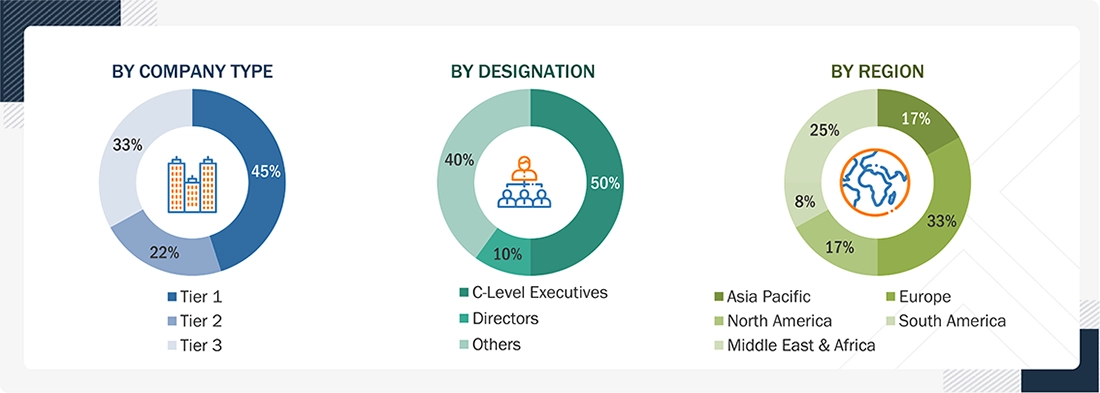
To know about the assumptions considered for the study, download the pdf brochure
Market Size Estimation
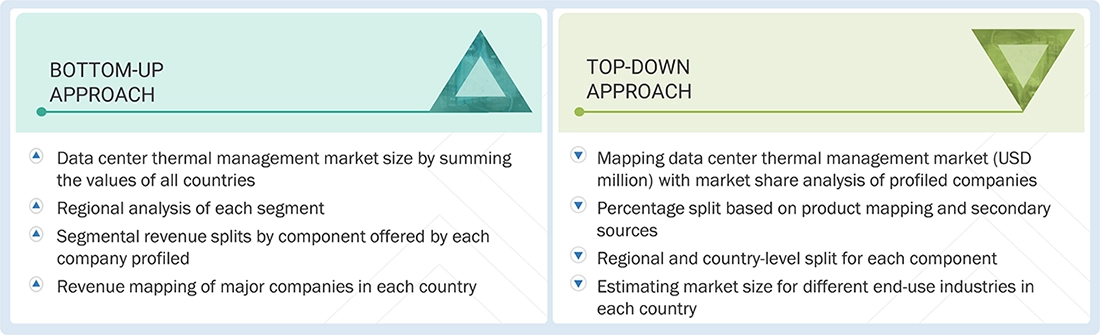
The top-down and bottom-up approaches have been employed to estimate and validate the total size of the data center thermal management market. These approaches have also been used extensively to estimate the size of various dependent market subsegments. The research methodology used to estimate the market size included the following:
The following segments provide details about the overall market size estimation process employed in this study:
- Extensive primary and secondary research was done to identify the key players.
- The value chain and market size of the data center thermal management market, in terms of value, were determined through primary and secondary research.
- All percentage shares, splits, and breakdowns were collected through secondary sources and verified through primary sources.
- All possible parameters that affect the market were covered in this research study and are viewed in extensive detail, verified through primary research, and analyzed to obtain the final quantitative and qualitative data.
- The study of reports, reviews, and newsletters of top market players, along with extensive interviews for opinions from key leaders, such as CEOs, directors, and marketing executives, is included in this research.
Data Center Thermal Management Market: Top-Down and Bottom-Up Approach
Data Triangulation
After estimating the overall market size using the above estimation, the market was split into various segments and subsegments. Data triangulation and market segmentation techniques, along with the market engineering process, were employed to obtain precise market analysis data for each segment and its subsegments.
Research Methodology: The research methodology used to estimate and forecast the global market size began by aggregating data and information from various levels, including country-level data.
Market Definition
Data center thermal management refers to the technologies, equipment, software, and strategies used to monitor, control, and optimize the temperature and heat dissipation within a data center to ensure the reliable, efficient, and continuous operation of IT infrastructure. It encompasses a wide range of cooling solutions, including air cooling, liquid cooling, precision cooling systems, chillers, computer room air conditioners (CRACs), computer room air handlers (CRAHs), coolant distribution units (CDUs), heat exchangers, cooling towers, pumps, airflow management systems, containment solutions, sensors, and intelligent thermal monitoring platforms.
Key Stakeholders
- Data center thermal management providers, processors, and technology providers
- Data center operators including hyperscale data centers, colocation data centers, and enterprise data centers
- Research institutions, standards organizations, and regulatory agencies such as ASTM, ISO, IAEA, and national materials authorities
- NGOs, governments, investment banks, venture capitalists, and private equity firms
Report Objectives
- To define, describe, and forecast the market size of data center thermal management, in terms of value and volume
- To provide detailed information regarding the key factors, such as drivers, restraints, opportunities, and industry-specific challenges, influencing the growth of the data center thermal management market
- To analyze and forecast the size of various segments (component, data center type, end-use industry, solution, technology, and type of cooling) of the data center thermal management market based on five major regions - North America, Europe, Asia Pacific, South America, Middle East & Africa; along with key countries in each of these regions.
- To analyze recent developments and competitive strategies, including expansions, partnerships, and acquisitions, to understand the market's competitive landscape.
- To strategically profile the key players in the market and comprehensively analyze their core competencies.
Available customizations:
With the given market data, MarketsandMarkets offers customizations according to the client-specific needs.
The following customization options are available for the report:
- Additional country-level analysis of the data center thermal management market
- Profiling of additional market players (up to 5)
Product Analysis
- Product matrix, which provides a detailed comparison of each company's product portfolio.
Get the Full Data Center Thermal Management Market Report
Full forecast, segment splits, and company analysis for all Data Center Thermal Management Market.
- US Data Center Thermal Management Market
- Canada Data Center Thermal Management Market
- Mexico Data Center Thermal Management Market
- Germany Data Center Thermal Management Market
- UK Data Center Thermal Management Market
- France Data Center Thermal Management Market
- Italy Data Center Thermal Management Market
- Netherlands Data Center Thermal Management Market
- UAE Data Center Thermal Management Market
- Saudi Arabia Data Center Thermal Management Market
- South Africa Data Center Thermal Management Market
- Rest Of Europe Data Center Thermal Management Market
- Rest Of Asia Pacific Data Center Thermal Management Market
- Rest Of The GCC Countries Data Center Thermal Management Market
- Rest Of South America Data Center Thermal Management Market
- China Data Center Thermal Management Market
- India Data Center Thermal Management Market
- Japan Data Center Thermal Management Market
- South Korea Data Center Thermal Management Market
Need a Tailored Report?
Customize this report to your needs
Get 10% FREE Customization
Customize This Report
