
Europe Data Integration Market (2025-2030)

The Europe Data Integration Market was valued at $4332.2 Million in 2025 and projected to reach to $8104 Million by 2030, representing a compound annual growth rate of 13.3%. Europe's data integration market is positioned for sustained expansion as enterprises accelerate digital transformation initiatives and respond to evolving regulatory landscapes.


| Market Size in | USD 26.32 MN |
| Market Forecast in | |
| CAGR | |
| Forecast Period | |
| Units Considered | Value (USD MN) |
Europe Data Integration Market Trends and Insights
- This 13.3% compound annual growth rate reflects Europe's increasing digital transformation initiatives across enterprises seeking to unify disparate data sources and improve operational efficiency.
- Europe's market expansion is driven by stringent data governance regulations, including GDPR compliance requirements, and the region's strong emphasis on cloud adoption and AI-driven analytics capabilities. The European data integration landscape is characterized by significant investment in modernizing legacy systems and enabling real-time data flows across organizations.
- Europe's enterprises are prioritizing data quality and integration solutions to support their competitive positioning in an increasingly data-driven economy.
- Between 2025 and 2030, Europe's market will benefit from accelerating digital initiatives, growing demand for API-based integration platforms, and the region's focus on building resilient, compliant data ecosystems that meet evolving regulatory standards..
Key Market Statistics
- CAGR (2025-2030) 13.3% CAGR
- Market Size, 2025 ~USD 4332.2 Million
- Forecast, 2030 ~USD 8104 Million
- Geography Europe
Europe Data Integration Market Overview
Strong Regional Valuation :
Europe's data integration market reached $4,332.2 million in 2025, representing a significant portion of global digital infrastructure investment with sustained momentum across enterprise sectors.
Accelerated Growth Trajectory :
At 13.3% CAGR through 2030, Europe's market expansion nearly doubles to $8,104.0 million, driven by regulatory compliance requirements and cross-border data harmonization needs unique to the region.
GDPR & Compliance Drivers :
Stringent European data protection regulations and GDPR compliance mandates are primary catalysts, compelling organizations to invest in robust data integration solutions for governance and risk mitigation.
Digital Transformation Leadership :
European enterprises are prioritizing unified data ecosystems to enhance operational efficiency, competitive positioning, and customer insights across increasingly complex multi-source environments.
Europe Data Integration Market Dynamics
- The region's emphasis on data sovereignty, privacy compliance, and cross-border data flows creates unique demand drivers that differentiate European market dynamics from global peers.
- Investment in cloud-native integration platforms and AI-powered data management solutions is accelerating across financial services, manufacturing, and public sector organizations. By 2030, the European market will benefit from increased adoption of real-time data integration, API-driven architectures, and hybrid integration platforms.
- Organizations are recognizing data integration as critical infrastructure for competitive advantage, customer experience enhancement, and operational resilience.
- The convergence of regulatory requirements, technological innovation, and business imperatives positions Europe as a high-growth region within the global data integration landscape..
Market Ecosystem

Data Integration Market: COMMERCIAL USE CASES ACROSS INDUSTRIES
| COMPANY | USE CASE DESCRIPTION | BENEFITS |
|---|---|---|
 |
Domino's was overwhelmed with data stemming from siloed systems, where manual ETL processes required days to complete, thereby impeding prompt global decision-making. | The integration provided real-time data visibility and faster decision-making (days to minutes), which significantly increased digital sales to over 50% of global transactions. |
 |
Facing long lead times, Schneider Electric needed to democratize application development and reduce IT dependency. It sought a low-code solution to empower global business teams, accelerate time-to-market, and maintain workflow governance. | SnapLogic enabled 140+ citizen developers and integrated over 100 applications using its platform. This successfully increased the autonomy and productivity of business teams across the enterprise. |
 |
HomeServe's fragmented, monolithic legacy systems prevented consistent multi-channel service and unified reporting. The outdated structure hindered the launch of new digital self-service features and could not support the growing demand for real-time transactions. | MuleSoft's API-led approach achieved a 59% integration asset reuse rate and a 69% footprint reduction. The modernization resulted in 30% faster API response times, allowing HomeServe to provide scalable, real-time omnichannel services. |
 |
MIT's finance team manually gathered billing data from 11 campuses, causing reporting delays of several days and reducing operational flexibility. Fragmented student records and departmental silos limited the institute's ability to quickly respond to enrollment and remote-learning demands. | Talend's platform cut billing processing time from days to minutes, freeing staff to focus on strategic initiatives. This scalable solution supported an agile cloud migration that facilitates remote learning and promotes ongoing digital transformation. |
Logos and trademarks shown above are the property of their respective owners. Their use here is for informational and illustrative purposes only.
Related Ecosystem
Analytics
- Natural Language Processing (NLP)
- Machine Learning
- Supply Chain Management
- Predictive Analytics
- Image Sensors
- International Business Machines Corporation
- MICROSOFT CORPORATION
- Oracle Corporation
- SAP SE
Key Takeaways
- Europe's data integration market will grow from $4.33B (2025) to $8.10B (2030) at a 13.3% CAGR, nearly doubling in value.
- Europe's GDPR and data governance regulations are primary drivers pushing enterprises to adopt robust data integration solutions.
- Europe's cloud-first strategy and API-based integration platforms are reshaping how organizations manage data workflows.
- Europe's market growth is supported by strong enterprise investment in digital transformation and real-time analytics capabilities.
Data Integration Market Report Scope
| Report Metric | Details |
|---|---|
| Base Year | 2025 |
| Fastest Growing Segment | HEALTHCARE & LIFE SCIENCES (End User) |
| Forecast Period | 2025–2030 |
| Growth Rate | CAGR of 13.6% from 2025 to 2030 |
| Largest Segment | SOFTWARE (Offering) |
| Market Size Base Year (Billions) | ~USD 17.57 (2025) |
| Revenue Forecast (Billions) | ~USD 33.24 (2030) |
| Segments Covered | Offering, Software, Data Integration Platform, Ipaas, Data Quality & Governance Software, Streaming Integration Tool, Service, Professional Service, Data Type, Application, Business Function, End User, Data Quality & Governance, Streaming Integration |
Europe Data Integration Market Report Segmentation
14 segment dimensions are covered across the global market.
By Offering
- Services
- Software
By Software
- Data Integration Platforms
- Data Quality & Governance Software
- Data Virtualization Software
- Ipaas
- Streaming Integration Tools
By Data Integration Platform
- Cdc
- Change Data Capture
- Data Replication
- Data Transformation
- Etl/Elt Engines
By Ipaas
- Cloud Native Integration
- Cloud/SaaS-Native Integrations
- Workflow Automation
By Data Quality & Governance Software
- Compliance Enforcement
- Metadata Management
- Semantic Mapping
By Streaming Integration Tool
- Event Brokers
- IoT & Edge Pipelines
- Stream Processing
By Service
- Managed Services
- Professional Services
By Professional Service
- Consulting
- Consulting Services
- Implementation
- Implementation Services
- Support
- Support Services
By Data Type
- Semi-Structured Data Integration
- Structured Data Integration
- Unstructured Data Integration
By Application
- Customer 360 View & Mdm
- Customer 360 View And Mdm
- Data Lakes & Big Data Management
- Data Lakes And Big Data Management
- Data Warehousing & Bi
- Data Warehousing And Business Intelligence
- Other Applications
- Real-Time Data Integration
By Business Function
- Finance & Accounting
- Hr
- Human Resources
- It
- Marketing
- Other Business Functions
- Sales
By End User
- Bfsi
- Energy & Utilities
- Government & Defense
- Healthcare & Life Sciences
- Manufacturing
- Media & Entertainment
- Other End Users
- Retail & E-Commerce
- Software & Technology Providers
- Telecommunications
- Transportation & Logistics
By Data Quality & Governance
- Compliance Enforcement
- Metadata Management
- Semantic Mapping
By Streaming Integration
- Event Brokers
- IoT & Edge Pipelines
- Stream Processing
EUROPE: DATA INTEGRATION MARKET, BY END USER, 2025–2030
| Segment | 2025 | 2026 | 2027 | 2028 | 2029 | 2030 | CAGR (%) |
|---|---|---|---|---|---|---|---|
| BFSI | 538.5 | 580.5 | 631.4 | 694.7 | 767.9 | 857.4 | 9.7 |
| ENERGY & UTILITIES | 166.4 | 177.6 | 191.2 | 208 | 227.2 | 250.4 | 8.5 |
| GOVERNMENT & DEFENSE | 193.4 | 205 | 219 | 236.3 | 255.6 | 278.8 | 7.6 |
| HEALTHCARE & LIFE SCIENCES | 632.5 | 731.6 | 853.4 | 1006.5 | 1192.1 | 1426.3 | 17.7 |
| MANUFACTURING | 441.9 | 495.8 | 561.8 | 644.4 | 743.3 | 867.1 | 14.4 |
| MEDIA & ENTERTAINMENT | 288.1 | 327.3 | 375.4 | 435.7 | 508.4 | 599.7 | 15.8 |
| OTHER END USERS | 329 | 347 | 368.7 | 395.2 | 424.6 | 459.5 | 6.9 |
| RETAIL & E-COMMERCE | 481.3 | 528 | 585 | 656.1 | 739.8 | 843.6 | 11.9 |
| SOFTWARE & TECHNOLOGY PROVIDERS | 770.7 | 882.3 | 1019.3 | 1191.2 | 1399 | 1660.5 | 16.6 |
| TELECOMMUNICATIONS | 255.2 | 277.2 | 304.1 | 337.5 | 376.6 | 424.6 | 10.7 |
| TRANSPORTATION & LOGISTICS | 235.2 | 260.9 | 292.2 | 331.4 | 378 | 436 | 13.1 |
| TOTAL | 4332.2 | 4813.3 | 5401.5 | 6137.1 | 7012.6 | 8104 | 13.3 |
Target Audience
- Enterprise IT Leaders : CIOs and IT directors across European organizations need market intelligence to justify data integration investments, evaluate vendor solutions, and align technology roadmaps with regional compliance mandates.
- Solution Providers & Vendors : Data integration platform vendors require detailed European market analysis to refine product positioning, identify growth segments, and develop region-specific go-to-market strategies for competitive advantage.
- Management Consultants : Strategy and digital transformation consultants advising European enterprises need market data to support recommendations on data integration investments and technology modernization initiatives.
- Investment & Private Equity Firms : Investors evaluating European data integration companies and market opportunities require comprehensive market sizing, growth forecasts, and competitive dynamics to inform investment decisions.
- Government & Regulatory Bodies : European policymakers and regulatory agencies benefit from market insights to understand digital infrastructure development, data governance trends, and economic impact of data integration adoption.
Key Companies in the Europe Data Integration Market
| Company | HQ | Ownership | Strongest segments |
|---|---|---|---|
| ZENSAR TECHNOLOGIES LTD | India | Public Company | Digital and Application Services – Experience & Product Engineering,Digital and Application Services – Data Engineering & Analytics / Gen AI,Digital and Application Services – Core Applications (SAP, Oracle, Salesforce, AMS, QE), |
| ARROW ELECTRONICS, INC | United States | Public Company | Global Components (semiconductors, IP&E, computing and memory),Global Enterprise Computing Solutions (datacenter, cloud, security, analytics), |
| ACXIOM CORPORATION | United States | Public Company | Data Collaboration & Clean Rooms,Identity Resolution & Graph,Activation & Connectivity, |
| CLOVERETL | Czech Republic | Private Company | Core ETL platform licenses/subscriptions,OEM/embedded ETL licensing,Professional services and support, |
| TELIA COMPANY | Sweden | Public Company | Consumer mobile (postpaid, prepaid, sub-brands),Fixed broadband and fiber (consumer and SME),TV, media, and content (TV4, MTV, pay TV), |
| IBM | United States | Public Company | Software (Hybrid Cloud and AI Platforms),Consulting (Strategy, Technology Services, Intelligent Operations),Infrastructure (Servers, Storage, Hybrid Cloud Infrastructure Services), |
| SAP | Germany | Public Company | S/4HANA and core ERP (finance, supply chain, manufacturing),HCM and people solutions (SuccessFactors, payroll, time),Customer experience and spend management, |
| ORACLE | United States | Public Company | Cloud SaaS (Fusion ERP/EPM/SCM/HCM, NetSuite, CX, Health),Cloud Infrastructure & Autonomous Database,License Support & On-Premise Licenses, |
| MICROSOFT | United States | Public Company | Azure and other cloud services,Microsoft 365 Commercial (incl. Teams, security, Copilot),LinkedIn, |
| TIBCO | United States | Private Company | Integration & Core Infrastructure (incl. TIBCO Cloud integration, messaging, API management),Business Optimization (analytics, real-time event processing),Process Automation & Collaboration, |
| QLIK | United States | Private Company | Analytics (Qlik Sense/QlikView and related),Data Integration and ETL,Automation and Application Automation, |
ZENSAR TECHNOLOGIES LTD
ZENSAR TECHNOLOGIES LTD is a public company founded in 1963 in India with 10,066 employees.
ARROW ELECTRONICS, INC
ARROW ELECTRONICS, INC is a public company founded in 1935 in the United States with 22,230 employees.
ACXIOM CORPORATION
ACXIOM CORPORATION is a public company founded in 2018 in the United States with 1,300 employees.
CLOVERETL
CLOVERETL is a private company founded in 2002 in the Czech Republic.
TELIA COMPANY
TELIA COMPANY is a public company founded in 1853 in Sweden with 14,552 employees.
IBM
IBM is a public company founded in 1911 in the United States with 264,300 employees.
SAP
SAP is a public company founded in 1972 in Germany with 111,038 employees.
ORACLE
ORACLE is a public company founded in 1977 in the United States with 141,000 employees.
MICROSOFT
MICROSOFT is a public company founded in 1975 in the United States with 228,000 employees.
TIBCO
TIBCO is a private company founded in 1996 in the United States with 3,856 employees.
QLIK
QLIK is a private company founded in 1993 in the United States with 2,511 employees.
Countries within Europe - compare and drill down
| Country | 2025 size (native) |
|---|---|
| UK | USD 1894.7 Million |
| Germany | USD 1627.5 Million |
| France | USD 1191.3 Million |
| Italy | USD 846.9 Million |
| Spain | USD 582.7 Million |
| Netherlands | USD 522.7 Million |
Country market size visualization
Reasons to Buy this Report
- Regional Market Sizing & Forecasts : Obtain precise market valuations for Europe ($4.3B in 2025) with country-level breakdowns for UK, Germany, France, Italy, Spain, and Netherlands to inform localized go-to-market strategies.
- Regulatory & Compliance Insights : Understand how GDPR, data residency requirements, and European data protection frameworks shape integration technology adoption and create differentiated market opportunities versus other regions.
- Competitive Landscape Analysis : Benchmark European market dynamics, identify leading solution providers, and assess competitive positioning within a region experiencing 13.3% annual growth and shifting technology preferences.
- Investment & Growth Opportunities : Identify high-potential European markets and customer segments driving the projected doubling of market size to $8.1B by 2030, enabling strategic resource allocation and partnership development.
- Technology Adoption Trends : Gain insights into European enterprise preferences for cloud-native, API-driven, and AI-powered data integration solutions aligned with regional compliance and operational efficiency priorities.
Frequently asked questions
What is the projected size of Europe's data integration market by 2030?
Europe's data integration market is projected to reach $8,104.0 million by 2030, growing from $4,332.2 million in 2025.
What is the CAGR for Europe's data integration market?
Europe's data integration market is expected to grow at a compound annual growth rate of 13.3% between 2025 and 2030.
What regulatory factors are driving Europe's data integration market growth?
Europe's GDPR compliance requirements and stringent data governance regulations are key drivers compelling enterprises to invest in data integration solutions.
How is Europe's cloud adoption influencing the data integration market?
Europe's strong emphasis on cloud adoption is accelerating demand for cloud-native data integration platforms and API-based solutions that enable seamless data flows.
What are the primary use cases for data integration solutions in Europe?
Europe's enterprises are leveraging data integration for legacy system modernization, real-time analytics, AI-driven insights, and ensuring regulatory compliance across data ecosystems.
RESEARCH METHODOLOGY
The research methodology for the data integration market report involved the use of extensive secondary sources and directories, as well as various reputed open-source databases, to identify and collect information useful for this technical and market-oriented study. In-depth interviews were conducted with various primary respondents, including data integration software providers, data integration service providers, iPaaS providers, data virtualization tool vendors, and enterprise end users; high-level executives of multiple companies offering data integration solutions; and industry consultants to obtain and verify critical qualitative and quantitative information and assess the market prospects and industry trends.
Secondary Research
In the secondary research process, various secondary sources were referred to to identify and collect information for the study. The secondary sources included annual reports; press releases and investor presentations of companies; white papers, certified publications such as Harvard Data Science Review, Journal of Big Data, IEEE Transactions on Big Data, ACM Transactions on Data Science, Data & Knowledge Engineering, Information Systems Journal, International Journal of Data Science and Analytics, Journal of Data and Information Quality, Big Data Research, Journal of Intelligent Information Systems, Data Mining and Knowledge Discovery, Journal of Data Science, Springer Big Data Analytics, Wiley Big Data Journal, and Expert Systems with Applications; and articles from recognized associations and government publishing sources including but not limited to Association for Computing Machinery (ACM), International Data Engineering and Science Association (IDEAS), Data Management Association (DAMA International), Big Data Value Association (BDVA), Open Data Institute (ODI), International Institute for Analytics (IIA), Global Big Data Conference, Data Science Association (DSA), Big Data Working Group (under CSA), and Linux Foundation AI & Data.
Secondary research was used to obtain key information about the industry’s value chain, the market’s monetary chain, the overall pool of key players, market classification and segmentation according to industry trends to the bottom-most level, regional markets, and key developments from the market and technology-oriented perspectives.
Primary Research
In the primary research process, a diverse range of stakeholders from both the supply and demand sides of the data integration ecosystem were interviewed to gather qualitative and quantitative insights specific to this market. From the supply side, key industry experts, such as chief executive officers (CEOs), vice presidents (VPs), marketing directors, technology & innovation directors, as well as technical leads from vendors offering data integration software & services, were consulted. Additionally, system integrators, service providers, and IT service firms that implement and support data integration were included in the study. On the demand side, input from IT decision-makers, infrastructure managers, and business heads of prominent enterprise end users was collected to understand the user perspectives and adoption challenges within targeted industries.
The primary research ensured that all crucial parameters affecting the data integration market—from technological advancements and evolving use cases (data warehousing & business intelligence, data lakes & Big Data management, customer 360 view and master data management etc.) to regulatory and compliance needs (GDPR, CCPA, Europe AI Act, AIDA, etc.) were considered. Each factor was thoroughly analyzed, verified through primary research, and evaluated to obtain precise quantitative and qualitative data for this market.
Once the initial phase of market engineering was completed, including detailed calculations for market statistics, segment-specific growth forecasts, and data triangulation, an additional round of primary research was undertaken. This step was crucial for refining and validating critical data points, such as data integration offerings (software & services), industry adoption trends, the competitive landscape, and key market dynamics like demand drivers (Surge in AI-centric data workloads needing high-fidelity input pipelines, rise of data products and productization of integration pipelines, enterprise adoption of data fabric and data mesh architectures, rise of contextual and event-driven integrations), challenges (fragmentation between business domains and centralized it pipelines, performance bottlenecks in iPaaS for high-frequency data loads, vendor lock-in with managed services and lack of interoperability), and opportunities (industry-specific AI-integrated iPaaS solutions, AI-generated pipelines and metadata-driven pipeline authoring, real-time CX orchestration in B2C businesses, edge orchestration via containerized ETL agents and federated scheduling).
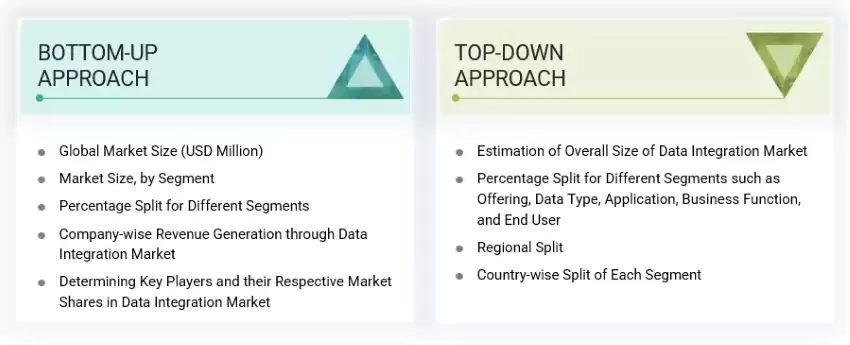
In the complete market engineering process, the top-down and bottom-up approaches and several data triangulation methods were extensively used to perform the market estimation and market forecast for the overall market segments and subsegments listed in this report. Extensive qualitative and quantitative analysis was performed on the complete market engineering process to record the critical information/insights throughout the report.
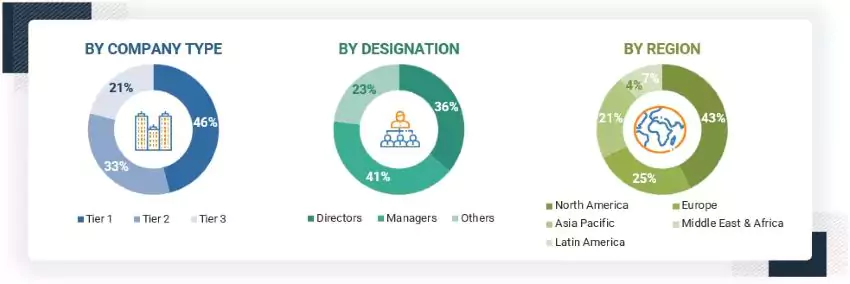
Note: Three tiers of companies are defined based on their total revenue as of 2024;
tier 1 = revenue more than USD 500 million, tier 2 = revenue between USD 500 million and 100 million, tier 3 = revenue less than USD 100 million
Source: MarketsandMarkets Analysis
To know about the assumptions considered for the study, download the pdf brochure
Market Size Estimation
Both top-down and bottom-up approaches were employed to estimate and forecast the data integration market and its dependent submarkets. This multi-layered analysis was further reinforced through data triangulation, incorporating both primary and secondary research inputs. The market figures were also validated against the existing MarketsandMarkets repository for accuracy. The following research methodology was used to estimate the market size:
Data Integration Market : Top-Down and Bottom-Up Approach
Data Triangulation
After arriving at the overall market size using the market size estimation processes as explained above, the market was split into several segments and subsegments. To complete the overall market engineering process and arrive at the exact statistics of each market segment and subsegment, data triangulation and market breakup procedures were employed, wherever applicable. The overall market size was then used in the top-down procedure to estimate the size of other individual markets via percentage splits of the market segmentation.
Market Definition
Data integration is the process of combining data from different sources and providing the user with a unified view of this data. It involves the movement and consolidation of data from disparate sources into meaningful and valuable information. Data integration serves as a core function of enterprise data architecture, enabling data quality, consistency, and availability across operational and analytical use cases.
Stakeholders
- Data Integration Software Developers
- Integration Platform as-a-Service (iPaaS) Vendors
- Data Integration Service Providers
- Big Data Providers
- Business Analysts
- Cloud Service Providers
- Consulting Service Providers
- Enterprise End-users
- Distributors and Value-added Resellers (VARs)
- Government Agencies
- Independent Software Vendors (ISV)
- Managed Service Providers
- Market Research and Consulting Firms
- Support & Maintenance Service Providers
- System Integrators (SIs)/Migration Service Providers
- Technology Providers
- Academia & Research Institutions
- Investors & Venture Capital Firms
Report Objectives
- To define, describe, and forecast the data integration market, by offering (software and services), data type, application, business function, and end user
- To provide detailed information related to major factors (drivers, restraints, opportunities, and industry-specific challenges) influencing market growth
- To analyze the micro markets with respect to individual growth trends, prospects, and their contribution to the total market
- To analyze the opportunities in the market for stakeholders by identifying the high-growth segments of the market
- To analyze opportunities in the market and provide details of the competitive landscape for stakeholders and market leaders
- To forecast the market size of segments for the five main regions: North America, Europe, Asia Pacific, the Middle East & Africa, and Latin America
- To profile the key players and comprehensively analyze their market ranking and core competencies
- To analyze competitive developments, such as partnerships, product launches, and mergers & acquisitions, in the data integration market
Available Customizations
With the given market data, MarketsandMarkets offers customizations as per the company’s specific needs. The following customization options are available for the report:
Product Analysis
- Product matrix provides a detailed comparison of the product portfolio of each company
Geographic Analysis as per Feasibility
- Further breakup of the North American market for Data integration
- Further breakup of the European market for Data integration
- Further breakup of the Asia Pacific market for Data integration
- Further breakup of the Middle Eastern & African market for Data integration
- Further breakup of the Latin American market for Data integration
Company Information
- Detailed analysis and profiling of additional market players (up to five)
Get the Full Data Integration Market Report
Full forecast, segment splits, and company analysis for all Data Integration Market.
- US Data Integration Market
- Canada Data Integration Market
- UK Data Integration Market
- Germany Data Integration Market
- France Data Integration Market
- Italy Data Integration Market
- Spain Data Integration Market
- Netherlands Data Integration Market
- China Data Integration Market
- India Data Integration Market
- Japan Data Integration Market
- South Korea Data Integration Market
- Singapore Data Integration Market
- Saudi Arabia Data Integration Market
- UAE Data Integration Market
- South Africa Data Integration Market
- Qatar Data Integration Market
- Turkey Data Integration Market
- Brazil Data Integration Market
- Mexico Data Integration Market
- Argentina Data Integration Market
Need a Tailored Report?
Customize this report to your needs
Get 10% FREE Customization
Customize This Report
