
Asia Pacific Dental Anesthetics Market (2025-2030)

The Asia Pacific Dental Anesthetics Market was valued at $273.1 Million in 2025 and projected to reach to $345.7 Million by 2030, representing a compound annual growth rate of 4.8%. The Asia Pacific dental anesthetics market is positioned for sustained growth through 2030, expanding from $273.1 million to $345.7 million.


| Market Size in | USD 26.32 MN |
| Market Forecast in | |
| CAGR | |
| Forecast Period | |
| Units Considered | Value (USD MN) |
Asia Pacific Dental Anesthetics Market Trends and Insights
- Asia Pacific's growth trajectory outpaces the global average, driven by rising dental care awareness, increasing disposable incomes, and expanding dental infrastructure across emerging economies.
- The region's large population base and growing prevalence of dental procedures position Asia Pacific as a critical market for anesthetics manufacturers. Asia Pacific's dental anesthetics market benefits from advancing healthcare systems and rising patient demand for pain-free dental treatments.
- Key markets within Asia Pacific, including India, China, and Southeast Asia, are experiencing rapid adoption of modern anesthetics and improved clinical practices.
- Between 2025 and 2030, Asia Pacific is expected to capture significant market share as dental tourism, cosmetic dentistry, and preventive care initiatives gain momentum across the region..
Key Market Statistics
- CAGR (2025-2030) 4.8% CAGR
- Market Size, 2025 ~USD 273.1 Million
- Forecast, 2030 ~USD 345.7 Million
- Geography Asia Pacific
Asia Pacific Dental Anesthetics Market Overview
Outpacing Global Growth :
Asia Pacific's dental anesthetics market grows at 4.8% CAGR, exceeding the global average of 4%, driven by rapid urbanization and healthcare modernization across emerging economies.
Rising Dental Care Awareness :
Increasing consumer awareness about oral health and cosmetic dentistry in Asia Pacific is fueling demand for advanced anesthetic solutions and professional dental procedures.
Expanding Middle Class & Disposable Income :
Growing disposable incomes across China, India, and Southeast Asia are enabling greater access to dental treatments, directly boosting anesthetic product consumption.
Infrastructure Development :
Rapid expansion of dental clinics and healthcare facilities in emerging Asia Pacific markets is creating new demand channels for anesthetic products and services.
Asia Pacific Dental Anesthetics Market Dynamics
- This 26.6% cumulative growth reflects structural shifts in the region's healthcare landscape, including increased dental tourism, rising cosmetic dentistry adoption, and government initiatives promoting preventive oral care.
- Key growth drivers include population growth, urbanization, and improved healthcare accessibility in emerging markets. Market expansion will be supported by technological advancements in anesthetic formulations, growing dental professional training programs, and rising patient expectations for pain-free procedures.
- However, regulatory variations across countries and pricing pressures in cost-sensitive markets may moderate growth rates.
- Strategic investments in distribution networks and partnerships with dental institutions will be critical for capturing market share in this dynamic region..
Market Ecosystem
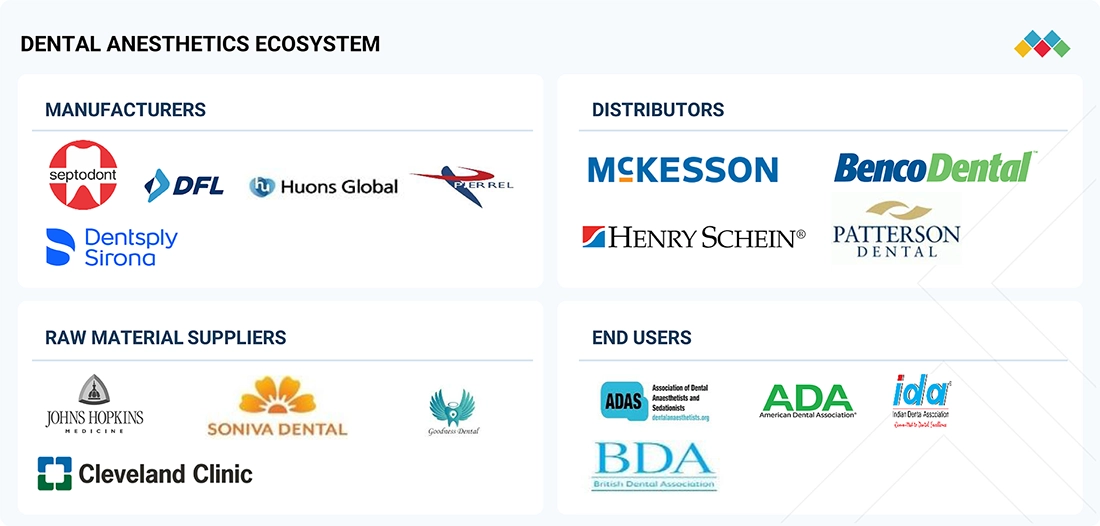
dental anesthetics market: COMMERCIAL USE CASES ACROSS INDUSTRIES
| COMPANY | USE CASE DESCRIPTION | BENEFITS |
|---|---|---|
 |
Septoject dental needles designed for atraumatic and precise anesthetic delivery in routine dental procedures | Minimize tissue trauma, improve injection comfort, reduce risk of needle breakage, enhance accuracy of anesthetic delivery, widely used across clinics globally |
 |
Oraqix (lidocaine/prilocaine topical anesthetic gel) indicated for anesthesia in periodontal scaling and root planing | Needle-free anesthesia option, improves patient comfort, rapid onset of action, reduces fear of injections, enhances compliance in minimally invasive periodontal care |
 |
Orabloc injectable articaine-based anesthetic used in routine and complex dental procedures | Provides strong and reliable anesthesia, rapid onset with extended duration, a favorable safety profile, widely accepted alternative to lidocaine in dental surgeries |
 |
Injectable dental anesthetics (lidocaine, articaine formulations) for local anesthesia during various dental treatments | Cost-effective solutions ensure consistent efficacy, expanding global availability, a strong presence in emerging Asian markets, supports a broad range of procedures |
 |
Ultracaine (articaine hydrochloride with epinephrine) injectable anesthetic for routine and surgical dentistry | High potency and fast onset, excellent diffusion in bone tissues, extended duration of action, suitable for complex extractions and surgical interventions |
Logos and trademarks shown above are the property of their respective owners. Their use here is for informational and illustrative purposes only.
Related Ecosystem
Key Takeaways
- Asia Pacific dental anesthetics market valued at $273.1M in 2025, forecast to reach $345.7M by 2030 at 4.8% CAGR
- Asia Pacific growth rate of 4.8% exceeds global CAGR of 4%, reflecting strong regional demand dynamics
- Rising disposable incomes and expanding dental infrastructure across Asia Pacific drive market expansion through 2030
- Asia Pacific emerging markets including India and China represent high-growth opportunities for anesthetics manufacturers
Dental Anesthetics Market Report Scope
| Report Metric | Details |
|---|---|
| Base Year | 2025 |
| Fastest Growing Segment | TOPICAL ANESTHETICS (Route Of Administration) |
| Forecast Period | 2025-2030 |
| Growth Rate | CAGR of 4% from 2025 to 2030 |
| Largest Segment | INJECTABLE ANESTHETICS (Route Of Administration) |
| Market Size Base Year (Billions) | ~USD 1.48 (2025) |
| Revenue Forecast (Billions) | ~USD 1.8 (2030) |
| Segments Covered | Drug Type, Route Of Administration, End User |
Asia Pacific Dental Anesthetics Market Report Segmentation
3 segment dimensions are covered across the global market.
By Drug Type
- Articaine
- Bupivacaine
- Lidocaine
- Mepivacaine
- Other Drug Types
- Prilocaine
By Route Of Administration
- Injectable Anesthetics
- Needles
- Syringes
- Topical Anesthetics
By End User
- Dental Clinics
- Hospitals
- Other End Users
Target Audience
- Dental Anesthetic Manufacturers : Evaluate Asia Pacific expansion opportunities, identify high-growth country markets, and develop region-specific product strategies to capitalize on 4.8% CAGR growth.
- Dental Equipment & Supply Distributors : Understand regional demand patterns, emerging market opportunities, and distribution channel dynamics to optimize inventory and partnership strategies across Asia Pacific.
- Healthcare Investment Firms : Assess investment potential in Asia Pacific dental care infrastructure, identify acquisition targets, and evaluate market valuations for M&A and portfolio decisions.
- Dental Practice Operators & Chains : Benchmark procurement costs, forecast anesthetic demand, and identify supplier opportunities to optimize operational efficiency and patient care quality in Asia Pacific markets.
- Healthcare Consultants & Advisors : Provide clients with credible regional market data, competitive insights, and growth forecasts to support strategic planning and market entry recommendations in Asia Pacific.
Countries within Asia Pacific - compare and drill down
| Country | 2025 size (native) |
|---|---|
| China | USD 68.4 Million |
| Japan | USD 77.1 Million |
| South Korea | USD 101.3 Million |
| India | USD 37.7 Million |
| Australia | USD 19.9 Million |
| Rest Of Asia Pacific | USD 30.99 Million |
Country market size visualization
Reasons to Buy this Report
- Regional Growth Opportunity : Capture insights into the fastest-growing dental anesthetics region globally, with 4.8% CAGR outpacing global averages and offering significant expansion potential.
- Country-Level Market Intelligence : Access detailed market sizing and forecasts for key Asia Pacific markets including China, Japan, South Korea, and India to inform localized business strategies.
- Emerging Market Dynamics : Understand unique growth drivers in emerging economies—rising disposable incomes, dental infrastructure expansion, and increasing cosmetic dentistry adoption—unavailable in global reports.
- Competitive Positioning : Identify market gaps and competitive opportunities specific to Asia Pacific's diverse regulatory environment and consumer preferences for anesthetic products.
- Strategic Investment Guidance : Make informed decisions on market entry, partnerships, and product development tailored to Asia Pacific's high-growth trajectory through 2030.
Frequently asked questions
What is the current size of the Asia Pacific dental anesthetics market?
The Asia Pacific dental anesthetics market is valued at $273.1 million in 2025 and is expected to grow to $345.7 million by 2030.
What is the projected growth rate for Asia Pacific dental anesthetics?
Asia Pacific dental anesthetics market is projected to grow at a compound annual growth rate (CAGR) of 4.8% from 2025 to 2030.
How does Asia Pacific growth compare to global dental anesthetics growth?
Asia Pacific's 4.8% CAGR outpaces the global market CAGR of 4%, indicating stronger regional growth momentum and market opportunity.
Which countries drive growth in the Asia Pacific dental anesthetics market?
Key growth drivers in Asia Pacific include India, China, and Southeast Asian nations, where rising incomes and dental care expansion fuel demand for anesthetics.
What factors support Asia Pacific dental anesthetics market expansion?
Asia Pacific market growth is supported by increasing disposable incomes, expanding dental infrastructure, rising dental tourism, and growing awareness of pain-free dental treatments.
RESEARCH METHODOLOGY
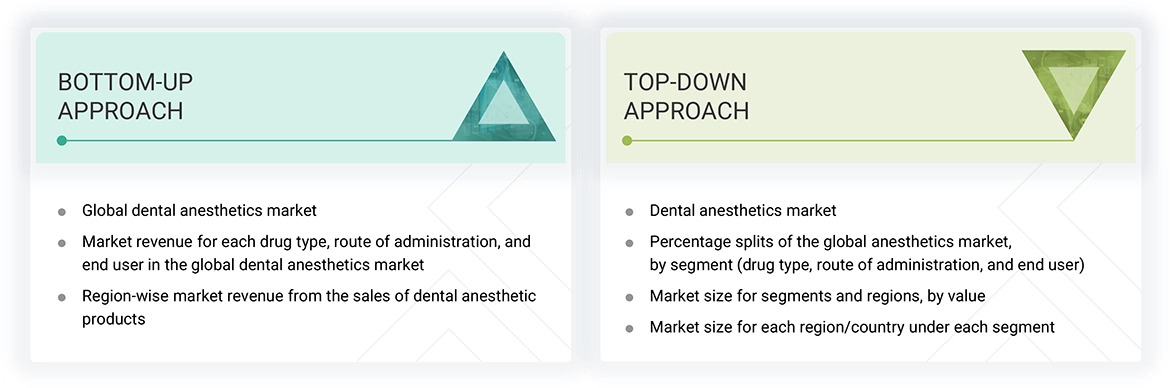
The study comprised four main activities aimed at estimating the current size of the dental anesthetics market. First, comprehensive secondary research was conducted to gather information on the market, as well as related and parent markets. Next, the findings, assumptions, and estimations were validated through primary research with industry experts across the value chain. Both top-down and bottom-up approaches were employed to determine the overall market size. Finally, market breakdown and data triangulation were utilized to estimate the sizes of segments and subsegments within the market.
Secondary Research
In the secondary research process, various sources were utilized to gather information on the dental anesthetics market. These sources included annual reports, press releases, and investor presentations from companies, as well as white papers, certified publications, and articles by recognized authors. We also referred to reputable websites, regulatory bodies, and databases such as D&B Hoovers, Bloomberg Business, and Factiva. This research helped us identify key players in the market and allowed us to classify and segment the data according to industry trends, down to the most detailed level. Additionally, we compiled a database of key industry leaders using the information obtained from our secondary research.
Primary Research
Extensive primary research was conducted after gathering information on the dental anesthetics market through secondary research. Several primary interviews were held with market experts from both the demand and supply sides across major regions, including North America, Europe, Asia Pacific, Latin America, the Middle East & Africa, and the GCC countries. Data was collected through questionnaires, emails, and telephone interviews.
Primary sources from the supply side included various industry experts, such as Chief Executive Officers (CEOs), Vice Presidents (VPs), and Directors from business development, marketing, and product development/innovation teams. This also encompassed key executives from dental anesthetics manufacturers, distributors, and key opinion leaders.
A breakdown of the primary respondents for the dental anesthetics market is provided below:
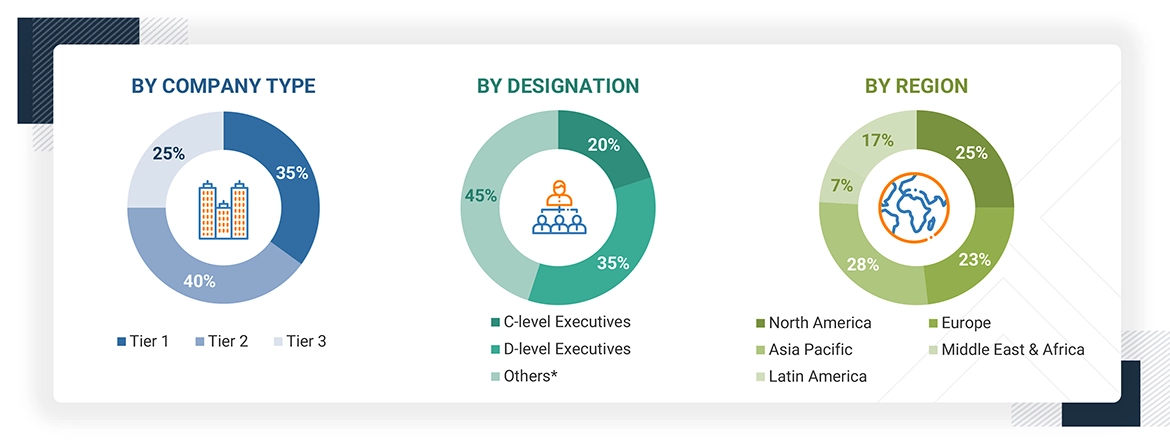
Note 1: C-level executives include CEOs, COOs, CTOs, and VPs.
Note 2: Others include sales, marketing, and product managers.
Note 3: Companies are classified into tiers based on their total revenue. As of 2024: Tier 1 = >USD 300 million, Tier 2 = USD 100 million to USD 300 million, and Tier 3 = < USD 100 million.
To know about the assumptions considered for the study, download the pdf brochure
Market Size Estimation
The research methodology used to estimate the size of the dental anesthetics market includes the following details:
The market sizing was undertaken from the global side.
Country-level Analysis: The size of the dental anesthetics market was obtained from the annual presentations of leading players and secondary data available in the public domain. The share of products in the overall dental anesthetics market was obtained from secondary data and validated by primary participants to arrive at the total dental anesthetics market. Primary participants further validated the numbers.
Geographic Market Assessment (By Region & Country): The geographic assessment was done using the following approaches:
- Approach 1: Geographic revenue contributions/splits of leading players in the market (wherever available) and respective growth trends
- Approach 2: Geographic adoption trends for individual product segments by end users and growth prospects for each of the segments (assumptions and indicative estimates validated from primary interviews)
At each point, the assumptions and approaches were validated by industry experts who were contacted during primary research. Considering the limitations of data available from secondary research, revenue estimates for individual companies (for the overall dental anesthetics market and geographic market assessment) were ascertained based on a detailed analysis of their respective product offerings, geographic reach/strength (direct or through distributors or suppliers), and the shares of the leading players in a particular region or country.
Global Dental Anesthetics Market Size: Top-down and Bottom-up Approach
Data Triangulation
After arriving at the overall size from the market size estimation process explained above, the total market was split into several segments and subsegments. The data triangulation and market breakdown procedures explained below were implemented, wherever applicable, to complete the overall market engineering process and arrive at the exact statistics for various market segments and subsegments. The data was triangulated by studying various factors and trends from the demand and supply sides. The market size was also validated using both the top-down and bottom-up approaches.
Market Definition
Local dental anesthetics are medications that are injected directly into the area of the mouth where a dental procedure will be performed. They work by temporarily blocking nerve signals in that specific region, effectively numbing the site and preventing pain while the patient remains fully conscious. These anesthetics are primarily classified into two types based on their chemical structure: amides (such as lidocaine and articaine) and esters (such as benzocaine and procaine). They are mainly administered through two routes: injectable methods (infiltration or nerve block) and topical applications (gels, sprays, or ointments applied to the mucosa).
Stakeholders
- Dental Anesthetics Manufacturers
- Raw Material Suppliers for Dental Anesthetics
- Suppliers and Distributors of Dental Anesthetics Products
- Healthcare Service Providers
- Teaching Hospitals and Academic Medical Centers
- Government Bodies/Municipal Corporations
- Regulatory Bodies
- Medical Research Institutes
- Business Research and Consulting Service Providers
- Venture Capitalists
- Market Research and Consulting Firms
Report Objectives
- To describe, analyze, and forecast the dental anesthetics market by drug type, route of administration, end user, and region
- To describe and forecast the dental anesthetics market for key regions, such as North America, Europe, the Asia Pacific, Latin America, the Middle East & Africa, and GCC Countries
- To provide detailed information regarding the drivers, restraints, opportunities, and challenges influencing the growth of the dental anesthetics market
- To strategically analyze the ecosystem, regulations, patenting trend, value chain, Porter’s five forces, and prices pertaining to the market under study
- To strategically analyze micromarkets with respect to individual growth trends, prospects, and contributions to the overall market
- To analyze market opportunities for stakeholders and provide details of the competitive landscape for market players
- To profile the key players and comprehensively analyze their market shares and core competencies in the dental anesthetics market
- To analyze competitive developments such as partnerships, collaborations, acquisitions, product launches, expansions, and R&D activities in the dental anesthetics market
- To benchmark players within the market using the proprietary Company Evaluation Matrix framework, which analyzes market players on various parameters within the broad categories of business and product strategy
Get the Full Dental Anesthetics Market Report
Full forecast, segment splits, and company analysis for all Dental Anesthetics Market.
- Germany Dental Anesthetics Market
- Italy Dental Anesthetics Market
- Spain Dental Anesthetics Market
- France Dental Anesthetics Market
- UK Dental Anesthetics Market
- Canada Dental Anesthetics Market
- US Dental Anesthetics Market
- China Dental Anesthetics Market
- Japan Dental Anesthetics Market
- South Korea Dental Anesthetics Market
- India Dental Anesthetics Market
- Australia Dental Anesthetics Market
- Brazil Dental Anesthetics Market
- Mexico Dental Anesthetics Market
- Argentina Dental Anesthetics Market
- -Rest Of Asia Pacific Dental Anesthetics Market
- -Rest Of Europe Dental Anesthetics Market
- -Rest Of Latin America Dental Anesthetics Market
- GCC Countries Dental Anesthetics Market
Need a Tailored Report?
Customize this report to your needs
Get 10% FREE Customization
Customize This Report
