
UK Desiccant Dehumidifier Market (2024-2029)

The UK Desiccant Dehumidifier Market was valued at $23.6 Million in 2024 and projected to reach to $28.2 Million by 2029, representing a compound annual growth rate of CAGR 3.6%. The UK desiccant dehumidifier market is positioned for steady growth through 2029, supported by continued investment in semiconductor fabrication and electronics assembly operations.


| Market Size in | USD 26.32 MN |
| Market Forecast in | |
| CAGR | |
| Forecast Period | |
| Units Considered | Value (USD MN) |
UK Desiccant Dehumidifier Market Trends and Insights
- The UK market is driven by increasing demand from the semiconductor and electronics manufacturing sectors, where moisture control is critical for product quality and operational efficiency.
- The UK's established electronics infrastructure and stringent manufacturing standards support steady adoption of desiccant dehumidification solutions across industrial facilities. In 2024, the UK market reflects moderate but consistent growth as manufacturers prioritize humidity management in cleanrooms and production environments.
- By 2029, the UK is expected to see expanded deployment across both legacy and emerging semiconductor facilities, supported by investments in advanced manufacturing technologies.
- The UK's position within the European supply chain and its focus on precision engineering continue to underpin demand for reliable dehumidification systems in the semiconductor and electronics industry..
Key Market Statistics
- CAGR (2024-2029) CAGR 3.6%
- Market Size, 2024 ~USD 23.6 Million
- Forecast, 2029 ~USD 28.2 Million
- Country UK
UK Desiccant Dehumidifier Market Overview
Market Valuation :
The UK desiccant dehumidifier market reached £23.6 million in 2024, with steady growth projected to £28.2 million by 2029, driven by semiconductor and electronics manufacturing demands.
Growth Trajectory :
UK market CAGR of 3.6% reflects moderate but consistent expansion, outpaced by the global market at 6%, indicating regional consolidation and maturity in established manufacturing sectors.
Sector Drivers :
The semiconductor and electronics industries remain primary growth catalysts in the UK, where precision moisture control is essential for maintaining product quality, yield rates, and operational reliability.
Manufacturing Infrastructure :
The UK's established electronics manufacturing base and stringent quality standards create sustained demand for advanced desiccant dehumidification solutions across production facilities.
UK Desiccant Dehumidifier Market Dynamics
- The 3.6% CAGR reflects a mature market with stable demand from established manufacturers prioritizing moisture control for product integrity.
- Regulatory compliance and quality assurance requirements in UK electronics manufacturing will sustain market expansion, though growth rates remain conservative compared to emerging markets.
- Industry consolidation and technological advancements in dehumidification efficiency are expected to shape competitive dynamics.
- The market will benefit from ongoing digital transformation initiatives and increased automation in UK manufacturing facilities, which necessitate precise environmental controls..
Market Ecosystem
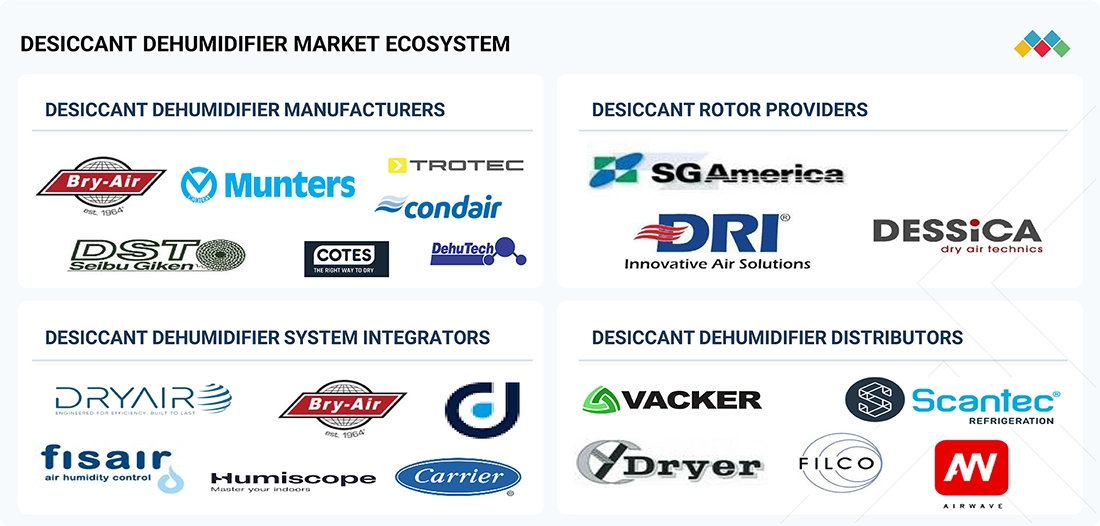
DESICCANT DEHUMIDIFIER MARKET SIZE SHARE & TRENDS: COMMERCIAL USE CASES ACROSS INDUSTRIES
| COMPANY | USE CASE DESCRIPTION | BENEFITS |
|---|---|---|
 |
Integrates desiccant dehumidifier systems in pharmaceutical manufacturing, battery production, and food processing facilities to maintain low-humidity and controlled environments. | Ensures product quality, minimizes moisture-related defects, and supports regulatory compliance. |
 |
Deploys desiccant dehumidifiers in cold storage, packaging, and electronics assembly plants to control humidity in low-temperature and high-humidity conditions. | Prevents condensation and corrosion, improves energy efficiency, and extends equipment life. |
 |
Uses desiccant-based dehumidification solutions in industrial drying, HVAC systems, and cleanrooms for precise climate control. | Provides stable humidity control, reduces downtime, and enhances operational efficiency. |
 |
Implements desiccant dehumidifier systems in commercial buildings, museums, and data centers to manage indoor air quality and moisture. | Improves air quality, protects sensitive assets, and lowers HVAC energy consumption. |
Logos and trademarks shown above are the property of their respective owners. Their use here is for informational and illustrative purposes only.
Related Ecosystem
Electrical System And Components
- Natural Language Processing (NLP)
- Sensors
- Machine Learning
- Temperature Sensors
- Actuators
- ABB India Limited
- Siemens ag
- SCHNEIDER ELECTRIC SE
- Eaton Corporation plc
- Lenovo
Electronics System And Components
- Sensors
- Temperature Sensors
- Pressure Sensors
- Actuators
- Image Sensors
- Lenovo
- Samsung
- Texas Instruments Incorporated
- HONEYWELL INTERNATIONAL INC.
- Teledyne Technologies Incorporated
Key Takeaways
- The UK desiccant dehumidifier market is valued at £23.6 million in 2024 and will reach £28.6 million by 2029 at a 3.6% CAGR.
- The UK semiconductor and electronics manufacturing sector drives consistent demand for moisture control solutions in cleanroom and production environments.
- The UK's stringent manufacturing standards and established industrial infrastructure support steady adoption of desiccant dehumidification technologies.
- By 2029, the UK market will benefit from increased investments in advanced manufacturing and precision engineering capabilities across the electronics sector.
Desiccant Dehumidifier Market Report Scope
| Report Metric | Details |
|---|---|
| Base Year | 2024 |
| Fastest Growing Segment | ELECTRONICS (Application) |
| Forecast Period | 2024-2029 |
| Growth Rate | CAGR of 6% from 2024 to 2029 |
| Largest Segment | INDUSTRIAL (End User) |
| Market Size Base Year (Billions) | ~USD 0.61 (2024) |
| Revenue Forecast (Billions) | ~USD 0.81 (2029) |
| Segments Covered | Product Type, End User, Application, Type |
UK Desiccant Dehumidifier Market Report Segmentation
4 segment dimensions are covered across the global market.
By Product Type
- Fixed/Mounted
- Portable
By End User
- Commercial
- Industrial
By Application
- Chemical
- Construction
- Electronics
- Energy
- Food & Pharmaceutical
By Type
- EV Battery Manufacturing
- Power Plants & Wind Turbines
UK: DESICCANT DEHUMIDIFIER MARKET, BY END USER, 2024–2029
| Segment | 2024 | 2025 | 2026 | 2027 | 2028 | 2029 | CAGR (%) |
|---|---|---|---|---|---|---|---|
| COMMERCIAL | 5.6 | 5.8 | 6.1 | 6.4 | 6.7 | 7.1 | 4.7 |
| INDUSTRIAL | 18 | 18.4 | 19 | 19.7 | 20.4 | 21.2 | 3.3 |
| TOTAL | 23.6 | 24.3 | 25.1 | 26 | 27.1 | 28.2 | 3.6 |
Target Audience
- UK Electronics Manufacturers : Semiconductor and electronics producers need market insights to optimize procurement strategies, evaluate dehumidification technology investments, and maintain competitive manufacturing standards.
- Dehumidifier Equipment Suppliers : UK and international equipment manufacturers require market data to identify growth opportunities, benchmark performance against competitors, and develop targeted sales strategies for British facilities.
- Industrial Facility Managers : Operations managers in UK electronics plants need market intelligence to justify capital expenditures on dehumidification systems and understand industry best practices for moisture control.
- Investment & Private Equity Firms : Investors evaluating opportunities in UK manufacturing and electronics sectors require detailed market analysis to assess growth potential, competitive positioning, and return on investment scenarios.
- Business Consultants & Analysts : Strategy consultants advising UK industrial clients need comprehensive market data to support recommendations on technology adoption, operational efficiency improvements, and market expansion strategies.
Reasons to Buy this Report
- UK-Specific Market Sizing : Obtain precise valuation data for the UK market (£23.6M in 2024) with accurate forecasts through 2029, enabling targeted investment and expansion decisions within the British electronics sector.
- Competitive Landscape Intelligence : Understand UK market dynamics, regional player positioning, and competitive strategies specific to British semiconductor and electronics manufacturers relying on desiccant dehumidification.
- Sector-Specific Demand Analysis : Identify growth opportunities within UK semiconductor fabrication and electronics assembly operations, where moisture control directly impacts product quality and manufacturing efficiency.
- Regulatory & Compliance Insights : Navigate UK-specific quality standards, environmental regulations, and manufacturing compliance requirements that drive demand for advanced dehumidification solutions in electronics production.
- Strategic Growth Planning : Leverage UK market forecasts and CAGR analysis to develop informed business strategies, resource allocation plans, and market entry or expansion initiatives within the British electronics industry.
Frequently asked questions
What is the current size of the UK desiccant dehumidifier market?
The UK desiccant dehumidifier market was valued at £23.6 million in 2024 and is expected to grow to £28.2 million by 2029.
What is the growth rate of the UK desiccant dehumidifier market?
The UK desiccant dehumidifier market is projected to grow at a compound annual growth rate (CAGR) of 3.6% from 2024 to 2029.
Which industries drive demand for desiccant dehumidifiers in the UK?
The UK semiconductor and electronics manufacturing sectors are the primary drivers of demand for desiccant dehumidifiers, where moisture control is essential for product quality.
Why is humidity control important in UK semiconductor manufacturing?
Humidity control is critical in UK semiconductor manufacturing to prevent moisture-related defects, ensure product reliability, and maintain compliance with stringent manufacturing standards.
What factors will support UK market growth through 2029?
The UK market will be supported by investments in advanced manufacturing technologies, increased precision engineering capabilities, and the UK's strategic position in the European electronics supply chain.
RESEARCH METHODOLOGY
The research process for this study included systematic gathering, recording, and analysis of data about customers and companies operating in the desiccant dehumidifier market. This process involved the extensive use of secondary sources, directories, and databases (Factiva, Oanda, and OneSource) for identifying and collecting valuable information for the comprehensive, technical, market-oriented, and commercial study of the desiccant dehumidifier market. In-depth interviews were conducted with primary respondents, including experts from core and related industries and preferred manufacturers, to obtain and verify critical qualitative and quantitative information as well as to assess growth prospects. Key players in the desiccant dehumidifier market were identified through secondary research, and their market rankings were determined through primary and secondary research. This research included studying annual reports of top players and interviewing key industry experts such as CEOs, directors, and marketing executives.
Secondary Research
In the secondary research process, various sources were used to identify and collect information important for this study. These include annual reports, press releases & investor presentations of companies, white papers, technology journals, certified publications, articles by recognized authors, directories, and databases.
Secondary research was mainly used to obtain key information about the industry's supply chain, the total pool of market players, the classification of the market according to industry trends to the bottom-most level, regional markets, and key developments from the market and technology-oriented perspectives.
Primary Research
Primary research was also conducted to identify the segmentation types, key players, competitive landscape, and key market dynamics, such as drivers, restraints, opportunities, challenges, and industry trends, along with key strategies adopted by players operating in the desiccant dehumidifier market. Extensive qualitative and quantitative analyses were performed on the complete market engineering process to list key information and insights throughout the report.
Extensive primary research has been conducted after acquiring knowledge about the desiccant dehumidifier market scenarios through secondary research. Several primary interviews have been conducted with experts from both demand (end users) and supply side (desiccant dehumidifier manufacturers/providers) across four major geographic regions: North America, Europe, Asia Pacific, and RoW. Approximately 80% and 20% of the primary interviews were conducted from the supply and demand side, respectively. These primary data have been collected through questionnaires, emails, and telephonic interviews.

To know about the assumptions considered for the study, download the pdf brochure
Market Size Estimation
In the complete market engineering process, both top-down and bottom-up approaches were implemented, along with several data triangulation methods, to estimate and validate the size of the desiccant dehumidifier market and various other dependent submarkets. Key players in the market were identified through secondary research, and their market share in the respective regions was determined through primary and secondary research. This entire research methodology included the study of annual and financial reports of the top players, as well as interviews with experts (such as CEOs, VPs, directors, and marketing executives) for key insights (quantitative and qualitative).
All percentage shares, splits, and breakdowns were determined using secondary sources and verified through primary sources. All the possible parameters that affect the markets covered in this research study were accounted for, viewed in detail, verified through primary research, and analyzed to obtain the final quantitative and qualitative data. This data was consolidated and supplemented with detailed inputs and analysis from MarketsandMarkets and presented in this report.
Desiccant Dehumidifier Market: Bottom-Up Approach and Top-Down Approach

Data Triangulation
After arriving at the overall market size from the market size estimation process, as explained above, the total market has been split into several segments and subsegments. To complete the overall market engineering process and arrive at the exact statistics for all segments and subsegments, market breakdown and data triangulation procedures have been employed, wherever applicable. The data have been triangulated by studying various factors and trends from both the demand and supply sides. Along with this, the market has been validated using top-down and bottom-up approaches.
Market Definition
A desiccant dehumidifier operates using the adsorption properties of a rotating desiccant wheel, similar to a sponge soaking up moisture directly from the air. Air is drawn into the dehumidifier and passes through the slowly revolving desiccant wheel. The desiccant absorbs moisture, and the dried air is returned to the room. To allow the desiccant wheel to absorb moisture indefinitely, it passes through a regeneration area, where a secondary hot airstream heats it. An electric heater heats this secondary airstream to over 120°C before passing it through the wheel. The hot air absorbs the moisture from the desiccant and is then vented externally.
Therefore, a desiccant dehumidifier has two airstreams—a process airstream and a regeneration airstream, which exhaust the moisture collected from the process airstream. As the freshly regenerated part of the wheel is hot, it carries some residual heat when it rotates into the process airstream. Along with drying the process airstream, the desiccant wheel provides some heat.
Key Stakeholders
- Dehumidifier Companies
- Raw Material Suppliers and Distributors
- Associations and Industrial Bodies
- Environmental Support Agencies
- System Integrators
- Government Councils
- Standardization Bodies
- Analysts and Strategic Business Planners
Report Objectives
- To define, describe, and estimate the desiccant dehumidifier market, by product type, application, end user, and region, in terms of value
- To forecast the size of the market, by region—North America, Europe, Asia Pacific, and the Rest of the World (RoW)—in terms of value
- To forecast the desiccant dehumidifier market size, by product type, in terms of volume
- To provide detailed information regarding drivers, restraints, opportunities, and challenges influencing the growth of the desiccant dehumidifier market
- To strategically analyze the micromarkets with respect to the individual growth trends, prospects, and their contribution to the desiccant dehumidifier market
- To map the competitive landscape based on company profiles, key player strategies, and key developments
- To provide a detailed overview of the desiccant dehumidifier value chain and ecosystem
- To provide information about key technology trends, impact of AI/Gen AI, macroeconomic outlook analysis, and patents related to the desiccant dehumidifier market
- To provide information regarding trade data related to the desiccant dehumidifier market
- To identify the key players operating in the desiccant dehumidifier market and comprehensively analyze their market shares and core competencies
- To analyze opportunities in the market for stakeholders by identifying high-growth segments of the desiccant dehumidifier market
- To benchmark the market players using the proprietary company evaluation matrix framework, which analyzes them on various parameters within the broad categories of market ranking/share and product portfolio
- To analyze competitive developments, such as contracts, acquisitions, product launches, collaborations, expansions, and research & development (R&D), in the desiccant dehumidifier market.
Available Customizations
With the given market data, MarketsandMarkets offers customizations according to the company’s specific needs. The following customization options are available for the report:
Company Information
- Detailed analysis and profiling of additional market players (up to 5)
Get the Full Desiccant Dehumidifier Market Report
Full forecast, segment splits, and company analysis for all Desiccant Dehumidifier Market.
- US Desiccant Dehumidifier Market
- Canada Desiccant Dehumidifier Market
- Mexico Desiccant Dehumidifier Market
- Germany Desiccant Dehumidifier Market
- France Desiccant Dehumidifier Market
- Italy Desiccant Dehumidifier Market
- Spain Desiccant Dehumidifier Market
- China Desiccant Dehumidifier Market
- Japan Desiccant Dehumidifier Market
- India Desiccant Dehumidifier Market
- South Korea Desiccant Dehumidifier Market
- Rest Of Europe Desiccant Dehumidifier Market
- Rest Of Asia Pacific Desiccant Dehumidifier Market
- GCC Countries Desiccant Dehumidifier Market
Need a Tailored Report?
Customize this report to your needs
Get 10% FREE Customization
Customize This Report
