
Brazil Digital PCR Market (2024-2029)

The Brazil Digital PCR Market was valued at $187.1 Million in 2024 and projected to reach to $261.6 Million by 2029, representing a compound annual growth rate of 6.9%. Brazil's digital PCR market is poised for sustained expansion as healthcare providers increasingly recognize the value of advanced molecular diagnostics in clinical decision-making.


| Market Size in | USD 26.32 MN |
| Market Forecast in | |
| CAGR | |
| Forecast Period | |
| Units Considered | Value (USD MN) |
Brazil Digital PCR Market Trends and Insights
- This represents a compound annual growth rate (CAGR) of 6.9%, reflecting increasing adoption of advanced molecular diagnostics across Brazil's healthcare sector.
- Brazil's market expansion is driven by rising demand for precision medicine, growing investments in research infrastructure, and expanding clinical applications in infectious disease detection and oncology. The Brazilian digital PCR market benefits from strengthening healthcare expenditure and a growing emphasis on early disease detection.
- Brazil's healthcare institutions are increasingly integrating digital PCR technologies to enhance diagnostic accuracy and throughput.
- Between 2024 and 2029, Brazil is expected to see accelerated adoption in both public and private laboratory settings, supported by regulatory improvements and greater awareness among healthcare professionals.
- This growth trajectory positions Brazil as a significant contributor to the Latin American digital PCR market expansion..
Key Market Statistics
- CAGR (2024-2029) 6.9% CAGR
- Market Size, 2024 ~USD 187.1 Million
- Forecast, 2029 ~USD 261.6 Million
- Country Brazil
Brazil Digital PCR Market Overview
Market Valuation :
Brazil's digital PCR market is valued at USD 187.1 million in 2024, with strong growth trajectory positioning it as a key market in Latin America for molecular diagnostics.
Growth Rate :
The Brazilian market is expanding at a CAGR of 6.9% through 2029, outpacing many emerging markets and reflecting increasing healthcare infrastructure investments and diagnostic adoption.
Precision Medicine Adoption :
Rising demand for precision medicine and personalized treatment approaches in Brazil is driving healthcare providers to adopt advanced digital PCR technologies for accurate molecular diagnostics.
Healthcare Investment :
Growing investments in Brazil's healthcare sector, coupled with expanding laboratory networks and research institutions, are accelerating the deployment of digital PCR systems across diagnostic centers.
Brazil Digital PCR Market Dynamics
- The market's 6.9% CAGR reflects growing adoption among diagnostic laboratories, research institutions, and hospitals seeking to enhance testing accuracy and throughput.
- Key drivers include rising prevalence of infectious diseases, cancer diagnostics demand, and government initiatives to modernize healthcare infrastructure. Looking ahead to 2029, Brazil's digital PCR market is expected to reach USD 261.6 million, driven by technological advancements, cost reductions, and expanded access to precision medicine.
- Increasing collaboration between international diagnostic companies and local healthcare providers will further accelerate market penetration.
- The convergence of rising healthcare spending, skilled laboratory workforce development, and regulatory support positions Brazil as a strategic growth market for digital PCR solutions in Latin America..
Market Ecosystem
Related Ecosystem
Advanced Genetic Sequencing
- Polymerase Chain Reaction (PCR)
- Reagents
- Assay Kits
- Bioinformatics
- Flow Cytometry
- Thermo Fisher Scientific Inc.
- Illumina, Inc.
- Qiagen N.V.
- Agilent Technologies, Inc.
- Danaher Corporation
Biotechnology
- Reagents
- Polymerase Chain Reaction (PCR)
- Stem Cells
- Assay Kits
- Flow Cytometers
- Thermo Fisher Scientific Inc.
- Merck KGaA
- Danaher Corporation
- Agilent Technologies, Inc.
- Bio-Rad Laboratories, Inc.
Key Takeaways
- Brazil's digital PCR market is valued at USD 187.1 million in 2024 and is forecast to reach USD 261.6 million by 2029, growing at a 6.9% CAGR.
- Brazil's market growth is driven by increasing adoption of precision medicine and expanding clinical applications in infectious disease and oncology diagnostics.
- Brazil's healthcare institutions are strengthening investments in molecular diagnostic infrastructure to support early disease detection and improved patient outcomes.
- Brazil's digital PCR market is positioned for accelerated adoption across both public and private laboratory settings through 2029.
Digital PCR Market Report Scope
| Report Metric | Details |
|---|---|
| Base Year | 2024 |
| Fastest Growing Segment | DPCR (Offering) |
| Forecast Period | 2024–2029 |
| Growth Rate | CAGR of 8.1% from 2024 to 2029 |
| Largest Segment | QPCR (Offering) |
| Market Size Base Year (Billions) | ~USD 10.03 (2024) |
| Revenue Forecast (Billions) | ~USD 14.8 (2029) |
| Segments Covered | Offering, Type, Application, End User |
Brazil Digital PCR Market Report Segmentation
4 segment dimensions are covered across the global market.
By Offering
- Dpcr
- Qpcr
By Type
- Beaming Digital Pcr
- Blood Screening
- Chip-Based Digital Pcr
- Clinical Applications
- Dpcr Instruments
- Dpcr Reagents & Consumables
- Droplet Digital Pcr
- Environmental Applications
- Forensic Applications
- Gene Expression
- Infectious Disease Testing
- Oncology Testing
- Other Clinical Applications
- Other Dpcr Applications
- Other Qpcr Applications
- Other Research Applications
- Qpcr Instruments
- Qpcr Products
- Qpcr Reagents & Consumables
- Qpcr Services
- Qpcr Software
- Research Applications
- Single-Cell Analysis
- Stem Cell Research
- Transplant Diagnostics
By Application
- Clinical Applications
- Dpcr
- Environmental Applications
- Forensic Applications
- Other Applications
- Qpcr
- Research Applications
By End User
- Academic & Research Institutes
- Cros And Cdmos
- Forensic Laboratories
- Hospitals And Diagnostic Laboratories
- Other End Users
- Pharmaceutical & Biotechnology Companies
BRAZIL: QPCR MARKET, BY END USER, 2022–2029
| Segment | 2022 | 2023 | 2024 | 2025 | 2026 | 2027 | 2028 | 2029 | CAGR (%) |
|---|---|---|---|---|---|---|---|---|---|
| ACADEMIC & RESEARCH INSTITUTES | 29.4 | 26.1 | 27.1 | 28.2 | 29.6 | 31.2 | 33.1 | 35.5 | 5.6 |
| CROS AND CDMOS | 17.6 | 15.6 | 16.4 | 17.4 | 18.5 | 19.8 | 21.3 | 23.2 | 7.2 |
| FORENSIC LABORATORIES | 13.1 | 11.5 | 11.9 | 12.3 | 12.8 | 13.4 | 14.2 | 15.1 | 5 |
| HOSPITALS AND DIAGNOSTIC LABORATORIES | 95.6 | 91 | 96.5 | 102.8 | 110.1 | 118.7 | 129 | 141.4 | 7.9 |
| OTHER END USERS | 11.34 | 10.25 | 10.48 | 10.76 | 11.1 | 11.52 | 12.04 | 12.69 | 3.9 |
| PHARMACEUTICAL & BIOTECHNOLOGY COMPANIES | 24.3 | 23.8 | 24.8 | 26 | 27.5 | 29.2 | 31.2 | 33.7 | 6.3 |
| TOTAL | 191.3 | 178.3 | 187.1 | 197.4 | 209.5 | 223.8 | 240.8 | 261.6 | 6.9 |
BRAZIL: DPCR MARKET, BY END USER, 2022–2029
| Segment | 2022 | 2023 | 2024 | 2025 | 2026 | 2027 | 2028 | 2029 | CAGR (%) |
|---|---|---|---|---|---|---|---|---|---|
| ACADEMIC & RESEARCH INSTITUTES | 3.5 | 3.2 | 3.4 | 3.7 | 4 | 4.3 | 4.7 | 5.1 | 8.4 |
| CROS AND CDMOS | 2.1 | 2 | 2.2 | 2.4 | 2.6 | 2.8 | 3.1 | 3.5 | 9.8 |
| FORENSIC LABORATORIES | 2 | 1.8 | 1.9 | 2 | 2.2 | 2.3 | 2.5 | 2.8 | 7.8 |
| HOSPITALS AND DIAGNOSTIC LABORATORIES | 12.5 | 11.3 | 12.3 | 13.4 | 14.7 | 16.2 | 18 | 20.2 | 10.6 |
| OTHER END USERS | 1 | 1 | 1 | 1 | 1.1 | 1.1 | 1.2 | 1.2 | 4.5 |
| PHARMACEUTICAL & BIOTECHNOLOGY COMPANIES | 3.1 | 2.8 | 3 | 3.2 | 3.4 | 3.7 | 4.1 | 4.5 | 8.8 |
| TOTAL | 24.2 | 22 | 23.7 | 25.7 | 27.9 | 30.5 | 33.6 | 37.4 | 9.5 |
Target Audience
- Diagnostic Equipment Manufacturers : Manufacturers need Brazil-specific market data to assess market potential, identify growth opportunities, and develop localized product strategies for the expanding Brazilian diagnostic laboratory sector.
- Healthcare Investment Firms : Investment professionals require detailed Brazil market analysis to evaluate portfolio opportunities, assess market attractiveness, and make informed capital allocation decisions in Latin American healthcare.
- Laboratory Network Operators : Laboratory chains and diagnostic centers need market insights to justify digital PCR technology investments, benchmark against competitors, and plan capacity expansion across Brazil's regions.
- Healthcare Consultants : Consulting firms advising healthcare clients require Brazil-specific market intelligence to develop strategic recommendations, competitive analyses, and market entry strategies for diagnostic solutions.
- Regulatory & Policy Advisors : Policy professionals and regulatory consultants need market data to understand Brazil's diagnostic landscape, inform healthcare policy recommendations, and support technology adoption initiatives.
Key Companies in the Brazil Digital PCR Market
| Company | HQ | Ownership | Strongest segments |
|---|---|---|---|
| NANOSTRING TECHNOLOGIES, INC | United States | Private Company | nCounter instruments and consumables (Pro, FLEX, SPRINT, CodeSets, panels, reagents),GeoMx DSP and spatial biology solutions,Prosigna IVD and clinical assays, |
| AFFYMETRIX INC | United States | Private Company | GeneChip gene expression and genotyping arrays,CytoScan and OncoScan cytogenetics and oncology products,eBioscience antibodies, flow cytometry, and immunoassays, |
| DECODE GENETICS | Iceland | Private Company | Internal discovery for Amgen pipeline,External research collaborations and data services,Licensing of genetic discoveries and IP, |
| DENVILLE SCIENTIFIC | United States | Private Company | Pipetting systems and tips,Centrifuge tubes, plates, and sample storage,Molecular biology equipment and thermal cyclers, |
| ROSETTA GENOMICS | Israel | Public Company | RosettaGX Cancer Origin & mi-LUNG,RosettaGX Reveal (thyroid FNA),mi-KIDNEY and other microRNA classifiers, |
| DANAHER CORPORATION | United States | Public Company | Biotechnology (bioprocessing and related solutions),Life Sciences (research and analytical instruments, genomics),Diagnostics (clinical instruments, consumables, software), |
| THERMO FISHER SCIENTIFIC INC. | United States | Public Company | Life Sciences Solutions,Analytical Instruments,Specialty Diagnostics, |
| MERCK KGAA | Germany | Public Company | Life Science (tools, reagents, bioprocessing, CDMO),Healthcare (prescription drugs, biopharmaceuticals),Electronics (semiconductor and display materials, equipment), |
| QIAGEN N.V. | Netherlands | Public Company | Sample technology consumables and instruments,Molecular diagnostics assays (TB, oncology, SRH, transplant, viral load),PCR and enzymes (qPCR, digital PCR, RT-PCR, configured solutions), |
| BIO-RAD LABORATORIES, INC. | United States | Public Company | Clinical Diagnostics systems, reagents, and quality controls,Life Science instruments and reagents,Other and services (software, support, education, ancillary), |
| AGILENT TECHNOLOGIES, INC. | United States | Public Company | Life Sciences and Diagnostics Markets,Agilent CrossLab,Applied Markets, |
| TAKARA BIO INC. | Japan | Private Company | Genetic and cellular research reagents,Instruments and cellular analysis devices,COVID-19 and other in vitro diagnostics, |
| BECTON, DICKINSON, AND COMPANY | United States | Public Company | Medical Essentials (syringes, needles, catheters, sharps, vascular access),Connected Care (infusion, medication management, pharmacy automation, informatics),BioPharma Systems (prefillable drug delivery, related solutions), |
| ABBOTT LABORATORIES | United States | Public Company | Diagnostic Products,Medical Devices,Nutritional Products, |
| MERIDIAN BIOSCIENCE | United States | Private Company | Molecular reagents (PCR/RT-PCR enzymes, dNTPs, buffers, ready-to-use solutions, qPCR controls),Immunoassay raw materials (antigens, antibodies, interference blockers),Custom antibody and protein manufacturing services, |
| BIOMÉRIEUX | France | Public Company | Microbiology (culture media, BACT/ALERT VIRTUO, TEMPO, CHEMUNEX, BIOBALL, ENDONEXT),ID/AST Systems (VITEK 2, VITEK MS, VITEK REVEAL, API RANGE, ETEST, RAPIDEC CARBA NP),Molecular & Syndromic PCR (BIOFIRE, BIOFIRE SPOTFIRE, ARGENE, EMAG, NUCLISENS), |
| EPPENDORF AG | Germany | Private Company | Liquid handling (pipettes, dispensers, automated systems),Separation & instrumentation (centrifuges, PCR cyclers, ULT freezers),Consumables (tubes, tips, plates, single-use bioreactors), |
NANOSTRING TECHNOLOGIES, INC
NanoString Technologies, Inc. is a U.S.-based private company founded in 2003 with 550 employees that develops molecular analysis platforms for life science research.
AFFYMETRIX INC
Affymetrix Inc. is a U.S. private company founded in 1991 with 1,150 employees that develops and manufactures molecular analysis tools and genomic platforms.
DECODE GENETICS
Decode Genetics is an Icelandic private company founded in 1996 with 331 employees engaged in genomic research and genetic analysis.
DENVILLE SCIENTIFIC
Denville Scientific is a U.S.-based private company founded in 1979 specializing in laboratory equipment and scientific supplies.
ROSETTA GENOMICS
Rosetta Genomics is an Israeli public company founded in 2000 with 86 employees focused on genomic and molecular diagnostics.
DANAHER CORPORATION
Danaher Corporation is a U.S.-based public company founded in 1969 with 59,000 employees operating a diversified conglomerate with significant life sciences and diagnostics divisions.
THERMO FISHER SCIENTIFIC INC.
Thermo Fisher Scientific Inc. is a U.S.-based public company founded in 1956 with 125,000 employees providing laboratory equipment, reagents, and analytical instruments worldwide.
MERCK KGAA
Merck KGaA is a German public company founded in 1668 with 59,077 employees operating in pharmaceuticals, life sciences, and performance materials.
QIAGEN N.V.
QIAGEN N.V. is a Netherlands-based public company founded in 1984 with 5,500 employees specializing in molecular diagnostics and life sciences sample preparation.
BIO-RAD LABORATORIES, INC.
Bio-Rad Laboratories, Inc. is a U.S.-based public company founded in 1952 with 7,450 employees manufacturing clinical diagnostics and life science research products.
AGILENT TECHNOLOGIES, INC.
Agilent Technologies, Inc. is a U.S.-based public company founded in 1999 with 18,000 employees providing analytical instruments and life sciences solutions.
TAKARA BIO INC.
Takara Bio Inc. is a Japanese private company founded in 2002 with 1,779 employees specializing in molecular biology reagents and biotechnology products.
BECTON, DICKINSON, AND COMPANY
Becton, Dickinson, and Company is a U.S.-based public company founded in 1897 with 72,000 employees manufacturing medical devices, diagnostics, and laboratory equipment.
ABBOTT LABORATORIES
Abbott Laboratories is a U.S.-based public company founded in 1888 with 115,000 employees operating in diagnostics, pharmaceuticals, nutritional products, and medical devices.
MERIDIAN BIOSCIENCE
Meridian Bioscience is a U.S.-based private company founded in 1976 with 704 employees developing and manufacturing diagnostic products and reagents.
BIOMÉRIEUX
bioMérieux is a French public company founded in 1963 with 14,894 employees specializing in in vitro diagnostics and microbiology testing solutions.
EPPENDORF AG
Eppendorf AG is a German private company founded in 1945 with 4,358 employees manufacturing laboratory equipment and consumables for life sciences research.
Reasons to Buy this Report
- Market Size & Growth Data : Access precise valuation metrics for Brazil's digital PCR market with detailed CAGR analysis, enabling accurate financial forecasting and investment decision-making for the 2024-2029 period.
- Competitive Landscape Intelligence : Understand Brazil-specific market dynamics, key players, and competitive positioning to identify partnership opportunities and market entry strategies tailored to the Brazilian healthcare ecosystem.
- Regional Growth Drivers : Gain insights into Brazil-specific factors driving digital PCR adoption, including healthcare infrastructure investments, precision medicine initiatives, and regulatory developments shaping market expansion.
- Forecast Accuracy : Leverage country-level projections to USD 261.6 million by 2029 for strategic planning, resource allocation, and revenue forecasting specific to the Brazilian market opportunity.
- Stakeholder Insights : Identify key decision-makers, healthcare providers, and laboratory networks in Brazil driving digital PCR adoption, enabling targeted business development and partnership strategies.
Frequently asked questions
What is the current size of Brazil's digital PCR market?
Brazil's digital PCR market was valued at USD 187.1 million in 2024 and is expected to grow to USD 261.6 million by 2029.
What is the projected growth rate for digital PCR in Brazil?
Brazil's digital PCR market is projected to grow at a compound annual growth rate (CAGR) of 6.9% from 2024 to 2029.
What are the main drivers of growth in Brazil's digital PCR market?
Brazil's digital PCR market growth is driven by increasing demand for precision medicine, expanding clinical applications in infectious disease and oncology, and growing investments in healthcare infrastructure.
Which sectors are adopting digital PCR technology in Brazil?
Brazil's digital PCR adoption is expanding across both public and private laboratory settings, including clinical diagnostics, research institutions, and pharmaceutical companies.
How does Brazil's digital PCR market compare to other Latin American countries?
Brazil represents a significant portion of the Latin American digital PCR market, with steady growth positioning it as a key regional contributor to market expansion.
RESEARCH METHODOLOGY
This research study involved the extensive use of secondary sources, directories, and databases to identify and collect valuable information for the analysis of the global digital PCR (dPCR) and real-time PCR (qPCR) market. In-depth interviews were conducted with various primary respondents, including key industry participants, subject-matter experts (SMEs), C-level executives of key market players, and industry consultants, to obtain and verify critical qualitative and quantitative information and assess the growth prospects of the market. The global market size estimated through secondary research was then triangulated with inputs from primary research to arrive at the final market size.
Secondary Research
Secondary research was used mainly to identify and collect information for the extensive, technical, market-oriented, and commercial study of the digital PCR (dPCR) and real-time PCR (qPCR) market. The secondary sources used for this study include World Bank, GLOBOCAN, World Health Organization (WHO), Eurostat, International Trade Administration, National Human Genome Research Institute (NHGRI, US), National Institutes of Health (NIH) (US), Institute for Health Metrics and Evaluation (US), US Food and Drug Administration (US FDA), Health Canada, European Medicines Agency (UK), Centers for Disease Control and Prevention (CDC), National Cancer Institute (NCI), European Medicines Agency (EMA), German Cancer Research Center, NHS (UK), Medicines and Healthcare Products Regulatory Agency (UK), Pharmaceuticals and Medical Devices Agency (Japan), Beijing Institute of Genomics (China), Ministry of Science & Technology (India), Ministry of Food and Drug Safety (South Korea), BioPlan Associates, Eurostat, and Factiva, research journals; corporate filings such as annual reports, SEC filings, investor presentations, and financial statements; press releases; trade, business, professional associations and among others. These sources were also used to obtain key information about major players, market classification, and segmentation according to industry trends, regional/country-level markets, market developments, and technology perspectives.
Primary Research
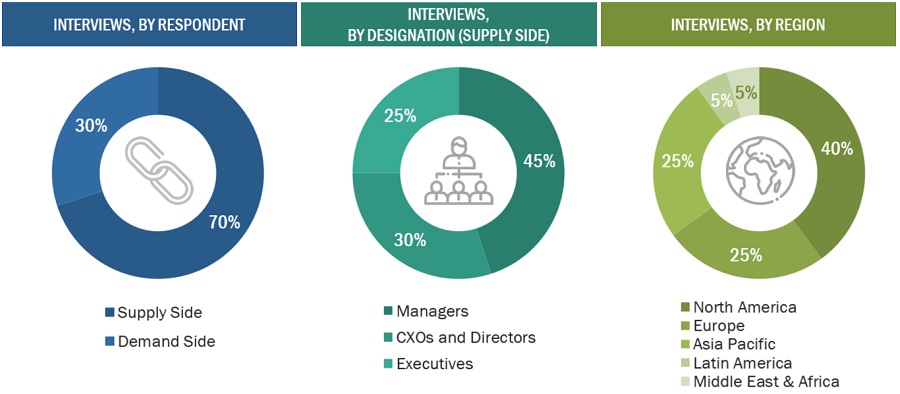
Extensive primary research was conducted after acquiring basic knowledge about the global digital PCR (dPCR) and real-time PCR (qPCR) market scenario through secondary research. Several primary interviews were conducted with market experts from the demand side, such as pharmaceutical and biotechnology companies, CROs, CMOs, and academic & research institutes, and experts from the supply side, such as C-level and D-level executives, product managers, marketing & sales managers of key manufacturers, distributors, and channel partners. These interviews were conducted across six major regions, including the Asia Pacific, North America, Europe, Latin America, Middle East and Africa. Approximately 70% and 30% of the primary interviews were conducted with supply-side and demand-side participants, respectively. This primary data was collected through questionnaires, e-mails, online surveys, personal interviews, and telephonic interviews.
The following is a breakdown of the primary respondents:
To know about the assumptions considered for the study, download the pdf brochure
Market Size Estimation
Both top-down and bottom-up approaches were used to estimate and validate the total size of the digital PCR (dPCR) and real-time PCR (qPCR) market. These methods were also used extensively to estimate the size of various subsegments in the market. The research methodology used to estimate the market size includes the following:
Bottom-up Approach
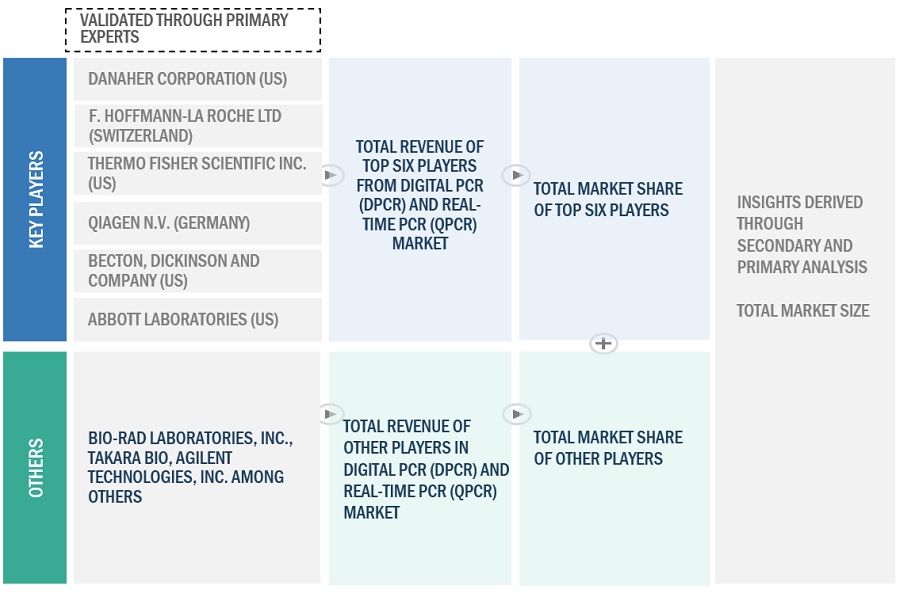
- The key players in the market have been identified through extensive secondary research.
- The revenues generated from the digital PCR (dPCR) and real-time PCR (qPCR) business of leading players have been determined through primary and secondary research to arrive at the overall digital PCR (dPCR) and real-time PCR (qPCR) market.
- All percentage shares, splits, and breakdowns have been determined using secondary sources and verified through primary sources.
- Additionally, to arrive at the digital PCR (dPCR) and real-time PCR (qPCR) market for product segments, the PCR business shares of leading players for separate product category (wherever available) were also gathered from secondary sources. In some instances, the shares of PCR product businesses were ascertained through a detailed analysis of various parameters, including product portfolios, market positioning and primary insights.
- All assumptions, approaches and individual shares/revenue estimates were validated through expert interviews.
To know about the assumptions considered for the study, Request for Free Sample Report
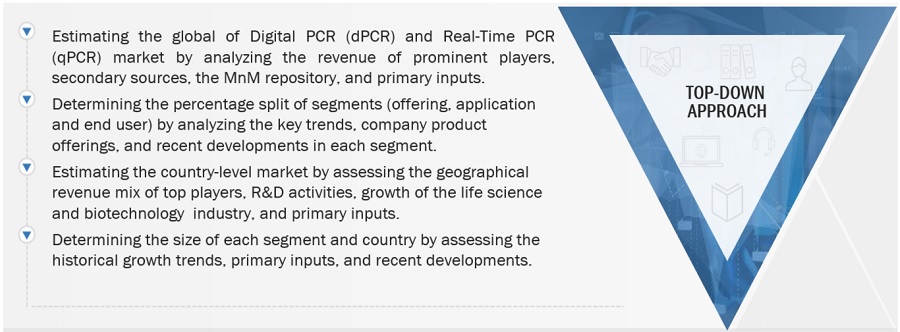
Top-down Approach
After arriving at the overall market size from the market size estimation process, the total market was split into several segments and subsegments.
Data Triangulation
After arriving at the market size from the market size estimation process explained above, the total market was divided into several segments and subsegments. To complete the overall market engineering process and arrive at the exact statistics for all segments and subsegments, data triangulation and market breakdown procedures were employed, wherever applicable. The data was triangulated by studying various factors and trends from both the demand and supply sides.
Market Definition
Polymerase chain reaction (PCR) is a well-established technique used for the in vitro amplification of a given nucleotide (such as DNA). Digital polymerase chain reaction (digital PCR or dPCR) is a third-generation polymerase chain reaction technique that is used to clonally amplify and directly quantify nucleic acid strands, including DNA, cDNA, or RNA. Similarly, quantitative/real-time PCR (qPCR) is a well-established PCR technique that is widely utilized in DNA identification, amplification, and quantification. It involves the real-time analysis of reaction mixtures with the aid of fluorescent markers that are specific to either the end product or the reactant.
Stakeholders
- dPCR and qPCR product manufacturing companies
- Third-party suppliers, direct suppliers, distributors, and channel partners
- Venture capitalists and other public-private funding agencies
- Healthcare service providers (including hospitals and diagnostic centers)
- Pharmaceutical and biotechnology companies
- Academic and research institutes
- CROs & CDMOs
- Forensic laboratories
- Market research and consulting firms
- Government and independent regulatory authorities
Report Objectives
- To define, describe, and forecast the digital PCR (dPCR) and real-time PCR (qPCR) market based on offering, application, end user, and region
- To provide detailed information regarding the major factors influencing market growth (such as drivers, restraints, opportunities, and challenges)
- To strategically analyze micro-markets with respect to individual growth trends, prospects, and contributions to the overall digital PCR (dPCR) and real-time PCR (qPCR) market
- To analyze opportunities in the market for stakeholders and provide details of the competitive landscape for market leaders
- To forecast the size of the market segments with respect to six main regions: North America, Europe, the Asia Pacific, Latin America, the Middle East, and Africa
- To profile the key players in the digital PCR (dPCR) and real-time PCR (qPCR) market and comprehensively analyze their product portfolios, market positions, and core competencies
- To track and analyze competitive developments in the digital PCR (dPCR) and real-time PCR (qPCR) market, such as acquisitions, product launches, expansions, agreements, partnerships, and collaborations
- To benchmark players within the digital PCR (dPCR) and real-time PCR (qPCR) market using the ‘Company Evaluation Matrix' framework, which analyzes market players based on various parameters within the broad categories of business strategy and product strategy
Available Customizations
With the given market data, MarketsandMarkets offers customizations as per the company’s specific needs. The following customization options are available for this report:
Portfolio Assessment
- Product Matrix, which gives a detailed comparison of the product portfolios of the top three companies.
Company Information
- Detailed analysis and profiling of additional market players (up to three).
Geographical Analysis
- A further breakdown of the Rest of Asia Pacific Digital PCR (dPCR) and real-time PCR (qPCR) market into countries
- A further breakdown of the Rest of European Digital PCR (dPCR) and real-time PCR (qPCR) market into countries
- A further breakdown of the Rest of Latin American Digital PCR (dPCR) and real-time PCR (qPCR) market into countries
Get the Full Digital PCR Market Report
Full forecast, segment splits, and company analysis for all Digital PCR Market.
- Canada Digital PCR Market
- US Digital PCR Market
- France Digital PCR Market
- Germany Digital PCR Market
- Italy Digital PCR Market
- UK Digital PCR Market
- Spain Digital PCR Market
- China Digital PCR Market
- Japan Digital PCR Market
- India Digital PCR Market
- Australia Digital PCR Market
- South Korea Digital PCR Market
- Mexico Digital PCR Market
- United Arab Emirates Digital PCR Market
Need a Tailored Report?
Customize this report to your needs
Get 10% FREE Customization
Customize This Report
