
India Drone Warfare Market (2023-2028)

The India Drone Warfare Market was valued at $484.9 Million in 2023 and projected to reach to $760.3 Million by 2028, representing a compound annual growth rate of 9.4%. India's drone warfare market is poised for sustained growth through 2028, driven by escalating border security concerns and the government's commitment to self-reliance in defense manufacturing.


| Market Size in | USD 26.32 MN |
| Market Forecast in | |
| CAGR | |
| Forecast Period | |
| Units Considered | Value (USD MN) |
India Drone Warfare Market Trends and Insights
- India's strategic focus on indigenous defense capabilities and border security modernization is driving significant investment in unmanned aerial systems for military applications.
- The market growth reflects India's commitment to developing autonomous defense technologies and reducing dependency on foreign drone systems. India's drone warfare sector is supported by increasing defense budgets and geopolitical tensions in the region, which have accelerated procurement and R&D initiatives.
- India's defense establishment is prioritizing the development of indigenous drone platforms for surveillance, reconnaissance, and tactical operations.
- Between 2023 and 2028, India's market expansion will be fueled by technological advancements, government support for domestic manufacturers, and integration of AI-enabled systems into India's military infrastructure. India's position as a key player in Asia Pacific's drone warfare market reflects the country's strategic importance and growing technological capabilities.
- India's investments in drone technology are expected to create substantial opportunities for both domestic and international defense contractors operating within India's regulatory framework..
Key Market Statistics
- CAGR (2023-2028) 9.4% CAGR
- Market Size, 2023 ~USD 484.9 Million
- Forecast, 2028 ~USD 760.3 Million
- Country India
India Drone Warfare Market Overview
Indigenous Defense Push :
India's 'Make in India' initiative is accelerating domestic drone warfare system development, reducing reliance on imports and creating a competitive indigenous defense ecosystem with companies like Hindustan Aeronautics Limited (HAL) and Bharat Electronics Limited (BEL).
Border Security Modernization :
Strategic investments in unmanned aerial systems for border surveillance along India's northern and western frontiers are driving market expansion, with focus on real-time intelligence gathering and threat detection capabilities.
Strong CAGR Performance :
India's drone warfare market is growing at 9.4% CAGR (2023-2028), outpacing the global average of 8.6%, reflecting accelerated military modernization and increased defense budgetary allocations for advanced technologies.
Market Valuation Growth :
The market is projected to expand from USD 484.9 million in 2023 to USD 760.3 million by 2028, representing a 57% increase driven by geopolitical tensions, technological advancements, and strategic military procurement programs.
India Drone Warfare Market Dynamics
- The integration of advanced technologies such as AI-enabled autonomous systems and enhanced surveillance capabilities will further propel market expansion.
- Private sector participation alongside government defense initiatives is creating a robust ecosystem for innovation and production scaling. Geopolitical dynamics in South Asia continue to necessitate advanced unmanned systems for military operations and intelligence gathering.
- India's increasing defense expenditure, coupled with strategic partnerships with global technology leaders, will accelerate the adoption of next-generation drone warfare platforms.
- The convergence of indigenous manufacturing capabilities and rising operational requirements positions India as a key growth market within the Asia-Pacific drone warfare sector..
Market Ecosystem
Related Ecosystem
Key Takeaways
- India's drone warfare market will grow from USD 484.9 million in 2023 to USD 760.3 million by 2028 at a 9.4% CAGR.
- India's defense modernization and border security priorities are primary drivers of market expansion.
- India is emphasizing indigenous drone development to reduce foreign dependency and build domestic capabilities.
- India's growing defense budget and geopolitical positioning support sustained investment in unmanned aerial systems.
Drone Warfare Market Report Scope
| Report Metric | Details |
|---|---|
| Base Year | 2023 |
| Fastest Growing Segment | DELIVERY (Application) |
| Forecast Period | 2023-2028 |
| Growth Rate | CAGR of 8.6% from 2023 to 2028 |
| Largest Segment | SEMI-AUTONOMOUS (Mode Of Operation) |
| Market Size Base Year (Billions) | ~USD 20.19 (2023) |
| Revenue Forecast (Billions) | ~USD 30.5 (2028) |
| Segments Covered | Capability, Platforms, Services, Application, Unmanned Combat Aerial Vehicles, Loitering Munitions, Mode Of Operation |
India Drone Warfare Market Report Segmentation
7 segment dimensions are covered across the global market.
By Capability
- Application Software
- Drone Launch And Recovery Systems
- Ground Control Station
- Ground Control Stations
- Ground Control Systems
- Platforms
- Services
By Platforms
- Small Drones
- Strategic Drones
- Tactical Drones
By Services
- Repair And Maintenance
- Simulation And Training
By Application
- Delivery
- Intelligence, Surveillance, And Maintenance
- Intelligence, Surveillance, And Reconnaissance
- Unmanned Combat Aerial Vehicles
By Unmanned Combat Aerial Vehicles
- Lethal Drones
- Loitering Munitions
- Stealth Drones
- Target Drones
By Loitering Munitions
- Expendables
- Recoverables
By Mode Of Operation
- Autonomous
- Semi-Autonomous
INDIA: DRONE WARFARE MARKET, BY APPLICATION, 2023–2028
| Segment | 2023 | 2024 | 2025 | 2026 | 2027 | 2028 | CAGR (%) |
|---|---|---|---|---|---|---|---|
| DELIVERY | 11.9 | 15.6 | 20.3 | 26.7 | 34.8 | 45.4 | 30.7 |
| INTELLIGENCE, SURVEILLANCE, AND RECONNAISSANCE | 273.8 | 296.3 | 317.7 | 343.9 | 368.8 | 393.8 | 7.5 |
| UNMANNED COMBAT AERIAL VEHICLES | 199.1 | 219.4 | 240.1 | 265.8 | 292.2 | 321.1 | 10 |
| TOTAL | 484.9 | 531.3 | 578.1 | 636.4 | 695.8 | 760.3 | 9.4 |
Target Audience
- Defense Contractors & OEMs : Manufacturers and systems integrators need India-specific market data to develop localized drone warfare solutions, identify government procurement opportunities, and establish manufacturing partnerships aligned with indigenous defense policies.
- Government & Military Procurement : Indian Ministry of Defence, armed forces, and procurement agencies require market intelligence to inform defense budgeting, capability gap analysis, and strategic acquisition planning for unmanned aerial systems.
- Private Equity & Investors : Investment firms targeting India's defense sector need validated market sizing, growth projections, and sector dynamics to evaluate investment opportunities in drone technology startups and established defense manufacturers.
- Technology & Component Suppliers : Suppliers of avionics, sensors, propulsion systems, and software platforms require India market insights to identify demand drivers, customer requirements, and localization opportunities within the drone warfare supply chain.
- Strategic Consultants & Analysts : Management consulting firms and research organizations need India-focused market data to support client advisory work on defense sector strategy, market entry planning, and competitive positioning in aerospace & defense.
Reasons to Buy this Report
- Strategic Market Sizing : Obtain precise valuation data for India's drone warfare market with verified 2023 baseline (USD 484.9M) and 2028 forecasts (USD 760.3M), enabling accurate investment planning and competitive positioning in this high-growth segment.
- Growth Trajectory Analysis : Understand India's 9.4% CAGR performance relative to global 8.6% benchmark, identifying market acceleration drivers and timing opportunities for product launches, partnerships, and market entry strategies.
- Indigenous Capability Insights : Access detailed intelligence on India's 'Make in India' defense initiatives, domestic manufacturer capabilities, and government procurement priorities to identify partnership and supply chain opportunities.
- Geopolitical Context : Leverage comprehensive analysis of border security modernization drivers, regional threat assessments, and military modernization priorities shaping India's drone warfare investments and procurement timelines.
- Competitive Landscape Mapping : Identify key Indian and international players competing in the market, their market share positions, technology differentiation, and strategic initiatives to inform competitive strategy and partnership development.
Frequently asked questions
What is the current size of India's drone warfare market?
India's drone warfare market was valued at USD 484.9 million in 2023 and is expected to grow to USD 760.3 million by 2028.
What is the projected growth rate for India's drone warfare market?
India's drone warfare market is projected to grow at a compound annual growth rate (CAGR) of 9.4% from 2023 to 2028.
What factors are driving growth in India's drone warfare market?
India's market growth is driven by defense modernization initiatives, border security requirements, indigenous technology development, and increasing defense budgets.
Is India developing indigenous drone warfare capabilities?
Yes, India is prioritizing the development of indigenous drone platforms to reduce foreign dependency and strengthen domestic defense capabilities.
How does India's drone warfare market compare to the global market?
India's drone warfare market is growing at 9.4% CAGR, which exceeds the global average of 8.6%, reflecting India's strategic importance in the Asia Pacific region.
RESEARCH METHODOLOGY
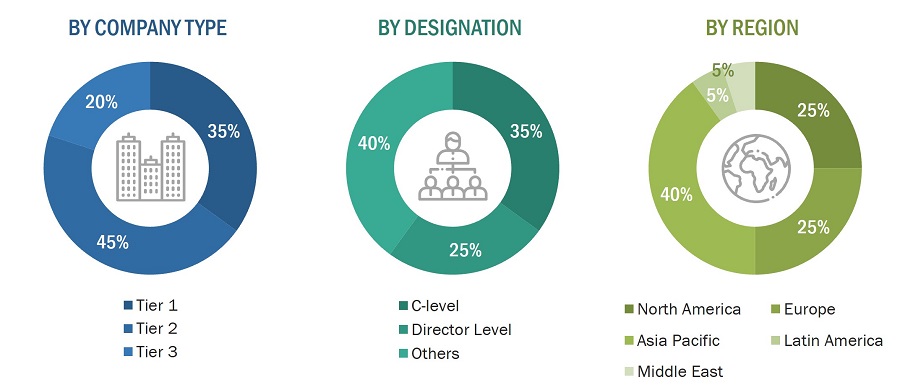
This research study on the drones warfare market involved the extensive use of secondary sources, directories, and databases such as Hoovers, Bloomberg BusinessWeek, and Factiva to identify and collect information relevant to the market. Primary sources included industry experts, service providers, manufacturers, solution providers, technology developers, alliances, and organizations related to all segments of this industry's value chain. In-depth interviews with primary respondents, including key industry participants, subject matter experts, industry consultants, and C-level executives, were conducted to obtain and verify critical qualitative and quantitative information about the drone warfare market and assess the market's growth prospects.
Secondary Research
The ranking analysis of companies in the drone warfare market was determined using secondary data from paid and unpaid sources and by analyzing major companies’ product portfolios and service offerings. These companies were rated based on the performance and quality of their products. These data points were further validated by primary sources.
Secondary sources referred for this research study on the drone warfare market included financial statements of companies offering drone warfare capability, along with various trade, business, and professional associations, among others. The secondary data was collected and analyzed to arrive at the overall size of the drone warfare market, which was validated by primary respondents.
In addition, the secondary research was used to obtain key information about the industry’s value chain and supply chain to identify key players operating in the market; market classifications and segmentation according to offerings of major players; and industry trends related to the capability, application, mode of operation, and regions as well as key developments in the market.
Primary Research
Extensive primary research was conducted after obtaining information about the current scenario of the drone warfare market through secondary research. Several primary interviews were conducted with market experts from both the demand and supply sides across six regions: North America, Europe, Asia Pacific, the Middle East, Latin America, and Africa. This primary data was collected through questionnaires, emails, and telephonic interviews.
These interviews were conducted to gather insights such as market statistics, data on revenue collected from the products and services, market breakdowns, market size estimations, market size forecasting, and data triangulation. It also helped analyze the capability, application, and mode of operation segments of the market for six key regions.
To know about the assumptions considered for the study, download the pdf brochure
Market Size Estimation
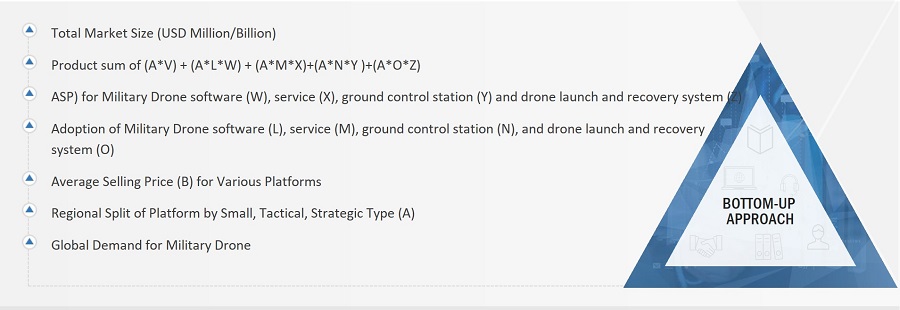
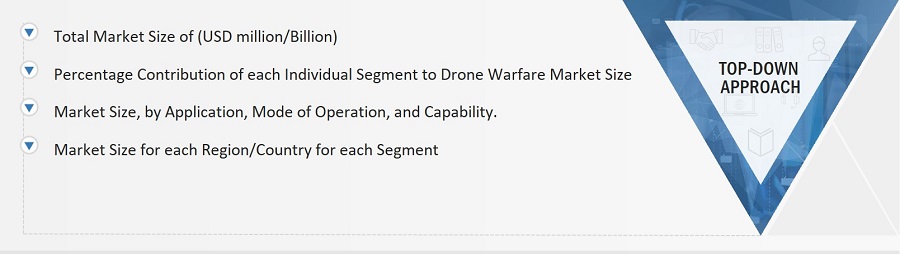
- Both top-down and bottom-up approaches were used to estimate and validate the size of the Drone warfare market.
- Key players were identified through secondary research, and their market ranking was determined through primary and secondary research. This included a study of annual and financial reports of the top market players and extensive interviews of leaders, including CEOs, directors, and marketing executives.
- All percentage shares, splits, and breakdowns were determined using secondary sources and verified through primary sources. All possible parameters that affect the markets covered in this research study were accounted for, viewed in extensive detail, verified through primary research, and analyzed to obtain the final quantitative and qualitative data. This data was consolidated, enhanced with detailed inputs, analyzed by MarketsandMarkets, and presented in this report.
Market size estimation methodology: Bottom-up Approach
Market size estimation methodology: Top-down Approach
Data triangulation
After arriving at the overall size of the drone warfare market from the market size estimation process explained above, the total market was split into several segments and subsegments. To complete the overall market engineering process and arrive at the exact statistics for various market segments and subsegments, data triangulation and market breakdown procedures explained below were implemented, wherever applicable. The data was triangulated by studying various factors and trends from both the demand and supply sides. Along with this, the market size was validated using both top-down and bottom-up approaches.
Market Definition
Drone warfare, also known as unmanned aerial vehicles, find application in diverse military roles like combat, intelligence, surveillance, reconnaissance (ISR), and delivery. The global armed forces increasingly embrace unmanned combat aerial vehicles (UCAVs), including lethal drones, combat drones, and target drones. These drones can be remotely piloted, optionally piloted, or fully autonomous, and they are categorized based on platforms such as small, strategic, and tactical. High Altitude Long Endurance (HALE) and Medium Altitude Long Endurance (MALE) drones, characterized by extended endurance, serve as fixed platforms capable of carrying substantial ISR payloads and precision munitions for combat.
Stakeholders
Various stakeholders of the market are listed below:
- Military Drone Manufacturers
- Defence contractors
- Original Equipment Manufacturers
- Military Service Providers
- Payload & Warhead Suppliers
- Research Organizations
- Investors and Venture Capitalists
- Ministries of Defense
- R&D Companies
Report Objectives
- To define, describe, and forecast the size of the drone warfare market based on Capability, application, mode of operation and region from 2023 to 2028
- To forecast the size of market segments with respect to five major regions, namely North America, Europe, Asia Pacific, the Middle East, Latin America and Africa.
- To identify and analyze key drivers, restraints, opportunities, and challenges influencing the growth of the market
- To strategically analyze micromarkets1 with respect to individual growth trends, prospects, and their contribution to the market
- To analyze opportunities for stakeholders in the market by identifying key market trends
- To analyze competitive developments such as contracts, acquisitions, expansions, agreements, joint ventures and partnerships, product developments, and research and development (R&D) activities in the market
- To provide a detailed competitive landscape of the -market, in addition to an analysis of business and corporate strategies adopted by leading market players
- To strategically profile key market players and comprehensively analyze their core competencies2
1 Micromarkets are referred to as the segments and subsegments of the Drone warfare markets considered in the scope of the report.
2 Core competencies of companies were captured in terms of their key developments and key strategies adopted to sustain their positions in the market.
Available customizations
Along with the market data, MarketsandMarkets offers customizations as per the specific needs of companies. The following customization options are available for the report:
Product Analysis
- Product matrix, which gives a detailed comparison of the product portfolio of each company
Regional Analysis
- Further breakdown of the market segments at the country level
Company Information
- Detailed analysis and profiling of additional market players (up to 5)
Get the Full Drone Warfare Market Report
Full forecast, segment splits, and company analysis for all Drone Warfare Market.
- Canada Drone Warfare Market
- US Drone Warfare Market
- France Drone Warfare Market
- Germany Drone Warfare Market
- Italy Drone Warfare Market
- Russia Drone Warfare Market
- Sweden Drone Warfare Market
- UK Drone Warfare Market
- Ukraine Drone Warfare Market
- Australia Drone Warfare Market
- China Drone Warfare Market
- Japan Drone Warfare Market
- South Korea Drone Warfare Market
- Saudi Arabia Drone Warfare Market
- UAE Drone Warfare Market
- Israel Drone Warfare Market
- Turkey Drone Warfare Market
- Brazil Drone Warfare Market
- Mexico Drone Warfare Market
- Rest Of Europe Drone Warfare Market
- Rest Of Asia Pacific Drone Warfare Market
- GCC Drone Warfare Market
- Rest Of Middle East Drone Warfare Market
Need a Tailored Report?
Customize this report to your needs
Get 10% FREE Customization
Customize This Report
