
US Drone Warfare Market (2023-2028)

The US Drone Warfare Market was valued at $7633.9 Million in 2023 and projected to reach to $11235.9 Million by 2028, representing a compound annual growth rate of 8.0%. The US drone warfare market is positioned for sustained expansion through 2028, supported by escalating geopolitical tensions, modernization of military infrastructure, and increased congressional funding for unmanned systems.


| Market Size in | USD 26.32 MN |
| Market Forecast in | |
| CAGR | |
| Forecast Period | |
| Units Considered | Value (USD MN) |
US Drone Warfare Market Trends and Insights
- The US maintains a dominant position in global drone warfare capabilities, driven by substantial defense spending, advanced technological innovation, and ongoing military modernization initiatives.
- The US market reflects increasing investment in autonomous systems, surveillance platforms, and precision strike capabilities across military branches. Growth in the US drone warfare market is underpinned by geopolitical tensions, counterterrorism operations, and the US military's strategic pivot toward unmanned systems.
- The US continues to lead in research and development of next-generation drone technologies, including artificial intelligence integration and extended operational range.
- Between 2023 and 2028, the US market expansion will be supported by defense budget allocations, procurement cycles, and the modernization of existing drone fleets across the Department of Defense. The US competitive landscape features established aerospace and defense contractors alongside emerging technology firms specializing in autonomous systems.
- Regulatory frameworks governing US drone operations, export controls, and international agreements shape market dynamics and influence both domestic production and international sales strategies for US-based manufacturers..
Key Market Statistics
- CAGR (2023-2028) 8.0% CAGR
- Market Size, 2023 ~USD 7633.9 Million
- Forecast, 2028 ~USD 11235.9 Million
- Country US
US Drone Warfare Market Overview
Market Valuation :
The US drone warfare market reached $7,633.9 million in 2023 and is projected to expand to $11,235.9 million by 2028, demonstrating robust growth in military unmanned systems investment.
Consistent Growth Trajectory :
With a CAGR of 8.0% through 2028, the US market outpaces many defense sectors, driven by modernization budgets and increased adoption of autonomous systems across military branches.
Technological Leadership :
The US maintains global dominance in drone warfare capabilities through continuous R&D investment, advanced sensor integration, and next-generation platform development by leading defense contractors.
Defense Spending Momentum :
Substantial federal defense appropriations and strategic military modernization initiatives fuel sustained demand for advanced drone systems, surveillance platforms, and autonomous warfare solutions.
US Drone Warfare Market Dynamics
- Defense contractors are accelerating development of AI-enabled platforms, extended-range capabilities, and multi-domain integration solutions to meet evolving operational requirements across the Department of Defense and allied forces. Investment in autonomous systems, swarm technology, and advanced targeting capabilities will drive market growth.
- The US military's emphasis on maintaining technological superiority, coupled with growing international demand for American drone systems, creates favorable conditions for market participants.
- Regulatory frameworks and export controls will continue shaping competitive dynamics and market opportunities..
Market Ecosystem
Related Ecosystem
Key Takeaways
- The US drone warfare market is valued at $7.6 billion in 2023 and will reach $11.2 billion by 2028 at an 8.0% CAGR.
- The US leads global drone warfare innovation through advanced AI integration, extended operational range, and autonomous system development.
- US market growth is driven by defense spending, geopolitical tensions, counterterrorism operations, and military modernization priorities.
- The US competitive landscape includes major aerospace contractors and emerging technology firms operating under strict export controls and regulatory frameworks.
Drone Warfare Market Report Scope
| Report Metric | Details |
|---|---|
| Base Year | 2023 |
| Fastest Growing Segment | DELIVERY (Application) |
| Forecast Period | 2023-2028 |
| Growth Rate | CAGR of 8.6% from 2023 to 2028 |
| Largest Segment | SEMI-AUTONOMOUS (Mode Of Operation) |
| Market Size Base Year (Billions) | ~USD 20.19 (2023) |
| Revenue Forecast (Billions) | ~USD 30.5 (2028) |
| Segments Covered | Capability, Platforms, Services, Application, Unmanned Combat Aerial Vehicles, Loitering Munitions, Mode Of Operation |
US Drone Warfare Market Report Segmentation
7 segment dimensions are covered across the global market.
By Capability
- Application Software
- Drone Launch And Recovery Systems
- Ground Control Station
- Ground Control Stations
- Ground Control Systems
- Platforms
- Services
By Platforms
- Small Drones
- Strategic Drones
- Tactical Drones
By Services
- Repair And Maintenance
- Simulation And Training
By Application
- Delivery
- Intelligence, Surveillance, And Maintenance
- Intelligence, Surveillance, And Reconnaissance
- Unmanned Combat Aerial Vehicles
By Unmanned Combat Aerial Vehicles
- Lethal Drones
- Loitering Munitions
- Stealth Drones
- Target Drones
By Loitering Munitions
- Expendables
- Recoverables
By Mode Of Operation
- Autonomous
- Semi-Autonomous
US: DRONE WARFARE MARKET, BY APPLICATION, 2023–2028
| Segment | 2023 | 2024 | 2025 | 2026 | 2027 | 2028 | CAGR (%) |
|---|---|---|---|---|---|---|---|
| DELIVERY | 187.7 | 229 | 281.7 | 370.3 | 482 | 671.2 | 29 |
| INTELLIGENCE, SURVEILLANCE, AND RECONNAISSANCE | 4310.8 | 4347.5 | 4414.4 | 4777.7 | 5106.7 | 5819.4 | 6.2 |
| UNMANNED COMBAT AERIAL VEHICLES | 3135.4 | 3220.1 | 3335.9 | 3692.1 | 4046.8 | 4745.4 | 8.6 |
| TOTAL | 7633.9 | 7796.6 | 8032.1 | 8840.1 | 9635.4 | 11235.9 | 8 |
Target Audience
- Defense Contractors : Prime and sub-tier contractors need detailed US market analysis to optimize bid strategies, identify growth segments, and benchmark competitive positioning against established and emerging rivals.
- Government Procurement Officials : DoD and military branch decision-makers require market intelligence to validate budget requests, assess technology maturity, and evaluate vendor capabilities for unmanned systems programs.
- Investment Firms : Private equity, venture capital, and institutional investors use market data to identify acquisition targets, assess portfolio company growth potential, and evaluate sector valuations.
- Technology Innovators : Startups and emerging tech companies need market insights to identify funding opportunities, understand customer requirements, and position solutions within the US defense ecosystem.
- Strategic Consultants : Management consulting firms advising defense clients require authoritative market data to support strategic planning, competitive analysis, and market entry recommendations.
Reasons to Buy this Report
- Strategic Defense Planning : Understand US military procurement trends and budget allocation patterns to align product development and market entry strategies with Department of Defense priorities and modernization timelines.
- Competitive Intelligence : Gain detailed insights into competitive positioning of major US defense contractors, emerging players, and technology differentiation strategies within the drone warfare ecosystem.
- Investment Decision Support : Access comprehensive market sizing, growth forecasts, and segment analysis to inform capital allocation decisions, M&A strategies, and portfolio optimization in the defense sector.
- Technology Roadmap Alignment : Identify emerging technology trends, R&D priorities, and capability gaps driving US military drone development to guide innovation investments and partnership opportunities.
- Export and Regulatory Compliance : Navigate complex US export controls, international sales regulations, and allied procurement requirements with market-specific insights on compliance frameworks and market access pathways.
Frequently asked questions
What is the current size of the US drone warfare market?
The US drone warfare market was valued at $7,633.9 million in 2023 and is expected to reach $11,235.9 million by 2028.
What is the projected growth rate for the US drone warfare market?
The US drone warfare market is projected to grow at a compound annual growth rate (CAGR) of 8.0% from 2023 to 2028.
What factors are driving growth in the US drone warfare market?
Key drivers include increased defense spending, geopolitical tensions, counterterrorism operations, military modernization, and technological advances in AI and autonomous systems.
Who are the major competitors in the US drone warfare market?
The US market includes established aerospace and defense contractors alongside emerging technology firms specializing in autonomous systems and unmanned platforms.
How do regulations impact the US drone warfare market?
US export controls, international agreements, and regulatory frameworks governing drone operations significantly shape domestic production and international sales strategies for US manufacturers.
RESEARCH METHODOLOGY
This research study on the drones warfare market involved the extensive use of secondary sources, directories, and databases such as Hoovers, Bloomberg BusinessWeek, and Factiva to identify and collect information relevant to the market. Primary sources included industry experts, service providers, manufacturers, solution providers, technology developers, alliances, and organizations related to all segments of this industry's value chain. In-depth interviews with primary respondents, including key industry participants, subject matter experts, industry consultants, and C-level executives, were conducted to obtain and verify critical qualitative and quantitative information about the drone warfare market and assess the market's growth prospects.
Secondary Research
The ranking analysis of companies in the drone warfare market was determined using secondary data from paid and unpaid sources and by analyzing major companies’ product portfolios and service offerings. These companies were rated based on the performance and quality of their products. These data points were further validated by primary sources.
Secondary sources referred for this research study on the drone warfare market included financial statements of companies offering drone warfare capability, along with various trade, business, and professional associations, among others. The secondary data was collected and analyzed to arrive at the overall size of the drone warfare market, which was validated by primary respondents.
In addition, the secondary research was used to obtain key information about the industry’s value chain and supply chain to identify key players operating in the market; market classifications and segmentation according to offerings of major players; and industry trends related to the capability, application, mode of operation, and regions as well as key developments in the market.
Primary Research
Extensive primary research was conducted after obtaining information about the current scenario of the drone warfare market through secondary research. Several primary interviews were conducted with market experts from both the demand and supply sides across six regions: North America, Europe, Asia Pacific, the Middle East, Latin America, and Africa. This primary data was collected through questionnaires, emails, and telephonic interviews.
These interviews were conducted to gather insights such as market statistics, data on revenue collected from the products and services, market breakdowns, market size estimations, market size forecasting, and data triangulation. It also helped analyze the capability, application, and mode of operation segments of the market for six key regions.
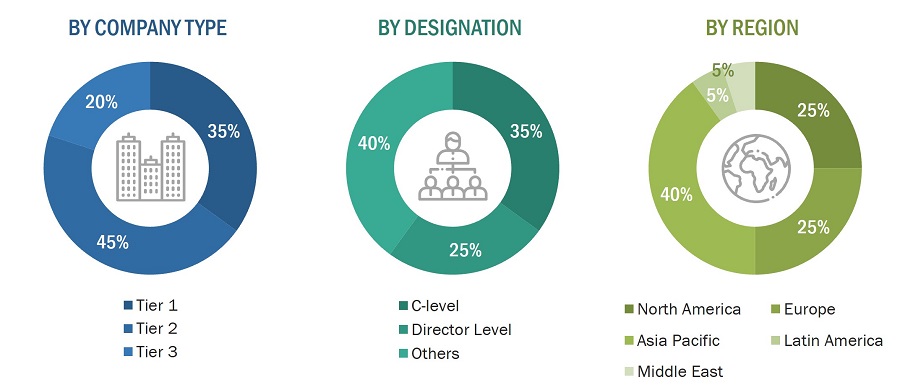
To know about the assumptions considered for the study, download the pdf brochure
Market Size Estimation
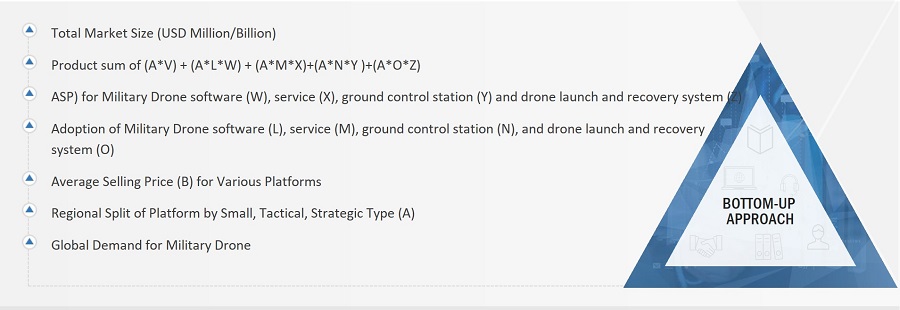
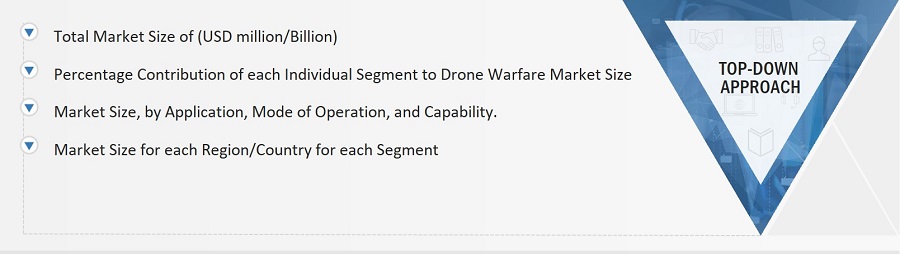
- Both top-down and bottom-up approaches were used to estimate and validate the size of the Drone warfare market.
- Key players were identified through secondary research, and their market ranking was determined through primary and secondary research. This included a study of annual and financial reports of the top market players and extensive interviews of leaders, including CEOs, directors, and marketing executives.
- All percentage shares, splits, and breakdowns were determined using secondary sources and verified through primary sources. All possible parameters that affect the markets covered in this research study were accounted for, viewed in extensive detail, verified through primary research, and analyzed to obtain the final quantitative and qualitative data. This data was consolidated, enhanced with detailed inputs, analyzed by MarketsandMarkets, and presented in this report.
Market size estimation methodology: Bottom-up Approach
Market size estimation methodology: Top-down Approach
Data triangulation
After arriving at the overall size of the drone warfare market from the market size estimation process explained above, the total market was split into several segments and subsegments. To complete the overall market engineering process and arrive at the exact statistics for various market segments and subsegments, data triangulation and market breakdown procedures explained below were implemented, wherever applicable. The data was triangulated by studying various factors and trends from both the demand and supply sides. Along with this, the market size was validated using both top-down and bottom-up approaches.
Market Definition
Drone warfare, also known as unmanned aerial vehicles, find application in diverse military roles like combat, intelligence, surveillance, reconnaissance (ISR), and delivery. The global armed forces increasingly embrace unmanned combat aerial vehicles (UCAVs), including lethal drones, combat drones, and target drones. These drones can be remotely piloted, optionally piloted, or fully autonomous, and they are categorized based on platforms such as small, strategic, and tactical. High Altitude Long Endurance (HALE) and Medium Altitude Long Endurance (MALE) drones, characterized by extended endurance, serve as fixed platforms capable of carrying substantial ISR payloads and precision munitions for combat.
Stakeholders
Various stakeholders of the market are listed below:
- Military Drone Manufacturers
- Defence contractors
- Original Equipment Manufacturers
- Military Service Providers
- Payload & Warhead Suppliers
- Research Organizations
- Investors and Venture Capitalists
- Ministries of Defense
- R&D Companies
Report Objectives
- To define, describe, and forecast the size of the drone warfare market based on Capability, application, mode of operation and region from 2023 to 2028
- To forecast the size of market segments with respect to five major regions, namely North America, Europe, Asia Pacific, the Middle East, Latin America and Africa.
- To identify and analyze key drivers, restraints, opportunities, and challenges influencing the growth of the market
- To strategically analyze micromarkets1 with respect to individual growth trends, prospects, and their contribution to the market
- To analyze opportunities for stakeholders in the market by identifying key market trends
- To analyze competitive developments such as contracts, acquisitions, expansions, agreements, joint ventures and partnerships, product developments, and research and development (R&D) activities in the market
- To provide a detailed competitive landscape of the -market, in addition to an analysis of business and corporate strategies adopted by leading market players
- To strategically profile key market players and comprehensively analyze their core competencies2
1 Micromarkets are referred to as the segments and subsegments of the Drone warfare markets considered in the scope of the report.
2 Core competencies of companies were captured in terms of their key developments and key strategies adopted to sustain their positions in the market.
Available customizations
Along with the market data, MarketsandMarkets offers customizations as per the specific needs of companies. The following customization options are available for the report:
Product Analysis
- Product matrix, which gives a detailed comparison of the product portfolio of each company
Regional Analysis
- Further breakdown of the market segments at the country level
Company Information
- Detailed analysis and profiling of additional market players (up to 5)
Get the Full Drone Warfare Market Report
Full forecast, segment splits, and company analysis for all Drone Warfare Market.
- Canada Drone Warfare Market
- France Drone Warfare Market
- Germany Drone Warfare Market
- Italy Drone Warfare Market
- Russia Drone Warfare Market
- Sweden Drone Warfare Market
- UK Drone Warfare Market
- Ukraine Drone Warfare Market
- Australia Drone Warfare Market
- China Drone Warfare Market
- India Drone Warfare Market
- Japan Drone Warfare Market
- South Korea Drone Warfare Market
- Saudi Arabia Drone Warfare Market
- UAE Drone Warfare Market
- Israel Drone Warfare Market
- Turkey Drone Warfare Market
- Brazil Drone Warfare Market
- Mexico Drone Warfare Market
- Rest Of Europe Drone Warfare Market
- Rest Of Asia Pacific Drone Warfare Market
- GCC Drone Warfare Market
- Rest Of Middle East Drone Warfare Market
Need a Tailored Report?
Customize this report to your needs
Get 10% FREE Customization
Customize This Report
