
China Dry Shampoo Market (2025-2030)

The China Dry Shampoo Market was valued at $441 Million in 2025 and projected to reach to $559 Million by 2030, representing a compound annual growth rate of 4.9%. China's dry shampoo market is poised for sustained growth as urbanization continues and consumers increasingly prioritize convenience in their daily grooming routines.


| Market Size in | USD 26.32 MN |
| Market Forecast in | |
| CAGR | |
| Forecast Period | |
| Units Considered | Value (USD MN) |
China Dry Shampoo Market Trends and Insights
- This growth trajectory reflects China's rising consumer interest in convenient hair care solutions and the increasing adoption of premium personal care products among urban populations.
- China's market expansion is driven by shifting lifestyle preferences, growing e-commerce penetration, and heightened awareness of hair health among younger demographics. The dry shampoo category in China benefits from the country's booming beauty and personal care sector, where innovation and product diversification are accelerating.
- Between 2025 and 2030, China is expected to capture significant market share within the Asia Pacific region, supported by robust distribution networks and strong brand presence from both international and domestic players.
- China's forecast growth of 4.9% outpaces the global CAGR of 4.3%, underscoring the market's strategic importance and the country's role as a key growth engine for the dry shampoo industry..
Key Market Statistics
- CAGR (2025-2030) 4.9% CAGR
- Market Size, 2025 ~USD 441 Million
- Forecast, 2030 ~USD 559 Million
- Country China
China Dry Shampoo Market Overview
Market Valuation :
China's dry shampoo market is valued at USD 441.0 million in 2025, with strong growth momentum driven by urbanization and changing consumer preferences toward convenience-based hair care solutions.
Robust Growth Trajectory :
The market is projected to reach USD 559.0 million by 2030, representing a CAGR of 4.9%, outpacing the global average of 4.3% and indicating China's accelerating adoption of dry shampoo products.
Premium Product Adoption :
Rising disposable incomes among China's urban middle class are driving increased consumption of premium and imported dry shampoo brands, reshaping the competitive landscape and pricing strategies.
E-commerce Dominance :
China's robust online retail ecosystem, led by platforms like Alibaba and JD.com, is facilitating rapid market penetration and enabling both domestic and international brands to reach consumers efficiently.
China Dry Shampoo Market Dynamics
- The expanding middle class, coupled with rising awareness of premium personal care products, creates significant opportunities for both established and emerging brands.
- E-commerce penetration and social media influence, particularly through platforms like Little Red Book and Douyin, are accelerating product discovery and adoption among younger demographics. Looking ahead to 2030, the market will likely benefit from innovation in product formulations tailored to Asian hair types and increased investment in localized marketing campaigns.
- Strategic partnerships between international brands and local distributors, combined with growing consumer interest in sustainable and natural ingredients, will further drive market expansion and competitive differentiation in China's dynamic dry shampoo segment..
Market Ecosystem

DRY SHAMPOO MARKET: COMMERCIAL USE CASES ACROSS INDUSTRIES
| COMPANY | USE CASE DESCRIPTION | BENEFITS |
|---|---|---|
 |
Develops and markets dry shampoo products under mass and premium personal care brands, targeting everyday consumers seeking quick hair refresh solutions; Focuses on high-volume retail distribution through supermarkets, pharmacies, and e-commerce platforms, supported by strong marketing and global reach | Broad consumer accessibility, affordability, strong brand trust, fast-moving consumer adoption, and scalable product launches across regions |
 |
Supplies dry shampoo products positioned around performance, scalp care, and hair health, leveraging advanced formulation science and consumer insights; Commercial strategy emphasizes innovation-led differentiation and omnichannel penetration in developed and emerging markets | Consistent product performance, strong R&D-backed claims, high consumer loyalty, and efficient global supply chain execution |
 |
Offers dry shampoo solutions across mass, premium, and professional segments, catering to consumers and salon professionals; Focuses on styling benefits, color-safe formulations, and premiumization, supported by strong influencer and salon partnerships | Premium brand positioning, professional endorsement, advanced formulations, high margins, and strong presence in salon and specialty retail channels |
 |
Markets dry shampoo products primarily through professional haircare and selective consumer brands, targeting salon use and style-conscious consumers; Emphasizes styling performance, lightweight feel, and residue-free formulations | Strong professional credibility, styling-focused benefits, differentiation through salon heritage, and loyal stylist-driven demand |
 |
Commercializes dry shampoo products under value-driven and performance-oriented brands, focusing on mass-market consumers; Strategy centers on cost-effective formulations, high retail visibility, and repeat usage | Competitive pricing, strong retail penetration, high volume sales, brand familiarity, and consistent demand from everyday consumers |
Logos and trademarks shown above are the property of their respective owners. Their use here is for informational and illustrative purposes only.
Related Ecosystem
Speciality Chemicals
Key Takeaways
- China's dry shampoo market reaches USD 441.0 million in 2025 with projected growth to USD 559.0 million by 2030.
- China's market CAGR of 4.9% exceeds the global average of 4.3%, positioning the country as a high-growth region.
- Urban consumers in China are increasingly adopting dry shampoo products driven by convenience and premium positioning.
- E-commerce channels and digital marketing are critical growth enablers for dry shampoo brands operating in China.
Dry Shampoo Market Report Scope
| Report Metric | Details |
|---|---|
| Base Year | 2025 |
| Fastest Growing Segment | OTHER FORMATS (Product Form) |
| Forecast Period | 2025–2030 |
| Growth Rate | CAGR of 4.3% from 2025 to 2030 |
| Largest Segment | SPRAY/AEROSOL (Product Form) |
| Market Size Base Year (Billions) | ~USD 4.35 (2025) |
| Revenue Forecast (Billions) | ~USD 5.37 (2030) |
| Segments Covered | Distribution Channel, Product Form, Function, End User |
China Dry Shampoo Market Report Segmentation
4 segment dimensions are covered across the global market.
By Distribution Channel
- Convenience Stores
- Direct Selling/Mlm Channels
- Online Retail/E-Commerce
- Specialty Stores (Beauty/Drug Stores)
- Subscription Services
- Supermarkets/Hypermarkets
By Product Form
- Other Formats
- Powder
- Spray/Aerosol
By Function
- Anti-Dandruff
- Color Protection
- Daily Care/Refresh
- Hair Loss Prevention
- Multi-Function
By End User
- Hair Clinics & Trichology Centers
- Hair Salons & Stylists
- Men
- Spas & Wellness Centers
- Unisex/Kids & Teens
- Women
Target Audience
- Consumer Goods Manufacturers : Beauty and personal care companies need China-specific market data to develop product portfolios, set competitive pricing, and allocate R&D resources for the world's second-largest economy.
- Investment & Private Equity Firms : Investors evaluating opportunities in China's beauty sector require detailed market sizing, growth projections, and competitive analysis to assess portfolio companies and identify acquisition targets.
- Retail & Distribution Partners : Distributors, retailers, and e-commerce platforms need China market intelligence to optimize inventory management, negotiate supplier terms, and capitalize on the 4.9% CAGR growth opportunity.
- Marketing & Brand Strategy Teams : Marketing professionals require China-focused insights on consumer demographics, purchasing behaviors, and channel preferences to develop effective localized campaigns and brand positioning strategies.
- Market Research & Consulting Firms : Research organizations and consultants need comprehensive China market data to support client advisory services, competitive benchmarking, and strategic recommendations in the personal care sector.
Key Companies in the China Dry Shampoo Market
| Company | HQ | Ownership | Strongest segments |
|---|---|---|---|
| UNILEVER PLC | United Kingdom | Public Company | Beauty & Wellbeing,Personal Care,Home Care, |
| PROCTER & GAMBLE | United States | Public Company | Fabric & Home Care,Baby, Feminine & Family Care,Beauty, |
| L'ORÉAL S.A. | France | Public Company | Skincare,Haircare and Hair Colourant,Make-up, |
| HENKEL AG & CO. KGAA | Germany | Public Company | Adhesive Technologies – Packaging & Consumer Goods,Adhesive Technologies – Mobility & Electronics,Adhesive Technologies – Craftsmen, Construction & Professional, |
| CHURCH & DWIGHT CO, INC. | United States | Public Company | Fabric & home care (ARM & HAMMER, OXICLEAN, XTRA, deodorizers),Personal care & health (TROJAN, FIRST RESPONSE, NAIR, ORAJEL, ZICAM),High-growth premium brands (BATISTE, WATERPIK, THERABREATH, HERO, TOUCHLAND), |
| KAO CORPORATION | Japan | Public Company | Hygiene Living Care (fabric, kitchen, home, sanitary),Health Beauty Care (facial, body, hair, oral, warming, in-bathroom),Cosmetics (self-selection and counseling-based), |
| THE ESTÉE LAUDER COMPANIES INC. | United States | Public Company | Skin Care,Makeup,Fragrance, |
| SHISEIDO COMPANY, LIMITED | Japan | Public Company | Skincare (incl. suncare and derm brands),Makeup,Fragrances, |
| WELLA COMPANY | Germany | Private Company | Professional hair color and care,Retail haircare and styling,Nail and beauty accessories, |
| REVLON | United States | Private Company | Color cosmetics & beauty tools (Revlon, Almay, SinfulColors),Hair color & hair care (Revlon ColorSilk, Revlon Professional, Creme of Nature, Llongueras),Skin care (Elizabeth Arden brands), |
| ORIFLAME | Switzerland | Private Company | Skincare,Color Cosmetics,Fragrances, |
| AVON | United Kingdom | Public Company | Respirators and CBRN protective wear,Powered/supplied air, rebreathers, underwater systems,Spares, filters, accessories, communications, |
| AMWAY | Malaysia | Public Company | Nutrition and wellness (NUTRILITE, bodykey, XS),Water and air treatment systems (eSpring, ATMOSPHERE),Beauty and personal care (ARTISTRY, G&H, GLISTER, SATINIQUE), |
UNILEVER PLC
Unilever PLC is a British multinational consumer goods company founded in 1860, employing 93,732 people. The company operates as a public corporation and is a major producer of personal care, home care, and food products.
PROCTER & GAMBLE
Procter & Gamble is an American multinational consumer goods corporation founded in 1837 with approximately 109,000 employees. As a public company, it manufactures and markets a wide range of branded products across beauty, health care, and home care categories.
L'ORÉAL S.A.
L'Oréal S.A. is a French multinational beauty and cosmetics company founded in 1909, employing 95,000 people worldwide. Operating as a public company, it is a leading producer of hair care, skincare, makeup, and fragrance products.
HENKEL AG & CO. KGAA
Henkel AG & Co. KGaA is a German multinational company founded in 1876 with 42,200 employees. As a public corporation, it operates in adhesive technologies, beauty care, and laundry and home care segments.
CHURCH & DWIGHT CO, INC.
Church & Dwight Co, Inc. is an American public company founded in 1846 with 5,550 employees. It manufactures and markets consumer products including baking soda-based brands, personal care items, and household products.
KAO CORPORATION
Kao Corporation is a Japanese public company founded in 1887 with 31,514 employees. It produces and sells personal care products, cosmetics, and household chemicals across multiple markets.
THE ESTÉE LAUDER COMPANIES INC.
The Estée Lauder Companies Inc. is an American multinational beauty and cosmetics company founded in 1946, employing 44,460 people. Operating as a public corporation, it manufactures and markets prestige skincare, makeup, fragrance, and hair care products.
SHISEIDO COMPANY, LIMITED
Shiseido Company, Limited is a Japanese multinational cosmetics and personal care company founded in 1872 with 26,330 employees. As a public company, it develops and sells skincare, makeup, fragrance, and hair care products globally.
WELLA COMPANY
Wella Company is a German hair care and cosmetics manufacturer founded in 1960. Operating as a private company, it specializes in professional hair color, care, and styling products.
REVLON
Revlon is an American private company founded in 1932 with 5,600 employees. It manufactures and markets cosmetics, nail care, and beauty products for consumers worldwide.
ORIFLAME
Oriflame is a Swiss private company founded in 1967 with 3,360 employees. It manufactures and sells cosmetics, skincare, and personal care products through direct sales channels.
AVON
Avon is a British public company founded in 1890 with 982 employees. It manufactures and distributes cosmetics, skincare, and personal care products primarily through direct sales.
AMWAY
Amway is a Malaysian public company founded in 1976 with 308 employees. It operates in the direct selling of health, beauty, and home care products.
Reasons to Buy this Report
- Market Size & Growth Data : Access precise valuation figures for China's dry shampoo market (USD 441M in 2025) with detailed forecasts through 2030, enabling accurate business planning and investment decisions specific to this high-growth market.
- Competitive Intelligence : Understand China's unique competitive landscape, including local brand positioning, international player strategies, and e-commerce dynamics that differ significantly from global market trends.
- Consumer Behavior Insights : Gain deep understanding of Chinese consumer preferences, purchasing patterns, and demographic trends driving adoption of dry shampoo among urban populations and premium product segments.
- Regional Market Dynamics : Identify China-specific growth drivers including urbanization rates, disposable income trends, and digital commerce penetration that create distinct opportunities compared to other Asian markets.
- Strategic Market Entry : Develop informed go-to-market strategies for China with localized insights on distribution channels, pricing strategies, and regulatory considerations essential for successful market entry or expansion.
Frequently asked questions
What is the current size of China's dry shampoo market?
China's dry shampoo market is valued at USD 441.0 million in 2025, making it a significant segment within the Asia Pacific region.
What is the projected market size for dry shampoo in China by 2030?
China's dry shampoo market is forecast to reach USD 559.0 million by 2030, representing growth of approximately USD 118 million over the five-year period.
What is the CAGR for China's dry shampoo market?
China's dry shampoo market is expected to grow at a CAGR of 4.9% from 2025 to 2030, outpacing the global growth rate of 4.3%.
What factors are driving growth in China's dry shampoo market?
Key growth drivers in China include rising urbanization, increasing consumer spending on premium personal care, e-commerce expansion, and growing awareness of convenient hair care solutions among younger demographics.
How does China's dry shampoo market compare to global trends?
China's market growth rate of 4.9% CAGR exceeds the global average of 4.3%, indicating that China is a faster-growing market and a strategic priority for dry shampoo manufacturers.
RESEARCH METHODOLOGY
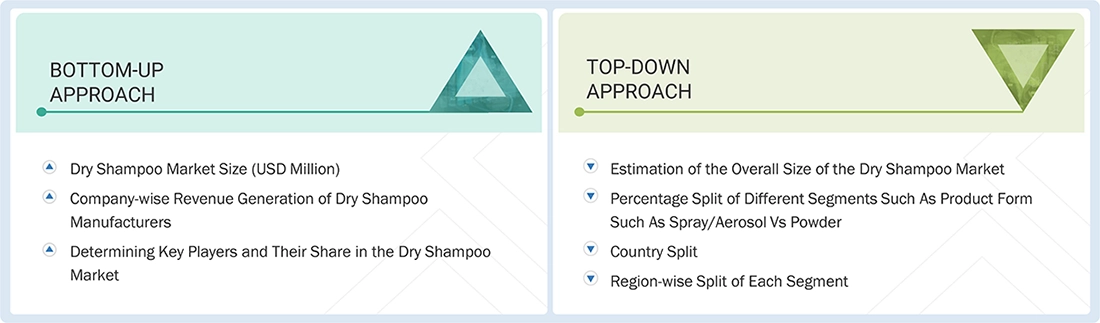
The study involves two major activities in estimating the current size of the dry shampoo market. Exhaustive secondary research was done to collect information on the market, peer market, and parent market. The next step was to validate these findings, assumptions, and sizing with industry experts across the value chain through primary research. Both top-down and bottom-up approaches were employed to estimate the complete market size. After that, market breakdown and data triangulation were used to estimate the market size of segments and subsegments.
Secondary Research
Secondary sources referred to for this research study include financial statements of companies offering dry shampoo and information from various trade, business, and professional associations. Secondary research has been used to obtain critical information about the industry's value chain, the total pool of key players, market classification, and segmentation according to industry trends to the bottom-most level and regional markets. Secondary data was collected and analyzed to arrive at the overall size of the dry shampoo market, which was validated by primary respondents.
Primary Research
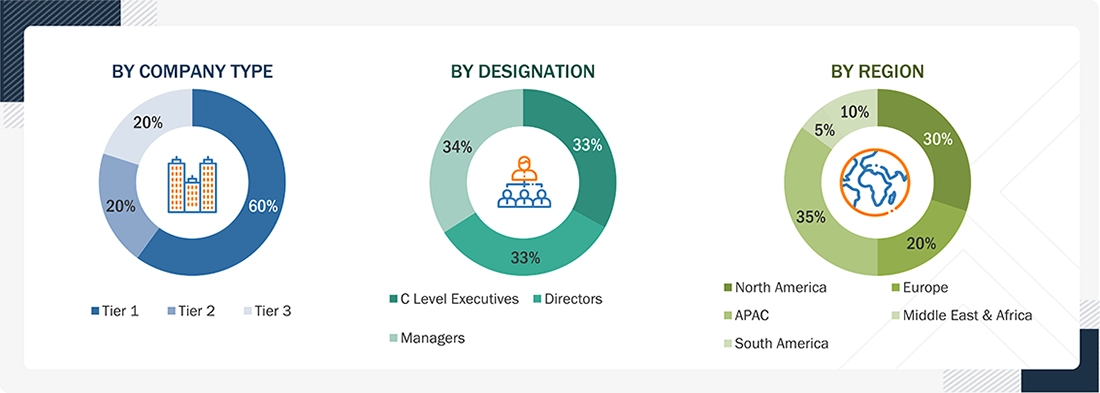
Extensive primary research was conducted after obtaining information regarding the dry shampoo market scenario through secondary research. Several primary interviews were conducted with market experts from both the demand and supply sides across major countries of North America, Europe, Asia Pacific, the Middle East & Africa, and South America. Primary data was collected through questionnaires, emails, and telephonic interviews. The primary sources from the supply side included various industry experts, such as Chief X Officers (CXOs), Vice Presidents (VPs), Directors from business development, marketing, product development/innovation teams, and related key executives from dry shampoo industry vendors; material providers; distributors; and key opinion leaders. Primary interviews were conducted to gather insights such as market statistics, data on revenue collected from the products and services, market breakdowns, market size estimations, market forecasting, and data triangulation. Primary research also helped in understanding the various trends related to product forms, functions, end users, distribution channels, and regions. Stakeholders from the demand side, such as CIOs, CTOs, CSOs, and customer/end users who are seeking dry shampoo, were interviewed to understand the buyer's perspective on the suppliers, products, and their current usage of dry shampoo.
Breakup of Primary Interviews:
To know about the assumptions considered for the study, download the pdf brochure
Market Size Estimation
The research methodology used to estimate the size of the dry shampoo market includes the following details. The market sizing of the market was undertaken from the demand side. The market was upsized based on the demand for dry shampoo in different end user segments at the regional level. This provides information on the demand aspects of the dry shampoo market for each end user. For each end user, all possible segments of the dry shampoo market were integrated and mapped.
Dry Shampoo Market : Top-Down and Bottom-Up Approach
Data Triangulation
After arriving at the overall size from the market size estimation process explained above, the total market was split into several segments and subsegments. The data triangulation and market breakdown procedures explained below were implemented, wherever applicable, to complete the overall market engineering process and arrive at the exact statistics for various market segments and subsegments. The data was triangulated by studying various factors and trends from the demand and supply sides. Along with this, the market size was validated using both the top-down and bottom-up approaches.
Market Definition
The dry shampoo market consists of haircare products that enable users to clean and refresh their hair through oil absorption, sweat absorption, and impurity removal from their scalp without using water. Dry shampoos come in spray and powder formats, which extend the duration between standard hair washing while they add hair volume and enhance hair texture. They serve customers who want grooming products that provide convenience, save time, and enable them to groom themselves while they travel. Dry shampoos provide two types of products: basic oil-absorbing dry shampoos and multifunctional variants that deliver multiple advantages, such as odor control, scalp care, color protection, and hair loss prevention.
Key Stakeholders
- Dry shampoo manufacturers
- Dry shampoo distributors and suppliers
- End-use industries
- Universities, governments, and research organizations
- Associations and industrial bodies
- R&D institutes
- Environmental support agencies
- Investment banks and private equity firms
- Research and consulting firms
Report Objectives
- To define, describe, and forecast the dry shampoo market size in terms of volume and value
- To provide detailed information regarding the key factors, such as drivers, restraints, opportunities, and challenges influencing the market growth
- To analyze and forecast the market by product form, function, distribution channel, end-user, and region
- To forecast the market size concerning five main regions (along with country-level data), namely, North America, Europe, Asia Pacific, the Middle East & Africa, and South America, and analyze the significant region-specific trends
- To strategically analyze micromarkets with respect to individual growth trends, prospects, and contributions of the submarkets to the overall market
- To analyze the market opportunities and the competitive landscape for stakeholders and market leaders
- To assess recent market developments and competitive strategies, such as agreements, contracts, acquisitions, partnerships & collaborations, and new product developments/new product launches, to draw the competitive landscape
- To strategically profile the key market players and comprehensively analyze their core competencies
Available customizations:
MarketsandMarkets offers the following customizations for this market report:
- Additional country-level analysis of the dry shampoo market
Product Analysis
- Product matrix, which provides a detailed comparison of the product portfolio of each company's market
Get the Full Dry Shampoo Market Report
Full forecast, segment splits, and company analysis for all Dry Shampoo Market.
- US Dry Shampoo Market
- Canada Dry Shampoo Market
- Mexico Dry Shampoo Market
- Germany Dry Shampoo Market
- France Dry Shampoo Market
- UK Dry Shampoo Market
- Italy Dry Shampoo Market
- Spain Dry Shampoo Market
- India Dry Shampoo Market
- Japan Dry Shampoo Market
- South Korea Dry Shampoo Market
- Australia Dry Shampoo Market
- Saudi Arabia Dry Shampoo Market
- UAE Dry Shampoo Market
- South Africa Dry Shampoo Market
- Brazil Dry Shampoo Market
- Argentina Dry Shampoo Market
- Rest Of Europe Dry Shampoo Market
- Rest Of Asia Pacific Dry Shampoo Market
Need a Tailored Report?
Customize this report to your needs
Get 10% FREE Customization
Customize This Report
