
Asia Pacific Dry Transformer Insulation Market (2025-2030)

The Asia Pacific Dry Transformer Insulation Market was valued at $476 Million in 2025 and projected to reach to $644 Million by 2030, representing a compound annual growth rate of 6.3%. The Asia Pacific dry transformer insulation market is poised for sustained expansion, growing from USD 476.0 million in 2025 to USD 644.0 million by 2030.


| Market Size in | USD 26.32 MN |
| Market Forecast in | |
| CAGR | |
| Forecast Period | |
| Units Considered | Value (USD MN) |
Asia Pacific Dry Transformer Insulation Market Trends and Insights
- Asia Pacific's 6.3% compound annual growth rate outpaces global trends, driven by rapid industrialization, grid modernization initiatives, and increasing renewable energy integration across the region.
- The market in Asia Pacific benefits from rising electricity demand, infrastructure investments, and the shift toward environmentally sustainable insulation materials in transformer manufacturing. Asia Pacific's dry transformer insulation sector is characterized by strong demand from utilities, manufacturing facilities, and renewable energy projects.
- Between 2025 and 2030, Asia Pacific is expected to capture significant market share as countries invest in smart grid technologies and upgrade aging electrical infrastructure.
- The region's competitive landscape features both established global players and emerging local manufacturers, positioning Asia Pacific as a critical growth engine for the global dry transformer insulation market..
Key Market Statistics
- CAGR (2025-2030) 6.3% CAGR
- Market Size, 2025 ~USD 476 Million
- Forecast, 2030 ~USD 644 Million
- Geography Asia Pacific
Asia Pacific Dry Transformer Insulation Market Overview
Regional Market Leadership :
Asia Pacific commands the dry transformer insulation market with a 6.3% CAGR, significantly outpacing the global growth rate of 5.5%, positioning the region as a key growth engine for the industry.
China's Dominance :
China leads Asia Pacific with USD 453 million in market size, representing over 95% of the region's total market value and driving substantial demand through massive infrastructure and renewable energy projects.
Rapid Industrialization & Grid Modernization :
Accelerated industrial expansion and government-backed smart grid initiatives across Asia Pacific are fueling demand for advanced dry transformer insulation solutions to support modernized electrical infrastructure.
Renewable Energy Integration :
Increasing renewable energy capacity additions across Asia Pacific require upgraded transformer networks with superior insulation materials, creating sustained market opportunities through 2030.
Asia Pacific Dry Transformer Insulation Market Dynamics
- This 6.3% CAGR reflects the region's strategic focus on energy infrastructure modernization and renewable energy adoption.
- China's dominant position, coupled with emerging opportunities in India, Japan, and South Korea, creates a diversified growth landscape. Key drivers include rapid urbanization, industrial electrification, and government investments in grid resilience and sustainability.
- The region's commitment to carbon neutrality targets and renewable energy integration will continue to propel demand for high-performance dry transformer insulation materials, positioning Asia Pacific as the fastest-growing market segment globally..
Market Ecosystem
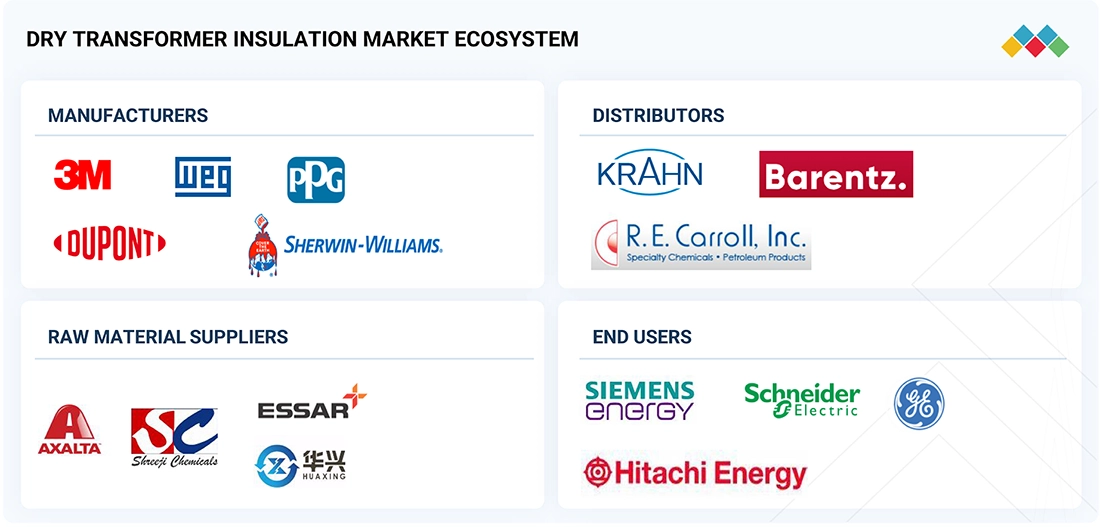
Dry Transformer Insulation Market: COMMERCIAL USE CASES ACROSS INDUSTRIES
| COMPANY | USE CASE DESCRIPTION | BENEFITS |
|---|---|---|
 |
Provides high-performance coatings and insulation materials for dry transformers, ensuring electrical insulation and thermal stability. | Excellent dielectric strength, thermal resistance, and long-term durability. |
 |
Offers advanced resin systems and insulating varnishes for dry transformers, enhancing mechanical and electrical properties. | Superior adhesion, chemical resistance, and improved transformer efficiency. |
 |
Supplies epoxy-based insulation systems and components for dry transformers, supporting reliable power distribution. | High mechanical strength, heat resistance, and cost-effective manufacturing. |
 |
Develops innovative insulation tapes and films for dry transformers, ensuring safety and performance in electrical applications. | Enhanced thermal stability, electrical insulation, and ease of application. |
 |
Manufactures high-quality dielectric films and insulation materials for dry transformers, optimizing energy efficiency. | Outstanding electrical properties, lightweight design, and environmental resilience. |
Logos and trademarks shown above are the property of their respective owners. Their use here is for informational and illustrative purposes only.
Related Ecosystem
Foam And Insulation
- Fiberglass
- Acoustic Insulation
- Elastomeric Foam
- HVAC System
- Flexible Foam
- Basf se
- Saint-gobain
- ARMACELL INTERNATIONAL
- THE WOODBRIDGE GROUP
- Sekisui Chemical Co., Ltd.
Key Takeaways
- Asia Pacific dry transformer insulation market valued at USD 476.0 million in 2025, growing at 6.3% CAGR through 2030.
- Asia Pacific's growth rate exceeds global average, driven by industrialization and renewable energy expansion across the region.
- Asia Pacific demand is fueled by grid modernization, smart infrastructure investments, and sustainable material adoption.
- Asia Pacific represents a strategic growth region with both multinational and local manufacturers competing for market share.
Dry Transformer Insulation Market Report Scope
| Report Metric | Details |
|---|---|
| Base Year | 2025 |
| Fastest Growing Segment | –OTHER SOLID INSULATORS (Type) |
| Forecast Period | 2025–2030 |
| Growth Rate | CAGR of 5.5% from 2025 to 2030 |
| Largest Segment | SOLID INSULATORS (Type) |
| Market Size Base Year (Billions) | ~USD 0.93 (2025) |
| Revenue Forecast (Billions) | ~USD 1.21 (2030) |
| Segments Covered | Type 2022–2024, Type, Component, Application |
Asia Pacific Dry Transformer Insulation Market Report Segmentation
4 segment dimensions are covered across the global market.
By Type 2022–2024
- Coatings
- Solid Insulators
- –Bushings & Terminals
- –Electrical Insulation
- –Electrical Insulation Coatings
- –Fire-Resistant & Thermal Protection Coatings
- –Moisture & Environmental Protection Coatings
- –Other Solid Insulators
- ––Epoxy Resin
- ––Other Electrical Insulation Coatings
- ––Polyester Varnish
By Type
- Coatings
- Solid Insulators
- –Bushings & Terminal
- –Bushings & Terminals
- –Electrical Insulation
- –Electrical Insulation Coatings
- –Fire-Resistant & Thermal Protection Coatings
- –Moisture & Environmental Protection Coatings
- –Other Solid Insulators
- ––Epoxy Resin
- ––Other Electrical Insulation Coatings
- ––Polyester Varnish
By Component
- Bushings
- Cores
- Enclosures
- Other Components
- Spacers & Support
- Spacers & Supports
- Windings
By Application
- Commercial
- Industrial
- Other Applications
Target Audience
- Transformer Manufacturers : Require detailed Asia Pacific market data to optimize production capacity, source insulation materials, and develop region-specific product strategies aligned with local grid modernization demands.
- Insulation Material Suppliers : Need country-level market insights to identify high-growth segments in China, India, and Japan, and to establish supply chain partnerships supporting rapid regional expansion.
- Utility Companies & Grid Operators : Utilize market forecasts to plan transformer replacement cycles, evaluate insulation technology upgrades, and align procurement strategies with renewable energy integration timelines.
- Investment & Private Equity Firms : Assess Asia Pacific market growth potential (6.3% CAGR) and country-specific opportunities to evaluate acquisition targets and portfolio companies in the transformer and electrical infrastructure sectors.
- Government & Policy Makers : Leverage market data to inform energy infrastructure policies, renewable energy targets, and grid modernization initiatives while understanding market dynamics and investment requirements.
Key Companies in the Asia Pacific Dry Transformer Insulation Market
| Company | HQ | Ownership | Strongest segments |
|---|---|---|---|
| 3M | United States | Public Company | Coatings – Electrical Insulation,Coatings – Fire-Resistance & Thermal Protection,Coatings – Moisture & Environmental Protection, |
| THE SHERWIN-WILLIAMS COMPANY | United States | Public Company | Coatings – Electrical Insulation,Coatings – Fire-Resistance & Thermal Protection,Coatings – Moisture & Environmental Protection, |
| PPG INDUSTRIES, INC. | United States | Public Company | Coatings – Electrical Insulation,Coatings – Fire-Resistance & Thermal Protection,Coatings – Moisture & Environmental Protection, |
| DUPONT | United States | Public Company | Coatings – Electrical Insulation,Coatings – Fire-Resistance & Thermal Protection,Coatings – Moisture & Environmental Protection, |
| WEG | Brazil | Public Company | Coatings – Electrical Insulation,Coatings – Fire-Resistance & Thermal Protection,Coatings – Moisture & Environmental Protection, |
| HUNTSMAN INTERNATIONAL LLC | United States | Private Company | Coatings – Electrical Insulation,Coatings – Fire-Resistance & Thermal Protection,Coatings – Moisture & Environmental Protection, |
| ALTANA AG | Germany | Private Company | Coatings – Electrical Insulation,Coatings – Fire-Resistance & Thermal Protection,Coatings – Moisture & Environmental Protection, |
3M
3M is a publicly traded American multinational company founded in 1902 that employs 60,500 people. The company operates across diverse industrial and consumer markets.
THE SHERWIN-WILLIAMS COMPANY
The Sherwin-Williams Company is a publicly traded American paint and coatings manufacturer founded in 1866 with 64,249 employees. It is one of the largest companies in the coatings industry.
PPG INDUSTRIES, INC.
PPG Industries, Inc. is a publicly traded American manufacturer of paints, coatings, and specialty materials founded in 1883 with 43,500 employees. The company serves industrial, commercial, and consumer markets globally.
DUPONT
DuPont is a publicly traded American chemical and materials company founded in 2015 with 15,000 employees. The company focuses on innovation in specialty chemicals and advanced materials.
WEG
WEG is a publicly traded Brazilian industrial company founded in 1961 with 49,258 employees. The company operates in the manufacturing and industrial sectors.
HUNTSMAN INTERNATIONAL LLC
Huntsman International LLC is a privately held American chemical company founded in 1970 with 6,000 employees. The company produces specialty chemicals and materials for various industrial applications.
ALTANA AG
ALTANA AG is a privately held German specialty chemicals company founded in 1873 with 8,317 employees. The company serves customers in coatings, adhesives, and other industrial sectors.
Countries within Asia Pacific - compare and drill down
| Country | 2025 size (native) |
|---|---|
| China | USD 453 Million |
| Japan | USD 97 Million |
| India | USD 46 Million |
| South Korea | USD 27 Million |
| Rest Of Asia Pacific | USD 21 Million |
Country market size visualization
Reasons to Buy this Report
- Regional Market Dominance Insights : Gain comprehensive understanding of Asia Pacific's 6.3% CAGR and its outperformance versus global trends, enabling strategic positioning in the fastest-growing transformer insulation market.
- Country-Level Market Intelligence : Access detailed market sizing for China (USD 453M), Japan (USD 97M), India (USD 46M), and South Korea (USD 27M) to identify high-potential investment and expansion opportunities.
- Growth Driver Analysis : Understand the specific catalysts driving Asia Pacific growth—industrialization, grid modernization, and renewable energy integration—to align product development and market entry strategies.
- Competitive Landscape Clarity : Benchmark your position against regional competitors and identify market gaps in Asia Pacific's USD 476M market, with forecasts through 2030 for long-term planning.
- Investment Decision Support : Make data-driven investment decisions with 5-year market projections showing growth to USD 644M, supporting business case development for Asia Pacific expansion initiatives.
Frequently asked questions
What is the current market size of dry transformer insulation in Asia Pacific?
The Asia Pacific dry transformer insulation market is valued at USD 476.0 million in 2025 and is projected to reach USD 644.0 million by 2030.
What is the growth rate for dry transformer insulation in Asia Pacific?
Asia Pacific's dry transformer insulation market is growing at a compound annual growth rate (CAGR) of 6.3% from 2025 to 2030.
What factors are driving growth in the Asia Pacific dry transformer insulation market?
Key drivers include rapid industrialization, grid modernization initiatives, renewable energy integration, rising electricity demand, and the adoption of environmentally sustainable insulation materials across Asia Pacific.
Which countries in Asia Pacific are leading the dry transformer insulation market?
Major markets in Asia Pacific include China, India, Japan, and Southeast Asian nations, which are investing heavily in electrical infrastructure and renewable energy projects.
How does Asia Pacific's growth compare to the global dry transformer insulation market?
Asia Pacific's 6.3% CAGR exceeds the global market CAGR of 5.5%, making the region a faster-growing segment within the global dry transformer insulation market.
RESEARCH METHODOLOGY
The study comprised four key activities aimed at estimating the current size of the global dry transformer insulation market. Comprehensive secondary research was initially undertaken to gather pertinent data regarding the market, related product categories, and the overarching product group. Following this, the findings, assumptions, and size estimates were validated through primary research with industry experts spanning the entire value chain of dry transformer insulation. To ensure accuracy, both top-down and bottom-up methodologies were utilized to estimate the overall market size. Subsequently, market segmentation and data triangulation techniques were employed to delineate the dimensions of various segments and sub-segments within the market.
Secondary Research
In the secondary research process, various secondary sources such as D&B Hoovers, Factiva, Bloomberg BusinessWeek, and Dun & Bradstreet were referred to identify and collect information for this study on the dry transformer insulation market. These secondary sources included annual reports, press releases & investor presentations of companies; white papers; certified publications; articles by recognized authors; regulatory bodies, trade directories, and databases.
Primary Research
The dry transformer insulation market comprises several stakeholders in the supply chain, which include raw material suppliers, distributors, end-product manufacturers, buyers, and regulatory organizations. Various primary sources from the supply and demand sides of the markets have been interviewed to obtain qualitative and quantitative information. The primary participants from the demand side include key opinion leaders, executives, vice presidents, and CEOs of companies in the dry transformer insulation market. Primary sources from the supply side include associations and institutions involved in the dry transformer insulation market, key opinion leaders, and processing players.
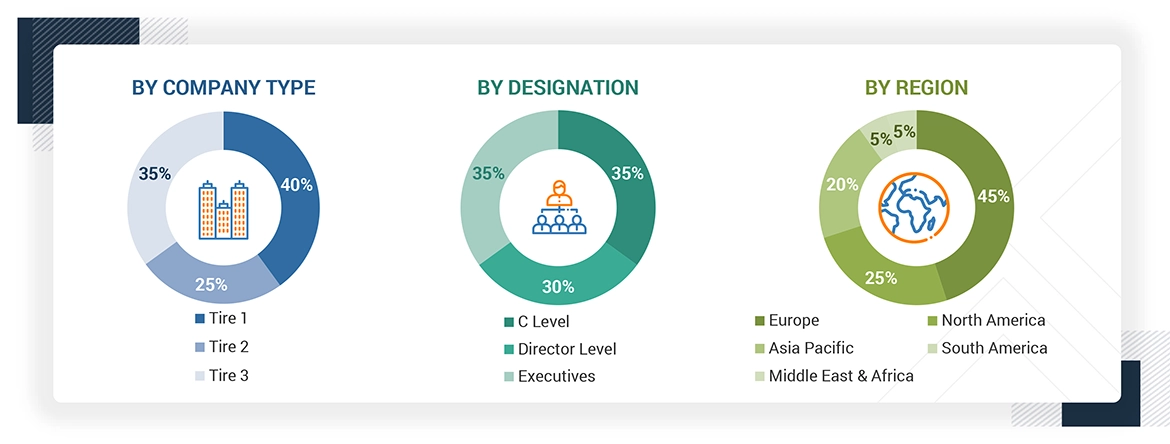
Following is Breakdown of Primary Respondents
To know about the assumptions considered for the study, download the pdf brochure
Market Size Estimation
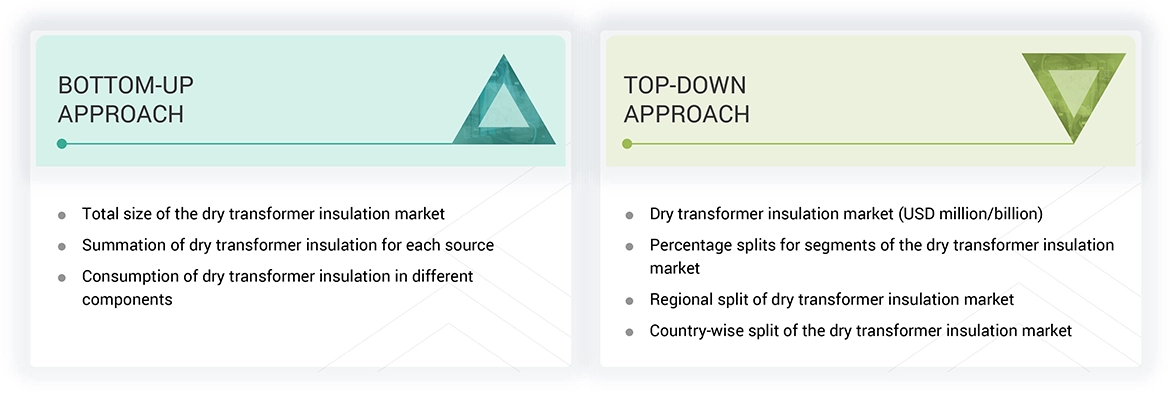
The bottom-up and top-down approaches have been used to estimate the dry transformer insulation market by type, component, and region. The research methodology used to calculate the market size includes the following steps:
- The key players in the industry and markets were identified through extensive secondary research.
- In terms of value, the industry’s supply chain and market size were determined through primary and secondary research processes.
- All percentage shares, splits, and breakdowns were determined using secondary sources and verified through primary sources.
- All possible parameters that impact the markets covered in this research study were accounted for, viewed in extensive detail, verified through primary research, and analyzed to obtain the final quantitative and qualitative data.
- The research included studying reports, reviews, and newsletters of top market players and extensive interviews with leaders such as directors and marketing executives to obtain opinions.
The following figure illustrates the overall market size estimation process employed for this study.
Data Triangulation
After arriving at the overall size of the dry transformer insulation market from the estimation process explained above, the total market was split into several segments and sub-segments. The data triangulation and market breakdown procedures were employed, wherever applicable, to complete the overall market engineering process and arrive at the exact statistics for all segments and subsegments. The data was triangulated by studying various factors and trends from both the demand and supply sides. The market size was also validated using both the top-down and bottom-up approaches.
Market Definition
Dry transformer insulation encompasses the comprehensive system of solid insulation materials employed in dry-type transformers. This system is crucial for preventing electrical discharges, managing heat dissipation, and ensuring safe and efficient operational conditions. Unlike oil-immersed transformers that rely on a liquid insulation medium, dry transformers utilize solid insulating materials such as epoxy resin, fiberglass, or Nomex to safeguard windings and other internal components. The dry transformer insulation system enhances safety by eliminating the risks of leaks or fires associated with oil-filled transformers, making it particularly suitable for indoor environments, environmentally sensitive applications, and areas with limited space in densely populated urban settings. Furthermore, this insulation system is characterized by low maintenance requirements, environmental sustainability, and adaptability to the renewable energy, industrial, and commercial sectors. As such, dry transformers represent a compelling option for organizations seeking reliable and efficient power solutions.
Stakeholders
- Dry transformer insulation manufacturers
- Raw material suppliers
- Regulatory bodies and government agencies
- Distributors and suppliers
- End-use industries
- Associations and industrial bodies
- Market research and consulting firms
Report Objectives
- To define, describe, and forecast the size of the dry transformer insulation market in terms of value and volume.
- To provide detailed information regarding the key factors influencing the growth of the market (drivers, restraints, opportunities, and challenges).
- To forecast the market size based on type, component, and region.
- To forecast the market size for the five main regions, namely, North America, Europe, Asia Pacific, South America, and the Middle East & Africa, along with their key countries.
- To strategically analyze micro markets with respect to individual growth trends, prospects, and contributions to the total market.
- To analyze the opportunities in the market for stakeholders and provide details of the competitive landscape for the market leaders.
- To strategically profile leading players and comprehensively analyze their key developments, such as product launches, expansions, and deals, in the dry transformer insulation market.
- To strategically profile key players and comprehensively analyze their market shares and core competencies.
- To study the impact of AI/Gen AI on the market under study and the macroeconomic outlook.
Get the Full Dry Transformer Insulation Market Report
Full forecast, segment splits, and company analysis for all Dry Transformer Insulation Market.
- US Dry Transformer Insulation Market
- Canada Dry Transformer Insulation Market
- Mexico Dry Transformer Insulation Market
- Germany Dry Transformer Insulation Market
- France Dry Transformer Insulation Market
- UK Dry Transformer Insulation Market
- Italy Dry Transformer Insulation Market
- China Dry Transformer Insulation Market
- Japan Dry Transformer Insulation Market
- India Dry Transformer Insulation Market
- South Korea Dry Transformer Insulation Market
- Brazil Dry Transformer Insulation Market
- Argentina Dry Transformer Insulation Market
- Rest Of Europe Dry Transformer Insulation Market
- Rest Of Asia Pacific Dry Transformer Insulation Market
- GCC Countries Dry Transformer Insulation Market
- –Rest Of GCC Countries Dry Transformer Insulation Market
- Rest Of South America Dry Transformer Insulation Market
Need a Tailored Report?
Customize this report to your needs
Get 10% FREE Customization
Customize This Report
