
Qatar Dual-Axis Gyro-Stabilized Platforms Market (2025-2030)

The Qatar Dual-Axis Gyro-Stabilized Platforms Market was valued at $29.4 Million in 2025 and projected to reach to $48.4 Million by 2030, representing a compound annual growth rate of 10.5%. Qatar's dual-axis gyro-stabilized platforms market is positioned for sustained growth driven by ongoing defense modernization programs and regional security requirements.


| Market Size in | USD 26.32 MN |
| Market Forecast in | |
| CAGR | |
| Forecast Period | |
| Units Considered | Value (USD MN) |
Qatar Dual-Axis Gyro-Stabilized Platforms Market Trends and Insights
- Qatar's strategic position in the Middle East and its substantial defense modernization initiatives are driving demand for advanced stabilization technologies in aerospace and defense applications.
- The market in Qatar is growing at a compound annual growth rate of 10.5%, outpacing global averages and reflecting the nation's commitment to upgrading its military and surveillance capabilities. The expansion of Qatar's market is underpinned by increased investments in unmanned aerial systems, maritime surveillance platforms, and precision targeting equipment.
- Qatar's defense sector is prioritizing gyro-stabilized platforms for enhanced operational accuracy and system reliability across airborne and ground-based applications.
- Between 2025 and 2030, Qatar is expected to see accelerated adoption driven by regional security concerns and technological advancement in stabilization systems. Qatar's market positioning reflects both domestic procurement initiatives and regional partnerships within the Middle East aerospace and defense ecosystem.
- The country's focus on indigenous capability development and technology integration is creating sustained demand for dual-axis gyro-stabilized platforms across military and commercial sectors..
Key Market Statistics
- CAGR (2025-2030) 10.5% CAGR
- Market Size, 2025 ~USD 29.4 Million
- Forecast, 2030 ~USD 48.4 Million
- Country Qatar
Qatar Dual-Axis Gyro-Stabilized Platforms Market Overview
Rapid Market Expansion :
Qatar's dual-axis gyro-stabilized platforms market is projected to grow from USD 29.4 million in 2025 to USD 48.4 million by 2030, representing a robust 10.5% CAGR, outpacing the global average of 8.6%.
Defense Modernization Drive :
Qatar's strategic defense modernization initiatives and significant military investments are accelerating adoption of advanced stabilization technologies across aerospace and defense platforms.
Regional Strategic Position :
Qatar's geopolitical importance in the Middle East and its role as a regional hub for defense procurement create sustained demand for cutting-edge gyro-stabilized platform solutions.
Technology Integration Focus :
Increasing integration of dual-axis gyro-stabilized platforms in surveillance, reconnaissance, and precision-guided systems reflects Qatar's commitment to advanced defense capabilities.
Qatar Dual-Axis Gyro-Stabilized Platforms Market Dynamics
- The country's substantial defense budget allocation and strategic partnerships with international aerospace and defense manufacturers are creating favorable conditions for market expansion.
- Investment in advanced surveillance and reconnaissance systems, coupled with the modernization of existing military platforms, will continue to fuel demand for stabilization technologies through 2030. The market outlook remains positive as Qatar prioritizes technological advancement in its defense sector.
- Increasing procurement of advanced aerial platforms, naval systems, and ground-based surveillance equipment will drive adoption of dual-axis gyro-stabilized solutions.
- Strategic collaborations with global defense contractors and domestic capability development initiatives are expected to further accelerate market growth, positioning Qatar as a key market within the Middle Eastern aerospace and defense landscape..
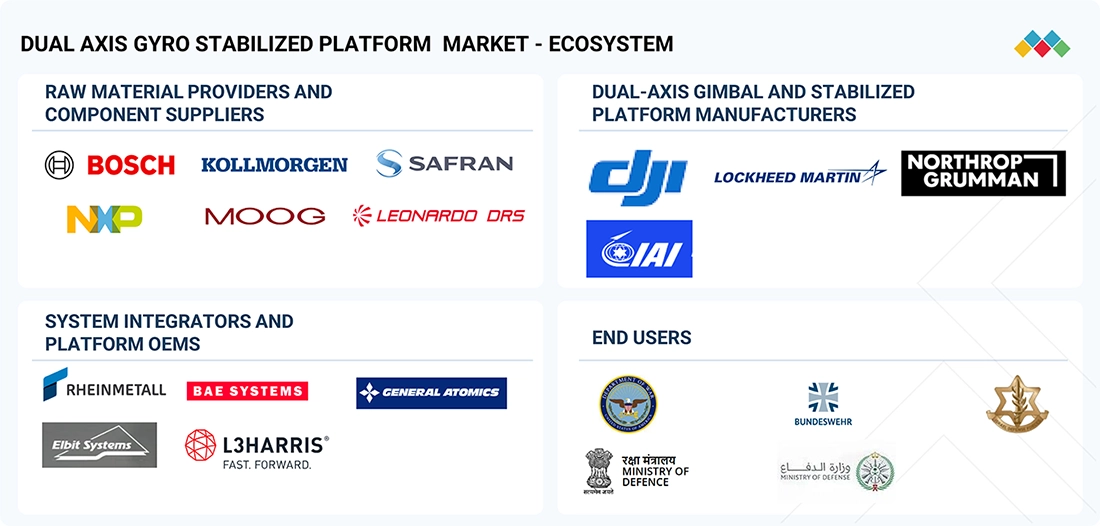
Market Ecosystem
DUAL AXIS GYRO STABILIZED PLATFORMS MARKET: COMMERCIAL USE CASES ACROSS INDUSTRIES
| COMPANY | USE CASE DESCRIPTION | BENEFITS |
|---|---|---|
 |
Stabilized remote weapon stations and electro-optical surveillance systems for commercial maritime security and offshore asset protection | Enhances situational awareness, ensures stable imaging in dynamic marine conditions, improves threat detection, and supports safe offshore operations |
 |
Gyro-stabilized electro-optical payloads for border surveillance, critical infrastructure monitoring, and commercial security applications | Improves real-time monitoring accuracy, supports continuous surveillance, enhances perimeter security, and enables efficient threat identification |
 |
Stabilized EO/IR payloads and surveillance systems for aerial mapping, environmental monitoring, and commercial ISR applications | Enables high-precision data collection, ensures stable imaging from airborne platforms, improves mapping accuracy, and supports wide-area monitoring |
 |
Advanced stabilized imaging and sensor systems for airborne surveillance, public safety, and disaster response operations | Enhances image clarity and tracking accuracy, supports real-time decision-making, improves mission efficiency, and enables reliable performance in dynamic environments |
 |
Fiber-optic gyro-based stabilization systems and antenna platforms for maritime communication and navigation in commercial shipping | Ensures stable connectivity, improves navigation accuracy, maintains signal reliability in rough sea conditions, and enhances operational efficiency for vessels |
Logos and trademarks shown above are the property of their respective owners. Their use here is for informational and illustrative purposes only.
Related Ecosystem
Key Takeaways
- Qatar's dual-axis gyro-stabilized platforms market is valued at USD 29.4 million in 2025 and will reach USD 48.4 million by 2030, representing a 10.5% CAGR.
- Qatar's defense modernization programs and regional security priorities are primary drivers of market expansion through 2030.
- Qatar is investing heavily in unmanned systems and surveillance platforms that require advanced gyro-stabilization technology.
- Qatar's market growth rate of 10.5% exceeds the global CAGR of 8.6%, indicating strong regional demand and strategic importance.
Dual-Axis Gyro-Stabilized Platforms Market Report Scope
| Report Metric | Details |
|---|---|
| Base Year | 2025 |
| Fastest Growing Segment | UNMANNED GROUND VEHICLE (Land Deployment) |
| Forecast Period | 2025–2030 |
| Growth Rate | CAGR of 8.6% from 2025 to 2030 |
| Largest Segment | AIRBORNE (Deployment) |
| Market Size Base Year (Billions) | ~USD 1.98 (2025) |
| Revenue Forecast (Billions) | ~USD 2.99 (2030) |
| Segments Covered | Gyro Technology, System Component, Payload Type, Deployment, Airborne Deployment, Manned Aircraft, Land Deployment, Marine Deployment, Ground Fixed Infrastructure, Application |
Qatar Dual-Axis Gyro-Stabilized Platforms Market Report Segmentation
10 segment dimensions are covered across the global market.
By Gyro Technology
- Fiber-Optic Gyroscopes (Fog)
- MEMS Gyroscopes
- Ring Laser Gyroscopes (Rlg)
By System Component
- Control Electronics
- Embedded Software & Stabilization Algorithms
- Inertial & Position Sensing
- Motion Control Hardware
- Power & Interface Modules
- Structural Assembly
By Payload Type
- Acoustic Payload
- Eo/Ir Imaging Payload
- Laser-Based Payload
- Radar & Antenna Stabilization Payload
- Scientific & Environmental Sensor Payload
- Weapon / Effector Payload
By Deployment
- Airborne
- Ground Fixed Infrastructure
- Land
- Marine
By Airborne Deployment
- Manned Aircraft
- Unmanned Aerial Vehicle
By Manned Aircraft
- Fixed Wing
- Rotary Wing
By Land Deployment
- Military Ground Vehicle
- Unmanned Ground Vehicle
By Marine Deployment
- Naval Ship
- Small Boat
- Unmanned Marine Vehicle
By Ground Fixed Infrastructure
- Border Towers
- Industrial Platforms
- Rail
By Application
- Aerial & Cinematic Imaging
- Atmospheric Research
- Communication Stabilization
- Intelligence, Surveillance, And Reconnaissance (Isr)
- Mapping & Surveying
- Monitoring & Inspection
- Navigation & Guidance
- Targeting & Fire Control
Target Audience
- Defense Contractors & Manufacturers : Manufacturers of gyro-stabilized platforms and aerospace systems need Qatar-specific market data to develop localized strategies and identify procurement opportunities.
- Government & Military Procurement Officials : Qatar's defense ministry and military procurement teams require detailed market intelligence to inform equipment specifications, budgeting, and technology acquisition decisions.
- Investment & Private Equity Firms : Investors targeting the Middle Eastern defense sector need Qatar market insights to evaluate investment opportunities and assess growth potential in stabilization technologies.
- Systems Integrators & Technology Partners : Companies integrating gyro-stabilized platforms into larger defense systems require Qatar-specific requirements and market dynamics to develop compatible solutions.
- Market Research & Strategy Consultants : Consultants advising aerospace and defense clients need granular Qatar market data to support strategic recommendations and competitive positioning analysis.
Key Companies in the Qatar Dual-Axis Gyro-Stabilized Platforms Market
| Company | HQ | Ownership | Strongest segments |
|---|---|---|---|
| KONGSBERG | Norway | Public Company | Air and coastal defense, combat systems, and C2,Naval strike and air-to-surface missiles,Remote weapon stations and land systems, |
| ASELSAN A.S. | Turkey | Public Company | Communication and Information Technologies (C4ISR, mission-critical comms),Radar and Electronic Warfare Systems,Microelectronics, Guidance & Electro-Optics, |
| ISRAEL AEROSPACE INDUSTRIES | Israel | Private Company | Air and Missile Defense / Special Mission Aircraft,Unmanned Aerial Systems (Military and Dual-Use),Space Systems and Satellites, |
| L3HARRIS TECHNOLOGIES, INC. | United States | Public Company | Space & Mission Systems (SMS),Communications & Spectrum Dominance (CSD),Missile Solutions (MSL), |
| KVH INDUSTRIES, INC. | United States | Public Company | VSAT airtime, KVH ONE, AgilePlans, OpenNet, and managed connectivity services,TracPhone and TracNet hardware (VSAT and hybrid terminals),TracVision and TVlink / satellite TV hardware and services, |
| LOCKHEED MARTIN CORPORATION | United States | Public Company | Aeronautics,Missiles and Fire Control,Rotary and Mission Systems, |
| ELBIT SYSTEMS LTD. | Israel | Public Company | Aerospace (airborne platforms, UAVs, avionics, training),C4I and Cyber,ISTAR and Electronic Warfare, |
| SAFRAN S.A. | France | Public Company | Aerospace Propulsion,Aircraft Equipment, Defense and Aerosystems,Aircraft Interiors, |
| LEONARDO S.P.A. | Italy | Public Company | Helicopters (military and civil, plus support),Defense electronics, sensors, and C2,Aircraft, aerostructures, and trainers, |
| TELEDYNE FLIR LLC | United States | Private Company | Thermal and optical gas imaging (G-Series and related),Visible-light imaging and video analytics systems,Measurement and diagnostic systems, |
| MOOG INC. | United States | Public Company | Space and Defense,Military Aircraft,Commercial Aircraft, |
| CACI INTERNATIONAL INC | United States | Public Company | Control, communications, and intelligence technology and networks,Cyber solutions (offensive, defensive, critical infrastructure protection),Digital solutions and enterprise IT for federal agencies, |
KONGSBERG
Kongsberg is a Norwegian public company founded in 1814 with 7,586 employees, operating as a diversified industrial enterprise.
ASELSAN A.S.
Aselsan A.S. is a Turkish public company established in 1975 with 16,243 employees, specializing in defense and aerospace technologies.
ISRAEL AEROSPACE INDUSTRIES
Israel Aerospace Industries is a private Israeli company founded in 1953 with 15,151 employees, engaged in aerospace and defense manufacturing.
L3HARRIS TECHNOLOGIES, INC.
L3Harris Technologies, Inc. is a U.S. public company founded in 1895 with 45,000 employees, providing advanced defense and aerospace solutions.
KVH INDUSTRIES, INC.
KVH Industries, Inc. is a U.S. public company founded in 1982 with 272 employees, operating in specialized technology sectors.
LOCKHEED MARTIN CORPORATION
Lockheed Martin Corporation is a U.S. public company founded in 1912 with 123,000 employees, serving as a major global defense and aerospace contractor.
ELBIT SYSTEMS LTD.
Elbit Systems Ltd. is an Israeli public company founded in 1966 with 20,000 employees, specializing in defense electronics and systems.
SAFRAN S.A.
Safran S.A. is a French public company founded in 1896 with 103,710 employees, operating as a major aerospace and defense supplier.
LEONARDO S.P.A.
Leonardo S.p.A. is an Italian public company founded in 1948 with 65,455 employees, providing defense, aerospace, and security solutions.
TELEDYNE FLIR LLC
Teledyne FLIR LLC is a U.S. private company founded in 1978 with 4,179 employees, focused on thermal imaging and sensing technologies.
MOOG INC.
Moog Inc. is a U.S. public company founded in 1951 with 13,500 employees, manufacturing precision motion and control systems.
CACI INTERNATIONAL INC
CACI International Inc is a U.S. public company founded in 1962 with 25,000 employees, providing information technology and professional services.
Reasons to Buy this Report
- Market-Specific Growth Data : Access precise market sizing and forecasting data exclusive to Qatar, enabling accurate investment decisions and resource allocation for the 2025-2030 period.
- Defense Procurement Intelligence : Understand Qatar's unique defense modernization priorities and procurement patterns to identify opportunities in gyro-stabilized platform applications and technologies.
- Competitive Landscape Analysis : Gain insights into key players, market dynamics, and competitive positioning specific to Qatar's aerospace and defense sector for strategic planning.
- Regional Strategic Context : Leverage Qatar's geopolitical significance and regional role to identify cross-border opportunities and partnerships within the Middle Eastern defense market.
- Technology Adoption Trends : Identify emerging technology integration patterns and system requirements specific to Qatar's military platforms and defense applications.
Frequently asked questions
What is the current market size of dual-axis gyro-stabilized platforms in Qatar?
Qatar's dual-axis gyro-stabilized platforms market is valued at USD 29.4 million in 2025.
What is the projected market size for Qatar by 2030?
Qatar's market is forecast to reach USD 48.4 million by 2030, growing at a 10.5% CAGR.
What are the primary drivers of growth in Qatar's gyro-stabilized platforms market?
Qatar's market growth is driven by defense modernization initiatives, increased investments in unmanned aerial systems, maritime surveillance upgrades, and regional security requirements.
How does Qatar's market growth compare to global trends?
Qatar's market is growing at 10.5% CAGR, which exceeds the global average of 8.6%, reflecting stronger regional demand and strategic defense priorities.
Which applications are driving demand for gyro-stabilized platforms in Qatar?
Key applications in Qatar include unmanned aerial systems, maritime surveillance platforms, precision targeting equipment, and airborne reconnaissance systems.
RESEARCH METHODOLOGY
The study followed four main steps to estimate the size of the dual-axis gyro-stabilized platforms market. Secondary research was conducted to gather data on stabilized platforms, electro-optical systems, gyro technologies, motion control hardware, and platform integration across airborne, land, and naval applications. These findings were confirmed through primary interviews with defense organizations, system integrators, platform manufacturers, and industry experts. The research team reviewed defense spending data, government budgets, procurement plans, and ongoing military modernization initiatives to evaluate market demand. Market estimates were then divided by gyro technology, system component, payload type, deployment, and application. Data triangulation was used to verify the final figures for each segment and sub-segment.
Secondary Research
Secondary research was conducted to establish the foundation for this study. Data was gathered from defense ministries, procurement agencies, and military modernization programs across regions. Company information was reviewed from annual reports, product documentation, press releases, and investor disclosures of dual-axis gyro-stabilized platform providers. The study also examined white papers, defense journals, and published research on electro-optical systems, gyro technologies, stabilization systems, and sensor integration. Additional insights were obtained from the aerospace & defense industry platforms and associations to analyze market trends and regional adoption.
Primary Research
Primary research was conducted after key insights from secondary analysis were identified. The study team engaged with executives, engineers, system integrators, and suppliers involved in the dual-axis gyro-stabilized platforms ecosystem. Discussions included manufacturers of electro-optical systems, defense platform providers, sensor developers, and industry experts across major regions. Interviews were conducted via calls and written correspondence to confirm market size estimates and user requirements. These inputs helped refine perspectives on competition, deployment strategies, and technological advancements. Feedback was also used to adjust assumptions and enhance data accuracy.
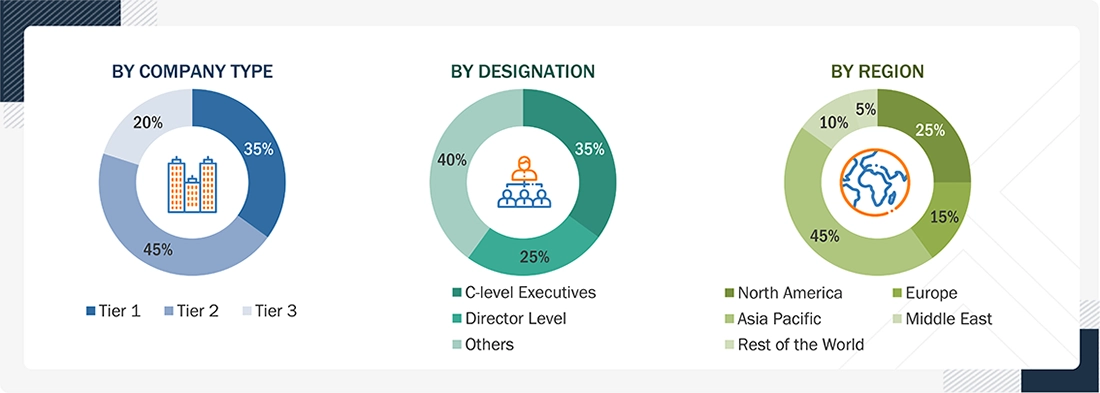
To know about the assumptions considered for the study, download the pdf brochure
Market Size Estimation
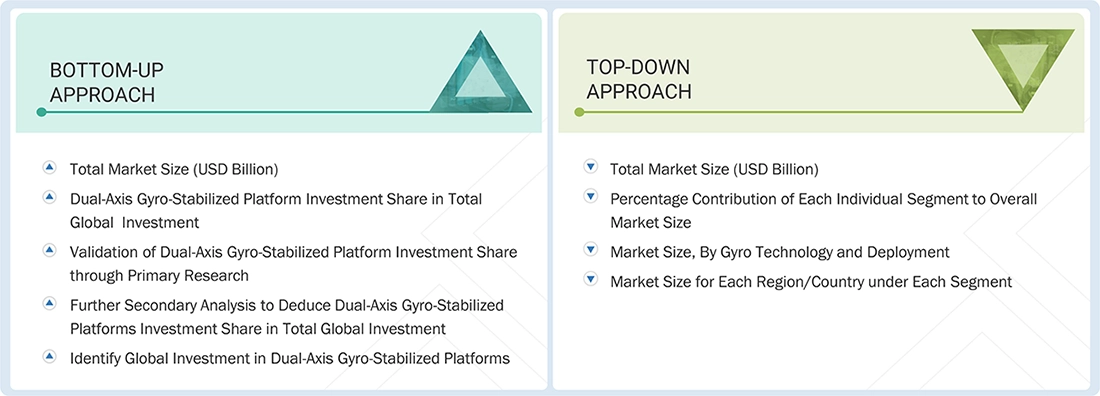
The top-down and bottom-up methods were used to estimate and validate the size of the dual-axis gyro-stabilized platforms market. The research process involved several steps to ensure accuracy.
- Key companies active in the dual-axis gyro-stabilized platforms market were identified through secondary research. Their market share was evaluated using a combination of primary inputs and published data. This included reviewing annual reports, financial disclosures, certification updates, and public filings from various organizations. Interviews were also conducted with industry participants such as company executives, program managers, operators, infrastructure providers, and aviation experts. These inputs were used to validate assumptions and refine market size estimates across regions.
- All percentage shares, segment splits, and market breakdowns were first developed using secondary information. These values were then verified through primary discussions with industry participants.
- The analysis assessed key factors influencing the dual-axis gyro-stabilized platforms market, including defense procurement frameworks, program timelines, technological advancements, platform integration capabilities, and investment trends. Each factor was evaluated through primary research and used to derive both quantitative and qualitative market estimates for this report.
Dual Axis Gyro Stabilized Platforms Market : Top-Down and Bottom-Up Approach
Data Triangulation
After determining the overall market size, the total market was divided into multiple segments and subsegments. The data triangulation and market breakdown procedures described below were carried out, where applicable, to complete the overall market analysis and determine the estimated market figures for the segments and subsegments. The data was triangulated by examining various factors and trends from both demand and supply sides. Additionally, the market size was validated using the top-down and bottom-up approaches.
Market Definition
The dual-axis gyro-stabilized platforms market encompasses all stabilized mounting systems, gimbal assemblies, control electronics, embedded software, and related services designed to maintain precise orientation and line-of-sight stability of payloads across two rotational axes (typically pitch and roll) despite platform motion or vibration. These systems are used to stabilize payloads such as electro-optical/infrared (EO/IR) sensors, radars, cameras, antennas, communication systems, and weapon systems mounted on moving platforms, including airborne, naval, land-based, and unmanned systems.
Key Stakeholders
- Defense ministries and armed forces responsible for surveillance, targeting, and platform stabilization requirements
- Homeland security and border protection agencies overseeing monitoring and reconnaissance operations
- Dual-axis gyro-stabilized platform manufacturers and original equipment manufacturers (OEMs)
- Electro-optical and infrared sensor system providers supporting surveillance and targeting capabilities
- Gyroscope and inertial navigation system providers (MEMS, fiber-optic, and ring laser gyroscopes)
- Motion control hardware providers (actuators, motors, controllers, and stabilization units)
- System integrators and defense platform manufacturers (land vehicles, naval vessels, airborne systems)
- Unmanned systems manufacturers (unmanned aerial systems, unmanned ground vehicles, and unmanned maritime platforms)
- Communication and data link solution providers supporting real-time data transmission
- Research organizations and government agencies involved in defense technology development and testing
- Maintenance, repair, and lifecycle service providers for stabilized platform systems
Report Objectives
- To define, describe, and forecast the size of the dual-axis gyro-stabilized platforms market, by gyro technology, system component, payload type, application, and deployment in terms of value
- To describe and forecast the market size of various segments across five key regions—North America, Europe, the Asia Pacific, the Middle East, and the Rest of the World, in terms of value
- To provide detailed information regarding drivers, restraints, opportunities, and challenges influencing the growth of the market
- To analyze the value chain and ecosystem, along with the average selling price of components
- To strategically analyze the regulatory landscape, standards, patents, import and export scenarios, trade data, the 2025 US tariffs, and case studies pertaining to the market under study
- To strategically analyze micromarkets1 with regard to individual growth trends, prospects, and contributions to the overall market
- To analyze opportunities in the market for stakeholders by identifying high-growth segments
- To provide details of the competitive landscape for market leaders
- To provide details of the macroeconomic outlook for regions
- To analyze strategies such asacquisitions, product launches, contracts, and partnerships adopted by players in the market
- To profile key players in the market and comprehensively analyze their market ranking based on their revenue, market share, and core competencies2
Available customizations:
MarketsandMarkets offers the following customizations for this market report:
- Additional country-level analysis of the dual-axis gyro-stabilized platforms market
- Profiling of other market players (up to 5)
Product Analysis
- Product matrix, which provides a detailed comparison of the product portfolio of each company in the dual-axis gyro-stabilized platforms market
Get the Full Dual-Axis Gyro-Stabilized Platforms Market Report
Full forecast, segment splits, and company analysis for all Dual-Axis Gyro-Stabilized Platforms Market.
- Canada Dual-Axis Gyro-Stabilized Platforms Market
- US Dual-Axis Gyro-Stabilized Platforms Market
- UK Dual-Axis Gyro-Stabilized Platforms Market
- Germany Dual-Axis Gyro-Stabilized Platforms Market
- France Dual-Axis Gyro-Stabilized Platforms Market
- Italy Dual-Axis Gyro-Stabilized Platforms Market
- Spain Dual-Axis Gyro-Stabilized Platforms Market
- China Dual-Axis Gyro-Stabilized Platforms Market
- India Dual-Axis Gyro-Stabilized Platforms Market
- Japan Dual-Axis Gyro-Stabilized Platforms Market
- Australia Dual-Axis Gyro-Stabilized Platforms Market
- South Korea Dual-Axis Gyro-Stabilized Platforms Market
- UAE Dual-Axis Gyro-Stabilized Platforms Market
- Saudi Arabia Dual-Axis Gyro-Stabilized Platforms Market
- Turkey Dual-Axis Gyro-Stabilized Platforms Market
- Rest Of Europe Dual-Axis Gyro-Stabilized Platforms Market
- Rest Of Asia Pacific Dual-Axis Gyro-Stabilized Platforms Market
Need a Tailored Report?
Customize this report to your needs
Get 10% FREE Customization
Customize This Report
