
India Ecommerce Platform Market (2025-2030)

The India Ecommerce Platform Market was valued at $320.1 Million in 2025 and projected to reach to $782.2 Million by 2030, representing a compound annual growth rate of 19.6%. India's ecommerce platform market is poised for transformative growth over the next five years, driven by fundamental shifts in consumer behavior and digital infrastructure development.


| Market Size in | USD 26.32 MN |
| Market Forecast in | |
| CAGR | |
| Forecast Period | |
| Units Considered | Value (USD MN) |
India Ecommerce Platform Market Trends and Insights
- This represents a compound annual growth rate of 19.6%, significantly outpacing global market growth of 12.7%.
- India's digital transformation, rising internet penetration, and increasing smartphone adoption are driving unprecedented demand for online retail infrastructure and marketplace solutions across the country. The forecast period from 2025 to 2030 will be critical for India's ecommerce ecosystem, as the market more than doubles in size.
- India's growing middle class, improved logistics networks, and government initiatives supporting digital commerce are creating favorable conditions for platform expansion.
- Major metropolitan areas and tier-2 cities in India are becoming increasingly important markets, with rural penetration expected to accelerate significantly by 2030. India's ecommerce platform market reflects the country's position as one of the world's fastest-growing digital economies.
- The competitive intensity in India continues to drive innovation in payment solutions, logistics integration, and seller enablement tools, positioning India as a key growth engine for the global ecommerce platform sector..
Key Market Statistics
- CAGR (2025-2030) 19.6% CAGR
- Market Size, 2025 ~USD 320.1 Million
- Forecast, 2030 ~USD 782.2 Million
- Country India
India Ecommerce Platform Market Overview
Explosive Growth Trajectory :
India's ecommerce platform market is projected to grow from $320.1 million in 2025 to $782.2 million by 2030, representing a 19.6% CAGR—significantly outpacing the global growth rate of 12.7%.
Digital Transformation Driver :
Rising internet penetration and smartphone adoption across India's tier-2 and tier-3 cities are unlocking new customer segments and creating unprecedented opportunities for ecommerce platform expansion.
Market Acceleration :
India's ecommerce platform market is experiencing rapid acceleration driven by increased digital payment adoption, improved logistics infrastructure, and growing consumer confidence in online shopping.
Regional Leadership :
India represents one of Asia's fastest-growing ecommerce markets, with local players and international entrants competing intensely to capture market share in this high-growth economy.
India Ecommerce Platform Market Dynamics
- The 19.6% CAGR reflects strong tailwinds from increasing smartphone penetration, affordable data plans, and expanding middle-class purchasing power across urban and semi-urban regions. Key growth catalysts include government initiatives promoting digital payments, improved last-mile delivery networks, and rising consumer trust in online transactions.
- As logistics capabilities mature and payment ecosystems expand, India's ecommerce platforms will capture growing market share from traditional retail, positioning the country as a critical growth engine for the global ecommerce sector..
Market Ecosystem
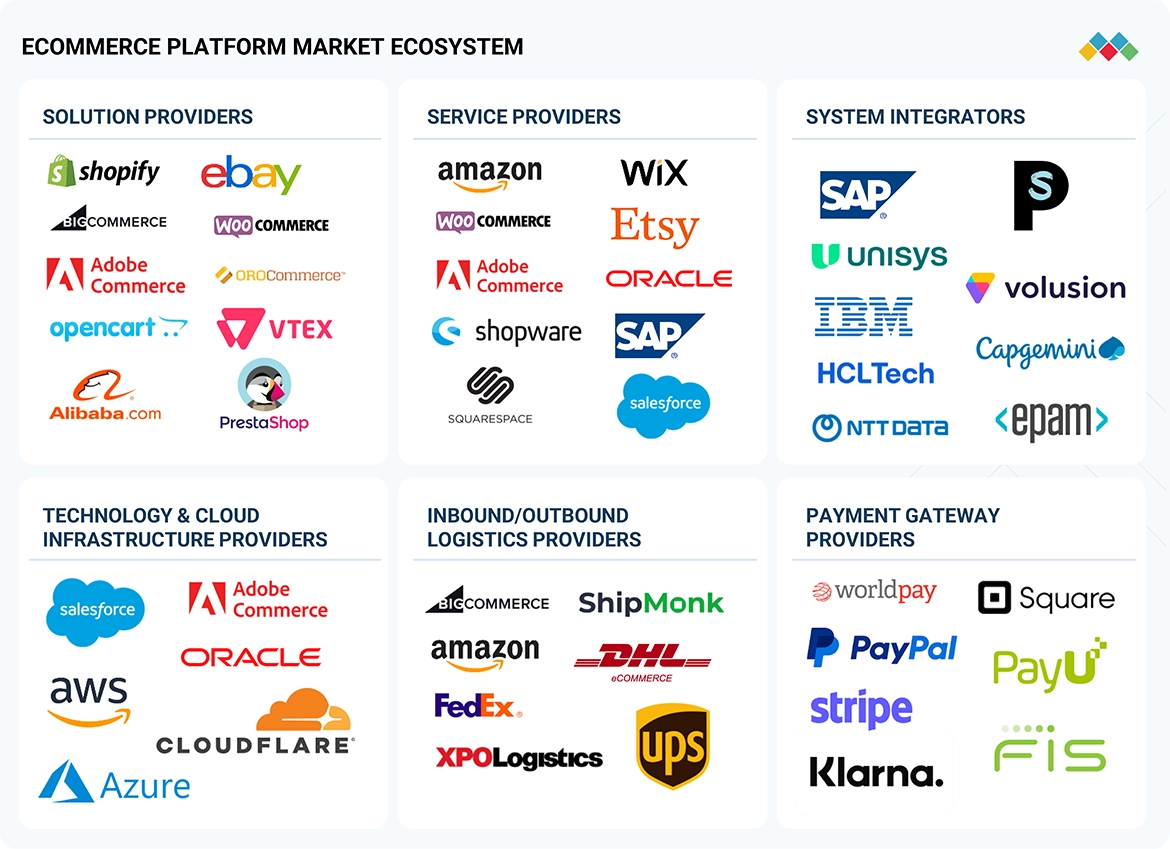
Ecommerce Platform Market: COMMERCIAL USE CASES ACROSS INDUSTRIES
| COMPANY | USE CASE DESCRIPTION | BENEFITS |
|---|---|---|
 |
Replatformed its digital experience to Shopify in 90 days to build a fast, mobile-first, and flexible flagship site that removes previous tech limitations. | Achieved 45% YoY revenue growth, reduced load times significantly, launched global sites within weeks, saved millions by simplifying tech stack, and enabled rapid product launches without performance issues. |
 |
Implemented a global digital commerce platform to scale operations and improve user experience across regions. | Enhanced customer engagement, increased sales through unified scalable platform, reduced checkout friction, supported faster merchandise launches, and grew global e-commerce performance. |
 |
Adopted VTEX to create a customer-centric e-commerce solution mapping individual journeys and boosting multichannel engagement. | Delivered higher customer satisfaction, faster checkout with VTEX Personal Shopper, increased sales participation (~25%), quick customer service response times, and improved brand loyalty with continuous engagement. |
Logos and trademarks shown above are the property of their respective owners. Their use here is for informational and illustrative purposes only.
Related Ecosystem
Software And Services
- Natural Language Processing (NLP)
- Machine Learning
- Supply Chain Management
- Predictive Analytics
- Image Sensors
- International Business Machines Corporation
- MICROSOFT CORPORATION
- Oracle Corporation
- SAP SE
- Amazon.com, Inc.
Key Takeaways
- India's ecommerce platform market will grow from $320.1M (2025) to $782.2M (2030), a 144% increase driven by digital adoption.
- India's 19.6% CAGR significantly exceeds the global average of 12.7%, making India the fastest-growing major ecommerce market.
- India's tier-2 and tier-3 city expansion, combined with improved payment infrastructure, will unlock new growth opportunities through 2030.
- India's competitive marketplace dynamics are accelerating innovation in logistics, seller tools, and consumer experience capabilities.
Ecommerce Platform Market Report Scope
| Report Metric | Details |
|---|---|
| Base Year | 2025 |
| Fastest Growing Segment | GENERATIVE AI (Type) |
| Forecast Period | 2025–2030 |
| Growth Rate | CAGR of 12.7% from 2025 to 2030 |
| Largest Segment | LARGE ENTERPRISES (Organization Size) |
| Market Size Base Year (Billions) | ~USD 9.08 (2025) |
| Revenue Forecast (Billions) | ~USD 16.5 (2030) |
| Segments Covered | Offering, Type, Ecommerce Model, Industry, Solution, Business Function, End User, Component, Service Model, Deployment Model, Organization Size |
India Ecommerce Platform Market Report Segmentation
11 segment dimensions are covered across the global market.
By Offering
- Services
- Solutions
By Type
- Ecommerce Management Platform
- End-To-End Platform
- Generative AI
- Other AI
- Payment & Billing Solutions
By Ecommerce Model
- B2B
- B2C
By Industry
- Beauty & Personal Care
- Consumer Electronics
- Fashion & Apparel
- Food & Beverage
- Health & Wellness
- Home Décor
- Household Consumables
- Other Industries
By Solution
- Ecommerce Management Platform
- End-To-End Platform
- Payment & Billing Solutions
By Business Function
- Cybersecurity
- Finance & Accounting
- Human Resource
- Marketing & Sales
- Operations
By End User
- Offline
- Online
By Component
- Services
- Solutions
By Service Model
- IaaS
- PaaS
- SaaS
By Deployment Model
- Hybrid Cloud
- Private Cloud
- Public Cloud
By Organization Size
- Large Enterprises
- Smes
INDIA: ECOMMERCE PLATFORM MARKET, BY INDUSTRY, 2025–2030
| Segment | 2025 | 2026 | 2027 | 2028 | 2029 | 2030 | CAGR (%) |
|---|---|---|---|---|---|---|---|
| CONSUMER ELECTRONICS | 53.1 | 64.2 | 77.4 | 93.3 | 109.1 | 126.6 | 19 |
| FASHION & APPAREL | 70.7 | 85 | 101.7 | 121.5 | 141.1 | 162.3 | 18.1 |
| FOOD & BEVERAGE | 37.3 | 45.8 | 56 | 68.5 | 81.3 | 95.7 | 20.8 |
| HEALTH & WELLNESS | 18.2 | 22.8 | 28.3 | 35.2 | 42.5 | 50.8 | 22.8 |
| HOME DÉCOR | 24.8 | 30.7 | 37.8 | 46.5 | 55.5 | 65.7 | 21.5 |
| HOUSEHOLD CONSUMABLES | 11.1 | 13.7 | 17 | 20.9 | 25.1 | 29.8 | 21.9 |
| BEAUTY & PERSONAL CARE | 41.7 | 50.9 | 61.9 | 75.2 | 88.8 | 103.9 | 20 |
| OTHER INDUSTRIES | 63.2 | 76.2 | 91.4 | 109.6 | 127.7 | 147.4 | 18.5 |
| TOTAL | 320.1 | 389.2 | 471.6 | 570.7 | 671.1 | 782.2 | 19.6 |
Target Audience
- Ecommerce Platform Operators : Platform companies need India-specific market data to benchmark performance, identify growth opportunities, and develop localized strategies for capturing share in this high-CAGR market.
- Investment & Private Equity Firms : Investors require detailed India market forecasts and growth analysis to evaluate investment opportunities, assess portfolio company potential, and identify acquisition targets in the ecommerce sector.
- Technology & Infrastructure Providers : SaaS, payment, and logistics companies need India market insights to understand demand drivers, size addressable opportunities, and develop India-specific product and service offerings.
- Strategic Consultants & Advisors : Consulting firms require comprehensive India ecommerce data to support client strategy development, market entry planning, and competitive positioning recommendations.
- Corporate Development & M&A Teams : Business development professionals need India market intelligence to identify acquisition targets, evaluate partnership opportunities, and support due diligence in this rapidly evolving market.
Key Companies in the India Ecommerce Platform Market
| Company | HQ | Ownership | Strongest segments |
|---|---|---|---|
| SHOPIFY | Canada | ||
| EBAY | United States | ||
| ETSY | United States | Public Company | Payment & Billing Solutions,Ecommerce Management Platform,End-To-End Platform, |
| SQUARE | United States | Private Company | Payment & Billing Solutions,Ecommerce Management Platform,End-To-End Platform, |
| AMAZON | United States | ||
| ADOBE | United States | ||
| ORACLE | United States | ||
| SQUARESPACE | United States | Private Company | End-To-End Platform,Ecommerce Management Platform,Payment & Billing Solutions, |
| SAP | Germany | Public Company | Payment & Billing Solutions,Ecommerce Management Platform,End-To-End Platform, |
| SALESFORCE | United States | Public Company | End-To-End Platform,Ecommerce Management Platform,Payment & Billing Solutions, |
| VTEX | Cayman Islands | Public Company | End-To-End Platform,Ecommerce Management Platform,Payment & Billing Solutions, |
| TRADE ME | New Zealand | Private Company | Ecommerce Management Platform,End-To-End Platform,Payment & Billing Solutions, |
SHOPIFY
Shopify is a Canadian e-commerce platform that enables businesses to create and manage online stores.
EBAY
eBay is a United States-based online marketplace that facilitates the buying and selling of goods between consumers and businesses.
ETSY
Etsy is a United States-based online marketplace founded in 2005 that specializes in handmade, vintage, and unique items, operating as a public company with 2375 employees.
SQUARE
Square is a United States-based financial services and digital payments company founded in 2003, operating as a private company with 1749 employees.
AMAZON
Amazon is a United States-based multinational technology and e-commerce company that offers a wide range of products and services including retail, cloud computing, and digital streaming.
ADOBE
Adobe is a United States-based software company that develops creative, marketing, and document management applications and services.
ORACLE
Oracle is a United States-based multinational technology company that develops database software, cloud computing solutions, and enterprise applications.
SQUARESPACE
Squarespace is a United States-based website building and hosting platform founded in 2003 that operates as a private company with 1749 employees.
SAP
SAP is a German multinational software company founded in 1972 that develops enterprise resource planning solutions, operating as a public company with 111038 employees.
SALESFORCE
Salesforce is a United States-based cloud computing company founded in 1999 that provides customer relationship management software and services, operating as a public company with 83334 employees.
VTEX
VTEX is a Cayman Islands-based e-commerce platform founded in 2000 that provides digital commerce solutions, operating as a public company with 1139 employees.
TRADE ME
Trade Me is a New Zealand-based online marketplace founded in 1999 that facilitates buying and selling of goods and services, operating as a private company with 546 employees.
Reasons to Buy this Report
- Market Size & Forecast Precision : Access validated market valuations for India's ecommerce platform sector with detailed 2025-2030 projections, enabling accurate financial planning and investment decisions specific to this high-growth market.
- Competitive Landscape Intelligence : Understand India-specific competitive dynamics, local player strategies, and international market entry patterns to identify partnership and acquisition opportunities in this rapidly consolidating market.
- Growth Driver Analysis : Gain deep insights into India's unique growth catalysts—digital payment adoption, logistics infrastructure development, and tier-2/3 city expansion—to tailor market entry and expansion strategies.
- Regional Segmentation Data : Leverage India-specific market segmentation by geography, platform type, and customer demographics to identify high-potential micro-markets and optimize resource allocation.
- Strategic Decision Support : Make informed decisions on market entry timing, investment scale, and go-to-market strategies backed by comprehensive India market analysis and forward-looking trend forecasts.
Frequently asked questions
What is the current size of India's ecommerce platform market?
India's ecommerce platform market is valued at $320.1 million in 2025, representing significant growth potential in the Asia Pacific region.
What is the projected market size for India's ecommerce platform market by 2030?
India's ecommerce platform market is forecast to reach $782.2 million by 2030, reflecting a compound annual growth rate of 19.6%.
How does India's ecommerce platform market growth compare to global trends?
India's 19.6% CAGR significantly outpaces the global ecommerce platform market CAGR of 12.7%, positioning India as a high-growth market.
What factors are driving growth in India's ecommerce platform market?
India's market growth is driven by rising internet penetration, smartphone adoption, digital payment infrastructure, government digital commerce initiatives, and expanding middle-class consumer base.
Which regions within India are expected to contribute most to market growth?
India's metropolitan areas continue to lead, while tier-2 and tier-3 cities are emerging as high-growth segments, with rural penetration accelerating toward 2030.
RESEARCH METHODOLOGY
This research study involved extensive secondary sources, directories, and databases, such as Dun & Bradstreet, D&B Hoovers, and Bloomberg BusinessWeek, to identify and collect valuable information for a technical, market-oriented, and commercial study of the eCommerce platform market. The primary sources have been mainly industry experts from the core and related industries and preferred suppliers, manufacturers, distributors, service providers, technology developers, alliances, and organizations related to all segments of the value chain of this market. In-depth interviews were conducted with primary respondents, including key industry participants, subject matter experts, C-level executives of key market players, and industry consultants, to obtain and verify critical qualitative and quantitative information.
Secondary Research
In the secondary research process, various secondary sources were referred to identify and collect information for the study. The secondary sources included annual reports, press releases, investor presentations of companies, white papers, certified publications, and articles from recognized associations and government publishing sources. Several journals and associations were also referred to, such as the Journal of Electronic Commerce Research (JECR) and the Journal of Electronic Commerce in Organizations (JECO). Secondary research was used to obtain key information about industry insights, the market’s monetary chain, the overall pool of key players, market classification and segmentation according to industry trends to the bottom-most level, regional markets, and key developments from both the market and technology-oriented perspectives.
Primary Research
In the primary research process, various primary sources from the supply and demand sides were interviewed to obtain qualitative and quantitative information for the report. The primary sources from the supply side included industry experts, such as chief executive officers (CEOs), chief technology officers (CTOs), chief operating officers (COOs), vice presidents (VPs), marketing directors, technology and innovation directors, and related key executives from various key companies and organizations operating in the eCommerce platform market. The primary sources from the demand side included eCommerce platform end users, consultants/specialists, chief information officers (CIOs), and subject-matter experts from enterprises and government associations.
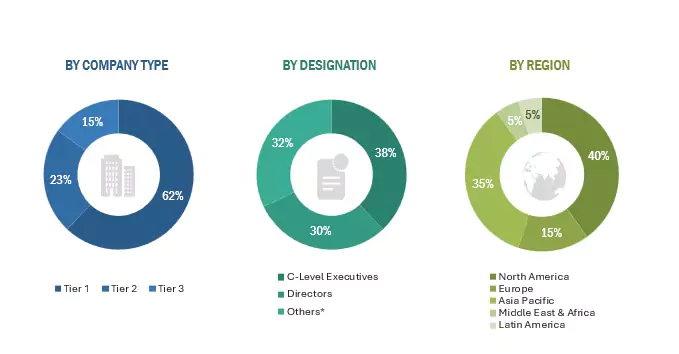
Note: Others include sales managers, marketing managers, and product managers.
Tier 1 companies’ revenue is more than USD 1 billion; Tier 2 companies ‘revenue ranges between USD 500 million
and USD 1 billion; and Tier 3 companies’ revenue ranges between USD 100 million and USD 500 million.
To know about the assumptions considered for the study, download the pdf brochure
Market Size Estimation
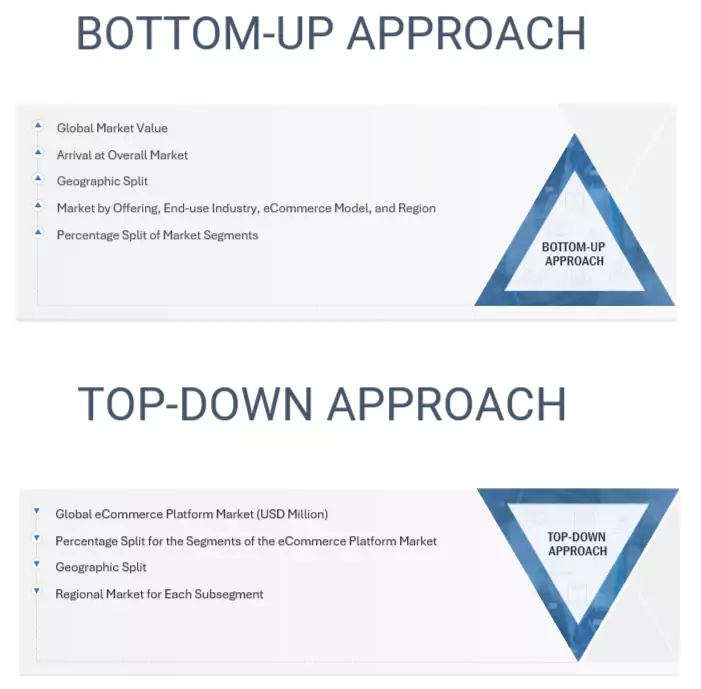
Multiple approaches were adopted to estimate and forecast the size of the eCommerce platform market. The first approach involves estimating market size by summing up the revenue companies generate through selling eCommerce platform solutions.
The top-down and bottom-up approaches were used to estimate and validate the total size of the eCommerce platform market. These methods were extensively used to estimate the size of various segments in the market. The research methodology used to estimate the market size includes the following:
- Key players in the market have been identified through extensive secondary research.
- In terms of value, the industry’s supply chain and market size have been determined through primary and secondary research processes.
- All percentage shares, splits, and breakups have been determined using secondary sources and verified through primary sources.
Ecommerce Platform Market : Top-Down and Bottom-Up Approach
Data Triangulation
After determining the overall market size, the eCommerce platform market was divided into several segments and subsegments. A data triangulation procedure was used to complete the overall market engineering process and determine the exact statistics for all segments and subsegments, wherever applicable. The data was triangulated by studying various factors and trends from the demand and supply sides. Along with data triangulation and market breakdown, the market size was validated by the top-down and bottom-up approaches.
Market Definition
An eCommerce platform comprises various technologies that facilitate buying and selling over the internet. It assists vendors in showcasing their products, providing discounts, and keeping customers engaged. On the buyer’s end, these technologies help consumers search for products they want, create shopping lists, and pay for their purchases online. It is a tool that enables businesses to manage their virtual assets, omnichannel marketing, digital sales, and operations all in one place.
According to Shopify, an eCommerce platform is a software application that facilitates online commerce between merchants and consumers. These platforms can handle web hosting, inventory management, payment processing, marketing, order fulfillment, and more.
Stakeholders
- eCommerce Platform Providers
- eCommerce Software Providers
- Government Organizations
- Regulatory Authorities
- Policymakers and Financial Organizations
- Consulting Firms
- Research Organizations
- Academic Institutions
- Resellers and Distributors
- Training Providers
Report Objectives
- To analyze and forecast the global eCommerce platform market from 2025 to 2030 for the following segments: Offerings: Solutions and Services; eCommerce Models: B2B (Business-to-Business) and B2C (Business-to-Consumer); and End-use Industries: Beauty & Personal Care, Consumer Electronics, Fashion & Apparel, Food & Beverage, Home Décor, Health & Wellness, Household Consumables, and Other Industries
- To examine the various macroeconomic and microeconomic factors that influence market growth
- To forecast the size of the market segments for North America, Europe, Asia Pacific (APAC), Latin America, and the Middle East & Africa (MEA)
- To provide detailed information about the major factors (drivers, restraints, opportunities, and challenges) influencing the growth of the eCommerce platform market
- To analyze each submarket concerning individual growth trends, prospects, and contributions to the overall eCommerce platform market
- To analyze the opportunities in the market for stakeholders by identifying the high-growth segments of the eCommerce platform market
- To profile the key market players, provide a comparative analysis based on business overviews, regional presence, product offerings, business strategies, and key financials, and illustrate the market’s competitive landscape
- To track and analyze competitive developments in the market, such as mergers and acquisitions, product developments, partnerships and collaborations, and research and development (R&D) activities
Available Customizations
With the given market data, MarketsandMarkets offers customizations based on the company’s specific needs. The following customization options are available for the report.
Geographic Analysis as per Feasibility
- Analysis for additional countries (up to five)
Company Information
- Detailed analysis and profiling of additional market players (up to 5)
Get the Full Ecommerce Platform Market Report
Full forecast, segment splits, and company analysis for all Ecommerce Platform Market.
- Canada Ecommerce Platform Market
- US Ecommerce Platform Market
- UK Ecommerce Platform Market
- Germany Ecommerce Platform Market
- China Ecommerce Platform Market
- Brazil Ecommerce Platform Market
- France Ecommerce Platform Market
- Italy Ecommerce Platform Market
- Rest Of Europe Ecommerce Platform Market
- Spain Ecommerce Platform Market
- Japan Ecommerce Platform Market
- Rest Of Asia Pacific Ecommerce Platform Market
- Singapore Ecommerce Platform Market
- Mexico Ecommerce Platform Market
- Rest Of Latin America Ecommerce Platform Market
- Rest Of Mea Ecommerce Platform Market
- Saudi Arabia Ecommerce Platform Market
- South Africa Ecommerce Platform Market
- UAE Ecommerce Platform Market
Need a Tailored Report?
Customize this report to your needs
Get 10% FREE Customization
Customize This Report
