
Rest Of Europe Edge Data Center Market (2025-2030)

The Rest Of Europe Edge Data Center Market was valued at $5375.3 Million in 2025 and projected to reach to $11350 Million by 2030, representing a compound annual growth rate of 16.1%. Rest Of Europe's edge data center market is positioned for sustained expansion through 2030, driven by the region's digital transformation initiatives and increasing enterprise reliance on distributed computing architectures.


| Market Size in | USD 26.32 MN |
| Market Forecast in | |
| CAGR | |
| Forecast Period | |
| Units Considered | Value (USD MN) |
Rest Of Europe Edge Data Center Market Trends and Insights
- This expansion reflects Rest Of Europe's increasing demand for low-latency computing infrastructure driven by IoT proliferation, 5G deployment, and real-time data processing requirements across manufacturing, retail, and telecommunications sectors.
- Rest Of Europe is positioning itself as a critical hub for distributed computing, with enterprises investing heavily in edge infrastructure to reduce bandwidth costs and improve application performance. The 16.1% compound annual growth rate (CAGR) through 2030 underscores Rest Of Europe's strategic importance in the global edge computing ecosystem.
- Rest Of Europe's market growth is fueled by regulatory compliance needs, data sovereignty requirements, and the region's commitment to digital transformation initiatives.
- Key verticals driving adoption in Rest Of Europe include smart cities, autonomous vehicles, and industrial automation, where edge data centers enable real-time decision-making and reduced latency.
- Rest Of Europe's competitive landscape is intensifying as both hyperscalers and regional providers establish edge infrastructure to serve enterprise and consumer demands..
Key Market Statistics
- CAGR (2025-2030) 16.1% CAGR
- Market Size, 2025 ~USD 5375.3 Million
- Forecast, 2030 ~USD 11350 Million
- Country Rest Of Europe
Rest Of Europe Edge Data Center Market Overview
Rapid Market Expansion :
Rest Of Europe's edge data center market is projected to nearly double from USD 5,375.3 million in 2025 to USD 11,350 million by 2030, representing a strong 16.1% CAGR that closely mirrors global growth trends.
5G and IoT Drivers :
The region's edge infrastructure growth is fueled by accelerating 5G network deployments and widespread IoT adoption across manufacturing hubs, retail operations, and telecommunications sectors requiring ultra-low latency solutions.
Real-Time Data Processing Demand :
Rest Of Europe's enterprises increasingly require edge computing for immediate data processing, reducing bandwidth costs and enabling faster decision-making in time-sensitive applications across multiple verticals.
Strategic Regional Positioning :
Rest Of Europe serves as a critical bridge between Western European markets and emerging Eastern European economies, creating unique opportunities for distributed edge infrastructure deployment and localized data sovereignty compliance.
Rest Of Europe Edge Data Center Market Dynamics
- Manufacturing sectors across Central and Eastern Europe are particularly investing in edge solutions to support Industry 4.0 initiatives, while telecommunications providers are building localized infrastructure to support 5G service delivery and reduce latency for consumer applications. The market's growth trajectory reflects broader European regulatory trends emphasizing data residency and GDPR compliance, which favor localized edge deployments over centralized cloud models.
- Investment in edge infrastructure is expected to accelerate as enterprises recognize cost efficiencies and performance improvements, with particular momentum in countries modernizing their digital infrastructure and seeking alternatives to Western European data center concentration..
Market Ecosystem
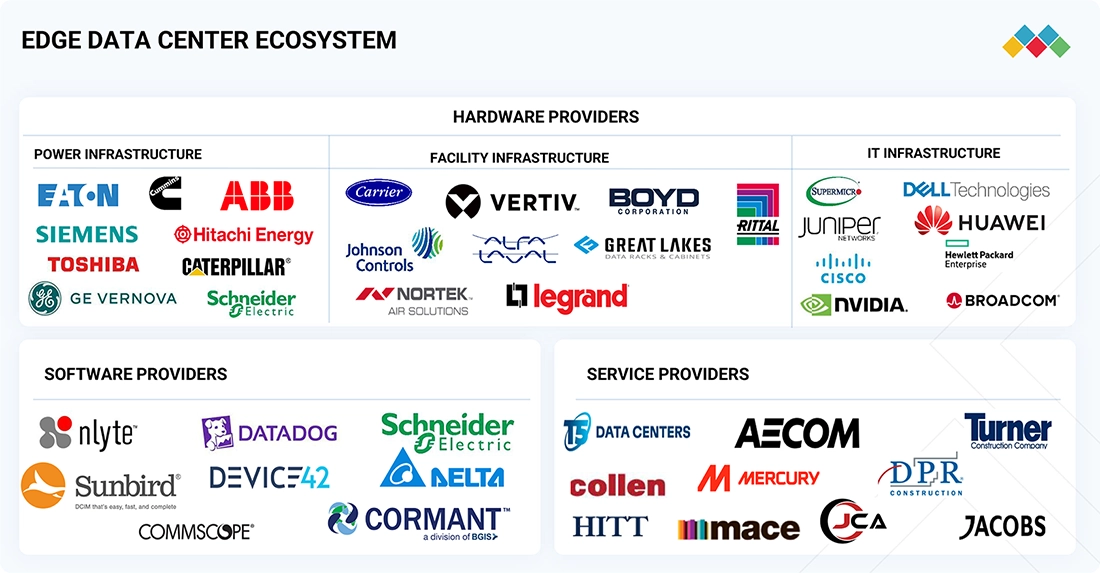
EDGE DATA CENTER MARKET: COMMERCIAL USE CASES ACROSS INDUSTRIES
| COMPANY | USE CASE DESCRIPTION | BENEFITS |
|---|---|---|
 |
SK Telecom deployed a 5G Multi-Access Edge Computing (MEC) platform with Dell Technologies, Intel, AWS Wavelength, MobiledgeX and Bridge Alliance, featuring on-site MEC infrastructure and AI offloading | Enabled AI offloading with neural processing units, quantum cryptography and Telco API services; improved scalability, low latency edge delivery and created new revenue streams from edge services |
 |
P&G accelerated global manufacturing with Microsoft Azure IoT Edge solutions, deploying Azure Arc, Kubernetes-native MQTT brokers, Azure Data Lake and AI/ML models across 35+ countries | 90% reduction in AI model deployment time, scalable edge AI deployment across plants, improved OEE, enhanced quality assurance, cloud-to-edge integration and strategic innovation via real-time data-driven insights |
 |
Afterpay used Digital Realty’s edge computing network for distributed infrastructure, cloud optimization and real-time decision-making at the data source | Faster access to cloud resources for 450+ employees, significant latency reduction, improved IT scalability, enhanced monitoring, streamlined and responsive user experience globally |
 |
TED enhanced media delivery and productivity with 365 Data Centers’ edge infrastructure, deploying distributed colocation edge centers, low-latency networks and scalable connectivity for HD video workflows | Deployed 2 Gbps low-latency network, enabled near-real-time HD video transfers, enhanced productivity and operational efficiency, reduced bandwidth cost versus traditional cloud/on-prem |
 |
Georgia Tech advanced high-performance research using DataBank’s edge-enabled High-Performance Computing Cluster with distributed edge data centers and integrated data flow architecture | Delivered cost-effective and high-performing HPCC infrastructure, increased network backup and data capacity, reduced cooling/space demands, enabled complex research at optimized cost and performance |
Logos and trademarks shown above are the property of their respective owners. Their use here is for informational and illustrative purposes only.
Related Ecosystem
Automotive Electronics And Electrical Equipment
- Battery Electric Vehicle (BEV)
- Light Commercial Vehicles (LCVs)
- Fuel Cell Electric Vehicle (FCEV)
- Sensors
- Hybrid Electric Vehicle (HEV)
- BOSCH LIMITED
- Continental ag
- DENSO Corporation
- Panasonic Holdings Corporation
- Texas Instruments Incorporated
Data Centre And Networking
- Software-Defined Networking (SDN)
- Mid-Sized Data Centers
- Small Data Centers
- Remote Monitoring
- Smart Healthcare
- Cisco Systems, Inc.
- HUAWEI TECHNOLOGIES CO LTD
- Hewlett Packard Enterprise Company
- MITSUBISHI ELECTRIC INFORMATION SYSTEMS CORPORATION
- MITSUBISHI ELECTRIC INFORMATION NETWORK CORPORATION
Key Takeaways
- Rest Of Europe's edge data center market will more than double from USD 5,375.3 million in 2025 to USD 11,350 million by 2030, growing at a 16.1% CAGR.
- Rest Of Europe is driven by 5G rollout, IoT expansion, and enterprise demand for low-latency, distributed computing infrastructure.
- Data sovereignty and GDPR compliance requirements position Rest Of Europe as a preferred location for edge deployments serving European enterprises.
- Rest Of Europe's edge market is attracting both global hyperscalers and regional providers competing to establish localized infrastructure.
Edge Data Center Market Report Scope
| Report Metric | Details |
|---|---|
| Base Year | 2025 |
| Fastest Growing Segment | AR/VR & IMMERSIVE EXPERIENCES (Application) |
| Forecast Period | 2025-2030 |
| Growth Rate | CAGR of 16.5% from 2025 to 2030 |
| Largest Segment | INFRASTRUCTURE (Component) |
| Market Size Base Year (Billions) | ~USD 50.89 (2025) |
| Revenue Forecast (Billions) | ~USD 109.2 (2030) |
| Segments Covered | Component, Infrastructure, Data Center It Infrastructure, Data Center Power Infrastructure, Data Center Racks & Enclosures, Data Center Cooling Infrastructure, Software, Service, Application, End User, Enterprise |
Rest Of Europe Edge Data Center Market Report Segmentation
11 segment dimensions are covered across the global market.
By Component
- Edge Hardware
- Edge Software
- Infrastructure
- Services
- Software
By Infrastructure
- Data Center Cooling Infrastructure
- Data Center It Infrastructure
- Data Center Power Infrastructure
- Data Center Racks & Enclosures
By Data Center It Infrastructure
- Network
- Networking
- Server
- Servers
- Storage
By Data Center Power Infrastructure
- Cabling Infrastructure
- Power Backup
- Power Distribution
- Power Generation
- Switchgear
By Data Center Racks & Enclosures
- Enclosed
- Enclosed Racks
- Open Frame
- Open Frame Racks
By Data Center Cooling Infrastructure
- Air Cooling
- Liquid Cooling
By Software
- Analytics & Edge AI Software
- Building/Facility Management Software
- Compliance & Security Software
- Dcim Software
- Virtualization, Automation, And Orchestration Software
By Service
- Design & Consulting
- Integration & Deployment
- Support & Maintenance
By Application
- 5G Services & Network Function Virtualization (Nfv)
- 5G Services & Nfv
- Ar/Vr & Immersive Experiences
- Cdn & Caching
- Connected & Autonomous Mobility
- Content Delivery Network & Caching
- Edge AI Inference & Real-Time Analytics
- Industrial IoT & Automation
- Interactive Gaming & Competitive Play
- Other Applications
By End User
- Colocation Service Providers
- Enterprises
- Hyperscalers & Cloud Service Providers
By Enterprise
- Bfsi
- Energy & Utilities
- Government & Public Sector
- Healthcare & Life Sciences
- Manufacturing
- Other Enterprises
- Retail & Consumer Goods
- Technology & Software
- Telecommunications
Target Audience
- Data Center Operators & Infrastructure Providers : Need Rest Of Europe-specific market data to identify optimal locations for edge facility deployment, assess regional demand intensity, and plan capacity expansion aligned with projected 16.1% CAGR growth.
- Telecommunications & Network Providers : Require detailed insights into Rest Of Europe's 5G rollout timelines and edge infrastructure requirements to strategically position edge computing services and optimize network architecture for low-latency applications.
- Enterprise IT & Digital Transformation Leaders : Need regional market intelligence to evaluate edge computing adoption trends, benchmark against Rest Of Europe peers, and justify infrastructure investments aligned with local digital transformation initiatives.
- Technology Vendors & Solution Providers : Seek Rest Of Europe market segmentation and growth forecasts to prioritize product development, identify emerging use cases in manufacturing and retail, and develop region-specific go-to-market strategies.
- Investment & Strategy Consultants : Require comprehensive Rest Of Europe market analysis to advise clients on edge computing investment opportunities, competitive positioning, and M&A strategies within the region's rapidly expanding infrastructure market.
Reasons to Buy this Report
- Regional Market Sizing & Forecasts : Obtain precise market valuations specific to Rest Of Europe with detailed 2025-2030 projections, enabling accurate budget allocation and investment planning tailored to regional growth trajectories rather than global averages.
- Competitive Landscape Intelligence : Understand Rest Of Europe's unique competitive dynamics, including regional players, market consolidation trends, and infrastructure deployment patterns distinct from Western European markets and global competitors.
- Regulatory & Compliance Insights : Navigate Rest Of Europe's specific data sovereignty requirements, GDPR implications, and localization mandates that directly influence edge infrastructure investment decisions and deployment strategies across the region.
- Vertical-Specific Opportunities : Identify high-growth segments within Rest Of Europe's manufacturing, retail, and telecommunications sectors with tailored edge computing requirements, enabling targeted market entry and partnership strategies.
- Strategic Investment Decisions : Make informed capital allocation decisions for edge infrastructure expansion in Rest Of Europe with confidence, backed by regional demand drivers, growth catalysts, and market maturity assessments specific to your target markets.
Frequently asked questions
What is the current market size of edge data centers in Rest Of Europe?
Rest Of Europe's edge data center market is valued at USD 5,375.3 million in 2025 and is expected to grow to USD 11,350 million by 2030.
What is the projected growth rate for Rest Of Europe's edge data center market?
Rest Of Europe's edge data center market is projected to grow at a compound annual growth rate (CAGR) of 16.1% from 2025 to 2030.
What are the primary drivers of edge data center adoption in Rest Of Europe?
Rest Of Europe's edge data center growth is driven by 5G deployment, IoT proliferation, real-time data processing needs, GDPR compliance requirements, and enterprise demand for low-latency infrastructure.
Which industries are leading edge data center investments in Rest Of Europe?
Rest Of Europe's key verticals include smart cities, autonomous vehicles, industrial automation, telecommunications, retail, and manufacturing sectors requiring real-time computing capabilities.
How does data sovereignty impact Rest Of Europe's edge data center market?
Rest Of Europe's strict data sovereignty and GDPR regulations drive enterprises to deploy edge infrastructure locally, creating strong demand for regionally-based edge data centers.
RESEARCH METHODOLOGY
This research study on the edge data center market involved extensive secondary sources, directories, IEEE Communication-Efficient: Algorithms and Systems, International Journal of Innovation and Technology Management, and paid databases. Primary sources were mainly industry experts from the core and related industries, preferred edge data center providers, third-party service providers, consulting service providers, end users, and other commercial enterprises. In-depth interviews with primary respondents, including key industry participants and subject matter experts, were conducted to obtain and verify critical qualitative and quantitative information and assess the market’s prospects.
Secondary Research
In the secondary research process, various sources were referred to identify and collect information for this study. Secondary sources included annual reports, press releases, and investor presentations of companies; white papers, journals, and certified publications; and articles from recognized authors, directories, and databases. The data was also collected from other secondary sources, such as journals, government websites, blogs, and vendors’ websites. Additionally, the edge data center spending of various countries was extracted from the respective sources.
Primary Research
In the primary research process, various sources from the supply and demand sides were interviewed to obtain qualitative and quantitative information on the market. The primary sources from the supply side included various industry experts, such as Chief Experience Officers (CXOs), Vice Presidents (VPs), and directors specializing in business development, marketing, and edge data center providers. It also included key executives from edge data center vendors, system integrators (SIs), professional service providers, industry associations, and other key opinion leaders.
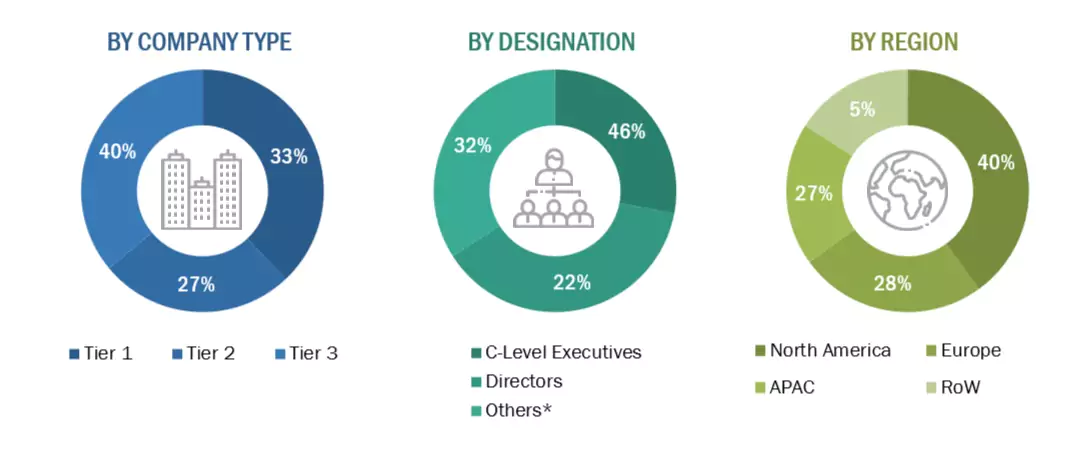
Note: Tier 1 companies’ revenues are more than USD 10 billion; tier 2 companies’ revenues range between
USD 1 and 10 billion; and tier 3 companies’ revenues range between USD 500 million and USD 1 billion.
Other designations include sales managers, marketing managers, and product managers.
Source: Industry Experts
To know about the assumptions considered for the study, download the pdf brochure
Market Size Estimation
Multiple approaches were adopted to estimate and forecast the edge data center market. The first approach involved estimating the market size by companies’ revenue generated through the sale of edge data center services.
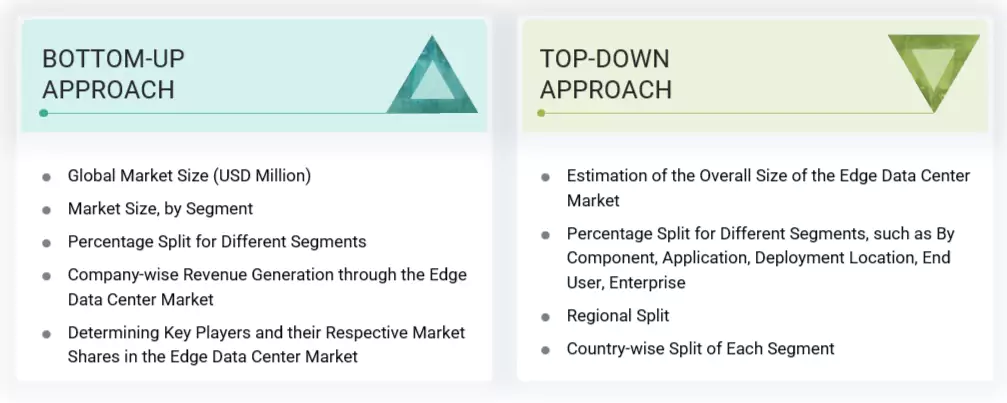
Market Size Estimation Methodology- Top-down approach
The top-down approach for the edge data center market begins with estimating the overall market size and then breaking it down into smaller segments for a detailed view. This methodology leverages macro-level market statistics and applies percentage splits to distribute the total value across different components such as hardware, software, and services. It further dissects the market by application, organization size, deployment model, and vertical to provide a comprehensive segmentation. The analysis also incorporates regional and country-wise splits to account for geographical variations in demand and adoption. This approach is particularly useful for aligning forecasts with strategic planning and investment decisions, as it relies on broad industry data, trends, and top-level insights from authoritative reports. By starting from an aggregate figure and allocating shares based on weighted assumptions and historical patterns, the top-down method ensures that the derived estimates align with the global market perspective, supporting stakeholders in assessing high-level growth opportunities and regional priorities in the edge data center ecosystem.
Market Size Estimation Methodology-Bottom-up approach
The bottom-up approach to estimating the edge data center market focuses on deriving market size from the granular level by aggregating data across individual companies and segments. This methodology involves assessing company-wise revenue generation within the edge data center ecosystem, examining their respective contributions to the overall market. It begins by analyzing the global market size in monetary terms and then segmenting it by various dimensions such as hardware, software, and services. Furthermore, percentage splits for different segments are calculated to understand the relative contribution of each component or application area. A critical aspect of this approach includes identifying key players in the edge data center domain and determining their respective market shares based on actual sales data, partnerships, and regional presence. This process ensures a highly accurate and realistic estimation, as it relies on validated data sources and bottom-line financials, making it particularly suitable for understanding competitive landscapes, micro-market trends, and investment opportunities in edge data center solutions.
Edge Data Center Market : Top-Down and Bottom-Up Approach
Data Triangulation
After determining the overall market size using the market size estimation processes as explained above, the market was split into several segments and subsegments. Data triangulation and market breakup procedures were employed, wherever applicable, to complete the overall market engineering process and arrive at the exact statistics of each market segment and subsegment. The overall market size was then used in the top-down procedure to estimate the size of other individual markets via percentage splits of the market segmentation.
Market Definition
The edge data center market refers to the segment of the data center industry focused on deploying smaller, decentralized facilities located closer to end users and data sources to deliver low-latency processing, high bandwidth, and real-time data management. Unlike traditional centralized data centers, edge data centers are designed to support emerging technologies such as IoT, 5G, artificial intelligence (AI), and real-time analytics, enabling faster response times and reducing the dependency on distant cloud or core facilities. These facilities integrate critical IT infrastructure, including servers, storage, and networking, with advanced cooling systems and energy-efficient designs to handle high-performance and AI-driven workloads. Edge data centers are strategically positioned in metropolitan areas, remote sites, and near critical applications to optimize performance for industries such as telecommunications, healthcare, manufacturing, retail, and autonomous systems. The market encompasses hardware, software, and services that enable distributed computing, virtualization, orchestration, and secure connectivity. As businesses and service providers increasingly adopt digital transformation strategies, the edge data center market plays a pivotal role in enhancing scalability, resilience, and operational efficiency. This evolution positions edge data centers as a foundational component of next-generation digital infrastructure, supporting mission-critical applications and delivering superior user experiences.
Stakeholders
- Training and consulting service providers
- Information Technology (IT) infrastructure providers
- Component providers
- System Integrators (SI)
- Support service providers
- Cloud Service Providers (CSPs)
- Government organizations and standardization bodies
- Data center providers
- Regional associations
- Independent hardware and software vendors
- Value-added resellers and distributors
Report Objectives
- To forecast the market based on Component (IT Infrastructure (storage, server, networking), Data Center Power Infrastructure (Power Generation (Generators, Gas Turbines), Power Backup (Uninterrupted Power Supply (UPS), Battery Energy Storage System (Bess)), Power Distribution (Switchboards, Busways, Power Distribution Units (PDUs), Other Power Distribution), Switchgear (High Voltage Switchgear, Medium Voltage Switchgear, Low Voltage Switchgear), Cabling Infrastructure, Data Center Racks & Enclosure (Open Frame, Enclosed), Data Center Cooling Infrastructure ((Air Cooling (Air-Cooled Chillers, Cooling Towers, Other Air-cooling Solutions), Liquid Cooling (Heat Exchangers, Water-cooled Chillers, Coolant Distribution Unit (CDU), Other Liquid Cooling Solutions), Software (DCIM Software, Building/Facility Management Software, Virtualization, Automation & Orchestration Software, Compliance & Security Software, Analytics & Edge AI Software), Service (Design & Consulting, Integration & Deployment, Support & Maintenance), Application (Edge AI Inference & Real-time Analytics, AR/VR & Immersive Experiences, 5G?Services & Network Function Virtualization (NFV), Content?Delivery Network (CDN) & Caching, Industrial?IoT & Automation, Interactive Gaming & Competitive Play, Connected & Autonomous Mobility, Other Applications (Smart Facility Security & Access Management and Smart Buildings & Facility Management), Deployment Location (Metro Edge Data Center, Network Edge Data Center, Regional Edge Data Center), End User (Hyperscalers & Cloud Service Providers, Colocation Service Providers, Enterprises), Enterprise (Manufacturing, Retail and E-commerce, Telecom, Energy & Utilities, Banking, Financial Services, and Insurance (BFSI), Healthcare & Life Sciences, Technology & Software, Government & Public Sector, Other Enterprises (Transportation & Logistics and Media & Entertainment), and Region
- To forecast the market size of five major regional segments: North America, Europe, Asia Pacific, the Middle East & Africa, and Latin America
- To strategically analyze the market subsegments with respect to individual growth trends, prospects, and contributions to the total market
- To provide detailed information related to the major factors influencing the growth of the market (drivers, restraints, opportunities, and challenges)
- To strategically analyze macro and micro markets with respect to growth trends, prospects, and their contributions to the overall market
- To analyze the industry trends, patents and innovations, and pricing data related to the market
- To analyze the opportunities in the market for stakeholders and provide details of the competitive landscape for major players
- To analyze the impact of AI/generative AI on the market
- To profile the key players in the market and comprehensively analyze their market share/ranking and core competencies
- To track and analyze the competitive developments such as mergers & acquisitions, product launches, and partnerships & collaborations in the market
Available Customizations
With the given market data, MarketsandMarkets offers customizations as per the company’s specific needs. The following customization options are available for the report:
Product Analysis
- The product matrix provides a detailed comparison of the product portfolio of each company.
Geographic Analysis as per Feasibility
- Further breakup of the North American edge data center market
- Further breakup of the European edge data center market
- Further breakup of the Asia Pacific edge data center market
- Further breakup of the Middle East & African edge data center market
- Further breakup of the Latin American edge data center market
Company Information
- Detailed analysis and profiling of additional market players (up to five)
Get the Full Edge Data Center Market Report
Full forecast, segment splits, and company analysis for all Edge Data Center Market.
- South Africa Edge Data Center Market
- Brazil Edge Data Center Market
- Mexico Edge Data Center Market
- Rest Of Asia Pacific Edge Data Center Market
- Rest Of Latin America Edge Data Center Market
- GCC Countries Edge Data Center Market
- Ksa Edge Data Center Market
- Rest Of GCC Countries Edge Data Center Market
- Canada Edge Data Center Market
- US Edge Data Center Market
- UK Edge Data Center Market
- Germany Edge Data Center Market
- France Edge Data Center Market
- Italy Edge Data Center Market
- China Edge Data Center Market
- Japan Edge Data Center Market
- India Edge Data Center Market
- UAE Edge Data Center Market
Need a Tailored Report?
Customize this report to your needs
Get 10% FREE Customization
Customize This Report
