
Japan Edible Oils Market (2024-2029)

The Japan Edible Oils Market was valued at $3554.4 Million in 2024 and projected to reach to $3864.8 Million by 2029, representing a compound annual growth rate of 1.7%. Japan's edible oils market demonstrates resilience with steady growth at 1.7% CAGR through 2029, significantly lower than the global 4.1% rate.


| Market Size in | USD 26.32 MN |
| Market Forecast in | |
| CAGR | |
| Forecast Period | |
| Units Considered | Value (USD MN) |
Japan Edible Oils Market Trends and Insights
- Japan's market growth reflects steady demand driven by traditional culinary preferences and increasing health consciousness among consumers.
- The relatively modest growth rate in Japan compared to global averages underscores the market's maturity and saturation in this developed economy. In Japan, the edible oils sector is characterized by established consumer preferences for specific oil types, including soybean, canola, and sesame oils, which remain integral to Japanese cuisine.
- Between 2024 and 2029, Japan's market will benefit from premiumization trends, growing interest in plant-based products, and innovations in oil extraction and processing technologies.
- Japan's aging population and focus on wellness-oriented food products are expected to sustain moderate but consistent market expansion throughout the forecast period..
Key Market Statistics
- CAGR (2024-2029) 1.7% CAGR
- Market Size, 2024 ~USD 3554.4 Million
- Forecast, 2029 ~USD 3864.8 Million
- Country Japan
Japan Edible Oils Market Overview
Market Valuation :
Japan's edible oils market is valued at USD 3,554.4 million in 2024, reflecting a mature and established market with consistent consumer demand for quality oils.
Growth Trajectory :
The market is projected to reach USD 3,864.8 million by 2029, growing at a CAGR of 1.7%, indicating steady but modest expansion driven by health-conscious consumer trends.
Traditional Preferences :
Japan's edible oils market is shaped by deep-rooted culinary traditions favoring sesame oil, soy oil, and other specialty oils that align with Japanese cuisine and cooking methods.
Health & Wellness Focus :
Increasing health consciousness among Japanese consumers is driving demand for premium, organic, and functional edible oils with perceived nutritional and wellness benefits.
Japan Edible Oils Market Dynamics
- This reflects Japan's mature market status and saturated consumer base with established purchasing patterns.
- The market is characterized by strong preference for traditional oils and premium products that cater to health-conscious demographics. Future growth will be driven by premiumization trends, increased focus on organic and functional oils, and innovation in product offerings targeting aging populations.
- Consumer awareness of health benefits associated with specific oil types—such as omega-3 rich oils and plant-based alternatives—will support market expansion.
- However, market growth will remain constrained by demographic challenges and stable consumption patterns typical of developed markets..
Market Ecosystem
Related Ecosystem
Fandb Ingredients
- Dairy Products
- Bakery Products
- Microorganism
- Polydextrose
- Carbohydrates
- AZELIS HOLDINGS SA
- Archer-Daniels-Midland Company
- Kerry Group plc
- Amway
- DSM FIRMMENICH
Key Takeaways
- Japan's edible oils market is valued at USD 3,554.4 million in 2024 with a projected value of USD 3,864.8 million by 2029.
- Japan's market is growing at a 1.7% CAGR, reflecting a mature and stable market compared to faster-growing regions.
- Japan's consumer preferences for traditional oils like sesame and canola drive consistent demand in the edible oils sector.
- Japan's focus on health and wellness products is expected to support premiumization and sustained growth through 2029.
Edible Oils Market Report Scope
| Report Metric | Details |
|---|---|
| Base Year | 2024 |
| Fastest Growing Segment | SOYBEAN OIL (Type) |
| Forecast Period | 2024-2029 |
| Growth Rate | CAGR of 4.1% from 2024 to 2029 |
| Largest Segment | LIQUID (Form) |
| Market Size Base Year (Billions) | ~USD 251.06 (2024) |
| Revenue Forecast (Billions) | ~USD 306.92 (2029) |
| Segments Covered | Type, End Use, Packaging Type, Form |
Japan Edible Oils Market Report Segmentation
4 segment dimensions are covered across the global market.
By Type
- Olive Oil
- Other Edible Oils
- Palm Oil
- Rapeseed Oil
- Soybean Oil
- Sunflower Oil
By End Use
- Food Service
- Household
- Industrial
By Packaging Type
- Bottles
- Metal Cans & Tins
- Pouches
By Form
- Dry
- Liquid
- Solid
Target Audience
- Food & Beverage Manufacturers : Japanese and international F&B companies need market-specific data to develop products aligned with local preferences, optimize supply chains, and identify growth opportunities in Japan's edible oils sector.
- Retail & Distribution Companies : Retailers and distributors operating in Japan require detailed market insights to stock appropriate product assortments, forecast demand, and make informed purchasing decisions for Japanese consumers.
- Investment & Private Equity Firms : Investors evaluating opportunities in Japan's food sector need comprehensive market data to assess growth potential, valuation metrics, and competitive dynamics of the edible oils market.
- Market Research & Consulting Professionals : Analysts and consultants serving clients in Japan's food industry require detailed market cutout data to support strategic recommendations, competitive analysis, and market forecasting.
- Agricultural & Oil Production Companies : Producers and suppliers of edible oils need Japan-specific market intelligence to understand demand patterns, pricing trends, and opportunities for product positioning in this mature market.
Reasons to Buy this Report
- Market Size & Valuation Data : Access precise market valuation figures for Japan (USD 3,554.4M in 2024) with 5-year forecasts, enabling accurate financial planning and investment decisions specific to the Japanese market.
- Growth Rate Analysis : Understand Japan's 1.7% CAGR in context of global 4.1% growth, identifying market maturity levels and competitive positioning opportunities within the Japanese edible oils sector.
- Consumer Preference Insights : Gain detailed understanding of Japanese consumer preferences for traditional oils, premium products, and health-conscious choices that drive purchasing decisions in this unique market.
- Strategic Market Entry : Develop informed market entry or expansion strategies for Japan with comprehensive data on market dynamics, growth drivers, and competitive landscape specific to Japanese consumers.
- Trend Identification : Identify emerging trends in health consciousness, premiumization, and organic product demand within Japan's edible oils market to capitalize on growth opportunities and consumer shifts.
Frequently asked questions
What is the current size of Japan's edible oils market?
Japan's edible oils market is valued at USD 3,554.4 million in 2024.
What is the projected market size for Japan's edible oils by 2029?
Japan's edible oils market is projected to reach USD 3,864.8 million by 2029.
What is the growth rate of Japan's edible oils market?
Japan's edible oils market is growing at a CAGR of 1.7% from 2024 to 2029.
Which oil types are most popular in Japan?
Japan's consumers predominantly prefer soybean, canola, and sesame oils, which are integral to traditional Japanese cuisine.
What factors are driving growth in Japan's edible oils market?
Japan's market growth is driven by health consciousness, premiumization trends, wellness-oriented products, and innovations in oil processing technologies.
RESEARCH METHODOLOGY
The study involved two major approaches in estimating the current size of the edible oils market. Exhaustive secondary research was done to collect information on the market, peer, and parent markets. The next step was to validate these findings, assumptions, and sizing with industry experts across the value chain through primary research. Both top-down and bottom-up approaches were employed to estimate the complete market size. After that, market breakdown and data triangulation were used to estimate the market size of segments and subsegments.
Secondary Research
In the secondary research process, various sources such as annual reports, press releases & investor presentations of companies, white papers, food journals, certified publications, articles from recognized authors, directories, and databases were referred to identify and collect information.
Secondary research was mainly used to obtain key information about the industry’s supply chain, the total pool of key players, and market classification and segmentation as per the industry trends to the bottom-most level, regional markets, and key developments from both market- and technology-oriented perspectives.
Primary Research
Extensive primary research was conducted after obtaining information regarding the edible oils market scenario through secondary research. Several primary interviews were conducted with market experts from both the demand and supply sides across major countries of North America, Europe, Asia Pacific, South America, and the Rest of the World. Primary data was collected through questionnaires, emails, and telephonic interviews. The primary sources from the supply side included various industry experts, such as Chief X Officers (CXOs), Vice Presidents (VPs), Directors from business development, marketing, research, and development teams, and related key executives from distributors and key opinion leaders. Primary interviews were conducted to gather insights such as market statistics, data on revenue collected from the products and services, market breakdowns, market size estimations, market forecasting, and data triangulation. Primary research also helped in understanding the various trends related to type, packaging type, packaging technology, grade, extraction technology, end-use, application, distribution channel and region. Stakeholders from the demand side, such as bakery products manufacturers, food processing company, and flavor enhancement brands, were interviewed to understand the buyer’s perspective on the suppliers, products, and their current usage and the outlook of their business, which will affect the overall market.
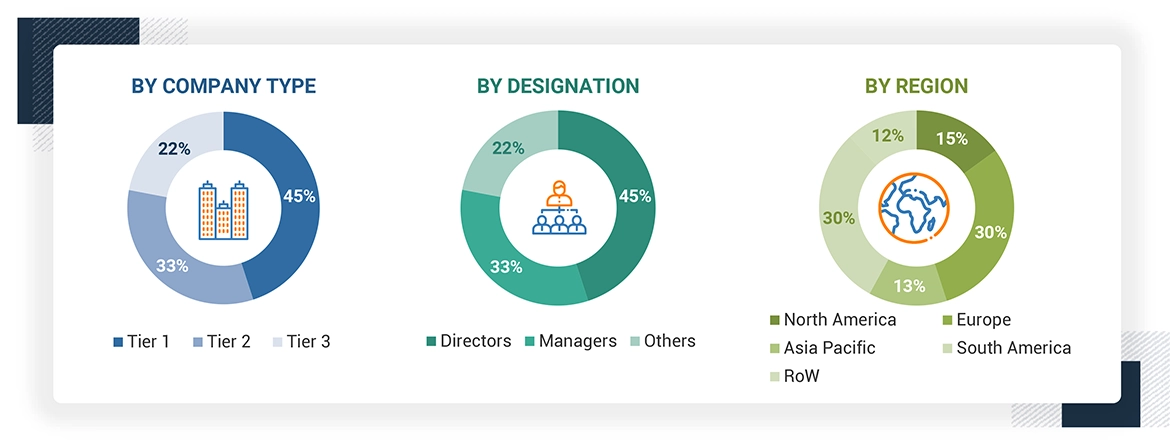
Note: The three tiers of the companies are defined based on their total revenues in 2022 or 2023, as per
the availability of financial data: Tier 1: Revenue > USD 1 billion; Tier 2: USD 100 million ≤ Revenue ≤ USD
1 billion; Tier 3: Revenue < USD 100 million.
To know about the assumptions considered for the study, download the pdf brochure
|
COMPANY NAME |
DESIGNATION |
|
ADM (US) |
Product Development Manager |
|
Associated British Foods plc (UK) |
Senior R&D Scientist |
|
Cargill Incorporated (US) |
Global Marketing Director |
|
AJANTA SOYA LIMITED (India) |
Head of Edible Oils Technology |
|
United Plantations Berhad (Malaysia) |
Senior Research Scientist |
|
Bunge (US) |
Business Development Manager |
Market Size Estimation
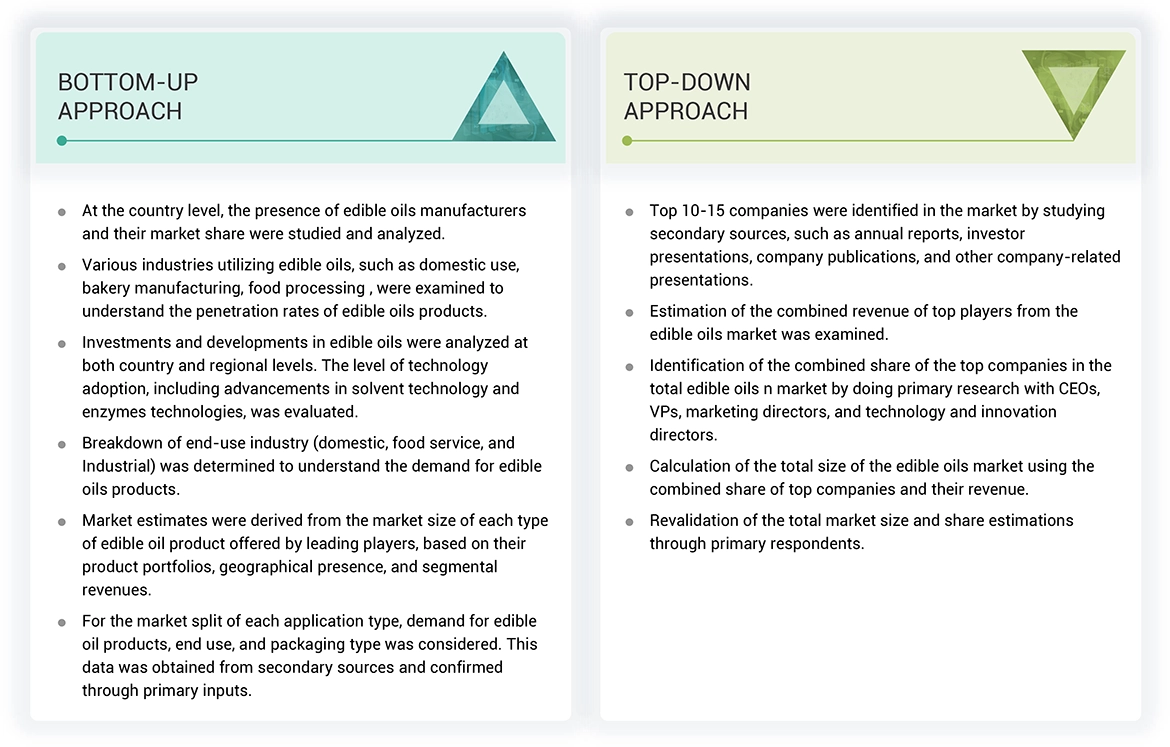
Both the top-down and bottom-up approaches were used to estimate and validate the total size of the edible oils market. These approaches were also used extensively to determine the size of various subsegments in the market. The research methodology used to estimate the market size includes the following details:
- The key players in the industry and the overall markets were identified through extensive secondary research.
- All shares, splits, and breakdowns were determined using secondary sources and verified through primary sources.
- All possible parameters that affect the market covered in this research study were accounted for, viewed in extensive detail, verified through primary research, and analyzed to obtain final quantitative and qualitative data.
- The research included the study of reports, reviews, and newsletters of top market players, along with extensive interviews for opinions from leaders, such as CEOs, directors, and marketing executives.
Edible Oils Market : Top-Down and Bottom-Up Approach
Data Triangulation
After arriving at the overall market size from the estimation process explained above, the total market was split into several segments and subsegments. The data triangulation and market breakdown procedures were employed, wherever applicable, to estimate the overall edible oils market and arrive at the exact statistics for all segments and subsegments. The data was triangulated by studying various factors and trends from the demand and supply sides. The market size was also validated using both the top-down and bottom-up approaches.
Market Definition
According to the US Patents and Trademark Office (USPTO), edible oil is defined as “the fat of a plant origin, which is in the form of liquid at room temperature and is appropriate to use in food. The different kinds of edible oils of plant origin include palm oil, soybean oil, pumpkin seed oil, canola oil, sunflower oil, corn oil, peanut oil, corn oil, sesame oil, sesame seed oil, and grape seed oil, among others.”
They are used in baking, frying, and several food preparations. Edible oils are also used in flavorings and cooking, which does not involve any heat source, such as bread dips and salad dressings.
Stakeholders
- Edible Oil Manufacturers
-
Food and Beverage Manufacturers
- Fortified food producers
- Functional beverage companies
-
Regulatory bodies and institutions:
- U.S. Food and Drug Administration (FDA)
- European Food Safety Authority (EFSA)
- Health Canada
- Food Safety and Standards Authority of India (FSSAI)
- World Health Organization (WHO)
- National Institutes of Health (NIH)
- Institute of Food Technologists (IFT)
-
Distributors and Wholesalers
- Ingredient and equipment distributors
-
Research and Development Institutions
- Academic research organizations
- Private research labs
Report Objectives
-
MARKET INTELLIGENCE
- To determine and project the size of the edible oils market with respect to the types, end-use and regions in terms of value over five years, ranging from 2024 to 2029.
- To identify the attractive opportunities in the market by determining the largest and fastest-growing segments across regions
- To provide detailed information about the key factors influencing market growth (drivers, restraints, opportunities, and challenges)
- To analyze the opportunities in the market for stakeholders and provide details of the competitive landscape for market leaders.
- To analyze the micro-markets with respect to individual growth trends, prospects, and their contribution to the total market.
- To identify and profile the key players in the edible oils market.
- To understand the competitive landscape and identify the major growth strategies adopted by players across the key regions.
Available Customizations
With the given market data, MarketsandMarkets offers customizations according to company-specific scientific needs.
The following customization options are available for the report:
Product Analysis
- Product Matrix, which gives a detailed comparison of the product portfolio of each company.
Geographic Analysis as per Feasibility
With the given market data, MarketsandMarkets offers customizations according to company-specific scientific needs.
- Further breakdown of the Rest of Europe edible oils market into key countries.
- Further breakdown of the Rest of Asia Pacific edible oils market into key countries.
- Further breakdown of the Rest of South America edible oils market into key countries.
Company Information
- Detailed analyses and profiling of additional market players (up to five)
Get the Full Edible Oils Market Report
Full forecast, segment splits, and company analysis for all Edible Oils Market.
- US Edible Oils Market
- Canada Edible Oils Market
- Mexico Edible Oils Market
- Germany Edible Oils Market
- UK Edible Oils Market
- France Edible Oils Market
- Spain Edible Oils Market
- Italy Edible Oils Market
- Netherlands Edible Oils Market
- Poland Edible Oils Market
- Austria Edible Oils Market
- Czech Republic Edible Oils Market
- Hungary Edible Oils Market
- Romania Edible Oils Market
- China Edible Oils Market
- India Edible Oils Market
- Australia Edible Oils Market
- South Korea Edible Oils Market
- Indonesia Edible Oils Market
- Malaysia Edible Oils Market
- Brazil Edible Oils Market
- Argentina Edible Oils Market
- Bulgaria Edible Oils Market
- Rest Of Europe Edible Oils Market
- Slovakia Edible Oils Market
- Rest Of Asia Pacific Edible Oils Market
- Rest Of South America Edible Oils Market
Need a Tailored Report?
Customize this report to your needs
Get 10% FREE Customization
Customize This Report
