
Canada Electric Fuse Market (2025-2030)

The Canada Electric Fuse Market was valued at $107.3 Million in 2025 and projected to reach to $132.6 Million by 2030, representing a compound annual growth rate of 4.3%. Canada's electric fuse market is positioned for steady growth driven by infrastructure renewal initiatives and the country's transition toward clean energy.


| Market Size in | USD 26.32 MN |
| Market Forecast in | |
| CAGR | |
| Forecast Period | |
| Units Considered | Value (USD MN) |
Canada Electric Fuse Market Trends and Insights
- This steady expansion reflects Canada's ongoing investment in electrical infrastructure modernization, renewable energy integration, and grid reliability initiatives.
- Canada's market growth is driven by increasing demand for protective electrical components across industrial, commercial, and utility sectors as the country transitions toward sustainable energy systems. The Canadian electric fuse market benefits from stringent safety regulations, aging infrastructure replacement cycles, and the country's commitment to clean energy adoption.
- Between 2025 and 2030, Canada is expected to see heightened demand for advanced fuse technologies that support smart grid deployment and distributed energy resources.
- Canada's position as a major energy producer and exporter further reinforces the need for robust electrical protection systems across transmission and distribution networks..
Key Market Statistics
- CAGR (2025-2030) 4.3% CAGR
- Market Size, 2025 ~USD 107.3 Million
- Forecast, 2030 ~USD 132.6 Million
- Country Canada
Canada Electric Fuse Market Overview
Market Size & Growth :
Canada's electric fuse market is valued at USD 107.3 million in 2025, with a projected CAGR of 4.3% through 2030, reaching USD 132.6 million. This growth trajectory reflects steady demand across industrial, utility, and residential sectors.
Infrastructure Modernization :
Canadian utilities are investing heavily in grid modernization and smart grid technologies, driving demand for advanced fuse solutions that enhance system reliability and reduce downtime in aging electrical infrastructure.
Renewable Energy Integration :
Canada's commitment to renewable energy expansion, particularly wind and hydroelectric projects, requires specialized fuse systems to manage variable power flows and protect distributed generation networks across provinces.
Regulatory & Safety Standards :
Stringent Canadian electrical codes and safety regulations mandate high-quality fuse components, creating consistent demand from utilities, manufacturers, and construction firms adhering to CSA and provincial compliance requirements.
Canada Electric Fuse Market Dynamics
- Provincial utilities are upgrading aging distribution networks while integrating renewable sources, necessitating reliable protection devices.
- The market benefits from strong regulatory frameworks and significant capital investments in grid modernization across major provinces including Ontario, British Columbia, and Alberta. Looking ahead to 2030, the Canadian market will be shaped by increasing electrification of transportation, industrial automation, and smart grid deployments.
- Growing demand from data centers, manufacturing facilities, and residential construction will sustain market expansion.
- Strategic partnerships between local distributors and international fuse manufacturers will enhance product availability and innovation tailored to Canadian specifications..
Market Ecosystem
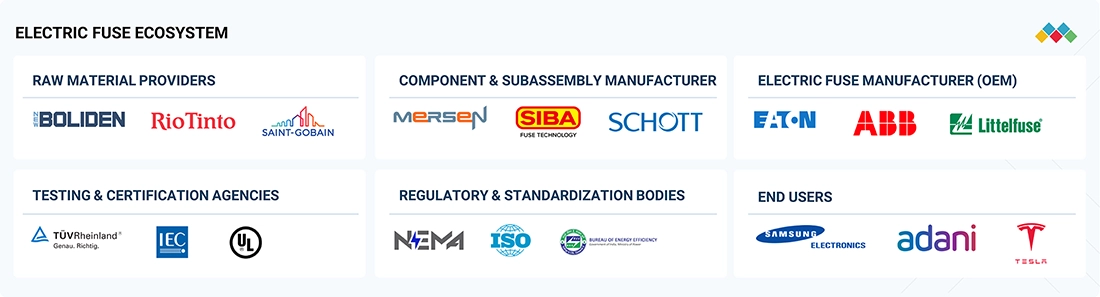
Electric Fuse Market: COMMERCIAL USE CASES ACROSS INDUSTRIES
| COMPANY | USE CASE DESCRIPTION | BENEFITS |
|---|---|---|
 |
Rexel Electrical Knoxfield faced challenges managing low-volume, high-mix fuse inventories, leading to stockouts, service delays, and operational inefficiencies. Fuseco partnered with Rexel to restructure the fuse section, introducing clearly labeled tote boxes, digital inventory reconciliation, and assorted fuse kits to improve accessibility for miniature and cartridge fuses. | The initiative streamlined inventory management by reducing obsolete and excess stock while improving accuracy through digital reconciliation. Customer accessibility and service levels were enhanced, allowing faster order fulfillment and better availability of specialty fuses. The solution also increased fuse sales, picking accuracy, and operational efficiency, strengthening Rexel’s reputation as a reliable supplier of niche and hard-to-find fuse products. |
 |
Fuse Service provided a turnkey electrical installation for a newly constructed U.S. home, covering design, wiring, panel setup, outlets, lighting, and low-voltage systems. The solution ensured code compliance, streamlined delivery, and future-ready capacity for EV charging, security, and data systems. | The integrated solution ensured code compliance, seamless coordination, and reduced project complexity. Homeowners received a fully operational electrical system with future-proof capacity for upgrades, improved efficiency in installation, and a single point of contact for all electrical needs. The project minimized delays, enhanced quality, and offered convenience and reliability throughout the construction process. |
Logos and trademarks shown above are the property of their respective owners. Their use here is for informational and illustrative purposes only.
Related Ecosystem
Power Infrastructure
- Geographical Information System (GIS)
- Cogeneration
- Battery Electric Vehicle (BEV)
- Cellular Network
- Fuel Cell
- Siemens ag
- ABB India Limited
- SCHNEIDER ELECTRIC SE
- General Electric Company
- Eaton Corporation plc
Key Takeaways
- Canada's electric fuse market is valued at USD 107.3 million in 2025 and will reach USD 132.6 million by 2030, growing at 4.3% CAGR.
- Canada's market growth is supported by infrastructure modernization, renewable energy integration, and strict electrical safety compliance requirements.
- Canada's aging electrical grid and transition to distributed energy resources are driving demand for advanced protective fuse technologies.
- Canada's role as a major energy producer creates sustained demand for reliable electrical protection systems across utility and industrial sectors.
Electric Fuse Market Report Scope
| Report Metric | Details |
|---|---|
| Base Year | 2025 |
| Fastest Growing Segment | DC (Current Type) |
| Forecast Period | 2025–2030 |
| Growth Rate | CAGR of 4.9% from 2025 to 2030 |
| Largest Segment | AC (Current Type) |
| Market Size Base Year (Billions) | ~USD 3.99 (2025) |
| Revenue Forecast (Billions) | ~USD 5.07 (2030) |
| Segments Covered | Type, Current Type, Voltage, End User |
Canada Electric Fuse Market Report Segmentation
4 segment dimensions are covered across the global market.
By Type
- Cartridge & Plug Fuses
- Distribution Cutouts
- Distributions Cutouts
- Other Types
- Power Fuses & Fuse Links
By Current Type
- Ac
- Dc
By Voltage
- High
- Low
- Medium
By End User
- Commercial
- Industrial
- Other End User
- Other End Users
- Residential
- Transporatation
- Transportation
- Utilities
CANADA: ELECTRIC FUSE MARKET, BY END USER, 2025–2030
| Segment | 2025 | 2026 | 2027 | 2028 | 2029 | 2030 | CAGR (%) |
|---|---|---|---|---|---|---|---|
| COMMERCIAL | 9.6 | 10.1 | 10.6 | 11 | 11.4 | 11.9 | 4.4 |
| INDUSTRIAL | 14.7 | 15.4 | 16.1 | 16.8 | 17.5 | 18.1 | 4.3 |
| OTHER END USERS | 2.8 | 2.9 | 3 | 3.2 | 3.3 | 3.4 | 4.2 |
| RESIDENTIAL | 3.5 | 3.6 | 3.8 | 3.9 | 4 | 4.2 | 3.8 |
| TRANSPORTATION | 5.2 | 5.5 | 5.8 | 6.1 | 6.4 | 6.7 | 5.1 |
| UTILITIES | 71.5 | 75.1 | 78.6 | 81.9 | 85.2 | 88.3 | 4.3 |
| TOTAL | 107.3 | 112.7 | 117.9 | 122.9 | 127.8 | 132.6 | 4.3 |
Target Audience
- Utility Companies & Grid Operators : Canadian utilities need market intelligence to plan fuse procurement, evaluate supplier capabilities, and align purchasing strategies with grid modernization and renewable integration initiatives.
- Electrical Equipment Manufacturers : Manufacturers require Canada-specific demand forecasts, regulatory insights, and competitive analysis to develop products meeting Canadian standards and capture market share in this growing segment.
- Distributors & Wholesalers : Electrical distributors need accurate market sizing and growth projections to optimize inventory management, negotiate supplier contracts, and identify emerging demand from construction and industrial sectors.
- Construction & Engineering Firms : Contractors and engineers need market data to understand fuse specifications, compliance requirements, and supplier availability for residential, commercial, and industrial electrical projects across Canada.
- Investment & Strategy Consultants : Consultants advising energy sector clients require detailed Canadian market analysis to support M&A decisions, market entry strategies, and investment recommendations in the electrical protection equipment space.
Key Companies in the Canada Electric Fuse Market
| Company | HQ | Ownership | Strongest segments |
|---|---|---|---|
| NVENT ELECTRIC | United Kingdom | Public Company | Systems Protection (enclosures, equipment protection, cooling, control buildings, bus systems),Electrical Connections (power and data connections, cable management, grounding, tools and test instruments), |
| MERSEN | France | Public Company | Advanced Materials (graphite, SiC, carbon/carbon, corrosion-resistant equipment),Electrical Power Protection (fuses, DC protection, surge protection, switches, power stacks),Motion and Power Transfer (carbon brushes, slip rings, current collectors, brush gear assemblies), |
| LITTELFUSE, INC. | United States | Public Company | Electronics segment (fuses, TVS, Si/SiC power semis, ESD, interconnects),Transportation segment (fuses, PDMs, breakers, sensors),Industrial segment (industrial fuses, relays, contactors, safety devices), |
| BEL | United States | Public Company | Copper cable and connectivity solutions,Fiber cable and connectivity solutions,Interconnect panels, racks, enclosures, signal extension and switching, |
| FUJI ELECTRIC CO., LTD. | Japan | Public Company | Power semiconductors,AC drives, motors, and industrial controls,Power supply and UPS, including data center and solar inverters, |
| HUBBELL | United States | Public Company | Utility transmission and distribution components,Grid edge, smart meters, communications, protection and control,Wiring devices and rough-in electrical products, |
NVENT ELECTRIC
NVENT Electric is a United Kingdom-based electrical equipment manufacturer founded in 1903, operating as a public company with 12,000 employees.
MERSEN
Mersen is a French public company founded in 1889 that employs 7,153 people and operates in the electrical equipment sector.
LITTELFUSE, INC.
Littelfuse, Inc. is a United States-based public company founded in 1927 with 17,000 employees, specializing in electrical components and equipment.
BEL
BEL is a United States-based public company founded in 1902 with 8,000 employees operating in the electrical equipment industry.
FUJI ELECTRIC CO., LTD.
Fuji Electric Co., Ltd. is a Japanese public company founded in 1923 with 26,955 employees, providing electrical and industrial equipment solutions.
HUBBELL
Hubbell is a United States-based public company founded in 1888 with 18,200 employees, operating in the electrical equipment and components industry.
Reasons to Buy this Report
- Market-Specific Sizing & Forecasts : Access precise valuation data for Canada's electric fuse market with country-specific CAGR (4.3%) and detailed projections through 2030, enabling accurate budgeting and investment planning for Canadian operations.
- Infrastructure Investment Insights : Understand provincial utility spending patterns, grid modernization timelines, and capital allocation across Canada's major electrical networks to identify high-opportunity regions and customer segments.
- Regulatory & Compliance Framework : Gain detailed knowledge of Canadian electrical codes, CSA standards, and provincial safety requirements that influence product specifications, procurement processes, and competitive positioning in the market.
- Renewable Energy Opportunity Analysis : Identify growth drivers from Canada's renewable energy expansion, including wind farms, hydroelectric projects, and distributed generation networks requiring specialized fuse protection solutions.
- Competitive Landscape & Partnerships : Discover key market players, distribution channels, and partnership opportunities specific to Canada, enabling strategic market entry or expansion decisions for manufacturers and suppliers.
Frequently asked questions
What is the current size of Canada's electric fuse market?
Canada's electric fuse market is estimated at USD 107.3 million in 2025.
What is the projected market size for Canada's electric fuse market by 2030?
Canada's electric fuse market is projected to reach USD 132.6 million by 2030.
What is the growth rate of Canada's electric fuse market?
Canada's electric fuse market is expected to grow at a compound annual growth rate of 4.3% from 2025 to 2030.
What factors are driving growth in Canada's electric fuse market?
Canada's market growth is driven by infrastructure modernization, renewable energy adoption, grid reliability requirements, and aging electrical system replacement cycles.
Which sectors are the primary consumers of electric fuses in Canada?
Canada's primary consumers include utility companies, industrial manufacturers, commercial enterprises, and renewable energy operators requiring electrical protection systems.
RESEARCH METHODOLOGY
The study involved major activities in estimating the current size of the electric fuse market. Exhaustive secondary research was done to collect information on the peer and parent markets. The next step was to validate these findings, assumptions, and sizing with industry experts across the value chain through primary research. The top-down and bottom-up approaches were employed to estimate the total market size. Thereafter, market breakdown and data triangulation techniques were used to estimate the market size of the segments and subsegments.
Secondary Research
This research study utilized extensive secondary sources, directories, and databases, including Hoover’s, Bloomberg, Factiva, IRENA, the International Energy Agency, and Statista Industry Journal, to collect and identify valuable information for a technical, market-oriented, and commercial study of the electric fuse. Other secondary sources included annual reports, press releases, and investor presentations of companies; white papers; certified publications; and articles by recognized authors, as well as manufacturer associations, trade directories, and databases.
Primary Research
In the primary research process, various primary sources from the supply and demand sides were interviewed to obtain qualitative and quantitative information for this report. Primary sources from the supply side include industry experts such as chief executive officers (CEOs), vice presidents (VPs), marketing directors, and related key executives from various companies and organizations operating in the electric fuse market.
In the complete market engineering process, the top-down and bottom-up approaches, along with several data triangulation methods, were extensively used to perform the market size estimations and forecasts for all segments and subsegments listed in this report. Extensive qualitative and quantitative analyses were conducted to complete the market engineering process and list key information/insights throughout the report.
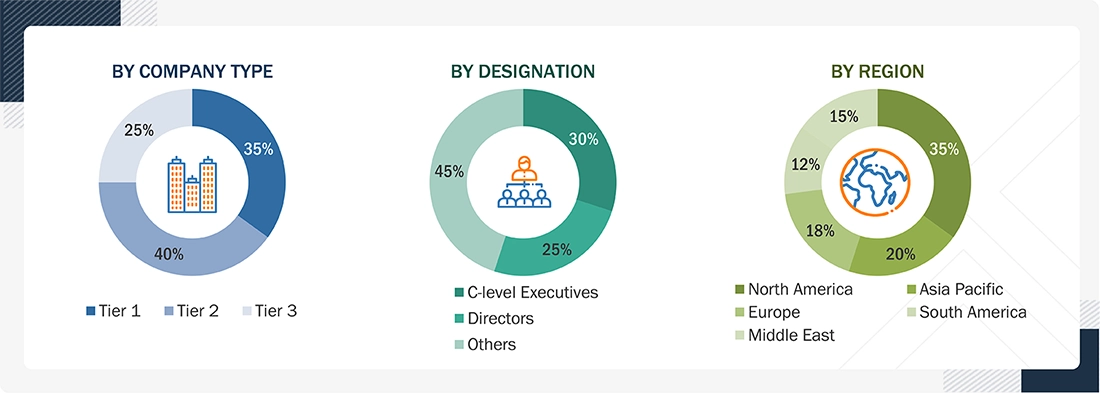
Note: The tiers of the companies are defined based on their total revenues as of 2024. Tier 1: > USD 1 billion,
Tier 2: From USD 500 million to USD 1 billion, and Tier 3: < USD 500 million. Others include sales managers, engineers, and regional managers.
To know about the assumptions considered for the study, download the pdf brochure
Market Size Estimation
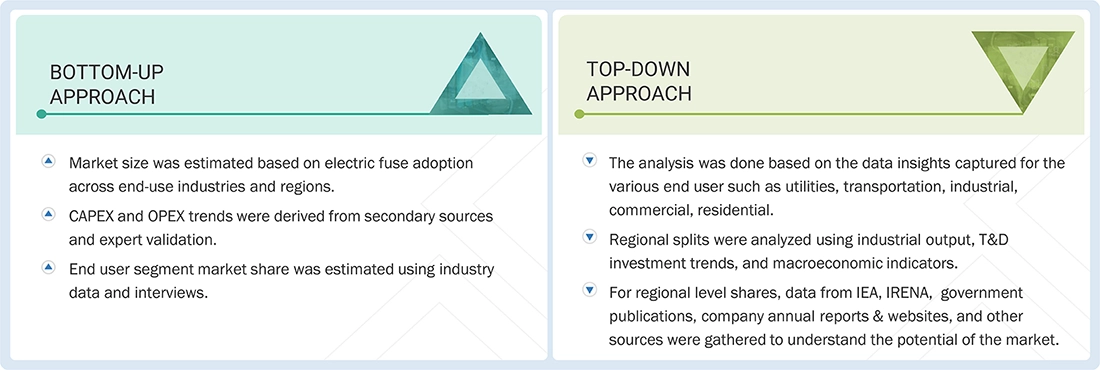
The top-down and bottom-up approaches were used to estimate and validate the total size of the electric fuse market. These methods were also used extensively to estimate the size of various subsegments of the market. The research methodology used to estimate the market size includes the following.
Electric Fuse Market : Top-Down and Bottom-Up Approach
Data Triangulation
The total market was split into several segments and subsegments after arriving at the overall market size from the above estimation process. Data triangulation and market breakdown processes were employed to complete the overall market engineering process and arrive at the exact statistics for all the segments and subsegments, wherever applicable. The data was triangulated by studying various factors and trends from the demand and supply sides. In addition, the market size was validated using both the top-down and bottom-up approaches.
Market Definition
An electric fuse is a safety device used in electrical circuits to protect equipment and wiring from overcurrent or short circuits. It consists of a metallic wire or strip that melts when the current flowing through it exceeds a specified limit, thereby interrupting the circuit and preventing damage or fire. Electric fuses help protect electrical equipment from overcurrent situations in circuits and avoid catastrophic aftereffects such as fire or electric arcing.
The electric fuse market is defined as the total revenue generated by companies from the sale of electric fuses across various end-use industries such as utilities, industrial, residential, commercial, EV Charging, transportation, data centers, and others.
Stakeholders
- Electric fuse manufacturers, dealers, and suppliers
- Energy utilities
- Government and industry associations
- Government and research organizations
- Institutional investors
- Investors/shareholders
- Power and energy associations
- Transmission and distribution utilities
Report Objectives
- To describe, segment, and forecast the electric fuse market size, by type, current type, voltage, and end user in terms of value
- To forecast the market size across five key regions, namely North America, Europe, Asia Pacific, the Middle East & Africa, and South America, along with the country-level market sizes, in terms of value
- To forecast the market size across five key regions, namely, North America, Europe, Asia Pacific, the Middle East & Africa, and South America, in terms of volume
- To provide detailed information about the key drivers, restraints, opportunities, and challenges influencing the growth of the electric fuse market
- To strategically analyze the electric fuse market for individual growth trends, prospects, and contributions of each segment to the market
- To provide information pertaining to the supply chain, trends/disruptions impacting customer business, ecosystem/market map, pricing analysis, patent analysis, case study analysis, technology analysis, key conferences and events, impact of AI/Gen AI, impact of US Tariff, Porter’s five forces analysis, and regulatory landscape of the electric fuse market.
- To strategically analyze the micromarkets1 with respect to individual growth trends, upcoming expansions, and their contributions to the overall market
- To analyze opportunities for stakeholders in the electric fuse market and draw a competitive landscape for market players
- To benchmark players within the market using the company evaluation matrix, which analyzes market players on various parameters within the broad categories of business and product strategies
- To compare key market players with respect to the market share, product specifications, and applications
- To strategically profile key players and comprehensively analyze their market ranking and core competencies2
- To track and analyze competitive developments, such as contracts, agreements, investments, expansions, product launches, partnerships, joint ventures, collaborations, and acquisitions, in the electric fuse market
Available Customizations
MarketsandMarkets offers customizations according to the specific needs of the companies using the given market data.
The following customization options are available for the report:
Product Analysis
- Product matrix, which gives a detailed comparison of the product portfolio of each company
Geographic Analysis as per Feasibility
- Further breakdown of the electric fuse market by country
Company Information
- Detailed analysis and profiling of additional market players (up to five)
Get the Full Electric Fuse Market Report
Full forecast, segment splits, and company analysis for all Electric Fuse Market.
- China Electric Fuse Market
- India Electric Fuse Market
- Japan Electric Fuse Market
- South Korea Electric Fuse Market
- Malaysia Electric Fuse Market
- Australia Electric Fuse Market
- Indonesia Electric Fuse Market
- Vietnam Electric Fuse Market
- Germany Electric Fuse Market
- UK Electric Fuse Market
- France Electric Fuse Market
- Spain Electric Fuse Market
- Italy Electric Fuse Market
- Mexico Electric Fuse Market
- US Electric Fuse Market
- Saudi Arabia Electric Fuse Market
- UAE Electric Fuse Market
- Qatar Electric Fuse Market
- South Africa Electric Fuse Market
- Brazil Electric Fuse Market
- Argentina Electric Fuse Market
- Venezuela Electric Fuse Market
- Rest Of Europe Electric Fuse Market
- GCC Electric Fuse Market
- Rest Of GCC Electric Fuse Market
Need a Tailored Report?
Customize this report to your needs
Get 10% FREE Customization
Customize This Report
