
Netherlands EV Charging Station Market (2026-2031)

The Netherlands EV Charging Station Market was valued at $238 Million in 2026 and projected to reach to $306 Million by 2031, representing a compound annual growth rate of 3.6%. The Netherlands EV charging market is entering a consolidation phase characterized by infrastructure optimization and technological advancement.


| Market Size in | USD 26.32 MN |
| Market Forecast in | |
| CAGR | |
| Forecast Period | |
| Units Considered | Value (USD MN) |
Netherlands EV Charging Station Market Trends and Insights
- This moderate growth trajectory reflects the Netherlands' mature EV infrastructure landscape, where the country has already established itself as a leader in electric vehicle adoption across Europe.
- The Netherlands benefits from strong government support, dense urban populations, and existing charging networks that continue to expand and modernize. Driving growth in the Netherlands market are ongoing investments in fast-charging technology, workplace charging solutions, and grid modernization initiatives.
- The Netherlands is prioritizing interoperability standards and payment integration to enhance user experience across its charging ecosystem.
- Between 2026 and 2031, the market will see incremental capacity additions focused on addressing charging gaps in rural areas and supporting the transition of commercial vehicle fleets to electric power. The Netherlands' charging infrastructure maturity means growth is characterized by quality improvements and network optimization rather than rapid expansion.
- Market participants in the Netherlands are increasingly focused on smart charging solutions, renewable energy integration, and seamless cross-border connectivity with neighboring European markets..
Key Market Statistics
- CAGR (2026-2031) 3.6% CAGR
- Market Size, 2026 ~USD 238 Million
- Forecast, 2031 ~USD 306 Million
- Country Netherlands
Netherlands EV Charging Station Market Overview
Mature Market Leadership :
The Netherlands has established itself as Europe's EV charging infrastructure leader, with one of the highest charging station densities globally. This maturity positions the market for steady, sustainable growth rather than explosive expansion.
Moderate Growth Trajectory :
With a CAGR of 3.6% from 2026-2031, the Netherlands market reflects saturation in urban areas and a shift toward optimization of existing infrastructure rather than rapid deployment of new stations.
Market Valuation :
The market is valued at $238.0 million in 2026 and is projected to reach $306.0 million by 2031, representing a $68 million increase driven by technological upgrades and rural expansion initiatives.
Infrastructure Optimization Focus :
Growth is increasingly driven by fast-charging technology upgrades, smart grid integration, and expansion into underserved rural regions rather than new station proliferation in saturated urban centers.
Netherlands EV Charging Station Market Dynamics
- While the 3.6% CAGR is modest compared to global growth rates, it reflects a maturing market where the focus shifts from quantity to quality and efficiency.
- Investment priorities are moving toward ultra-fast charging networks, renewable energy integration, and smart charging solutions that support grid stability. Future growth will be driven by regulatory requirements for charging accessibility in rural areas, fleet electrification initiatives, and the integration of vehicle-to-grid (V2G) technology.
- The Netherlands' commitment to carbon neutrality and the EU's charging infrastructure directives will continue to support steady market expansion, with opportunities emerging in software solutions, energy management systems, and charging network consolidation..
Market Ecosystem
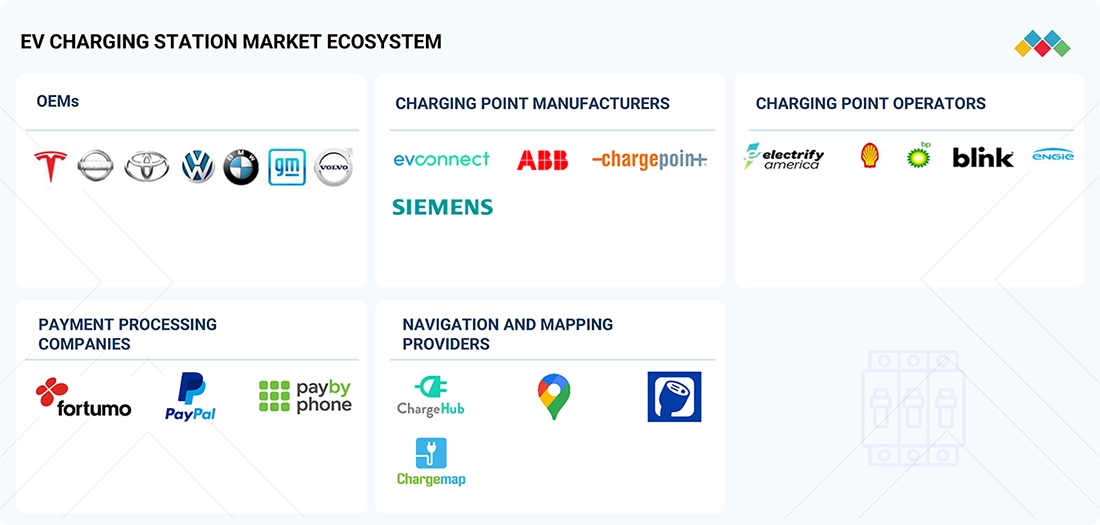
EV CHARGING STATION MARKET SIZE, SHARE & ANALYSIS: COMMERCIAL USE CASES ACROSS INDUSTRIES
| COMPANY | USE CASE DESCRIPTION | BENEFITS |
|---|---|---|
 |
Supplies high-power DC fast chargers for highways, commercial fleets, bus depots, and fuel station operators | Enables rapid charging, increases charger utilization, and supports heavy-duty EV operations |
 |
Develops public fast-charging networks and fleet charging solutions for logistics operators and urban mobility providers | Supports fleet transition to EVs, improves asset utilization, and creates energy service revenues |
 |
Deploys AC and DC charging stations across workplaces, retail locations, fleet depots, and public charging corridors | Generates recurring revenue, increases customer dwell time, and supports fleet electrification |
 |
Operates a global fast-charging network (Supercharger) supporting passenger EV owners and commercial fleet operators | Increases charging accessibility, reduces range anxiety, and improves EV adoption rates |
 |
Installs EV chargers at fuel stations, retail sites, and urban charging hubs to serve passenger and commercial EV users | Diversifies revenue streams, attracts EV customers, and future-proofs fuel retail infrastructure |
Logos and trademarks shown above are the property of their respective owners. Their use here is for informational and illustrative purposes only.
Related Ecosystem
Automotive Advance Technologies
- Battery Electric Vehicle (BEV)
- Light Commercial Vehicles (LCVs)
- Fuel Cell Electric Vehicle (FCEV)
- Hybrid Electric Vehicle (HEV)
- Internal Combustion Engine (ICE)
- BOSCH LIMITED
- Continental ag
- Visteon Corporation
- DENSO Corporation
- ZF FRIEDRICHSHAFEN AG
Automotive Electronics And Electrical Equipment
- Battery Electric Vehicle (BEV)
- Light Commercial Vehicles (LCVs)
- Fuel Cell Electric Vehicle (FCEV)
- Sensors
- Hybrid Electric Vehicle (HEV)
- BOSCH LIMITED
- DENSO Corporation
- Continental ag
- Panasonic Holdings Corporation
- Texas Instruments Incorporated
Electric Hybrid Vehicles
- Battery Electric Vehicle (BEV)
- Fuel Cell Electric Vehicle (FCEV)
- Light Commercial Vehicles (LCVs)
- Hybrid Electric Vehicle (HEV)
- Agricultural Tractors
- Visteon Corporation
- Byd company ltd.
- BOSCH LIMITED
- Tesla, Inc.
- FORD MOTOR COMPANY
Key Takeaways
- The Netherlands EV Charging Station Market is valued at $238.0 million in 2026 and will reach $306.0 million by 2031 at a 3.6% CAGR.
- The Netherlands has achieved mature EV charging infrastructure, positioning it as a European leader with focus on optimization over rapid expansion.
- Smart charging, renewable energy integration, and cross-border connectivity are key growth drivers in the Netherlands market through 2031.
- The Netherlands is addressing rural charging gaps and supporting commercial fleet electrification as primary expansion opportunities.
EV Charging Station Market Report Scope
| Report Metric | Details |
|---|---|
| Base Year | 2026 |
| Forecast Period | 2026–2031 |
| Growth Rate | CAGR of 17.7% from 2026 to 2031 |
| Market Size Base Year (Billions) | ~USD 38.62 (2026) |
| Revenue Forecast (Billions) | ~USD 87.24 (2031) |
| Segments Covered | Application, Charging Infrastructure Type, Charging Point Type, Connection Phase, Dc Fast Charging Type, Installation Type, Level Of Charging, Operation |
Netherlands EV Charging Station Market Report Segmentation
8 segment dimensions are covered across the global market.
By Application
- Private
- Public
- Semi-Public
By Charging Infrastructure Type
- Ccs
- Chademo
- Gb/T Fast
- Nacs/Tesla Supercharger
- Type 1
- Type 2
By Charging Point Type
- Ac Charging
- Dc Charging
By Connection Phase
- Single Phase
- Three Phase
By Dc Fast Charging Type
- Dc Ultrafast 1
- Dc Ultrafast 2
- Fast Dc
- Slow Dc
By Installation Type
- Fixed Chargers
- Portable Chargers
By Level Of Charging
- Level 1
- Level 2
- Level 3
By Operation
- Mode 1
- Mode 2
- Mode 3
- Mode 4
Target Audience
- Charging Network Operators : Operators need detailed market data to optimize network expansion strategies, identify underserved regions, and plan technology upgrades in a mature market where growth depends on operational efficiency and service differentiation.
- EV Infrastructure Technology Providers : Software and hardware vendors require insights into Dutch market preferences for smart charging, grid integration, and user experience to develop solutions that meet the sophisticated demands of Europe's most advanced EV market.
- Investment & Private Equity Firms : Investors evaluating opportunities in the Dutch charging sector need accurate market sizing, growth projections, and competitive dynamics to assess acquisition targets, portfolio companies, and capital allocation decisions.
- Automotive & Fleet Operators : Fleet managers and automotive companies planning electrification strategies in the Netherlands need market intelligence on charging availability, infrastructure reliability, and expansion plans to support vehicle deployment decisions.
- Government & Policy Makers : Dutch and EU policymakers require market analysis to evaluate infrastructure adequacy, identify policy gaps, and design regulations that support sustainability goals while ensuring equitable access across urban and rural regions.
Key Companies in the Netherlands EV Charging Station Market
| Company | HQ | Ownership | Strongest segments |
|---|---|---|---|
| VOLEX GROUP | United Kingdom | Public Company | DC fast-charging cable assemblies and harnesses,AC charging cables, plugs, and power cords,Integrated manufacturing services for charger OEMs, |
| DAIMLER AG | Germany | Public Company | Depot DC fast charging infrastructure and services,Public and semi-public corridor DC fast charging for heavy-duty,AC charging and mixed infrastructure for light commercial fleets, |
| SHELL PLC | United Kingdom | Public Company | Public DC fast charging (highway and urban hubs),Public AC destination charging,Depot and fleet DC charging solutions, |
| CLP POWER HONG KONG LIMITED | Hong Kong | Private Company | DC fast charging infrastructure and energy sales,AC destination and workplace charging,Services, software, and CPO/operations, |
| VISTEON CORPORATION | United States | Public Company | High-Voltage Power Electronics for DC Fast Charging,Battery Management Systems (wired and wireless),SmartCore and Domain Controllers for Charging Integration, |
| BLINK CHARGING CO. | United States | Public Company | Networked Level 2 AC charging (residential and commercial),DC fast charging (public, fleet, and corridor sites),Software, network services, and payment processing, |
| ENPHASE ENERGY | United States | Public Company | Residential AC charging integrated with solar-plus-storage,Standalone residential AC charging (non-solar-attached),Small commercial and fleet-oriented charging, |
| WALLBOX | Spain | Public Company | AC residential chargers (Pulsar family, ABL eM4 Single),AC shared and commercial chargers (Pulsar Pro, ABL eM4 Twin, eMC3),DC fast charging (Supernova, Hypernova, Quasar 2), |
| CHARGE+ | United States | Public Company | AC networked charging systems,DC fast charging systems,Charger management software and network services, |
| ALFEN NV | Netherlands | Public Company | AC destination and workplace chargers (Level 2, single- and three-phase),DC fast charging solutions and EV fast-charging hubs,Smart grid substations and microgrids linked to EV charging, |
VOLEX GROUP
VOLEX GROUP is a United Kingdom-based public company established in 1892, employing 13,000 people.
DAIMLER AG
DAIMLER AG is a German public company established in 1896 with 108,655 employees.
SHELL PLC
SHELL PLC is a United Kingdom-based public company established in 1897 with 84,000 employees.
CLP POWER HONG KONG LIMITED
CLP POWER HONG KONG LIMITED is a Hong Kong-based private company founded in 1901 with 4,411 employees.
VISTEON CORPORATION
VISTEON CORPORATION is a United States-based public company founded in 2000 with 10,500 employees.
BLINK CHARGING CO.
BLINK CHARGING CO. is a United States-based public company founded in 2009 with 320 employees.
ENPHASE ENERGY
ENPHASE ENERGY is a United States-based public company founded in 2006 with 2,872 employees.
WALLBOX
WALLBOX is a Spain-based public company founded in 2015 with 594 employees.
CHARGE+
CHARGE+ is a United States-based public company founded in 2007 with 1,440 employees.
ALFEN NV
ALFEN NV is a Netherlands-based public company founded in 1937 with 923 employees.
Reasons to Buy this Report
- Market Entry Strategy Development : Understand the competitive landscape and saturation levels in the Netherlands to identify niche opportunities in fast-charging, rural expansion, or smart grid integration without competing in oversaturated urban markets.
- Investment Decision Support : Access detailed financial projections and growth drivers specific to the Dutch market to make informed investment decisions in charging infrastructure, technology providers, or network operators with realistic ROI expectations.
- Regulatory Compliance Insights : Gain clarity on Dutch and EU-specific regulations, accessibility requirements, and sustainability mandates that directly impact charging station deployment, technology standards, and operational requirements.
- Competitive Positioning : Benchmark your offerings against the mature Dutch market's expectations for reliability, technology integration, and customer experience to develop competitive advantages in this sophisticated market.
- Technology Roadmap Planning : Identify emerging technology trends in the Netherlands such as V2G integration, renewable energy coupling, and AI-driven smart charging to align product development with market demands and future growth areas.
Frequently asked questions
What is the current size of the EV Charging Station Market in the Netherlands?
The Netherlands EV Charging Station Market is valued at $238.0 million in 2026, reflecting the country's established and mature charging infrastructure.
What is the projected market size for the Netherlands by 2031?
The Netherlands market is forecast to reach $306.0 million by 2031, growing at a 3.6% compound annual growth rate from 2026.
Why is the Netherlands market growing slower than the global average?
The Netherlands has already achieved high EV charging infrastructure penetration, so growth is driven by optimization and quality improvements rather than rapid capacity expansion, resulting in a 3.6% CAGR compared to the global 17.7% CAGR.
What are the main growth drivers for the Netherlands EV Charging Station Market?
Key drivers in the Netherlands include investments in fast-charging technology, workplace charging solutions, smart grid integration, renewable energy connectivity, and commercial fleet electrification initiatives.
What challenges does the Netherlands market face between 2026 and 2031?
The Netherlands faces challenges in extending charging coverage to rural areas, managing grid capacity during peak charging periods, and maintaining interoperability standards across its mature network.
RESEARCH METHODOLOGY
The study involved four major activities in estimating the current size of the EV charging station market. Exhaustive secondary research was done to collect information on the market, the peer market, and the child markets. The next step was to validate these findings and assumptions and size them with industry experts across value chains through primary research. The top-down and bottom-up approaches were employed to estimate the complete market size. Thereafter, market breakdown and data triangulation processes were used to estimate the market size of segments and subsegments.
Secondary Research
In the secondary research process, various secondary sources such as company annual reports/presentations, press releases, industry association publications [for example, European Alternative Fuels Observatory (EAFO), European Automobile Manufacturers' Association (ACEA), China Association of Automobile Manufacturers (CAAM), International Organization of Motor Vehicle Manufacturers (OICA), Electrical Vehicle Charging Association (EVCA), National Highway Traffic Safety Administration (NHTSA), International Energy Association (IEA)], articles, directories, technical handbooks, trade websites, technical articles, and databases (for example, MarkLines and Factiva) were used to identify and collect information useful for an extensive commercial study of the global EV charging station market.
Primary Research
Extensive primary research was conducted after acquiring an understanding of the EV charging station market scenario through secondary research. Several primary interviews were conducted with market experts from both the demand (OEMs) and supply sides (EV charging station manufacturers, service providers, and component manufacturers) across major regions: North America, Europe, the Middle East, Asia Pacific, and the Rest of the World. Approximately 24% and 76% of primary interviews were conducted from the demand and supply sides, respectively. Primary data was collected through questionnaires, emails, and telephonic interviews.
In the canvassing of primaries, various departments within organizations, such as sales, operations, and marketing, were covered to provide a holistic viewpoint in the report. After interacting with industry experts, brief sessions were conducted with highly experienced independent consultants to reinforce the findings from primaries. This, along with in-house subject matter experts’ opinions, led to the findings described in the remainder of this report.
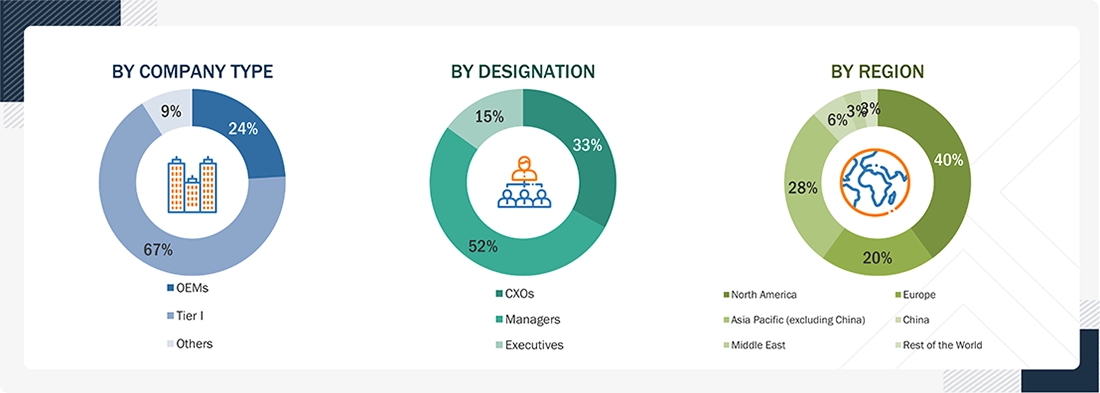
Note: Tier 1 companies’ revenue is more than USD 10 billion; Tier 2 companies’ revenue ranges between USD 1 and 10 billion; and Tier 3 companies’ revenue ranges between USD 500 million and USD 1 billion
To know about the assumptions considered for the study, download the pdf brochure
Market Size Estimation
Both top-down and bottom-up approaches were used to estimate and validate the total size of the market. These methods were also used extensively to estimate the size of various subsegments in the market. The research methodology used to estimate the market size includes the following:
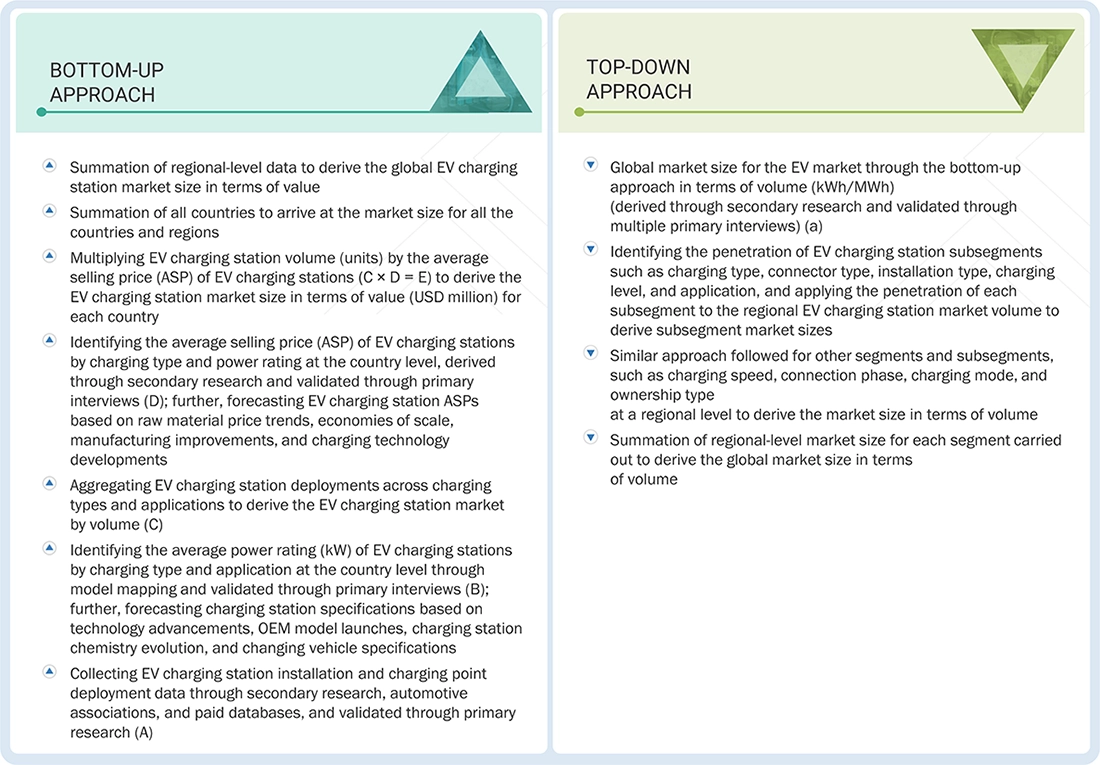
Data Triangulation
After arriving at the overall market size—using the market size estimation processes as explained above—the market was split into several segments and subsegments. To complete the overall market engineering process and arrive at the exact statistics of each market segment and subsegment, data triangulation and market breakdown procedures were employed, wherever applicable. The data was triangulated by studying various factors and trends from both the demand and supply sides.
Market Definition
EV charging station is electrical equipment used to charge plug-in electric vehicles. This equipment can charge an electric vehicle in 6-20 hours for normal charging (Level 1 & Level 2 charging) and approximately 15-60 minutes for fast/supercharging (Level 3 charging). EVs have different charging requirements and can be used with the required chargers. They allow the conversion of current for the vehicle to be easily charged and set up at homes, semi-public places, public charging stations, and a portable charging system.
Key Stakeholders
- Associations, Forums, and Alliances related to EV Charging Stations
- Utility Companies
- Oil & Gas Companies
- Automobile Manufacturers
- Battery Distributors
- Battery Manufacturers
- Charging Infrastructure Providers
- Charging Service Providers
- Energy Storage Companies
- Environmental Groups
- EV Charging Pole Manufacturers
- EV Charging Network Operators
- EV Charging Station Service Providers
- EV Component Manufacturers
- EV Distributors and Retailers
- EV Manufacturers
- Electric Utilities and Grid Operators
- Electrical Contractors
- Government Agencies and Policymakers
- Property Owners
Report Objectives
To define, describe, and forecast the EV charging station market based on level of charging, charging service type, charge point operator, charging infrastructure type, charging point type, installation type, connection phase, DC fast charging type, operation, application, and region
-
To segment and forecast the market size by volume (thousand units) and value
(USD million) based on the level of charging (Level 1, Level 2, and Level 3) - To segment and forecast the market size by volume (thousand units) based on application (private, semi-public, public)
- To segment and forecast the market size by volume (thousand units) based on charging point type (AC charging, DC charging)
- To segment and forecast the market size by volume (thousand units) based on charging infrastructure type (CCS, CHAdeMO, Type 1, NACS, GB/T Fast, Type 2)
- To provide qualitative insights on electric bus charging type (off-board top-down pantographs, onboard bottom-up pantographs, charging via connectors)
- To provide qualitative insights on charging service type (EV charging services, battery swapping services)
- To segment and forecast the market size by volume (thousand units) based on charge point operator (Asia Pacific, Europe, North America)
- To segment and forecast the market size by volume (thousand units) based on installation type (portable chargers, fixed chargers)
- To segment and forecast the market size by volume (thousand units) based on DC fast charging type (slow DC, fast DC, DC ultrafast 1, DC ultrafast 2)
- To segment and forecast the market size by volume (thousand units) based on operation (Mode 1, Mode 2, Mode 3, Mode 4)
- To segment and forecast the market size by volume (thousand units) based on connection phase (single phase, three phase)
- To forecast the market size with respect to key regions, namely, China, Asia Pacific, Europe, North America, the Middle East, and the Rest of the World
- To provide detailed information regarding the major factors influencing the market growth (drivers, challenges, restraints, and opportunities)
- To strategically analyze the market with respect to individual growth trends, prospects, and contributions to the total market
- To study the following with respect to the market
- Value Chain Analysis
- Ecosystem Analysis
- Technology Analysis
- Case Study Analysis
- Patent Analysis
- Tariff & Regulatory Landscape
- Average Selling Price Analysis
- Buying Criteria
- Impact of AI
- Investment and Funding Scenario
- Trends and Disruptions Impacting Customer Business
- Bill of Materials
- Evolution of EV Charging
- Opportunities in EV Charging
- Future of Charging
- Key Stakeholders and Buying Criteria
- Performance Indicators for EV Charging
- Power Booster in Charging Systems
- To strategically profile key players and comprehensively analyze their market shares and core competencies
- To track and analyze competitive developments such as deals, product developments, and other activities carried out by key industry participants
Available customizations:
With the given market data, MarketsandMarkets offers customizations tailored to company-specific needs.
- Further breakdown for the EV charging station market, by charging level, at the country level (for countries covered in the report)
- Further breakdown of the EV charging station market, by DC charging type, at the country level (for countries covered in the report)
Company information
- Profiles of additional market players (up to five)
Get the Full EV Charging Station Market Report
Full forecast, segment splits, and company analysis for all EV Charging Station Market.
- India EV Charging Station Market
- Japan EV Charging Station Market
- South Korea EV Charging Station Market
- Singapore EV Charging Station Market
- Thailand EV Charging Station Market
- Taiwan EV Charging Station Market
- Indonesia EV Charging Station Market
- China EV Charging Station Market
- France EV Charging Station Market
- Germany EV Charging Station Market
- Norway EV Charging Station Market
- Sweden EV Charging Station Market
- UK EV Charging Station Market
- Denmark EV Charging Station Market
- Austria EV Charging Station Market
- Spain EV Charging Station Market
- Switzerland EV Charging Station Market
- Canada EV Charging Station Market
- Israel EV Charging Station Market
- UAE EV Charging Station Market
- Saudi Arabia EV Charging Station Market
- Brazil EV Charging Station Market
- Mexico EV Charging Station Market
- South Africa EV Charging Station Market
- US EV Charging Station Market
Need a Tailored Report?
Customize this report to your needs
Get 10% FREE Customization
Customize This Report
