
Canada Electric Vehicle Tires Market (2025-2030)

The Canada Electric Vehicle Tires Market was valued at $888 Million in 2025 and projected to reach to $2417 Million by 2030, representing a compound annual growth rate of 15.4%. Canada's electric vehicle tire market is positioned for exceptional growth through 2030, driven by aggressive government incentives, expanding charging networks, and increasing consumer adoption of EVs.


| Market Size in | USD 26.32 MN |
| Market Forecast in | |
| CAGR | |
| Forecast Period | |
| Units Considered | Value (USD MN) |
Canada Electric Vehicle Tires Market Trends and Insights
- This represents a compound annual growth rate of 15.4%, significantly outpacing global trends.
- Canada's accelerating EV adoption, supported by federal incentives and provincial charging infrastructure investments, is driving demand for specialized tire technologies designed to optimize range and performance in electric vehicles. The Canadian market benefits from strong OEM partnerships and a growing aftermarket segment as the EV fleet matures.
- Canada's commitment to net-zero emissions and increasing consumer awareness of EV benefits are key catalysts for tire market expansion through 2030.
- Regional tire manufacturers and international suppliers are investing in production capacity and R&D to meet Canada's rising demand for high-performance, durable EV-specific tires..
Key Market Statistics
- CAGR (2025-2030) 15.4% CAGR
- Market Size, 2025 ~USD 888 Million
- Forecast, 2030 ~USD 2417 Million
- Country Canada
Canada Electric Vehicle Tires Market Overview
Strong Market Growth :
Canada's EV tire market is projected to grow from $888 million in 2025 to $2,417 million by 2030, representing a 15.4% CAGR that outpaces the global average of 13.6%.
Federal Incentive Support :
Canadian federal EV purchase incentives and rebate programs are accelerating vehicle adoption, directly increasing demand for specialized electric vehicle tires across the country.
Provincial Infrastructure Investment :
Significant investments in charging infrastructure across provinces like Ontario, British Columbia, and Quebec are supporting EV market penetration and tire replacement cycles.
Regional EV Adoption Leaders :
British Columbia and Ontario lead Canada's EV adoption rates, creating concentrated demand hotspots for premium EV tire products and specialized distribution networks.
Canada Electric Vehicle Tires Market Dynamics
- The 15.4% CAGR reflects strong tailwinds from federal and provincial policies promoting electrification and sustainability.
- Major automotive manufacturers are expanding EV production capacity in Canada, further supporting tire demand. The market will benefit from rising consumer awareness of EV-specific tire benefits, including lower rolling resistance and enhanced efficiency.
- Regional disparities in EV adoption will create opportunities for targeted distribution strategies.
- Competition will intensify as both international tire manufacturers and emerging players establish Canadian operations to capture this high-growth segment..
Market Ecosystem
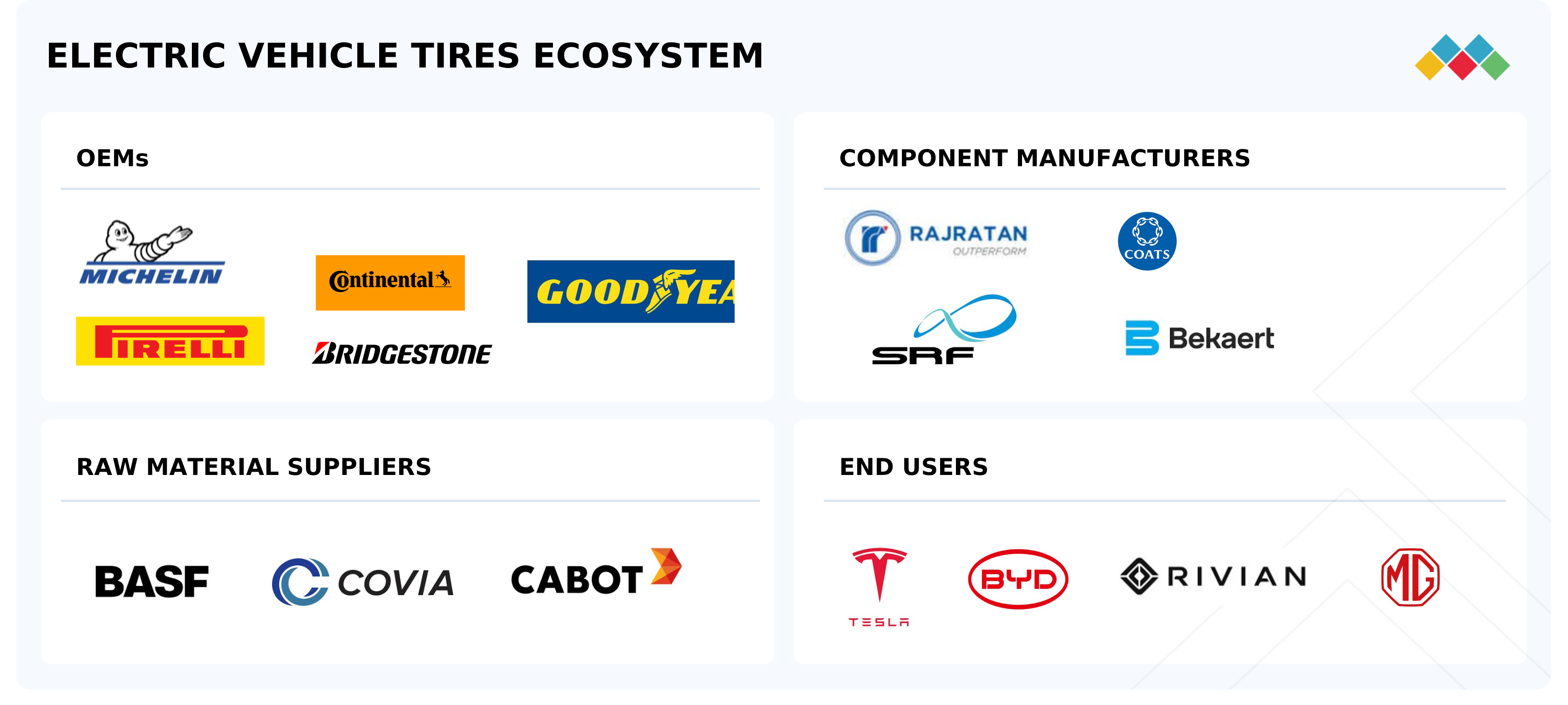
Electric Vehicle Tires Market: COMMERCIAL USE CASES ACROSS INDUSTRIES
| COMPANY | USE CASE DESCRIPTION | BENEFITS |
|---|---|---|
 |
Specialized EV tire designs with low rolling resistance, noise-reducing tread, and reinforced structures | Improved battery range, reduced cabin noise, higher load-bearing capacity |
 |
EV-specific tire compounds engineered for high torque and instant acceleration | Better grip, reduced wear, improved durability under EV loads |
 |
Integration of sustainable materials such as recycled rubber and bio-based compounds in EV tires | Lower carbon footprint, compliance with sustainability goals, long-term cost savings |
 |
Noise Cancelling System (PNCS) technology and foam inserts for EV comfort | Quieter driving experience, increased consumer satisfaction, premium positioning |
Logos and trademarks shown above are the property of their respective owners. Their use here is for informational and illustrative purposes only.
Related Ecosystem
Automotive Advance Technologies
- Battery Electric Vehicle (BEV)
- Light Commercial Vehicles (LCVs)
- Fuel Cell Electric Vehicle (FCEV)
- Hybrid Electric Vehicle (HEV)
- Internal Combustion Engine (ICE)
- BOSCH LIMITED
- Continental ag
- Visteon Corporation
- DENSO Corporation
- ZF FRIEDRICHSHAFEN AG
Automotive Materials
- Light Commercial Vehicles (LCVs)
- Battery Electric Vehicle (BEV)
- Hybrid Electric Vehicle (HEV)
- Fuel Cell Electric Vehicle (FCEV)
- Agricultural Tractors
- GORKOVSKY AVTOMOBILNY ZAVOD
- AISIN CORPORATION
- Continental ag
- Basf se
- BOSCH LIMITED
Automotive Systems
- Light Commercial Vehicles (LCVs)
- Battery Electric Vehicle (BEV)
- Hybrid Electric Vehicle (HEV)
- Agricultural Tractors
- Fuel Cell Electric Vehicle (FCEV)
- BOSCH LIMITED
- DENSO Corporation
- ZF FRIEDRICHSHAFEN AG
- Continental ag
- GORKOVSKY AVTOMOBILNY ZAVOD
Key Takeaways
- Canada's EV tire market will grow from $888M (2025) to $2,417M (2030) at a 15.4% CAGR, driven by rapid EV adoption.
- Canada's federal EV incentives and expanding charging networks are accelerating demand for specialized electric vehicle tire solutions.
- The Canadian aftermarket segment is emerging as a significant growth opportunity as the EV fleet ages and replacement tire demand increases.
- Canada's net-zero commitments and consumer sustainability focus are positioning the country as a high-growth EV tire market in North America.
Electric Vehicle Tires Market Report Scope
| Report Metric | Details |
|---|---|
| Base Year | 2025 |
| Fastest Growing Segment | HEAVY COMMERCIAL VEHICLES (Vehicle Type) |
| Forecast Period | 2025–2030 |
| Growth Rate | CAGR of 13.6% from 2025 to 2030 |
| Largest Segment | PASSENGER CARS (Vehicle Type) |
| Market Size Base Year (Billions) | ~USD 11.32 (2025) |
| Revenue Forecast (Billions) | ~USD 21.41 (2030) |
| Segments Covered | Vehicle Type, Propulsion Type, Rim Size, Load Index, Application |
Canada Electric Vehicle Tires Market Report Segmentation
5 segment dimensions are covered across the global market.
By Vehicle Type
- Buses
- Heavy Commercial Vehicles
- Light Commercial Vehicles
- Passenger Cars
By Propulsion Type
- Battery Electric Vehicle (Bev)
- Fuel Cell Electric Vehicle (Fcev)
- Plug-In Hybrid Electric Vehicle (Phev)
By Rim Size
- 13–15”
- 16–18”
- 19–21”
- > 21”
- >21
By Load Index
- Above 100
- Less Than 100
By Application
- Off-Road
- On-Road
Target Audience
- Tire Manufacturers & Suppliers : Need market sizing and growth forecasts to plan Canadian production capacity, supply chain investments, and product development for EV-specific tire lines.
- Automotive OEMs & Dealers : Require demand projections and regional adoption data to optimize tire sourcing strategies, inventory management, and aftermarket service offerings across Canada.
- Investment & Private Equity Firms : Seek validated market data and growth metrics to evaluate acquisition targets, fund allocation decisions, and investment opportunities in Canada's EV tire ecosystem.
- Distribution & Retail Networks : Need regional market insights and consumer demand patterns to expand EV tire inventory, establish new locations, and develop targeted marketing campaigns in Canada.
- Government & Policy Makers : Require market intelligence on EV tire adoption trends to inform transportation policy, sustainability initiatives, and economic development strategies for Canada's automotive sector.
Key Companies in the Canada Electric Vehicle Tires Market
| Company | HQ | Ownership | Strongest segments |
|---|---|---|---|
| MICHELIN | France | Public Company | BEV Passenger Car On-Road (16–18” and 19–21”),PHEV Passenger Car On-Road (16–18”),SUV/LCV EV On-Road (19–21” and >21” high load index), |
| BRIDGESTONE CORPORATION | Japan | Public Company | BEV – Passenger Cars (On-Road, 16–21” rims),BEV – SUVs and Crossovers (On-Road, 19–>21” rims),PHEV – Passenger and Light Commercial Vehicles, |
| THE GOODYEAR TIRE & RUBBER COMPANY | United States | Public Company | BEV passenger car on-road tires (16–21”),PHEV passenger car tires (13–18”),EV light commercial and last-mile delivery tires, |
| CONTINENTAL AG | Germany | Public Company | BEV – Passenger Car On-Road,PHEV – Passenger Car On-Road,EV – Light Commercial Vehicles & Vans, |
| PIRELLI & C. S.P.A. | Italy | Public Company | BEV – Passenger Car – On-Road – 19–21” and >21”,BEV – Passenger Car – On-Road – 16–18”,PHEV – Passenger Car and LCV – On-Road, |
| SUMITOMO RUBBER INDUSTRIES, LTD. | Japan | Public Company | BEV passenger-car on-road tires (16–18” and 19–21”),PHEV passenger-car on-road tires (13–18”),EV light commercial and last-mile delivery tires, |
| HANKOOK TIRE & TECHNOLOGY | South Korea | Public Company | BEV Passenger Car On-Road (16–18” and 19–21”),PHEV Passenger Car On-Road (16–18”),SUV / Light Truck EV (19–21” and >21”), |
| NOKIAN TYRES PLC | Finland | Public Company | BEV – Passenger Cars (on-road, all rim sizes),PHEV – Passenger Cars,Light Commercial Vehicles (BEV/PHEV), |
| KUMHO TIRE CO., INC. | South Korea | Public Company | BEV Passenger Car On-Road (16–18”),BEV Passenger Car On-Road (19–21” and >21”),PHEV Passenger Car and SUV On-Road (13–15” and 16–18”), |
| ZHONGCE RUBBER GROUP CO., LTD. | China | Public Company | BEV – Passenger Car – On-Road – 16–18” Rim,BEV – Passenger Car – On-Road – 19–21” Rim,PHEV – Passenger Car – On-Road – 16–18” Rim, |
| SAILUN GROUP CO., LTD. | China | Public Company | BEV – Passenger Car, On-Road, 16–18” & 19–21”,PHEV – Passenger Car, On-Road, 16–18”,EV Light Commercial Vehicles & Buses – On-Road, >21” and High Load Index, |
| APOLLO TYRES | India | Public Company | BEV passenger car – on-road – 16–18”,BEV passenger car – on-road – 19–21”,PHEV passenger car – on-road – 16–18”, |
| SHANDONG LINGLONG TYRE CO., LTD. | China | Public Company | BEV – Passenger Cars – On-Road – 16–18” & 19–21” – Replacement,PHEV – Passenger Cars – On-Road – 16–18” – Replacement,BEV – Light Commercial Vehicles – On-Road – 16–18” – Replacement, |
| GITI TIRE | China | Public Company | BEV Passenger Car – On-Road, 16–18”,BEV Passenger Car – On-Road, 19–21”,PHEV Passenger Car – On-Road, 16–18”, |
MICHELIN
Michelin is a French multinational tire manufacturer founded in 1863 with 116,600 employees. Operating as a public company, it is one of the world's largest tire producers.
BRIDGESTONE CORPORATION
Bridgestone Corporation is a Japanese tire manufacturer established in 1931 with 115,716 employees. As a public company, it ranks among the global leaders in tire production and automotive components.
THE GOODYEAR TIRE & RUBBER COMPANY
The Goodyear Tire & Rubber Company is a United States-based tire manufacturer founded in 1898 with 63,000 employees. The public company is a major producer of tires for various vehicle types and industrial applications.
CONTINENTAL AG
Continental AG is a German automotive supplier and tire manufacturer founded in 1871 with 22,076 employees. Operating as a public company, it produces tires and other automotive technology solutions.
PIRELLI & C. S.P.A.
Pirelli & C. S.p.A. is an Italian tire manufacturer established in 1872 with 30,704 employees. The public company specializes in high-performance and specialty tires for various vehicle segments.
SUMITOMO RUBBER INDUSTRIES, LTD.
Sumitomo Rubber Industries, Ltd. is a Japanese tire and rubber products manufacturer founded in 1909 with 37,671 employees. As a public company, it produces tires and industrial rubber products globally.
HANKOOK TIRE & TECHNOLOGY
Hankook Tire & Technology is a South Korean tire manufacturer founded in 1941 with 6,284 employees. The public company produces tires for passenger vehicles, commercial vehicles, and industrial applications.
NOKIAN TYRES PLC
Nokian Tyres PLC is a Finnish tire manufacturer established in 1898 with 3,936 employees. Operating as a public company, it specializes in tires for various climate conditions and vehicle types.
KUMHO TIRE CO., INC.
Kumho Tire Co., Inc. is a South Korean tire manufacturer founded in 1960 with 5,488 employees. The public company produces tires for passenger cars, commercial vehicles, and industrial use.
ZHONGCE RUBBER GROUP CO., LTD.
Zhongce Rubber Group Co., Ltd. is a Chinese tire manufacturer established in 1958 with 18,035 employees. Operating as a public company, it produces tires for various vehicle applications.
SAILUN GROUP CO., LTD.
Sailun Group Co., Ltd. is a Chinese tire manufacturer founded in 2002 with 25,128 employees. The public company produces tires for passenger vehicles, commercial vehicles, and industrial applications.
APOLLO TYRES
Apollo Tyres is an Indian tire manufacturer founded in 1972 with 17,118 employees. Operating as a public company, it produces tires for passenger cars, commercial vehicles, and two-wheelers.
SHANDONG LINGLONG TYRE CO., LTD.
Shandong Linglong Tyre Co., Ltd. is a Chinese tire manufacturer established in 1975 with 17,388 employees. The public company produces tires for various vehicle segments including passenger and commercial vehicles.
GITI TIRE
Giti Tire is a Chinese tire manufacturer founded in 1993 with 3,791 employees. The company produces tires for passenger vehicles, commercial vehicles, and industrial applications.
Reasons to Buy this Report
- Market Size & Growth Validation : Confirm the $888M market size for 2025 and validate the 15.4% CAGR projection through 2030 with detailed financial forecasts specific to Canada's EV tire segment.
- Regional Opportunity Mapping : Identify high-growth provinces and metropolitan areas with concentrated EV adoption, enabling targeted market entry and distribution strategies for Canadian operations.
- Competitive Landscape Analysis : Understand key tire manufacturers operating in Canada, their market share, product positioning, and competitive strategies in the rapidly expanding EV tire segment.
- Policy & Incentive Impact : Analyze how federal and provincial EV incentives, tax credits, and charging infrastructure investments directly influence tire demand and purchasing patterns across Canada.
- Strategic Investment Decisions : Support capital allocation, partnership development, and market entry planning with data-driven insights specific to Canada's unique EV tire market dynamics and growth trajectory.
Frequently asked questions
What is the current size of Canada's electric vehicle tires market?
Canada's electric vehicle tires market is valued at $888.0 million in 2025 and is expected to reach $2,417.0 million by 2030.
What is the growth rate of Canada's EV tire market?
Canada's electric vehicle tires market is growing at a compound annual growth rate (CAGR) of 15.4% from 2025 to 2030.
What factors are driving growth in Canada's EV tire market?
Key drivers include Canada's federal EV purchase incentives, expanding provincial charging infrastructure, rising EV adoption rates, and consumer demand for high-performance, range-optimized tires.
How does Canada's EV tire market compare to global trends?
Canada's 15.4% CAGR significantly exceeds the global average of 13.6%, reflecting stronger EV adoption momentum and supportive government policies in Canada.
What opportunities exist in Canada's EV tire aftermarket?
As Canada's EV fleet matures, the aftermarket segment presents substantial growth opportunities for replacement tires, maintenance services, and specialized EV tire solutions.
RESEARCH METHODOLOGY
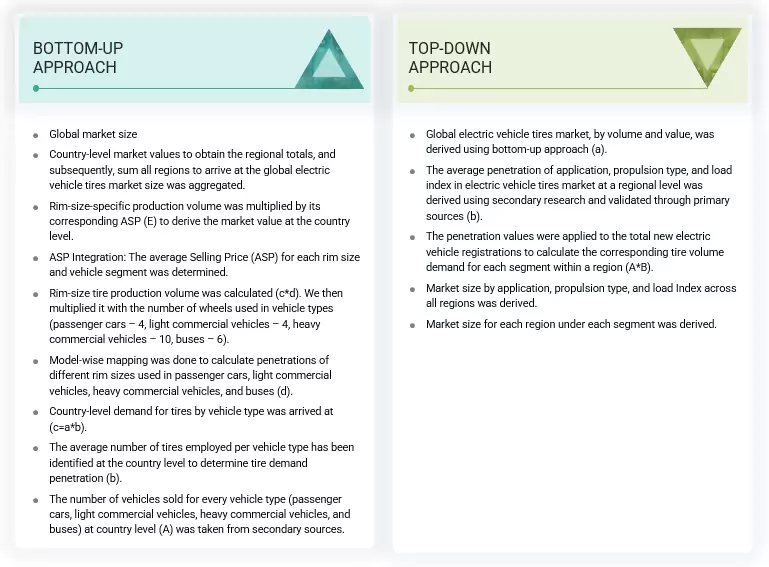
The study involved four major activities. The first step was to estimate the current size of the electric vehicle tires market and conduct exhaustive secondary research on the market, peer market, and model mapping. The next step was to validate these findings, assumptions, and sizing with the industry experts across the value chain through primary research. In the third step, the bottom-up and top-down approaches were employed to estimate the total market size. After that, market breakdown and data triangulation were used to determine the market size of segments and subsegments.
Secondary Research
In the secondary research process, various secondary sources have been used to identify and collect information for this study. The secondary sources include annual reports, press releases, and investor presentations of companies; whitepapers, certified publications; articles from recognized authors, directories, and databases; and articles from recognized associations and government publishing sources.
Secondary research has been used to obtain key information about the industry’s value chain, the overall pool of key players, market classification and segmentation according to industry trends to the bottom-most level, regional markets, and key developments from the market- and technology-oriented perspectives.
Primary Research
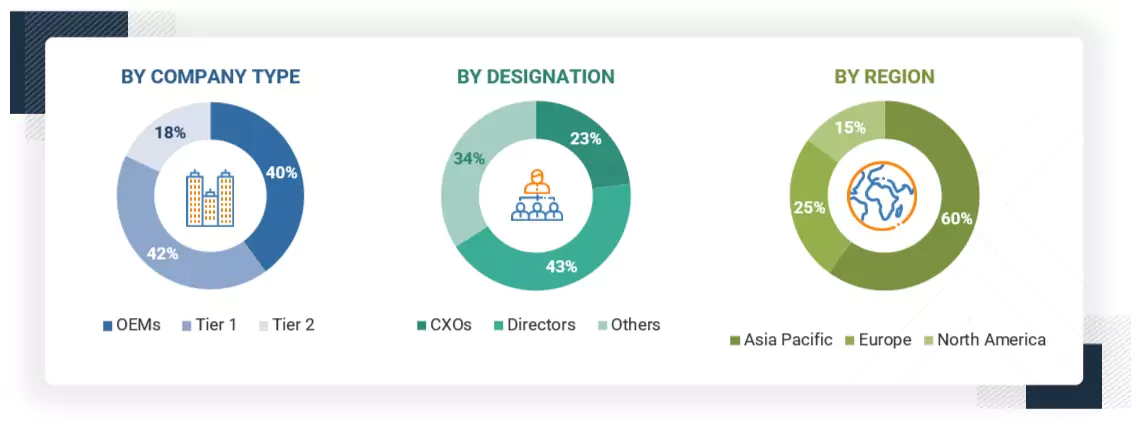
Extensive primary research has been conducted after understanding the electric vehicle tire market scenario through secondary research. Several primary interviews have been conducted with market experts from the demand-side electric vehicle manufacturers (country-level government associations and trade associations) and supply-side OEMs and component manufacturers across five major regions: North America, Europe, Asia Pacific, the Middle East, and Africa. Approximately 23% and 77% of primary interviews have been conducted from the demand and supply sides, respectively. Primary data has been collected through questionnaires, emails, and telephonic interviews. In the process of primary interviews, we have strived to cover various departments within organizations, such as sales, operations, and administration, to provide a holistic viewpoint in our report.
After interacting with industry experts, we also conducted brief sessions with highly experienced independent consultants to reinforce the findings from our primaries. This, along with the in-house subject matter expert opinions, led us to the findings as described in the remainder of this report.
To know about the assumptions considered for the study, download the pdf brochure
Market Size Estimation
A detailed market estimation approach was followed to estimate and validate the volume and value of the electric vehicle tires market. Key players in the market were identified through secondary research, and their global market shares were determined through primary and secondary research. The research methodology included the study of the annual and quarterly financial reports, regulatory filings of significant market players, and interviews with industry experts for detailed market insights. All major penetration rates, percentage shares, splits, and breakdowns for the market were determined using secondary sources, model mapping, and verified through primary sources. All key macro indicators affecting the revenue growth of the market segments and subsegments were accounted for, viewed in extensive detail, verified through primary research, and analyzed to get the validated and verified quantitative & qualitative data. The market data gathered was consolidated and added with detailed inputs, analyzed, and presented in this report.
Electric Vehicle Tires Market : Top-Down and Bottom-Up Approach
Data Triangulation
All percentage shares, splits, and breakdowns were determined using secondary sources and verified by primary sources. All parameters that affect the markets covered in this research study were accounted for, viewed in extensive detail, and analyzed to obtain the final quantitative and qualitative data. This data was consolidated and enhanced with detailed inputs and analysis from MarketsandMarkets and presented in the report.
Market Definition
Electric vehicle tires are defined as tires catered toward specific needs and challenges associated with electric vehicles. These needs and challenges include increased vehicle weight, higher torque from the electric powertrain, and more. Electric vehicle tires are expected to offer lower rolling resistance and lower road noise compared to standard automotive tires. Additionally, silica, nylon, steel belts, and synthetic rubber in the construction process add these features and improve the traction and safety of electric vehicles in different conditions.
Stakeholders
- Associations, Forums, and Alliances related to Electric Vehicle Tires
- Automobile Manufacturers
- Automotive Component Manufacturers
- Automotive Investors
- Aftermarket and Tire Retreading Associations
- Companies Operating in the Autonomous Vehicle Ecosystem
- Distributors and Retailers
- Electric Pick-up Truck Manufacturers
- Electric Medium and Heavy-duty Truck Manufacturers
- Electric Vehicle Manufacturers
- Electric Vehicle Distributors and Retailers
- Electric Vehicle Tire Manufacturers
- Electric Vehicle Tire Traders, Distributors, and Suppliers
- Government Agencies and Policy Makers
- Government and Research Organizations
- Original Equipment Manufacturer (OEM)
- Organized and Unorganized Aftermarket Suppliers
- Raw Material Suppliers of Tires/Tire Components (Suppliers for Tier I)
- Transport Authorities
- Technology Providers
Report Objectives
-
To segment and forecast the size of the electric vehicle tires market in terms of volume and value.
- To segment and forecast the size of the global market, by volume and value, based on propulsion type (battery electric vehicle (BEV), plug-in hybrid electric vehicle (PHEV), hybrid electric vehicle (HEV), and fuel cell electric vehicle (FCEV)
- To segment and forecast the size of the global market, by volume and value, based on vehicle type (passenger cars, light commercial vehicles, heavy commercial vehicles, and buses)
- To segment and forecast the size of the global market, by volume and value, based on rim size (13–15”, 16–18”, 19–21”, and > 21”)
- To segment and forecast the size of the global market, by volume and value, at the regional level, based on application (on-road and off-road)
- To segment and forecast the size of the global market, by volume at the regional level, based on load index (less than 100 and above 100)
- To provide qualitative insight for the sales channel (OEM and Aftermarket)
- To segment and forecast the market size, by volume and value, based on region (Asia Pacific, Europe, North America, Middle East, and Africa)
- To provide detailed information regarding the major factors influencing the market growth (drivers, restraints, challenges, and opportunities)
-
To study the following with respect to the market:
- Impact of AI/Gen AI
- Trend and Disruption Impacting Customer Business
- Value Chain Analysis
- Ecosystem Analysis
- Technology Analysis
- Trade Analysis
- Case Study Analysis
- Patent Analysis
- Regulatory Landscape
- Investment & Funding Scenario
- Key Stakeholders & Buying Criteria
- Key Conferences & Events
- Average Selling Price Analysis
- To analyze opportunities for stakeholders and the competitive landscape for market leaders
- To strategically profile key players and comprehensively analyze their market shares and core competencies
- To track and analyze competitive developments, such as deals (joint ventures, mergers & acquisitions, partnerships, collaborations), product developments, and other activities carried out by key industry participants
Available Customizations
With the given market data, MarketsandMarkets offers customizations per the company’s specific needs. The following customization options are available:
- Electric Vehicle Tires Market, By Vehicle Type at Country Level
- Electric Vehicle Tires Market, By Rim Size at Country Level
- Electric Vehicle Tires Market, By Propulsion Type at Country Level
- Profiling of Additional Market Players (Up to 3)
Get the Full Electric Vehicle Tires Market Report
Full forecast, segment splits, and company analysis for all Electric Vehicle Tires Market.
- China Electric Vehicle Tires Market
- Japan Electric Vehicle Tires Market
- India Electric Vehicle Tires Market
- South Korea Electric Vehicle Tires Market
- Germany Electric Vehicle Tires Market
- UK Electric Vehicle Tires Market
- France Electric Vehicle Tires Market
- Sweden Electric Vehicle Tires Market
- Spain Electric Vehicle Tires Market
- Netherlands Electric Vehicle Tires Market
- Norway Electric Vehicle Tires Market
- Austria Electric Vehicle Tires Market
- US Electric Vehicle Tires Market
Need a Tailored Report?
Customize this report to your needs
Get 10% FREE Customization
Customize This Report
