
South Korea Electronic Filtration Market (2025-2030)

The South Korea Electronic Filtration Market was valued at $409.2 Million in 2025 and projected to reach to $632.2 Million by 2030, representing a compound annual growth rate of 9.1%. South Korea's electronic filtration market is poised for sustained expansion, driven by the country's commitment to environmental sustainability and industrial excellence.


| Market Size in | USD 26.32 MN |
| Market Forecast in | |
| CAGR | |
| Forecast Period | |
| Units Considered | Value (USD MN) |
South Korea Electronic Filtration Market Trends and Insights
- This 9.1% compound annual growth rate reflects South Korea's strong industrial base, advanced manufacturing capabilities, and increasing regulatory focus on air and water quality standards.
- South Korea's electronics, automotive, and semiconductor sectors are driving demand for high-performance filtration solutions to meet stringent environmental compliance requirements. The market expansion in South Korea is underpinned by rapid urbanization, rising consumer awareness of pollution control, and substantial investments in clean technology infrastructure.
- South Korea's government initiatives promoting green manufacturing and circular economy principles are accelerating adoption of electronic filtration systems across industrial and commercial applications.
- By 2030, South Korea is expected to consolidate its position as a key regional hub for advanced filtration technologies, supported by its innovation ecosystem and export-oriented industries..
Key Market Statistics
- CAGR (2025-2030) 9.1% CAGR
- Market Size, 2025 ~USD 409.2 Million
- Forecast, 2030 ~USD 632.2 Million
- Country South Korea
South Korea Electronic Filtration Market Overview
Strong Industrial Base :
South Korea's advanced manufacturing sector, including semiconductors, electronics, and automotive industries, drives significant demand for electronic filtration solutions to meet stringent production standards.
Regulatory Compliance Push :
Increasingly strict environmental regulations on air and water quality in South Korea are compelling industries to adopt advanced electronic filtration technologies to meet government mandates.
Technology Innovation Hub :
South Korea's position as a global technology leader fosters continuous innovation in electronic filtration, with local manufacturers developing cutting-edge solutions for domestic and export markets.
Semiconductor Manufacturing Growth :
The booming semiconductor industry in South Korea requires ultra-pure air and water filtration, creating substantial opportunities for electronic filtration system providers.
South Korea Electronic Filtration Market Dynamics
- The 9.1% CAGR through 2030 reflects growing investments in clean technology across manufacturing sectors, particularly in semiconductors and automotive production.
- Government initiatives promoting green manufacturing and stricter emission standards will continue to accelerate market adoption. The market's growth trajectory is supported by South Korea's technological prowess and export-oriented economy.
- As local manufacturers enhance their filtration capabilities and expand internationally, domestic demand will remain robust.
- Strategic partnerships between filtration companies and South Korea's industrial giants will further propel market development, positioning the country as a key hub for advanced filtration solutions in Asia-Pacific..
Market Ecosystem
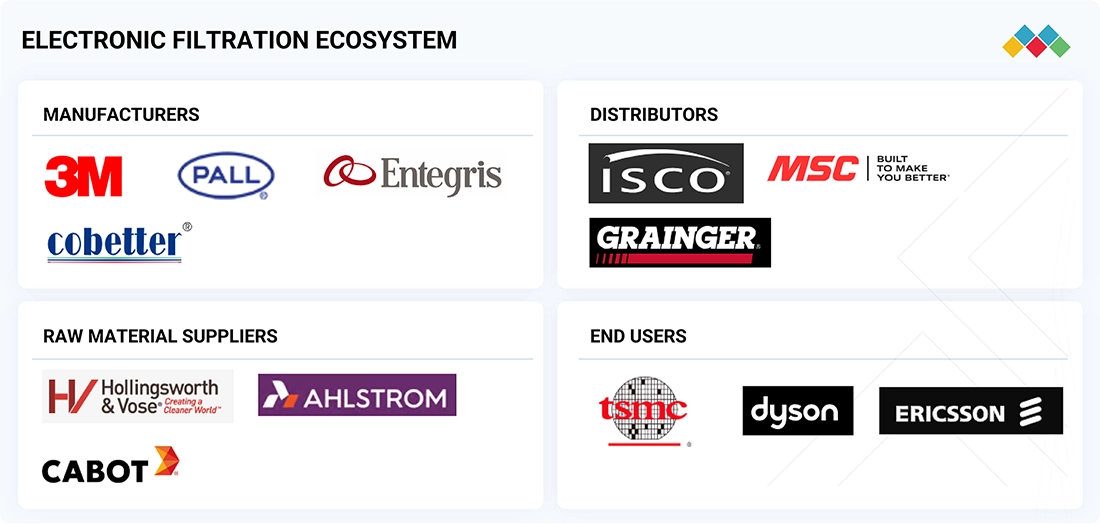
Electronic Filtration Market: COMMERCIAL USE CASES ACROSS INDUSTRIES
| COMPANY | USE CASE DESCRIPTION | BENEFITS |
|---|---|---|
 |
Provides advanced filtration for microelectronics and semiconductors, ensuring ultra-pure environments from polysilicon to wafer processing | Superior particle and contaminant removal, enhanced process purity, and improved production yields |
 |
Supplies liquid filtration for chemicals and slurries in semiconductor fabrication, targeting particle and organic contamination | High retention efficiency, protection against airborne molecular contamination, and increased manufacturing yields |
 |
Develops filtration solutions for electronics assembly and cleanrooms, purifying air and liquids for component production | Effective contaminant separation, reliable performance, and seamless integration into production systems |
 |
Offers membrane and depth filters for high-purity electronics processes, focusing on sterile filtration and impurity removal | Excellent virus and endotoxin removal, decolorization capabilities, and adsorption of small molecular contaminants |
 |
Provides filtration for microelectronics, optimizing fluid and gas purity in chemical processing and wafer fabrication | High-effectiveness filtration, cost and performance optimization, and enhanced equipment reliability |
Logos and trademarks shown above are the property of their respective owners. Their use here is for informational and illustrative purposes only.
Related Ecosystem
Membranes
- Reverse Osmosis
- Acetone
- Acrylonitrile Butadiene Styrene (ABS)
- Bioremediation
- Cartridge Filters
- Veolia
- Toray Industries, Inc.
- PALL CORPORATION
- DuPont de Nemours, Inc.
- Pentair plc
Water Purification
- Corrosion Inhibitors
- Cartridge Filters
- Fiberglass
- Reverse Osmosis
- Acetone
- Veolia
- Kemira oyj
- SOLENIS
- Basf se
- CALGON CARBON CORPORATION
Key Takeaways
- South Korea's electronic filtration market will grow from USD 409.2M (2025) to USD 632.2M (2030) at a 9.1% CAGR.
- South Korea's semiconductor and automotive industries are primary demand drivers for advanced electronic filtration solutions.
- South Korea's regulatory environment and green manufacturing initiatives are accelerating market adoption and technology innovation.
- South Korea is positioned as a regional leader in electronic filtration technology development and export capabilities.
Electronic Filtration Market Report Scope
| Report Metric | Details |
|---|---|
| Base Year | 2025 |
| Fastest Growing Segment | CELLULOSE (Filter Material) |
| Forecast Period | 2025–2030 |
| Growth Rate | CAGR of 8.5% from 2025 to 2030 |
| Largest Segment | LIQUID FILTERS (Product Type) |
| Market Size Base Year (Billions) | ~USD 4.7 (2025) |
| Revenue Forecast (Billions) | ~USD 7.06 (2030) |
| Segments Covered | Product Type, Filtration Technology, Filter Material, Application, End-Use Industry |
South Korea Electronic Filtration Market Report Segmentation
5 segment dimensions are covered across the global market.
By Product Type
- Air Filters
- Gas Filters
- Liquid Filters
- Other Product Types
By Filtration Technology
- Adsorption Filtration
- Depth Filtration
- Electrostatic Filtration
- Mechanical Filtration
- Membrane Filtration
- Other Filtration Technologies
By Filter Material
- Cellulose
- Ceramic
- Glass Fiber
- Nylon
- Other Filter Materials
- Pes
- Pp
- Ptfe
- Stainless Steel
By Application
- Cleanroom Environment
- Cleanroom Environments
- Cvd & Pvd
- Gas Delivery Systems
- Other Applications
- Photolithography
- Water Purification Process
- Wet Etching & Cleaning Process
By End-Use Industry
- Consumer Electronics
- Industrial Electronics
- Other End-Use Industries
- Semiconductor
- Semiconductor Industry
- Telecommunication Equipment
- Telecommunications Equipment
Target Audience
- Filtration Equipment Manufacturers : South Korea-based and international manufacturers need market intelligence to optimize product development, pricing strategies, and distribution channels for this high-growth regional market.
- Industrial & Manufacturing Companies : South Korean electronics, semiconductor, and automotive manufacturers require detailed market insights to evaluate filtration technology investments and supplier selection decisions.
- Investment & Private Equity Firms : Investors targeting South Korea's industrial technology sector need comprehensive market data to identify acquisition targets, assess growth potential, and make informed capital allocation decisions.
- Environmental & Regulatory Consultants : Consultants advising South Korean industries on compliance need market-specific data to recommend appropriate filtration solutions and understand regulatory impact on market dynamics.
- Market Entry & Business Development Teams : Companies planning to enter or expand in South Korea's filtration market require localized insights on market size, growth rates, competitive positioning, and customer requirements.
Key Companies in the South Korea Electronic Filtration Market
| Company | HQ | Ownership | Strongest segments |
|---|---|---|---|
| ENTEGRIS | United States | Public Company | Gas Filters,Liquid Filters,Air Filters, |
| 3M | United States | Public Company | Air Filters for Cleanrooms and Electronics Manufacturing,Liquid Filters for Process and Chemical Filtration,Gas Filters and Emissions Control for Electronics Facilities, |
| PARKER HANNIFIN CORP | United States | Public Company | Gas Filter,Liquid Filter,Air Filter, |
| DONALDSON COMPANY, INC. | United States | Public Company | Air Filters for Electronic and Cleanroom Applications,Gas Filters and Purification Systems,Liquid Filters for Electronic Processes, |
| MOTT | United Kingdom | Private Company | Gas filtration–related consulting and engineering,Liquid filtration and water-wastewater projects,Air filtration, HVAC, and cleanroom environments, |
| PORVAIR PLC | United Kingdom | Public Company | Gas Filters,Liquid Filters,Air Filters, |
| CAMFIL | Sweden | Private Company | Air Filters for Electronic and Semiconductor Applications,Gas Filters and Molecular Filtration,Liquid Filters and Ancillary Electronic Filtration, |
ENTEGRIS
Entegris is a publicly traded United States company founded in 1966 with 7,700 employees.
3M
3M is a publicly traded United States company founded in 1902 with 60,500 employees.
PARKER HANNIFIN CORP
Parker Hannifin Corp is a publicly traded United States company founded in 1917 with 57,950 employees.
DONALDSON COMPANY, INC.
Donaldson Company, Inc. is a publicly traded United States company founded in 1915 with 15,000 employees.
MOTT
Mott is a private United Kingdom-based company founded in 1973 with 18,769 employees.
PORVAIR PLC
Porvair PLC is a publicly traded United Kingdom company founded in 1982 with 992 employees.
CAMFIL
Camfil is a private Swedish company founded in 1963 with 3,736 employees.
Reasons to Buy this Report
- Market-Specific Sizing & Forecasts : Access precise valuation data for South Korea's electronic filtration market with detailed projections through 2030, enabling accurate business planning and investment decisions tailored to this high-growth economy.
- Regulatory & Compliance Insights : Understand South Korea's unique environmental regulations and quality standards driving filtration adoption across electronics, automotive, and semiconductor sectors to align your product offerings.
- Competitive Landscape Analysis : Identify key players, market dynamics, and competitive positioning specific to South Korea's filtration sector to develop effective market entry or expansion strategies.
- Industry-Specific Demand Drivers : Gain detailed intelligence on how South Korea's semiconductor, electronics, and manufacturing industries are fueling electronic filtration demand for targeted sales and marketing initiatives.
- Strategic Growth Opportunities : Discover emerging segments and untapped opportunities within South Korea's market to prioritize R&D investments and partnership development in this technology-forward nation.
Frequently asked questions
What is the current size of South Korea's electronic filtration market?
South Korea's electronic filtration market is valued at USD 409.2 million in 2025 and is expected to grow to USD 632.2 million by 2030.
What is the projected growth rate for South Korea's electronic filtration market?
South Korea's electronic filtration market is projected to grow at a compound annual growth rate (CAGR) of 9.1% from 2025 to 2030.
Which industries are driving demand in South Korea's electronic filtration market?
South Korea's electronics, semiconductor, automotive, and manufacturing sectors are the primary drivers of electronic filtration demand due to stringent environmental and quality standards.
What factors are supporting growth in South Korea's electronic filtration market?
South Korea's market growth is supported by government green manufacturing initiatives, rising pollution awareness, regulatory compliance requirements, and investments in clean technology infrastructure.
How does South Korea's electronic filtration market compare regionally?
South Korea is emerging as a key regional hub in Asia Pacific for electronic filtration technology innovation, manufacturing, and export, driven by its advanced industrial ecosystem.
RESEARCH METHODOLOGY
The research encompassed four key activities to quantify the current dimensions of the global electronic filtration market. A comprehensive secondary analysis was conducted to gather data on the market landscape, including adjacent product markets and the broader parent product category. Subsequently, these findings, underlying assumptions, and estimates were corroborated through primary research involving discussions with industry experts across the electronic filtration value chain. To derive the overall market size, both top-down and bottom-up methodologies were applied. Following this, we employed market segmentation strategies and data triangulation techniques to accurately delineate the sizes of various segments and sub-segments within the electronic filtration market.
Secondary Research
The market size for the companies offering electric filtration is arrived at by secondary data available through paid and unpaid sources, analyzing the product portfolios of the major companies in the ecosystem, and rating the companies by their performance and quality. Various secondary sources, such as Business Standard, Bloomberg, World Bank, and Factiva, were referred to identify and collect information for this study on the electronic filtration market. In the secondary research process, various secondary sources were referred to identify and collect information related to the study. Secondary sources included annual reports, press releases, and investor presentations of electronic filtration vendors, forums, certified publications, and whitepapers. The secondary research was used to obtain critical information on the industry’s value chain, the total pool of key players, market classification, and segmentation from the market and technology-oriented perspectives.
Primary Research
In the primary research process, various primary sources from both the supply and demand sides were interviewed to obtain qualitative and quantitative information for this report. The primary sources from the supply side included industry experts, such as Chief Executive Officers (CEOs), Vice Presidents (VPs), marketing directors, technology and innovation directors, and related key executives from several key companies and organizations operating in the electronic filtration market. After the complete market engineering (calculations for market statistics, market breakdown, market size estimations, market forecasting, and data triangulation), extensive primary research was conducted to gather information and verify and validate the critical numbers arrived at. Primary research was also conducted to identify the segmentation types, industry trends, competitive landscape of the electric filtration market offered by various market players, and key market dynamics, such as drivers, restraints, opportunities, challenges, industry trends, and key player strategies. In the complete market engineering process, the top-down and bottom-up approaches and several data triangulation methods were extensively used to perform the market estimation and market forecasting for the overall market segments and subsegments listed in this report. Extensive qualitative and quantitative analysis was performed on the complete market engineering process to list the key information/insights throughout the report.
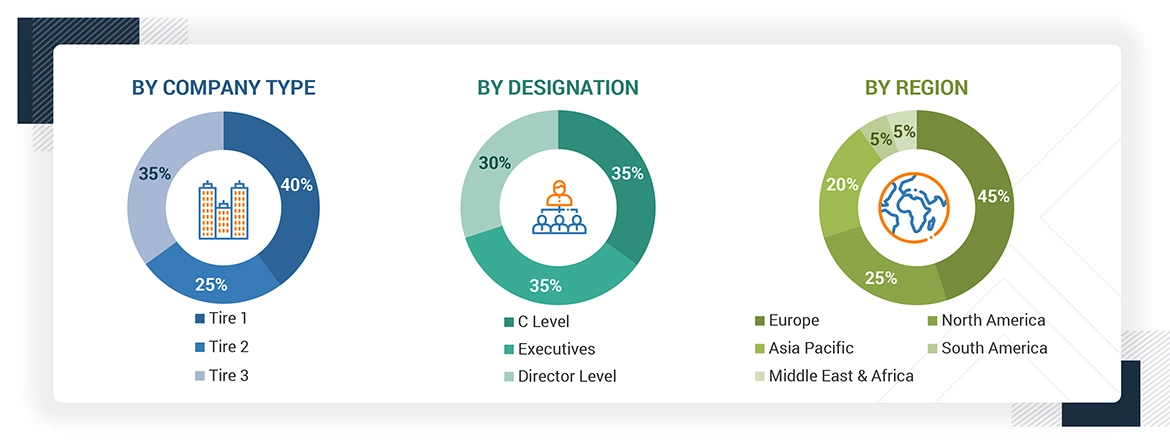
Notes: Other designations include sales, marketing, and product managers
Tier 1: >USD 1 Billion; Tier 2: USD 500 million–1 Billion; and Tier 3: USD 500 million.
To know about the assumptions considered for the study, download the pdf brochure
Market Size Estimation
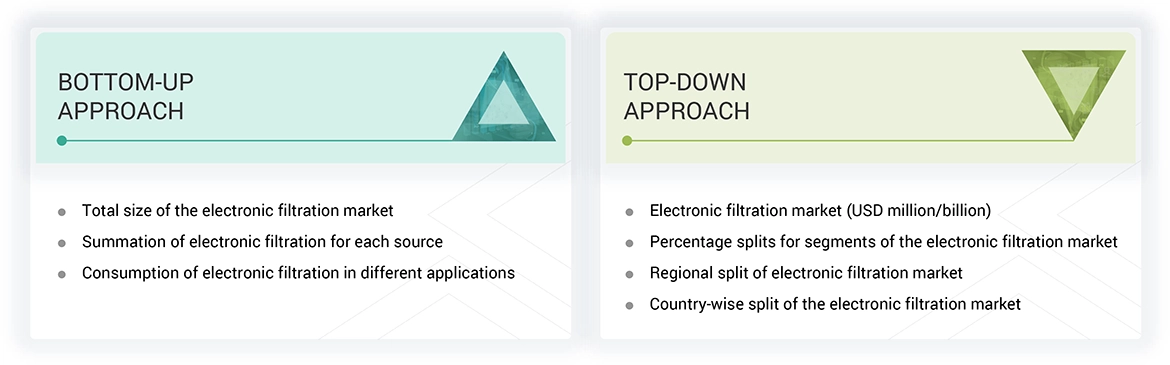
The top-down and bottom-up approaches were used to estimate and validate the size of the global electronic filtration market. These approaches were also used extensively to estimate the size of various dependent market segments. The research methodology used to estimate the market size included the following:
Electronic Filtration Market : Top-Down and Bottom-Up Approach
Data Triangulation
After arriving at the overall market size using the market size estimation processes, the market was split into several segments and subsegments. The data triangulation and market breakup procedures were employed, wherever applicable, to complete the overall market engineering process and arrive at the exact statistics of each market segment and subsegment. The data was triangulated by studying various factors and trends from both the demand and supply sides.
Market Definition
Electronic filtration products play a vital role in avoiding contamination of sensitive electronic systems and delivering the best performance. These filters are typically used in industries such as telecommunications, consumer electronics, automotive electronics, medical equipment, and industrial applications. Key market drivers include increasing demand for cleaner environments in electronics manufacturing, increased air and water pollution concerns, and the need for electronics compliant with environmental standards and regulations.
Key Stakeholders
- Filter manufacturers
- End users
- Technology and R&D institutions
- Regulatory bodies and standards organizations
- Distributors and suppliers
- Consultants and system integrators
- Investors and financial entities
Report Objectives
- To define, describe, and forecast the size of the global electronic filtration market based on product type, filter technology, filter material, application, end-use industry, and region in terms of value and volume
- To provide detailed information on the significant drivers, restraints, opportunities, and challenges influencing the market
- To strategically analyze micromarkets concerning individual growth trends, prospects, and their contribution to the market
- To assess the growth opportunities in the market for stakeholders and provide details on the competitive landscape for market leaders
- To forecast the market size of segments and subsegments for North America, Europe, Asia Pacific, South America, and the Middle East & Africa
- To strategically profile key players and comprehensively analyze their market shares and core competencies
- To analyze competitive developments such as product launches, acquisitions, partnerships, expansions, and investments in the electronic filtration market.
- To provide the impact of AI/Gen AI on the market
Available Customizations
With the given market data, MarketsandMarkets offers customizations according to client-specific needs.
- The following customization options are available for the electronic filtration market report:
Product Analysis
- A product matrix that gives a detailed comparison of the product portfolio of each company
Regional Analysis
- A further breakdown of the electronic filtration market for additional countries
Company Information
- Detailed analysis and profiling of additional market players (up to five)
Get the Full Electronic Filtration Market Report
Full forecast, segment splits, and company analysis for all Electronic Filtration Market.
- US Electronic Filtration Market
- Canada Electronic Filtration Market
- Mexico Electronic Filtration Market
- Germany Electronic Filtration Market
- France Electronic Filtration Market
- Spain Electronic Filtration Market
- UK Electronic Filtration Market
- Italy Electronic Filtration Market
- China Electronic Filtration Market
- Japan Electronic Filtration Market
- India Electronic Filtration Market
- Taiwan Electronic Filtration Market
- South Africa Electronic Filtration Market
- Brazil Electronic Filtration Market
- Argentina Electronic Filtration Market
- Rest Of Europe Electronic Filtration Market
- Rest Of Asia Pacific Electronic Filtration Market
Need a Tailored Report?
Customize this report to your needs
Get 10% FREE Customization
Customize This Report
