
India Electronic Lab Notebook Market (2025-2030)

The India Electronic Lab Notebook Market was valued at $28.8 Million in 2025 and projected to reach to $45.4 Million by 2030, representing a compound annual growth rate of 9.5%. India's Electronic Lab Notebook market is poised for significant expansion as the country's pharmaceutical, biotechnology, and academic research sectors increasingly digitalize their laboratory operations.


| Market Size in | USD 26.32 MN |
| Market Forecast in | |
| CAGR | |
| Forecast Period | |
| Units Considered | Value (USD MN) |
India Electronic Lab Notebook Market Trends and Insights
- This 9.5% compound annual growth rate reflects India's accelerating digital transformation in research and development sectors, driven by increasing adoption of cloud-based laboratory management solutions across pharmaceutical, biotechnology, and academic institutions.
- India's growing investment in R&D infrastructure and regulatory compliance requirements are positioning the country as a key growth market within the Asia Pacific region. The expansion of India's ELN market from 2025 to 2030 is underpinned by rising demand for data integrity, traceability, and automation in laboratory workflows.
- India's pharmaceutical and biotech sectors are increasingly recognizing the value of electronic documentation systems to meet international quality standards and streamline operational efficiency.
- Government initiatives promoting scientific research and the proliferation of contract research organizations (CROs) in India are further catalyzing market penetration and creating opportunities for both domestic and international ELN vendors..
Key Market Statistics
- CAGR (2025-2030) 9.5% CAGR
- Market Size, 2025 ~USD 28.8 Million
- Forecast, 2030 ~USD 45.4 Million
- Country India
India Electronic Lab Notebook Market Overview
Strong CAGR Growth :
India's ELN market is growing at 9.5% CAGR from 2025-2030, outpacing the global growth rate of 7.3%, indicating accelerated digital adoption in Indian research institutions.
Pharmaceutical Sector Leadership :
India's thriving pharmaceutical and biotech industries are driving ELN adoption, with companies modernizing laboratory workflows to meet international compliance standards and improve operational efficiency.
Cloud-Based Transformation :
Increasing preference for cloud-based laboratory management solutions among Indian R&D facilities is enabling remote collaboration, data security, and scalability across distributed research centers.
Market Valuation Expansion :
The market is projected to grow from USD 28.8 million in 2025 to USD 45.4 million by 2030, representing a 57.6% increase in market value over the five-year forecast period.
India Electronic Lab Notebook Market Dynamics
- The 9.5% CAGR reflects growing investments in R&D infrastructure, regulatory compliance requirements, and the need for efficient data management across multiple research facilities.
- Government initiatives promoting scientific innovation and the rise of contract research organizations (CROs) are further accelerating ELN adoption. The market's growth trajectory is supported by improving internet connectivity, rising awareness of data integrity benefits, and cost-effective cloud solutions tailored for Indian enterprises.
- As multinational pharmaceutical companies expand their Indian operations and domestic biotech firms scale up, demand for integrated laboratory management platforms will continue to surge, positioning India as a key growth market within the Asia-Pacific region..
Market Ecosystem
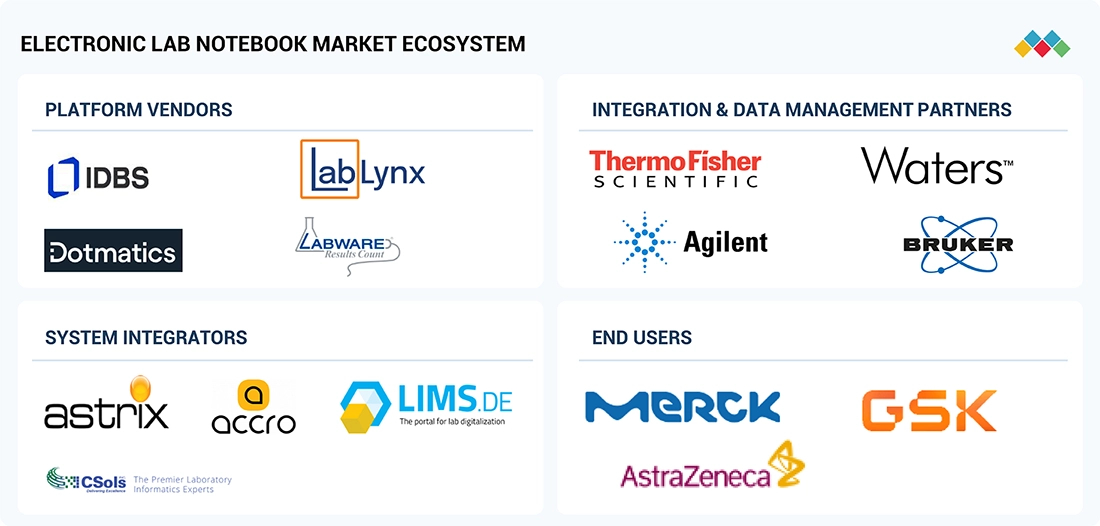
Electronic Lab Notebook Market: COMMERCIAL USE CASES ACROSS INDUSTRIES
| COMPANY | USE CASE DESCRIPTION | BENEFITS |
|---|---|---|
 |
Implemented ELNs integrated with laboratory instruments and LIMS to automate data capture and streamline experimental workflows in life sciences research. | Reduced manual data entry errors, accelerated research timelines, and improved traceability and compliance with regulatory standards. |
 |
Deployed a unified ELN and scientific data management platform to support modeling, simulation, and collaborative research across global R&D teams. | Enhanced collaboration, enabled scalable digital lab infrastructure, and improved reproducibility and innovation across scientific disciplines. |
 |
Integrated ELNs with analytical instruments and sample tracking systems to support regulated environments such as pharmaceutical and biotech labs. | Allowed real-time data capture, simplified regulatory compliance, and increased laboratory productivity and operational efficiency. |
 |
Tailored ELN solutions for analytical chemistry workflows, integrating data from chromatography and mass spectrometry instruments. | Centralized complex analytical data, improved data integrity, and facilitated faster decision-making in both quality control and research settings. |
 |
Offered a web-based ELN integrated with LIMS and SDMS to manage multidisciplinary research and quality assurance processes. | Enabled seamless data flow across laboratory systems, improved experiment documentation, and supported both R&D and QA/QC operations with enhanced efficiency. |
Logos and trademarks shown above are the property of their respective owners. Their use here is for informational and illustrative purposes only.
Related Ecosystem
Healthcare It
- Computed Tomography (CT)
- Machine Learning
- Magnetic Resonance Imaging (MRI)
- Natural Language Processing (NLP)
- Predictive Analytics
- CERNER CORPORATION
- PHILIPS HEALTHCARE
- Oracle Corporation
- GE HealthCare Technologies Inc.
- Siemens healthineers
Key Takeaways
- India's ELN market is valued at USD 28.8 million in 2025 and expected to reach USD 45.4 million by 2030, representing a 9.5% CAGR.
- India's pharmaceutical and biotech sectors are driving ELN adoption to meet regulatory compliance and international quality standards.
- Cloud-based and automation-focused ELN solutions are gaining traction in India's research institutions and CROs.
- Government R&D initiatives and digital transformation policies are accelerating ELN market growth across India.
Electronic Lab Notebook Market Report Scope
| Report Metric | Details |
|---|---|
| Base Year | 2025 |
| Fastest Growing Segment | SOFTWARE (Component) |
| Forecast Period | 2025–2030 |
| Growth Rate | CAGR of 7.3% from 2025 to 2030 |
| Largest Segment | PROPRIETARY ELN (License) |
| Market Size Base Year (Billions) | ~USD 0.72 (2025) |
| Revenue Forecast (Billions) | ~USD 1.03 (2030) |
| Segments Covered | Product Type, Component, Deployment, Type, License, Organization Size, End User |
India Electronic Lab Notebook Market Report Segmentation
7 segment dimensions are covered across the global market.
By Product Type
- Cross-Disciplinary Elns
- Specific Elns
By Component
- Services
- Software
By Deployment
- Cloud-Based Model
- Hybrid Model
- On-Premises Model
By Type
- Academic Research Institutes
- Biobanks & Biorepositories
- Biobanks And Biorepositories
- Clinical Research Laboratories
- Contract Service Organizations
- Infrastructure-As-A-Service (IaaS)
- Ngs Laboratories
- Other Life Sciences
- Pharmaceutical & Biotechnology Companies
- Platform-As-A-Service (PaaS)
- Software-As-A-Service (SaaS)
- Toxicology Laboratories
By License
- Open-Source Eln
- Proprietary Eln
By Organization Size
- Large
- Small & Medium
By End User
- Chemical Industry
- Environmental Research
- Food & Beverages And Agriculture
- Life Sciences
- Other End Users
- Petrochemicals And Oil & Gas
INDIA: ELECTRONIC LAB NOTEBOOK MARKET, BY END USER, 2023–2030
| Segment | 2023 | 2024 | 2025 | 2026 | 2027 | 2028 | 2029 | 2030 | CAGR (%) |
|---|---|---|---|---|---|---|---|---|---|
| CHEMICAL INDUSTRY | 2.93 | 3.2 | 3.49 | 3.82 | 4.18 | 4.58 | 5.04 | 5.55 | 9.7 |
| ENVIRONMENTAL RESEARCH | 1.18 | 1.26 | 1.36 | 1.47 | 1.59 | 1.72 | 1.87 | 2.03 | 8.3 |
| FOOD & BEVERAGES AND AGRICULTURE | 3.51 | 3.8 | 4.13 | 4.49 | 4.89 | 5.33 | 5.83 | 6.38 | 9.1 |
| LIFE SCIENCES | 13.35 | 14.58 | 15.95 | 17.49 | 19.19 | 21.12 | 23.27 | 25.67 | 10 |
| OTHER END USERS | 0.74 | 0.79 | 0.84 | 0.9 | 0.96 | 1.03 | 1.1 | 1.18 | 7 |
| PETROCHEMICALS AND OIL & GAS | 2.55 | 2.76 | 2.99 | 3.24 | 3.52 | 3.83 | 4.18 | 4.56 | 8.8 |
| TOTAL | 24.26 | 26.39 | 28.76 | 31.4 | 34.33 | 37.61 | 41.28 | 45.36 | 9.5 |
Target Audience
- Pharmaceutical Companies : Indian and multinational pharma firms need market intelligence to evaluate ELN adoption ROI, benchmark against competitors, and plan digital laboratory infrastructure investments.
- Biotech & Research Institutions : Biotech startups and academic research centers require data on market trends, vendor capabilities, and funding opportunities to modernize laboratory operations and improve research productivity.
- ELN Software Vendors : Technology providers and software companies need India-specific market insights to refine product offerings, identify customer segments, and develop localized go-to-market strategies.
- Healthcare IT Consultants : Consulting firms and system integrators advising Indian healthcare organizations need detailed market analysis to guide digital transformation initiatives and technology selection.
- Investment & Private Equity Firms : Investors evaluating opportunities in India's healthcare IT sector require comprehensive market data to assess growth potential, competitive positioning, and exit opportunities.
Key Companies in the India Electronic Lab Notebook Market
| Company | HQ | Ownership | Strongest segments |
|---|---|---|---|
| REVVITY, INC. | United States | Public Company | Diagnostics (prenatal, neonatal, infectious disease, immunodiagnostics),Life science reagents and assay platforms,Instruments, detection and imaging technologies, |
| WATERS CORPORATION | United States | Public Company | Liquid Chromatography Systems and Columns,Mass Spectrometry Systems,TA Instruments (Thermal, Rheometry, Calorimetry), |
| STARLIMS CORPORATION | Israel | Private Company | Core LIMS platform (web-based),ELN and SDMS modules,Cloud services (hosting, DB, HIPAA, managed infra), |
| AGILENT TECHNOLOGIES, INC. | United States | Public Company | Life Sciences and Diagnostics Markets,Agilent CrossLab,Applied Markets, |
| EPPENDORF SE | Germany | Private Company | Liquid handling (pipettes, dispensers, automated systems),Separation & instrumentation (centrifuges, PCR cyclers, ULT freezers),Consumables (tubes, tips, plates, single-use bioreactors), |
REVVITY, INC.
Revvity, Inc. is a publicly traded company founded in 1937 and headquartered in the United States with approximately 11,000 employees. The company operates in the life sciences and diagnostics sectors, providing analytical instruments, software, and services.
WATERS CORPORATION
Waters Corporation is a publicly traded analytical instruments company founded in 1958 and headquartered in the United States with approximately 7,900 employees. The company specializes in chromatography, mass spectrometry, and laboratory software solutions.
STARLIMS CORPORATION
StarLims Corporation is a private software company founded in 1986 and headquartered in Israel with 162 employees. The company provides laboratory information management system (LIMS) solutions for research and clinical laboratories.
AGILENT TECHNOLOGIES, INC.
Agilent Technologies, Inc. is a publicly traded company founded in 1999 and headquartered in the United States with approximately 18,000 employees. The company manufactures analytical instruments, software, and services for life sciences, diagnostics, and applied markets.
EPPENDORF SE
Eppendorf SE is a private company founded in 1945 and headquartered in Germany with approximately 4,358 employees. The company manufactures laboratory equipment, consumables, and instruments for life sciences research and diagnostics.
Reasons to Buy this Report
- India-Specific Market Sizing : Access precise valuation data for India's ELN market with verified 2025 baseline (USD 28.8M) and 2030 forecast (USD 45.4M), enabling accurate business planning and investment decisions.
- Competitive Landscape Intelligence : Understand India's unique competitive dynamics, local player strategies, and market consolidation trends specific to the Indian pharmaceutical and biotech sectors.
- Growth Driver Analysis : Identify key growth catalysts in India including regulatory compliance needs, CRO expansion, academic digitalization, and cloud adoption patterns driving the 9.5% CAGR.
- Regional Expansion Strategy : Develop targeted go-to-market strategies for India with insights into regional adoption rates, customer segments, and geographic concentration of pharmaceutical and research hubs.
- Investment & Partnership Opportunities : Discover high-potential investment targets, partnership opportunities, and acquisition candidates within India's rapidly growing ELN ecosystem and supporting technology sectors.
Frequently asked questions
What is the current size of India's Electronic Lab Notebook market?
India's Electronic Lab Notebook market was valued at USD 28.8 million in 2025 and is projected to grow to USD 45.4 million by 2030.
What is the expected growth rate for India's ELN market?
India's ELN market is expected to grow at a compound annual growth rate (CAGR) of 9.5% from 2025 to 2030.
Which sectors are driving ELN adoption in India?
India's pharmaceutical, biotechnology, and academic research sectors are the primary drivers of ELN adoption, supported by regulatory compliance requirements and quality standards.
What factors are contributing to India's ELN market growth?
Key growth factors in India include increasing R&D investments, regulatory compliance needs, digital transformation initiatives, and the expansion of contract research organizations (CROs).
How does India's ELN market compare to the global market?
India's ELN market is growing at 9.5% CAGR, which exceeds the global CAGR of 7.3%, positioning India as a high-growth market within the Asia Pacific region.
RESEARCH METHODOLOGY
The study involved comprehensive efforts to estimate the current size of the electronic lab notebook (ELN) market. Extensive secondary research was conducted to gather information about the market. The next step was to validate these findings, assumptions, and estimations by consulting industry experts throughout the value chain through primary research. Various methods were employed to calculate the overall market size, including top-down and bottom-up approaches. Subsequently, market segmentation and data triangulation processes were utilized to determine the sizes of the segments and subsegments within the electronic lab notebook market.
Secondary Research
This research study extensively utilized secondary sources, including directories and databases such as Dun & Bradstreet, Bloomberg Businessweek, and Factiva. It also incorporated white papers, annual reports, company documents, investor presentations, and SEC filings. The market analysis for companies providing electronic lab notebook solutions was conducted using both paid & unpaid secondary data. This involved examining the product portfolios of major companies in the sector and evaluating their performance and quality. Various sources were consulted throughout the secondary research process to gather relevant information. These included annual reports, press releases, investor presentations, white papers, academic journals, certified publications, articles by recognized authors, directories, and databases.
The secondary research process referred to various secondary sources to identify & collect information related to the study. These sources included annual reports, press releases, investor presentations of electronic lab notebook vendors, forums, certified publications, and whitepapers. The secondary research was used to obtain critical information on the industry’s value chain, the total pool of key players, market classification, and segmentation from the market & technology-oriented perspectives.
Primary Research
In the primary research process, various sources from both the supply & demand sides were interviewed to obtain qualitative & quantitative information for this report. Primary sources are mainly industry experts from the core and related industries and preferred suppliers, manufacturers, distributors, technology developers, researchers, and organizations related to all segments of this industry’s value chain. In-depth interviews were conducted with various primary respondents, including key industry participants, subject-matter experts (SMEs), C-level executives of key market players, and industry consultants, among other experts, to obtain and verify the critical qualitative and quantitative information and assess prospects.
Primary research was conducted to identify segmentation types; industry trends; key players; and key market dynamics such as drivers, restraints, opportunities, challenges, industry trends, and strategies adopted by key players.
After the complete market engineering (calculations for market statistics, market breakdown, market size estimations, market forecasting, and data triangulation), extensive primary research was conducted to gather information and verify & validate the critical numbers arrived at.
In the complete market engineering process, the top-down and bottom-up approaches and several data triangulation methods were extensively used to perform the market estimation and market forecasting for the overall market segments and subsegments listed in this report. Extensive qualitative and quantitative analysis was performed on the complete market engineering process to list the key information/insights throughout the report.
Breakdown of the Primary Respondents:
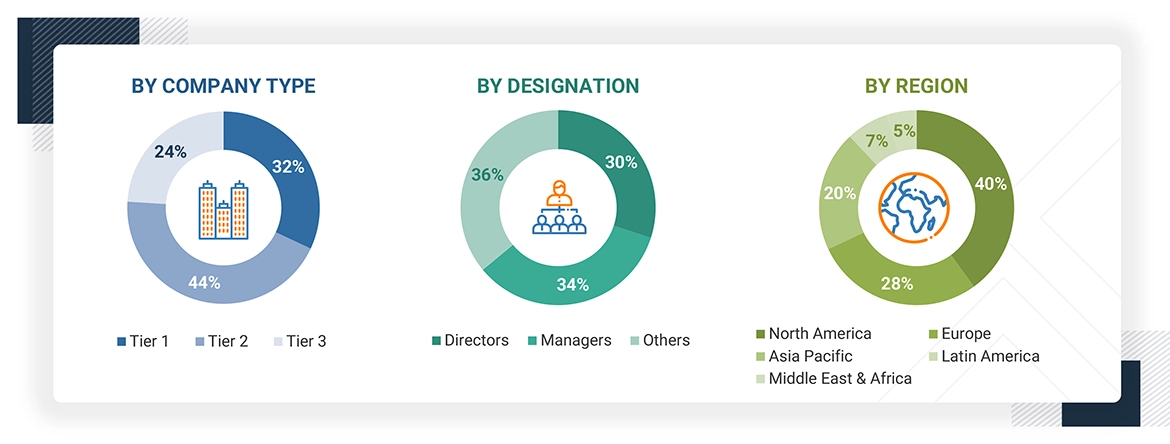
*Others include sales managers, marketing managers, and product managers.
Note: Tiers are defined based on a company’s total revenue. As of 2024: Tier 1 = >USD 1 billion, Tier 2 = USD 500 million to USD 1 billion, and Tier 3 = < USD 500 million.
To know about the assumptions considered for the study, download the pdf brochure
Market Size Estimation
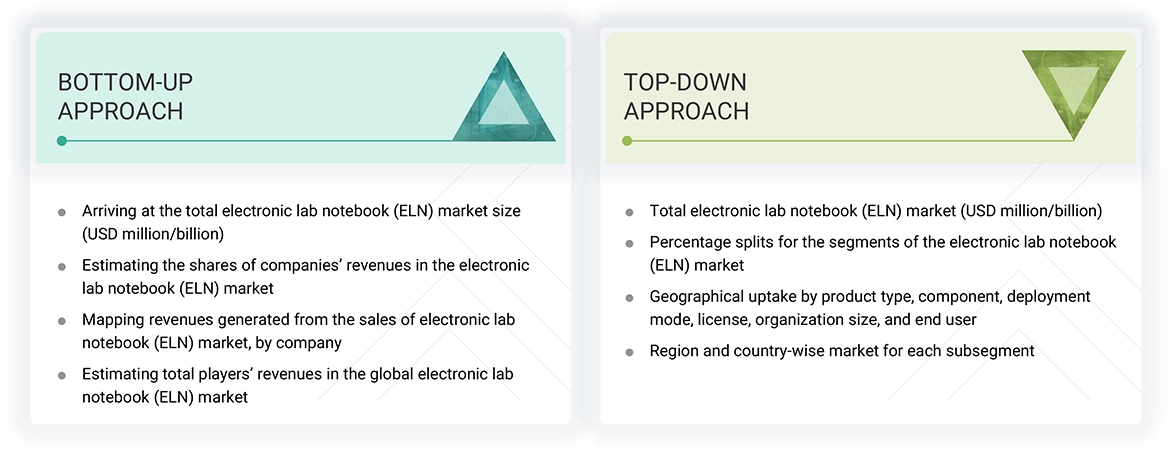
The market size estimates, and forecasts provided in this study are derived through the bottom-up approach (revenue share analysis of leading players) and the top-down approach (assessment of utilization/adoption/penetration trends by component, product, deployment mode, end user, and region).
Data Triangulation
The market was split into several segments and subsegments after arriving at the overall market size—using the market size estimation processes. Data triangulation and market breakdown procedures were employed to complete the overall market engineering process and arrive at the exact statistics of each market segment and sub-segment. The data was triangulated by studying various factors and trends from the demand and supply sides in the electronic lab notebook (ELN) market.
Market Definition
An Electronic Lab Notebook (ELN) designs, executes, and documents research, experiments, and assays. Scientists and lab technicians frequently utilize ELNs in the life sciences industry. Molecular biology, genetics, biochemistry, pharmacology, and microbiology are life science fields that extensively utilize ELNs. Researchers in these areas use ELNs to document observations, manage experimental data, collaborate with colleagues, and record experimental protocols.
Stakeholders
- Electronic Lab Notebook Software Vendors
- Electronic Lab Notebook Service Providers
- Independent Software Vendors (ISVs)
- Platform Providers
- Forums, Alliances, and Associations
- Government Organizations
- Institutional Investors and Investment Banks
- Investors/Shareholders
- Venture Capitalists
- Research & Consulting Firms
Report Objectives
- To define, describe, and forecast the global electronic lab notebook market based on product, component, deployment mode, license, organization size, and end user
- To provide detailed information regarding the factors influencing the growth of the market (such as the drivers, restraints, opportunities, and challenges)
- To strategically analyze micromarkets with respect to individual growth trends, prospects, and contributions to the overall electronic lab notebook market
- To analyze market opportunities for stakeholders and provide details of the competitive landscape for market leaders
- To forecast the size of the electronic lab notebook in five regions with country-level segmentation: North America, Europe, the Asia Pacific, Latin America, and the Middle East & Africa
- To profile key players and comprehensively analyze their product portfolios, market positions, and core competencies in the market
- To track and analyze competitive developments such as product launches; expansions; partnerships, agreements, collaborations, and acquisitions in the electronic notebook market
- To benchmark players within the electronic lab notebook market using the Company Evaluation Matrix framework, which analyzes market players on parameters within the broad categories of business strategy, market share, and product offering
Get the Full Electronic Lab Notebook Market Report
Full forecast, segment splits, and company analysis for all Electronic Lab Notebook Market.
- US Electronic Lab Notebook Market
- Canada Electronic Lab Notebook Market
- Germany Electronic Lab Notebook Market
- France Electronic Lab Notebook Market
- UK Electronic Lab Notebook Market
- Italy Electronic Lab Notebook Market
- Spain Electronic Lab Notebook Market
- China Electronic Lab Notebook Market
- Japan Electronic Lab Notebook Market
- Brazil Electronic Lab Notebook Market
- Mexico Electronic Lab Notebook Market
- Rest Of Europe Electronic Lab Notebook Market
- Rest Of Asia Pacific Electronic Lab Notebook Market
- Rest Of Latin America Electronic Lab Notebook Market
Need a Tailored Report?
Customize this report to your needs
Get 10% FREE Customization
Customize This Report
