
France Electronic Skin Patch Market (2024-2029)

The France Electronic Skin Patch Market was valued at $654.5 Million in 2024 and projected to reach to $1061.2 Million by 2029, representing a compound annual growth rate of 10.1%. France's electronic skin patch market is poised for sustained expansion through 2029, driven by increasing healthcare digitalization and growing patient demand for non-invasive monitoring solutions.


| Market Size in | USD 26.32 MN |
| Market Forecast in | |
| CAGR | |
| Forecast Period | |
| Units Considered | Value (USD MN) |
France Electronic Skin Patch Market Trends and Insights
- This expansion reflects France's strong healthcare infrastructure and increasing adoption of wearable medical technologies across the country.
- France is positioning itself as a key hub for advanced medical device innovation within Europe, driven by rising demand for remote patient monitoring and chronic disease management solutions. The French market benefits from significant investment in digital health initiatives and regulatory support for medical device innovation.
- France's aging population and prevalence of chronic conditions are accelerating the adoption of electronic skin patches for continuous health monitoring.
- Between 2024 and 2029, France is expected to see accelerated market penetration as healthcare providers and consumers increasingly recognize the clinical and economic benefits of these technologies. France's competitive advantage lies in its combination of advanced manufacturing capabilities, strong pharmaceutical and medical device sectors, and supportive healthcare policies.
- The country's emphasis on precision medicine and personalized healthcare is creating favorable conditions for electronic skin patch deployment across hospitals, clinics, and home care settings..
Key Market Statistics
- CAGR (2024-2029) 10.1% CAGR
- Market Size, 2024 ~USD 654.5 Million
- Forecast, 2029 ~USD 1061.2 Million
- Country France
France Electronic Skin Patch Market Overview
Market Valuation :
France's electronic skin patch market reached $654.5 million in 2024, demonstrating strong market maturity and adoption within the country's advanced healthcare ecosystem.
Projected Growth Trajectory :
The market is forecast to grow at a CAGR of 10.1% through 2029, reaching $1,061.2 million, outpacing many European counterparts in wearable medical device adoption.
Healthcare Infrastructure Advantage :
France's robust healthcare system and high reimbursement rates for innovative medical devices create favorable conditions for electronic skin patch market expansion and clinical adoption.
European Innovation Hub :
France is establishing itself as a key center for advanced medical device innovation in Europe, attracting R&D investments and fostering collaboration between healthcare providers and technology companies.
France Electronic Skin Patch Market Dynamics
- The country's strong regulatory framework and established medical device manufacturing base support accelerated commercialization of innovative wearable technologies.
- French healthcare providers are increasingly integrating electronic skin patches into chronic disease management and remote patient monitoring programs, reflecting broader European trends toward personalized medicine.
- Government initiatives promoting digital health and aging population demographics further strengthen market fundamentals, positioning France as a strategic market for medical device manufacturers targeting Western Europe..
Market Ecosystem
Related Ecosystem
Sensors And Control
- Sensors
- Temperature Sensors
- Image Sensors
- Pressure Sensors
- Flow Sensors
- BAUMER ELECTRIC AG
- HONEYWELL INTERNATIONAL INC.
- Stmicroelectronics
- Lenovo
- Texas Instruments Incorporated
Key Takeaways
- France's electronic skin patch market is valued at $654.5 million in 2024 and is projected to reach $1,061.2 million by 2029, representing a 10.1% CAGR.
- France's aging demographic and high prevalence of chronic diseases are primary drivers of electronic skin patch adoption across the country.
- France's robust healthcare infrastructure and digital health investments position the country as a leading European market for wearable medical technologies.
- Remote patient monitoring and continuous health tracking applications are expected to dominate France's electronic skin patch market through 2029.
Electronic Skin Patch Market Report Scope
| Report Metric | Details |
|---|---|
| Base Year | 2024 |
| Fastest Growing Segment | HOME CARE (Healthcare) |
| Forecast Period | 2024-2029 |
| Growth Rate | CAGR of 12.5% from 2024 to 2029 |
| Largest Segment | MONITORING & DIAGNOSTIC (Type) |
| Market Size Base Year (Billions) | ~USD 14.98 (2024) |
| Revenue Forecast (Billions) | ~USD 27 (2029) |
| Segments Covered | Type, Application, Wireless Connectivity, End User, Healthcare |
France Electronic Skin Patch Market Report Segmentation
5 segment dimensions are covered across the global market.
By Type
- Monitoring & Diagnostic
- Therapeutic
By Application
- Cardiovascular Monitoring
- Diabetes Management
- Electrical Stimulation
- General Patient Monitoring
- Iontophoresis
- Motion Sensing
- Other Applications
- Sweat Sensing
- Temperature Sensing
- Wound Monitoring & Treatment
By Wireless Connectivity
- Connected
- Non-Connected
By End User
- Fitness & Sports
- Healthcare
- Other End Users
By Healthcare
- Diagnostic Laboratories
- Home Care
- Hospitals & Clinics
Target Audience
- Medical Device Manufacturers : Manufacturers need France-specific market data to assess market opportunity, develop localized product strategies, and identify optimal entry points within Europe's advanced healthcare market.
- Healthcare Investors & PE Firms : Investment professionals require detailed France market analysis to evaluate portfolio opportunities, assess growth potential, and make informed capital allocation decisions in the wearable medical device sector.
- French Healthcare Providers : Hospitals and clinics need market insights to understand technology adoption trends, evaluate vendor solutions, and plan digital health infrastructure investments aligned with market evolution.
- Regulatory & Compliance Consultants : Consultants advising on French market entry require country-specific regulatory landscape analysis, reimbursement frameworks, and compliance requirements for electronic skin patch commercialization.
- Market Research & Strategy Teams : Corporate strategists need granular France market data to benchmark competitive positioning, identify white space opportunities, and develop evidence-based business expansion plans in Western Europe.
Reasons to Buy this Report
- Market-Specific Sizing & Forecasts : Access precise valuation data for France's electronic skin patch market with country-specific CAGR projections through 2029, enabling accurate financial planning and investment decisions.
- Competitive Landscape Intelligence : Understand France's unique competitive dynamics, local market players, and regulatory environment to identify partnership opportunities and market entry strategies specific to the French healthcare sector.
- Healthcare System Insights : Gain detailed analysis of France's healthcare infrastructure, reimbursement policies, and clinical adoption patterns that directly influence electronic skin patch market penetration and growth potential.
- Regional Growth Drivers : Identify France-specific growth catalysts including aging demographics, digital health initiatives, and government healthcare innovation programs driving market expansion through 2029.
- Strategic Market Positioning : Leverage France-focused market intelligence to develop targeted go-to-market strategies, optimize resource allocation, and capitalize on France's role as a European medical device innovation hub.
Frequently asked questions
What is the current size of France's electronic skin patch market?
France's electronic skin patch market was valued at $654.5 million in 2024 and is expected to grow to $1,061.2 million by 2029.
What is the projected growth rate for France's electronic skin patch market?
France's electronic skin patch market is projected to grow at a compound annual growth rate (CAGR) of 10.1% from 2024 to 2029.
What factors are driving growth in France's electronic skin patch market?
Key drivers include France's aging population, increasing prevalence of chronic diseases, strong healthcare infrastructure, digital health investments, and growing demand for remote patient monitoring solutions.
Which applications are leading France's electronic skin patch market?
Remote patient monitoring, continuous glucose monitoring, cardiac monitoring, and drug delivery applications are among the leading segments in France's electronic skin patch market.
How does France's market compare to the global electronic skin patch market?
While the global market grows at 12.5% CAGR, France's market grows at 10.1% CAGR, reflecting France's mature healthcare system and steady adoption of advanced medical technologies.
RESEARCH METHODOLOGY
The research process for this study included the systematic gathering, recording, and analysis of data about customers and companies operating in the electronic skin patch market. This research study involved the extensive use of secondary sources, directories, and databases (Factiva, Oanda, and OneSource) to identify and collect valuable information for this extensive, technical, market-oriented, and commercial market study. In-depth interviews were conducted with various primary respondents, including experts from core and related industries and preferred manufacturers, to obtain and verify critical qualitative and quantitative information and assess the growth prospects of the market. Key players in the market were identified through secondary research, and their market rankings were determined through primary and secondary research. This research included studying annual reports of top players and interviewing key industry experts, such as CEOs, directors, and marketing executives.
Secondary Research
Various secondary sources were referred to in the secondary research process to identify and collect information relevant to this study. Secondary sources include annual reports, press releases, and investor presentations of companies; white papers, certified publications, and articles from recognized authors; directories; and databases. Secondary research was mainly done to obtain critical information about the industry’s supply chain, value chain, the pool of key players, and market classification and segmentation according to industry trends, geographic markets, and key developments from market- and technology-oriented perspectives.
Secondary sources included corporate filings (such as annual reports, investor presentations, and financial statements); trade, business, and professional associations; white papers; journals and certified publications; articles by recognized authors; gold-standard and silver-standard websites; directories; and databases. Data was also collected from secondary sources, such as the International Diabetes Federation (IDF), the International Trade Centre (ITC) (Switzerland), and the National Institute of Health (NIH).
Primary Research
Extensive primary research was conducted after understanding and analyzing the current scenario of the electronic skin patch market through secondary research. Several primary interviews were conducted with key opinion leaders from the demand and supply sides across four major regions: North America, Europe, Asia Pacific, and RoW. Approximately 25% of the primary interviews were conducted with the demand side, while 75% were conducted with the supply side. This primary data was collected mainly through telephonic interviews, which accounted for 80% of the total primary interviews. Questionnaires and e-mails were also used to collect data. In canvassing primaries, the report covers various departments within organizations, such as sales, operations, and administration, to provide a holistic viewpoint.
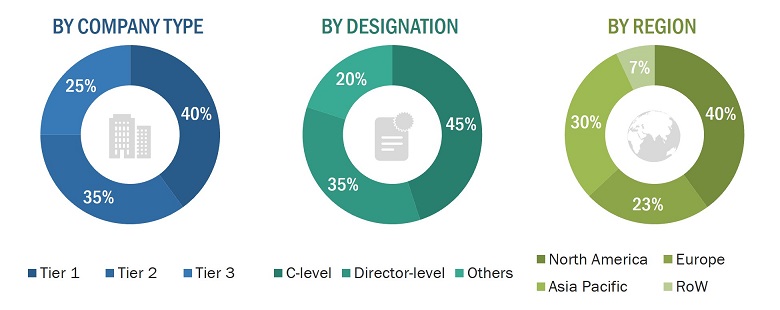
To know about the assumptions considered for the study, download the pdf brochure
Market Size Estimation
In the complete market engineering process, top-down and bottom-up approaches and several data triangulation methods have been used to estimate and forecast the size of the market and its segments and sub-segments listed in the report. Extensive qualitative and quantitative analyses have been carried out on the complete market engineering process to list the key information/insights pertaining to the electronic skin patch market.
Key players in the market have been identified through secondary research, and their rankings in the respective regions have been determined through primary and secondary research. This entire procedure involved the study of the annual and financial reports of top players and interviews with industry experts, such as chief executive officers, vice presidents, directors, and marketing executives, for quantitative and qualitative key insights. All percentage shares, splits, and breakdowns have been determined using secondary sources and verified through primary sources. All parameters that affect the markets covered in this research study have been accounted for, viewed in extensive detail, verified through primary research, and analyzed to obtain the final quantitative and qualitative data. This data has been consolidated and enhanced with detailed inputs and analysis from MarketsandMarkets and presented in this report.
Electronic Skin Patch Market: Bottom-Up Approach
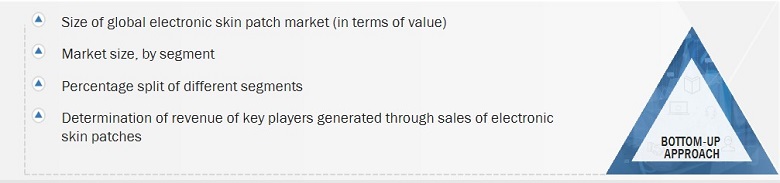
The bottom-up approach has been employed to arrive at the overall size of the Electronic Skin Patch market from the revenues of key players and their share in the market.
Electronic Skin Patch Market: Top-Down Approach
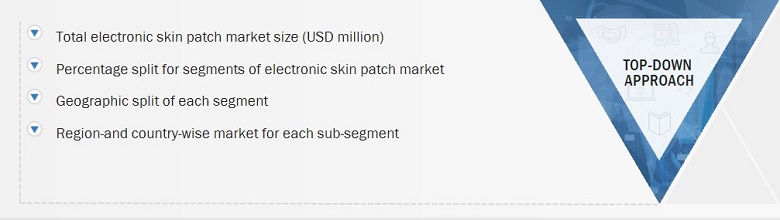
In the top-down approach, the overall size of the electronic skin patch market was used to estimate the size of the individual markets (mentioned in the market segmentation) through percentage splits obtained from secondary and primary research. For calculating the size of specific market segments, the size of the most appropriate parent market was used to implement the top-down approach. The bottom-up approach was also implemented for the data extracted from the secondary research to validate the size of various segments and sub-segments of the market.
The market share of each company was estimated to verify the revenue share used earlier in the bottom-up approach. The data triangulation procedure and data validation through primaries determined and confirmed the individual market size in this study. The data triangulation procedure used for this study was explained in the next section.
Data Triangulation
After arriving at the overall size of the market from the estimation process explained above, the market was split into several segments and sub-segments. The data triangulation and market breakdown procedures were employed (wherever applicable) to complete the overall market engineering process and arrive at the exact statistics for all segments and sub-segments. The data was triangulated by studying various factors and trends from the demand and supply sides. The size of the electronic skin patch market was validated using both top-down and bottom-up approaches.
Market Definition
An electronic skin patch is a thin, flexible device embedded with electronic components and sensors that adhere to the skin. It is designed to monitor physiological parameters, such as heart rate, glucose level, temperature, and motion. It also delivers therapeutic agents, including drugs or electrical stimulation, to the body. These patches often incorporate wireless communication capabilities, enabling real-time transmission of data to smartphones or other devices for monitoring or analysis. They offer non-invasive and continuous monitoring, making them valuable in healthcare, fitness, and research applications.
Key Stakeholders
- Raw material and manufacturing equipment suppliers
- Government bodies, venture capitalists, and private equity firms
- Regulatory bodies
- Integrated device manufacturers (IDMs)
- Electronic skin patch component-related intellectual property owners
- Electronic skin patch technology platform developers
- Electronic skin patch component manufacturers
- Distributors and retailers
- Research organizations
- Healthcare providers
- Industry associations and forums
- End users
Report Objectives
- To describe and forecast the electronic skin patch market size, by type, by application, by wireless connectivity and end user, in terms of value
- To describe and forecast the market size, by type, in terms of volume
- To forecast the market size across four regions, namely, North America, Europe, Asia Pacific, and the Rest of the World (RoW), in terms of value
- To present detailed information regarding the major factors influencing the market (drivers, restraints, opportunities, and challenges)
- To provide an ecosystem analysis, case study analysis, patent analysis, technology analysis, average selling price analysis, Porter’s Five Forces analysis, and regulations pertaining to the market
- To offer a comprehensive overview of the value chain of the electronic skin patch ecosystem
- To critically analyze micromarkets1 with respect to individual growth trends, prospects, and contributions to the total market
- To strategically profile key players and comprehensively analyze their market shares and core competencies
- To assess the opportunities for stakeholders and describe the competitive landscape of the market
- To analyze competitive developments, such as collaborations, agreements, partnerships, and product developments, in the market
- To evaluate the impact of the recession on the electronic skin patch market
Available Customizations
With the given market data, MarketsandMarkets offers customizations according to the company’s specific needs. The following customization options are available for the report:
Company Information
- Detailed analysis and profiling of additional market players (up to 7)
Get the Full Electronic Skin Patch Market Report
Full forecast, segment splits, and company analysis for all Electronic Skin Patch Market.
- US Electronic Skin Patch Market
- Canada Electronic Skin Patch Market
- Mexico Electronic Skin Patch Market
- Germany Electronic Skin Patch Market
- UK Electronic Skin Patch Market
- Rest Of Europe Electronic Skin Patch Market
- China Electronic Skin Patch Market
- Japan Electronic Skin Patch Market
- South Korea Electronic Skin Patch Market
- Rest Of Asia Pacific Electronic Skin Patch Market
- GCC Countries Electronic Skin Patch Market
- Rest Of Middle East Electronic Skin Patch Market
Need a Tailored Report?
Customize this report to your needs
Get 10% FREE Customization
Customize This Report
