
Japan Embedded Finance Market (2024-2029)

The Japan Embedded Finance Market was valued at $3700 Million in 2024 and projected to reach to $9000 Million by 2029, representing a compound annual growth rate of 19.7%. Japan's embedded finance market is poised for sustained expansion as digital payment adoption accelerates across consumer and enterprise segments.


| Market Size in | USD 26.32 MN |
| Market Forecast in | |
| CAGR | |
| Forecast Period | |
| Units Considered | Value (USD MN) |
Japan Embedded Finance Market Trends and Insights
- This represents a compound annual growth rate of 19.7%, significantly outpacing global trends.
- Japan's digital transformation, coupled with increasing consumer adoption of fintech solutions and seamless payment integration across e-commerce and retail platforms, is driving this accelerated growth trajectory. The Japanese market benefits from strong technological infrastructure, high smartphone penetration, and a culturally receptive population toward digital financial services.
- Japan's embedded finance ecosystem is being shaped by partnerships between traditional financial institutions and technology companies, enabling innovative payment solutions and financial services integration.
- By 2029, Japan is expected to solidify its position as a key embedded finance hub in the Asia Pacific region, with continued investment in API-driven financial services and open banking initiatives..
Key Market Statistics
- CAGR (2024-2029) 19.7% CAGR
- Market Size, 2024 ~USD 3700 Million
- Forecast, 2029 ~USD 9000 Million
- Country Japan
Japan Embedded Finance Market Overview
Market Valuation & Growth :
Japan's embedded finance market is valued at $3,700 million in 2024, with a projected CAGR of 19.7% through 2029, reaching $9,000 million. This growth rate significantly exceeds the global average of 16.1%, positioning Japan as a high-growth market in the Asia-Pacific region.
Digital Transformation Catalyst :
Japan's advanced digital infrastructure and high internet penetration are driving embedded finance adoption. The nation's tech-savvy population and established e-commerce ecosystem create ideal conditions for seamless payment integration and fintech innovation across retail and online channels.
Consumer Adoption Trends :
Japanese consumers increasingly prefer integrated financial services within their shopping experiences. Rising demand for contactless payments, mobile wallets, and buy-now-pay-later solutions reflects a shift toward convenience-driven financial services embedded in everyday platforms.
Strategic Market Opportunities :
Key growth drivers include partnerships between traditional retailers and fintech companies, expansion of embedded lending solutions, and integration of payment services in social commerce platforms. Japan's aging population also creates opportunities for simplified, embedded financial services targeting seniors.
Japan Embedded Finance Market Dynamics
- The convergence of e-commerce growth, mobile-first consumer behavior, and regulatory support for fintech innovation creates a favorable environment for market participants.
- Traditional financial institutions are increasingly partnering with technology companies to embed financial services into non-financial platforms, enhancing customer experience and operational efficiency. Looking ahead to 2029, Japan's embedded finance market will be shaped by technological advancements in API integration, enhanced cybersecurity frameworks, and evolving consumer preferences for seamless omnichannel experiences.
- The market's 19.7% CAGR reflects strong investor confidence and the strategic importance of embedded finance in Japan's digital economy transformation, positioning the country as a regional leader in fintech innovation..
Market Ecosystem
Related Ecosystem
Software And Services
- Natural Language Processing (NLP)
- Machine Learning
- Supply Chain Management
- Predictive Analytics
- Image Sensors
- International Business Machines Corporation
- MICROSOFT CORPORATION
- Oracle Corporation
- SAP SE
- Amazon.com, Inc.
Key Takeaways
- Japan's embedded finance market is valued at $3,700 million in 2024 and is forecast to grow to $9,000 million by 2029, representing a 19.7% CAGR.
- Japan's strong digital infrastructure and high fintech adoption rates position the country as a leading embedded finance market in Asia Pacific.
- Strategic partnerships between Japanese banks and fintech companies are accelerating the integration of financial services into non-financial platforms.
- Japan's embedded finance growth is driven by e-commerce expansion, mobile payment adoption, and regulatory support for open banking frameworks.
Embedded Finance Market Report Scope
| Report Metric | Details |
|---|---|
| Base Year | 2024 |
| Fastest Growing Segment | EMBEDDED LENDING (Type) |
| Forecast Period | 2024-2029 |
| Growth Rate | CAGR of 16.1% from 2024 to 2029 |
| Largest Segment | B2B (Business Model) |
| Market Size Base Year (Billions) | ~USD 112.54 (2024) |
| Revenue Forecast (Billions) | ~USD 237.4 (2029) |
| Segments Covered | Type, Business Model, Industry, Solution, Transaction Type, Payment Mode, Vertical, Payment Method |
Japan Embedded Finance Market Report Segmentation
8 segment dimensions are covered across the global market.
By Type
- Embedded Insurance
- Embedded Investment/Wealth Management
- Embedded Lending
- Embedded Payments
- Other Types
By Business Model
- B2B
- B2C
By Industry
- Education
- Healthcare
- Other Industries
- Other Industries (Real Estate, Energy, Media & Entertainment, Agriculture)
- Retail & Ecommerce
- Telecom
- Transportation, Mobility, And Logistics
- Travel & Hospitality
By Solution
- Other Solutions
- Payment Gateways
- Payment Processors
- Payment Wallet
- Pos
By Transaction Type
- Cross Border
- Domestic
By Payment Mode
- Ach Transfer
- Cards
- Digital Wallet
- Other Payment Modes
By Vertical
- Bfsi
- Government And Utilities
- Healthcare
- It & Ites
- Media & Entertainment
- Media And Entertainment
- Other Verticals
- Real Estate
- Retail
- Retail & Ecommerce
- Telecom
- Transportation & Logistics
- Travel & Hospitality
- Travel And Hospitality
By Payment Method
- Ach
- Credit Card
- Debit Card
- Ewallet
- Other Payment Methods
Target Audience
- Fintech Companies & Startups : Emerging and established fintech firms need Japan-specific market data to develop localized embedded finance solutions, identify partnership opportunities with retailers and financial institutions, and optimize market entry strategies in this high-growth economy.
- Traditional Financial Institutions : Banks and insurance companies require insights into embedded finance trends to remain competitive, identify digital transformation opportunities, and develop partnerships with technology platforms to embed their services in non-financial channels.
- E-commerce & Retail Platforms : Online retailers and brick-and-mortar chains need market intelligence to integrate payment solutions, offer buy-now-pay-later options, and enhance customer experience through embedded financial services tailored to Japanese consumer preferences.
- Investment & Private Equity Firms : Investors evaluating opportunities in Japan's fintech sector require comprehensive market sizing, growth projections, and competitive analysis to make informed investment decisions and identify high-potential portfolio companies in embedded finance.
- Technology & Platform Providers : Software companies, payment processors, and API providers need Japan market data to develop embedded finance infrastructure, understand local integration requirements, and identify partnership opportunities with financial and retail ecosystem players.
Reasons to Buy this Report
- Competitive Intelligence : Gain detailed insights into Japan's embedded finance competitive landscape, including key players, market share distribution, and strategic partnerships. Understand how local and international fintech companies are positioning themselves in this high-growth market.
- Growth Opportunity Assessment : Identify specific segments and use cases driving the 19.7% CAGR in Japan. Evaluate market entry strategies, expansion opportunities, and revenue potential across retail, e-commerce, lending, and payment integration sectors.
- Consumer Behavior Insights : Understand Japanese consumer preferences for embedded financial services, adoption rates across demographics, and willingness to use integrated payment solutions. Data-driven insights inform product development and marketing strategies tailored to local market dynamics.
- Regulatory & Compliance Framework : Navigate Japan's evolving regulatory environment for embedded finance, including licensing requirements, data protection standards, and compliance obligations. Stay informed on policy changes affecting market operations and strategic planning.
- Investment & Partnership Strategy : Support M&A decisions, partnership evaluations, and investment planning with comprehensive market data. Benchmark performance metrics, identify acquisition targets, and assess collaboration opportunities with established players in Japan's embedded finance ecosystem.
Frequently asked questions
What is the current size of Japan's embedded finance market?
Japan's embedded finance market was valued at $3,700 million in 2024 and is projected to reach $9,000 million by 2029.
What is the expected growth rate for embedded finance in Japan?
Japan's embedded finance market is expected to grow at a compound annual growth rate (CAGR) of 19.7% from 2024 to 2029.
What are the primary drivers of embedded finance growth in Japan?
Key drivers include Japan's advanced digital infrastructure, high smartphone penetration, e-commerce expansion, mobile payment adoption, and regulatory support for open banking initiatives.
How does Japan's embedded finance market compare to global trends?
Japan's 19.7% CAGR significantly exceeds the global embedded finance market CAGR of 16.1%, demonstrating Japan's accelerated adoption and market maturity.
What role do partnerships play in Japan's embedded finance ecosystem?
Strategic collaborations between traditional Japanese financial institutions and fintech companies are enabling seamless integration of financial services into non-financial platforms and accelerating market innovation.
RESEARCH METHODOLOGY
This research study involved the extensive use of secondary sources, directories, and databases, such as Dun & Bradstreet (D&B) Hoovers and Bloomberg BusinessWeek, to identify and collect information useful for a technical, market-oriented, and commercial study of the embedded finance market. The primary sources have been mainly industry experts from the core and related industries and preferred suppliers, manufacturers, distributors, service providers, technology developers, alliances, and organizations related to all segments of the value chain of this market. In-depth interviews have been conducted with various primary respondents, including key industry participants, subject matter experts, C-level executives of key market players, and industry consultants, to obtain and verify critical qualitative and quantitative information.
Secondary Research
The market for companies offering embedded finance solutions to different verticals has been estimated and projected based on the secondary data made available through paid and unpaid sources, as well as by analyzing their product portfolios in the ecosystem of the embedded finance market. It also involved rating company products based on their performance and quality. In the secondary research process, various sources, such as the FTT Embedded Finance & Super-Apps 2024 Summit, Institute of International Finance (IIF), Fintech Retreat Conference 2024, have been referred to for identifying and collecting information for this study on the market. The secondary sources included annual reports, press releases investor presentations of companies, white papers, journals, and certified publications and articles by recognized authors, directories, and databases. Secondary research has been mainly used to obtain key information about the supply chain of the market, the total pool of key players, market classification, segmentation according to industry trends to the bottommost level, regional markets, and key developments from both market- and technology-oriented perspectives that have been further validated by primary sources.
Primary Research
In the primary research process, various primary sources from both the supply and demand sides were interviewed to obtain qualitative and quantitative information on the market. The primary sources from the supply side included various industry experts, including Chief Experience Officers (CXOs); Vice Presidents (VPs); directors from business development, marketing, and product development/innovation teams; related key executives from embedded finance solution vendors, service providers, and industry associations; and key opinion leaders. Primary interviews were conducted to gather insights, such as market statistics, revenue data collected from solutions and services, market breakups, market size estimations, market forecasts, and data triangulation. Primary research also helped understand various trends related to technologies, applications, deployments, and regions. Stakeholders from the demand side, such as Chief Information Officers (CIOs), Chief Technology Officers (CTOs), Chief Strategy Officers (CSOs), and end users using embedded finance solutions, were interviewed to understand the buyer’s perspective on suppliers, products, service providers, and their current usage of embedded finance solutions which would impact the overall embedded finance market.
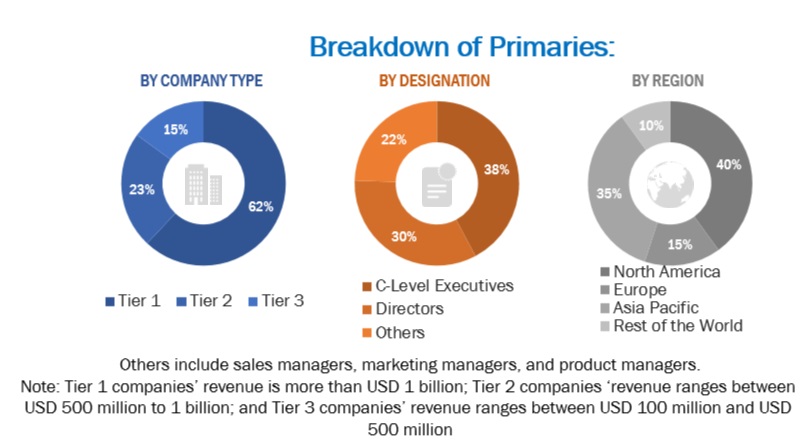
To know about the assumptions considered for the study, download the pdf brochure
Market Size Estimation
Multiple approaches were adopted to estimate and forecast the size of the embedded finance market. The first approach involves estimating market size by summing up the revenue companies generate by selling embedded finance offerings.
Both top-down and bottom-up approaches were used to estimate and validate the total size of the market. These methods were extensively used to estimate the size of various segments in the market. The research methodology used to estimate the market size includes the following:
- Key players in the market have been identified through extensive secondary research.
- In terms of value, the industry’s supply chain and market size have been determined through primary and secondary research processes.
- All percentage shares, splits, and breakups have been determined using secondary sources and verified through primary sources.
Embedded Finance Market Size: Bottom-Up Approach
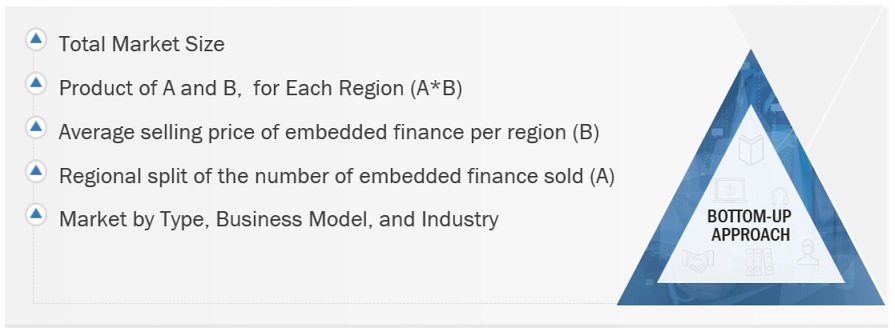
To know about the assumptions considered for the study, Request for Free Sample Report
Embedded Finance Market Size: Top-Down Approach
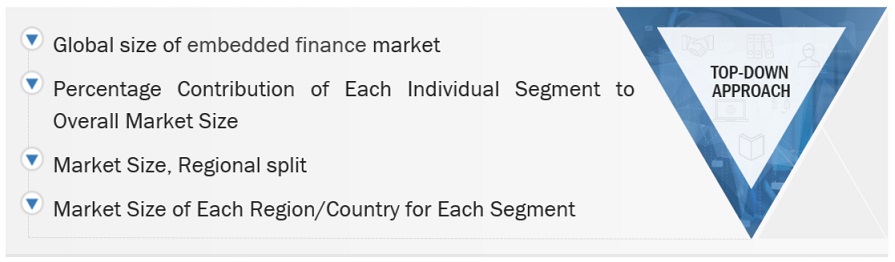
Data Triangulation
After arriving at the overall market size, the embedded finance market was divided into several segments and subsegments. A data triangulation procedure was used to complete the overall market engineering process and arrive at the exact statistics for all segments and subsegments, wherever applicable. The data was triangulated by studying various factors and trends from the demand and supply sides. Along with data triangulation and market breakdown, the market size was validated by the top-down and bottom-up approaches.
Market Definition
Embedded finance integrates financial services technology into platforms outside the financial sector. These platforms can provide various services, including loans, insurance, and payments, among others, using application programming interfaces (APIs), integrating financial transactions into the user experience.
Key Stakeholders
- Embedded Finance providers
- Financial Institutions
- Consumers
- Government
- Non-financial Institutions
- System integrators
- Technology consultants
- Embedders
- Enablers
Report Objectives
- To determine, segment, and forecast the embedded finance market based on type (Embedded payments, embedded insurance, embedded lending, embedded investment/wealth management, and other types), business model, industry, and region in terms of value
- To forecast the size of the market segments concerning 5 main areas: North America, Europe, Asia Pacific, Middle East & Africa, and Latin America
- To provide detailed information about the major factors (drivers, restraints, opportunities, and challenges) influencing the growth of the market
- To study the complete value chain and related industry segments and perform a value chain analysis of the market landscape
- To strategically analyze the macro and micromarkets1 with respect to individual growth trends, prospects, and contributions to the total market
- To analyze the industry trends, pricing data, patents, and innovations related to the market
- To analyze the opportunities for stakeholders by identifying the high-growth segments of the market
- To profile the key players in the market and comprehensively analyze their market share/ranking and core competencies
- To track and analyze competitive developments, such as mergers & acquisitions, product launches & developments, partnerships, agreements, collaborations, business expansions, and R&D activities
Available Customizations
With the given market data, MarketsandMarkets offers customizations as per the company’s specific needs. The following customization options are available for the report:
Country-wise information
- Analysis for additional countries (up to five)
Company Information
- Detailed analysis and profiling of additional market players (up to 5)
Geographic Analysis
- Further breakup of the Asia Pacific market into countries contributing 75% to the regional market size
- Further breakup of the North American market into countries contributing 75% to the regional market size
- Further breakup of the Latin American market into countries contributing 75% to the regional market size
- Further breakup of the Middle East & Africa market into countries contributing 75% to the regional market size
- Further breakup of the European market into countries contributing 75% to the regional market size
Get the Full Embedded Finance Market Report
Full forecast, segment splits, and company analysis for all Embedded Finance Market.
- UK Embedded Finance Market
- Italy Embedded Finance Market
- China Embedded Finance Market
- India Embedded Finance Market
- Brazil Embedded Finance Market
- US Embedded Finance Market
- Canada Embedded Finance Market
- France Embedded Finance Market
- Germany Embedded Finance Market
- Rest Of Europe Embedded Finance Market
- Spain Embedded Finance Market
- Anz Embedded Finance Market
- Rest Of Apac Embedded Finance Market
- Mexico Embedded Finance Market
- Rest Of Latin America Embedded Finance Market
- Ksa Embedded Finance Market
- Rest Of GCC Countries Embedded Finance Market
- UAE Embedded Finance Market
Need a Tailored Report?
Customize this report to your needs
Get 10% FREE Customization
Customize This Report
