
US Environmental DNA Market (2026-2031)

The US Environmental DNA Market was valued at $353.9 Million in 2026 and projected to reach to $691.4 Million by 2031, representing a compound annual growth rate of 14.3%. The US Environmental DNA market is poised for sustained growth through 2031, driven by heightened consumer demand for food transparency and regulatory pressure on manufacturers to ensure product safety and authenticity.


| Market Size in | USD 26.32 MN |
| Market Forecast in | |
| CAGR | |
| Forecast Period | |
| Units Considered | Value (USD MN) |
US Environmental DNA Market Trends and Insights
- This expansion reflects the US food industry's increasing adoption of eDNA technologies for traceability, authenticity verification, and contamination detection across supply chains.
- The US market benefits from stringent regulatory frameworks, consumer demand for transparency, and significant investment in food safety infrastructure that drives widespread implementation of environmental DNA solutions. Driving this growth, the US market is witnessing accelerated adoption among major food processors, retailers, and regulatory bodies seeking to enhance product integrity and consumer trust.
- Between 2026 and 2031, the US is expected to lead North American adoption of eDNA applications in seafood authentication, allergen detection, and microbial monitoring.
- The 14.3% compound annual growth rate underscores the US market's position as a critical hub for innovation and commercialization of environmental DNA technologies within the global Food & Beverage sector..
Key Market Statistics
- CAGR (2026-2031) 14.3% CAGR
- Market Size, 2026 ~USD 353.9 Million
- Forecast, 2031 ~USD 691.4 Million
- Country US
US Environmental DNA Market Overview
Market Valuation Growth :
The US Environmental DNA market in Food & Beverage is valued at $353.9 million in 2026, with a projected expansion to $691.4 million by 2031, representing a robust 14.3% CAGR.
Regulatory Compliance Driver :
Stringent FDA regulations and food safety standards in the US are accelerating adoption of eDNA technologies for supply chain transparency and contamination detection across major food processors.
Supply Chain Authentication :
US food manufacturers are increasingly leveraging eDNA for product authenticity verification, particularly in premium segments like seafood, organic products, and specialty ingredients to combat fraud.
Technology Integration :
Major US food and beverage companies are integrating eDNA testing into quality assurance protocols, enabling real-time traceability from farm to consumer across complex distribution networks.
US Environmental DNA Market Dynamics
- The adoption of eDNA technologies is becoming standard practice among large-scale food processors, particularly in seafood, dairy, and processed food segments.
- Investment in laboratory infrastructure and analytical capabilities is expanding across the US, with both established testing facilities and emerging biotech firms entering the market.
- The convergence of blockchain traceability systems with eDNA analysis is creating comprehensive supply chain solutions that resonate with both regulators and quality-conscious consumers..
Market Ecosystem
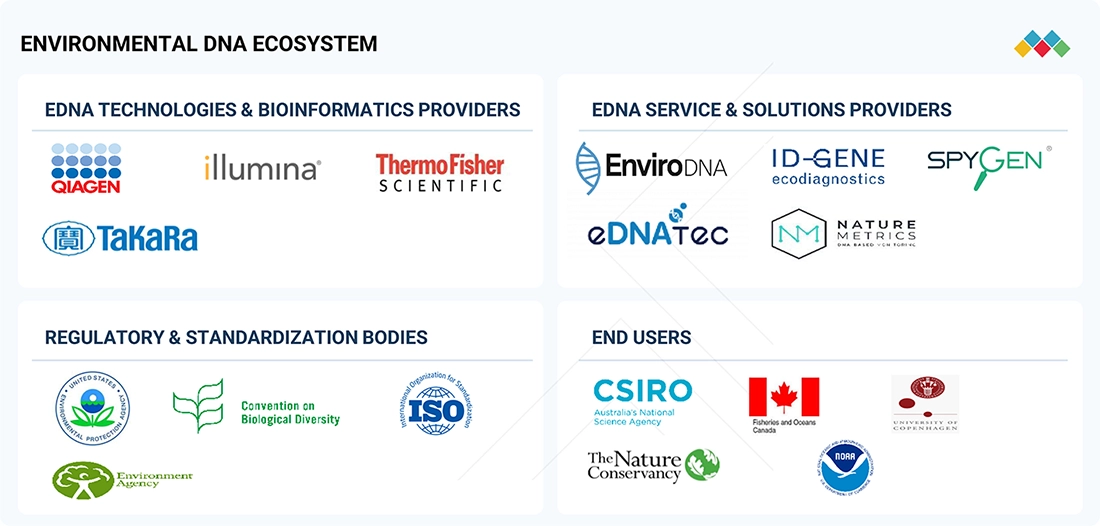
ENVIRONMENTAL DNA MARKET SIZE, SHARE, GROWTH TRENDS & FORECAST TO 2031: COMMERCIAL USE CASES ACROSS INDUSTRIES
| COMPANY | USE CASE DESCRIPTION | BENEFITS |
|---|---|---|
 |
Provides qPCR, NGS workflows, microbial profiling assays, and environmental sample analysis tools for water, soil, and ecosystem monitoring using eDNA | Enables high-sensitivity detection of microbial contaminants and biodiversity signals, supports regulatory environmental testing workflows, and improves scalability of environmental monitoring programs |
 |
Supplies end-to-end eDNA extraction, purification, and inhibitor-removal kits for wastewater surveillance, biodiversity monitoring, mining-site environmental testing, and microbiome analysis | Improves DNA yield from inhibitor-rich environmental samples, increases reproducibility across large monitoring programs, and enables reliable detection in low-biomass ecosystems |
 |
Provides next-generation sequencing (NGS) platforms for eDNA metabarcoding, shotgun metagenomics, and biodiversity profiling across aquatic, soil, and airborne environments | Allows simultaneous detection of thousands of species from a single environmental sample, supports large-scale ecosystem monitoring, and enables high-resolution taxonomic identification for conservation and compliance programs |
 |
Offers contract eDNA sequencing and biodiversity monitoring services (e.g., species detection, invasive species tracking, microbial contamination mapping) using NGS-based environmental DNA analytics | Enables outsourced turnkey biodiversity surveillance, supports long-term environmental monitoring programs, and provides regulatory-grade species detection for conservation and industrial compliance |
Logos and trademarks shown above are the property of their respective owners. Their use here is for informational and illustrative purposes only.
Related Ecosystem
Fandb Processing And Technology
- Dairy Products
- Bakery Products
- Filtration Equipment
- Heat Exchanger
- Acetic Acid
- Gea group
- John Bean Technologies Corporation
- Alfa Laval Corporate AB
- AZELIS HOLDINGS SA
- SPX FLOW INC
Food Safety And Tic
- Dairy Products
- Polymerase Chain Reaction (PCR)
- Campylobacter
- Enzyme-Linked Immunosorbent Assay (ELISA)
- Safety Testing
- EUROFINS SCIENTIFIC SE
- Intertek Group plc
- Sgs s.a.
- Als limited
- PROMEGA CORPORATION
Key Takeaways
- The US Environmental DNA market is valued at $353.9 million in 2026 and will nearly double to $691.4 million by 2031, growing at a 14.3% CAGR.
- The US market is driven by regulatory compliance requirements, consumer demand for food transparency, and heightened focus on supply chain authenticity verification.
- The US leads North American adoption of eDNA technologies for seafood traceability, allergen detection, and microbial contamination monitoring in Food & Beverage applications.
- The US market's growth trajectory reflects strong investment in food safety infrastructure and the commercialization of advanced environmental DNA solutions by major industry players.
Environmental DNA Market Report Scope
| Report Metric | Details |
|---|---|
| Base Year | 2026 |
| Fastest Growing Segment | CLIMATE CHANGE IMPACT ASSESSMENT (Application) |
| Forecast Period | 2026–2031 |
| Growth Rate | CAGR of 14.9% from 2026 to 2031 |
| Largest Segment | WATER (Sample Type) |
| Market Size Base Year (Billions) | ~USD 1.52 (2026) |
| Revenue Forecast (Billions) | ~USD 3.04 (2031) |
| Segments Covered | Application, Detection Method, Sample Type, Type Of Solution, Service, Product, Instrument & Hardware, Consumable & Reagent |
US Environmental DNA Market Report Segmentation
8 segment dimensions are covered across the global market.
By Application
- Aquaculture & Fisheries
- Biodiversity Monitoring
- Climate Change Impact Assessment
- Conservation Biology
- Forensics & Compliance
- Invasive Species Detection
- Water Quality Assessment
By Detection Method
- Crispr-Based Detection
- Ddpcr
- Hybrid Methods (Qpcr + Ngs)
- Metabarcoding (Ngs)
- Metagenomics
- Qpcr
By Sample Type
- Air
- Biological Waste
- Sediment
- Soil
- Water
By Type Of Solution
- Consumables & Reagents
- Instruments & Hardware
- Services
By Service
- Bioinformatics & Data Interpretation
- End-To-End Project Studies
- Laboratory Analysis
- Sample Collection & Field Services
- Sequencing Services
By Product
- Dna Extraction Kits & Library Preparation Kits
- Pcr & Detection Reagents
- Sampling Consumables
By Instrument & Hardware
- Pcr Systems (Qpcr, Ddpcr)
- Sample Processing Instruments
- Sequencing Platforms (Ngs)
By Consumable & Reagent
- Dna Extraction Kits & Library Preparation Kits
- Pcr & Detection Reagents
- Sampling Consumables
Target Audience
- Food & Beverage Manufacturers : Large-scale US food processors need market intelligence to implement eDNA-based quality assurance systems, ensure regulatory compliance, and enhance supply chain transparency to meet consumer expectations.
- Testing & Diagnostics Companies : Laboratory service providers and biotech firms require detailed market data to identify growth opportunities, understand competitive landscapes, and develop targeted service offerings for US food industry clients.
- Supply Chain & Logistics Providers : Third-party logistics and supply chain management companies need insights into eDNA adoption trends to integrate traceability solutions and offer enhanced transparency services to food industry clients.
- Regulatory & Compliance Officers : Food safety and quality assurance professionals require market analysis to understand best practices, regulatory trends, and technology standards for implementing eDNA programs across US operations.
- Investment & Private Equity Firms : Investors evaluating opportunities in food tech and biotech sectors need comprehensive market data to assess growth potential, identify acquisition targets, and make informed funding decisions in the US eDNA space.
Key Companies in the US Environmental DNA Market
| Company | HQ | Ownership | Strongest segments |
|---|---|---|---|
| THERMO FISHER SCIENTIFIC INC. | United States | Public Company | Life Sciences Solutions,Analytical Instruments,Specialty Diagnostics, |
| ILLUMINA, INC. | United States | Public Company | Sequencing instruments,Sequencing consumables (reagents, flow cells, library prep, WGS and targeted kits),Array-based instruments and consumables, |
| QIAGEN | Netherlands | Public Company | Sample technology consumables and instruments,PCR and enzymes (research and clinical),Immune response and infectious disease assays, |
| SGS SOCIéTé GéNéRALE DE SURVEILLANCE SA | Switzerland | Public Company | Testing & Inspection,Certification and Assurance (incl. consulting, digital trust, sustainability), |
| EUROFINS SCIENTIFIC | Luxembourg | Public Company | Food and Feed Testing,Environment Testing,Biopharma Services, |
| STANTEC | Canada | Public Company | Transportation & Civil Infrastructure (roads, transit, utilities),Water (resources, treatment, distribution, wastewater),Buildings (architecture, interiors, MEP, fire, sustainability), |
| TAKARA BIO INC. | Japan | Private Company | Genetic and cellular research reagents,PCR instruments and cellular analysis devices,In vitro diagnostics (including COVID-19 testing), |
| APPLIED GENOMICS | United States | Private Company | Mammostrat breast cancer prognostic test,Pulmotype NSCLC classification IHC panel,Pulmostrat early-stage lung cancer prognostic test, |
THERMO FISHER SCIENTIFIC INC.
Thermo Fisher Scientific Inc. is a United States-based public company founded in 1956 that employs 125,000 people. The company operates as a major provider of life sciences products and services.
ILLUMINA, INC.
Illumina, Inc. is a United States-based public company founded in 1998 with 8,625 employees. The company specializes in DNA sequencing and genetic analysis technologies.
QIAGEN
QIAGEN is a Netherlands-based public company founded in 1984 with 5,500 employees. The company provides molecular diagnostics and life sciences products and services.
SGS SOCIéTé GéNéRALE DE SURVEILLANCE SA
SGS Société Générale de Surveillance SA is a Switzerland-based public company founded in 1878 with 83,000 employees. The company operates as a leading provider of inspection, verification, testing, and certification services.
EUROFINS SCIENTIFIC
Eurofins Scientific is a Luxembourg-based public company founded in 1987 with 65,694 employees. The company provides laboratory testing and scientific analysis services across multiple industries.
STANTEC
Stantec is a Canada-based public company founded in 1954 with 34,000 employees. The company provides professional design and consulting services in engineering, architecture, and environmental sectors.
TAKARA BIO INC.
Takara Bio Inc. is a Japan-based private company founded in 2002 with 1,779 employees. The company provides biotechnology products and services for life sciences research.
APPLIED GENOMICS
Applied Genomics is a United States-based private company founded in 2000. The company operates in the genomics and genetic analysis sector.
Reasons to Buy this Report
- Regulatory Compliance Intelligence : Understand how FDA and USDA regulations are shaping eDNA adoption across US food manufacturers, enabling your organization to stay ahead of compliance requirements and avoid costly violations.
- Competitive Market Positioning : Identify key players and market share dynamics in the US eDNA sector to benchmark your competitive position and discover partnership or acquisition opportunities in this high-growth market.
- Investment Decision Support : Access detailed financial projections and growth trajectories to inform capital allocation decisions, whether for technology development, facility expansion, or market entry strategies in the US.
- Supply Chain Strategy Development : Leverage market insights to design robust traceability and authenticity verification programs that differentiate your products and build consumer trust in an increasingly transparent food landscape.
- Technology Adoption Roadmap : Evaluate emerging eDNA technologies and analytical platforms gaining traction in the US market to prioritize investments that deliver maximum ROI and operational efficiency gains.
Frequently asked questions
What is the current size of the US Environmental DNA market?
The US Environmental DNA market in Food & Beverage is valued at $353.9 million in 2026 and is projected to reach $691.4 million by 2031.
What is the growth rate of the US Environmental DNA market?
The US Environmental DNA market is growing at a compound annual growth rate (CAGR) of 14.3% from 2026 to 2031.
What are the primary applications of environmental DNA in the US Food & Beverage sector?
The US market utilizes eDNA for seafood authentication, allergen detection, microbial contamination monitoring, supply chain traceability, and product authenticity verification.
What factors are driving growth in the US Environmental DNA market?
Growth in the US market is driven by stringent regulatory frameworks, consumer demand for transparency, food safety concerns, and investment in advanced traceability technologies.
How does the US Environmental DNA market compare to global trends?
The US market grows at 14.3% CAGR, slightly below the global rate of 14.9%, reflecting the US as a mature but rapidly expanding market within the Food & Beverage sector.
RESEARCH METHODOLOGY
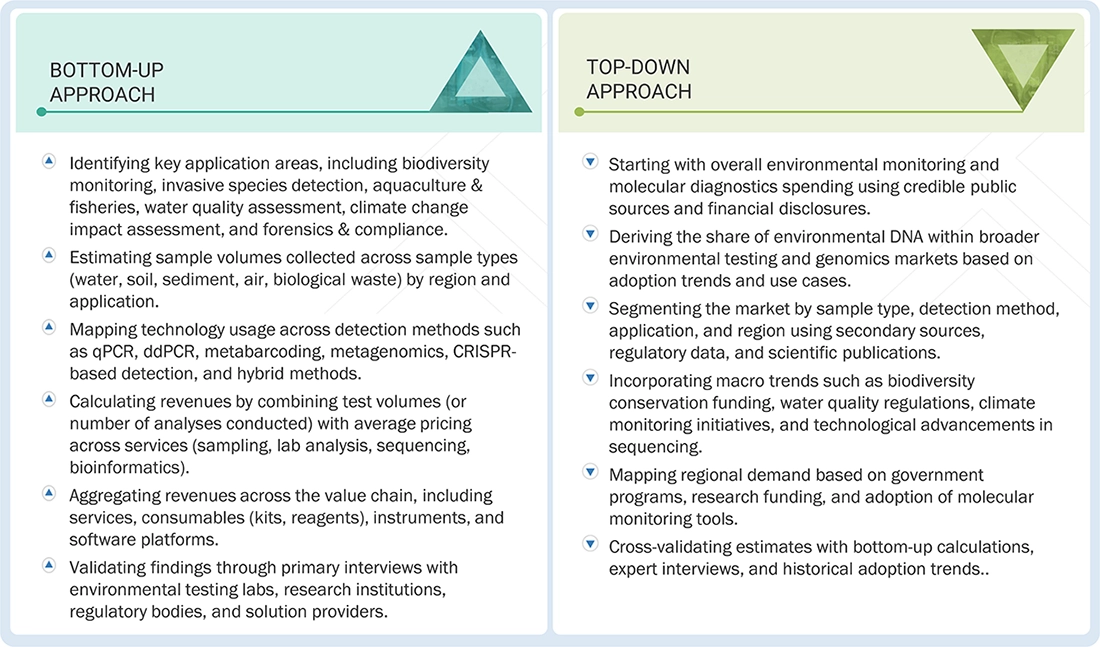
The study employed two primary approaches to estimate the current size of the environmental DNA market. Exhaustive secondary research was conducted to gather information on the market, peer markets, and parent markets. The next step was to validate these findings, assumptions, and sizing with industry experts across the value chain through primary research. Both top-down and bottom-up approaches were employed to estimate the complete market size. After that, market breakdown and data triangulation were used to estimate the market size of segments and subsegments.
Secondary Research
This research study involved the extensive use of secondary sources—directories and databases such as Web of Science, Scopus, PubMed, GenBank, EMBL-EBI, and GBIF—to identify and collect information useful for a technical, market-oriented, and commercial study of the market. In the secondary research process, various sources such as annual reports, press releases & investor presentations of companies, white papers, food journals, certified publications, articles from recognized authors, directories, and databases were referred to to identify and collect information. Secondary research was mainly used to obtain key information about the industry’s supply chain, the total pool of key players, and market classification and segmentation as per the industry trends to the bottom-most level, regional markets, and key developments from both market- and technology-oriented perspectives.
Primary Research
Extensive primary research was conducted after obtaining information regarding the environmental DNA market scenario through secondary research. Several primary interviews were conducted with market experts from both the demand and supply sides across major countries of North America, Europe, Asia Pacific, South America, and RoW. Primary data was collected through questionnaires, emails, and telephonic interviews. The primary sources from the supply side included various industry experts, such as CXOs, VPs, directors from business development, marketing, research, and development teams, and key opinion leaders. Primary interviews were conducted to gather insights such as market statistics, data on revenue collected from the products and services, market breakdowns, market size estimations, market forecasting, and data triangulation. Primary research also helped in understanding the various trends related to eDNA sample type, type of solution, detection methods, and application. Stakeholders from the demand side, such as research institutions and universities, and third-party vendors, were interviewed to understand the users’ perspective on the service, and their current usage of eDNA and the outlook of their business, which will affect the overall market.
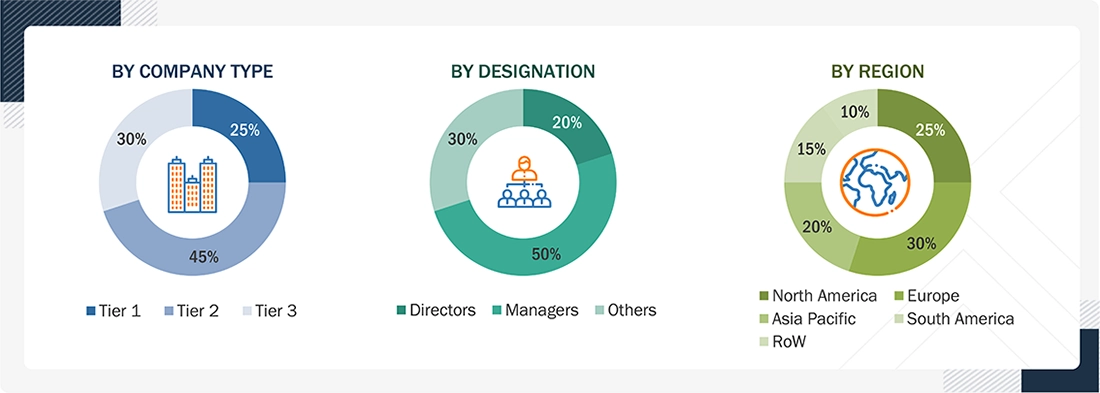
Note: The tiers of the companies are defined based on their total revenues in 2024 or 2025, as per the availability of financial data: Tier 1: Revenue >USD 1 billion; Tier 2: USD 100 million ≤ Revenue ≤ USD 1 billion; Tier 3: Revenue <USD 100 million.
|
COMPANY |
DESIGNATION |
|
Thermo Fisher |
R&D Expert |
|
EnviroDNA |
Sales Manager |
|
Illumina, Inc. |
Manager |
|
NatureMetrics |
Sales Manager |
|
Eurofins Scientific |
Marketing Manager |
To know about the assumptions considered for the study, download the pdf brochure
Market Size Estimation
Both the top-down and bottom-up approaches were used to estimate and validate the total size of the environmental DNA market. These approaches were also used extensively to determine the size of various subsegments in the market. The research methodology used to estimate the market size includes the following details:
- The key players in the industry and the overall markets were identified through extensive secondary research.
- All shares, splits, and breakdowns were determined using secondary sources and verified through primary sources.
- All possible parameters that affect the market covered in this research study were accounted for, viewed in extensive detail, verified through primary research, and analyzed to obtain final quantitative and qualitative data.
- The research included the study of reports, reviews, and newsletters of top market players, along with extensive interviews for opinions from leaders, such as CEOs, directors, and marketing executives
Data Triangulation
After arriving at the overall market size from the estimation process explained above, the total market was split into several segments and subsegments. The data triangulation and market breakdown procedures were employed, wherever applicable, to estimate the overall environmental DNA market and arrive at the exact statistics for all segments and subsegments. The data was triangulated by studying various factors and trends from the demand and supply sides. The market size was also validated using both the top-down and bottom-up approaches.
Market Definition
The environmental DNA market comprises products and services used to collect, analyze, and interpret genetic material obtained from environmental samples such as water, soil, sediment, and air.
According to the European Commission Joint Research Center, environmental DNA refers to genetic material extracted directly from environmental samples without the need to capture or observe organisms, enabling the detection and monitoring of species and ecosystems.
Similarly, the International Organization for Standardization recognizes environmental DNA-based methods as molecular approaches for biodiversity assessment and environmental monitoring, supporting standardized and reproducible detection of species from environmental samples.
Key Stakeholders
- Sample collection kit and consumables providers
- Molecular reagent and assay developers
- Sequencing technology providers (NGS platforms, PCR systems)
- Bioinformatics and data analysis solution providers
- Environmental testing laboratories and service providers
- Academic institutions and research organizations
- Aquaculture, fisheries, and environmental consulting firms
- Water utilities and environmental monitoring agencies
- Conservation organizations and biodiversity monitoring groups
- Government and regulatory authorities
- Associations, regulatory bodies, and other industry-related bodies
- Convention on Biological Diversity
- International Organization for Standardization
- European Commission (including Joint Research Center)
- United States Environmental Protection Agency
- National Oceanic and Atmospheric Administration
- Food and Agriculture Organization
- United Nations Environment Programme
- Research institutes and universities
- Industry and trade associations
Report Objectives
- To determine, define, and project the size of the environmental DNA market, with respect to sample type, detection method, type of solution application, and regional markets, over five years, ranging from 2026 to 2031
- To identify the attractive opportunities in the market by determining the largest and fastest-growing segments across regions
- To provide detailed information about the key factors influencing the growth of the market (drivers, restraints, opportunities, and challenges)
- To analyze the micro markets with respect to individual growth trends, prospects, and their contribution to the total market
- To strategically profile key market players and comprehensively analyze their core competencies in each segment
- To track and analyze competitive developments, such as alliances, joint ventures, new product developments, mergers, and acquisitions, in the environmental DNA market.
Available customizations:
With the given market data, MarketsandMarkets offers customizations according to company-specific scientific needs.
The following customization options are available for the report:
PRODUCTS ANALYSIS
- Products Matrix, which gives a detailed comparison of the service portfolio of each company.
GEOGRAPHIC ANALYSIS
With the given market data, MarketsandMarkets offers customizations according to company-specific scientific needs.
- Further breakdown of the Rest of Europe environmental DNA market into key countries.
- Further breakdown of the Rest of Asia Pacific environmental DNA market into key countries.
- Further breakdown of the Rest of South America environmental DNA market into key countries.
COMPANY INFORMATION
- Detailed analyses and profiling of additional market players (up to five)
Get the Full Environmental DNA Market Report
Full forecast, segment splits, and company analysis for all Environmental DNA Market.
- Canada Environmental DNA Market
- Mexico Environmental DNA Market
- UK Environmental DNA Market
- Germany Environmental DNA Market
- France Environmental DNA Market
- Italy Environmental DNA Market
- Spain Environmental DNA Market
- China Environmental DNA Market
- India Environmental DNA Market
- Japan Environmental DNA Market
- Brazil Environmental DNA Market
- Argentina Environmental DNA Market
- Rest Of Europe Environmental DNA Market
- Rest Of Asia Pacific Environmental DNA Market
Need a Tailored Report?
Customize this report to your needs
Get 10% FREE Customization
Customize This Report
