
Japan EPDM Market (2026-2031)

The Japan EPDM Market was valued at $148.5 Million in 2026 and projected to reach to $165.5 Million by 2031, representing a compound annual growth rate of 2.2%. Japan's EPDM market is positioned for moderate but stable growth through 2031, driven by ongoing demand from established industrial sectors and Japan's commitment to manufacturing excellence.


| Market Size in | USD 26.32 MN |
| Market Forecast in | |
| CAGR | |
| Forecast Period | |
| Units Considered | Value (USD MN) |
Japan EPDM Market Trends and Insights
- This moderate growth trajectory reflects Japan's mature industrial base and steady demand from packaging, construction, mining, and gases sectors.
- Japan's focus on durability and quality in manufacturing supports consistent EPDM adoption across these verticals. The Japanese EPDM market benefits from the country's advanced infrastructure and stringent regulatory standards that favor high-performance elastomers.
- Japan's construction sector, in particular, drives demand for weather-resistant sealing and insulation applications.
- Between 2026 and 2031, Japan is expected to maintain its position as a significant EPDM consumer within Asia Pacific, though growth remains constrained by market saturation and competition from alternative materials..
Key Market Statistics
- CAGR (2026-2031) 2.2% CAGR
- Market Size, 2026 ~USD 148.5 Million
- Forecast, 2031 ~USD 165.5 Million
- Country Japan
Japan EPDM Market Overview
Mature Market Stability :
Japan's EPDM market demonstrates steady growth at 2.2% CAGR, reflecting a mature industrial economy with established manufacturing standards and consistent demand across packaging, construction, mining, and gases sectors.
Quality-Driven Manufacturing :
Japanese manufacturers prioritize durability and precision in EPDM applications, supporting sustained market demand. This focus on quality differentiates Japan's market from faster-growing regions with lower standards.
Diversified Sector Applications :
Japan's EPDM demand spans multiple industries including automotive packaging, construction sealing, mining equipment, and industrial gas containment, providing market resilience across economic cycles.
Market Size Trajectory :
The Japanese EPDM market is valued at USD 148.5 million in 2026 and is forecast to reach USD 165.5 million by 2031, representing steady incremental growth in a developed economy.
Japan EPDM Market Dynamics
- The 2.2% CAGR reflects a mature market with limited disruption but consistent replacement cycles and infrastructure maintenance requirements.
- Construction and automotive packaging remain key demand drivers, supported by Japan's reputation for quality standards and durability requirements. While Japan's growth rate lags the global 4.2% CAGR, the market benefits from technological advancement in EPDM formulations and increasing environmental regulations favoring high-performance elastomers.
- Investment in sustainable manufacturing practices and recycling initiatives will support long-term market stability, positioning Japan as a quality-focused market with predictable demand patterns..
Market Ecosystem
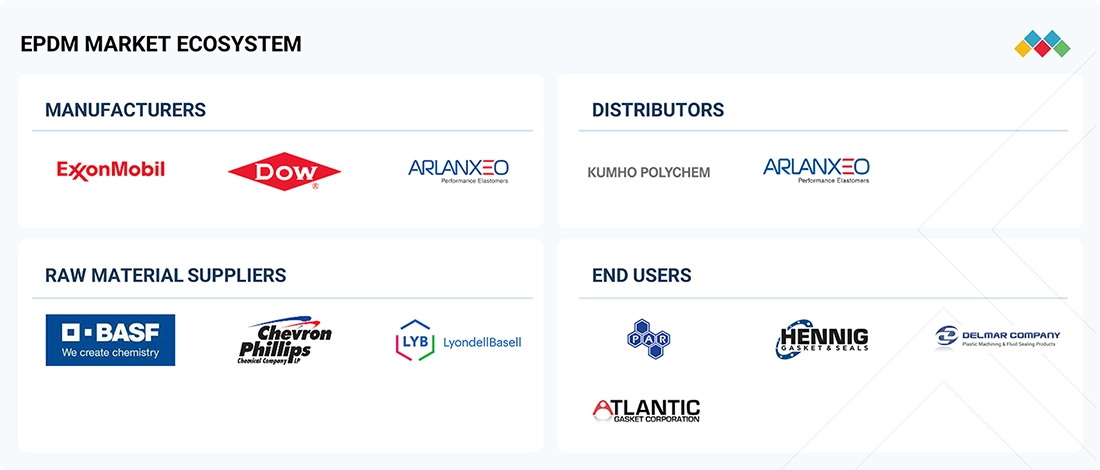
EPDM MARKET: COMMERCIAL USE CASES ACROSS INDUSTRIES
| COMPANY | USE CASE DESCRIPTION | BENEFITS |
|---|---|---|
 |
Carlisle SynTec Systems installed its FleeceBACK EPDM roofing membrane with Factory-Applied Tape Seam technology at the Tecta America Zero Company office and warehouse facility in Cincinnati, Ohio. The project involved reroofing the existing structure with a durable EPDM solution designed to improve installation efficiency, minimize disruption, and enhance long-term roof protection against harsh weather conditions. | The FleeceBACK EPDM roofing system provided superior weather resistance, durability, and long-term waterproofing performance. The solution improved wind uplift resistance, reduced installation time and maintenance requirements, and delivered enhanced protection against environmental exposure, ensuring reliable and energy-efficient roofing performance for the facility over the long term. |
Logos and trademarks shown above are the property of their respective owners. Their use here is for informational and illustrative purposes only.
Related Ecosystem
Automotive Materials
- Light Commercial Vehicles (LCVs)
- Battery Electric Vehicle (BEV)
- Hybrid Electric Vehicle (HEV)
- Fuel Cell Electric Vehicle (FCEV)
- Agricultural Tractors
- GORKOVSKY AVTOMOBILNY ZAVOD
- AISIN CORPORATION
- Continental ag
- Basf se
- BOSCH LIMITED
Resins And Polymers
- Polycarbonate
- Acrylonitrile Butadiene Styrene (ABS)
- Epoxy Resin
- Light Commercial Vehicles (LCVs)
- Polypropylene (PP)
- Basf se
- DOW CHEMICAL COMPANY
- Solvay sa
- Saudi arabia basic industries corporation (sabic)
- DuPont de Nemours, Inc.
Packaging
- Ampoules
- Gravure Process
- Rigid Packaging
- Aerosols
- Aseptic Filling and Sealing Equipment
- Amcor plc
- Essentra plc
- Berry Global Group, Inc.
- Mondi plc
- SEALED AIR CORPORATION
Key Takeaways
- Japan's EPDM market valued at USD 148.5 million in 2026, growing to USD 165.5 million by 2031 at 2.2% CAGR
- Japan's construction and packaging sectors are primary drivers of EPDM demand due to durability and weather-resistance requirements
- Japan's mature market and regulatory standards favor premium EPDM products over lower-cost alternatives
- Japan's growth rate of 2.2% is below global average, reflecting market maturity and saturation in key industrial segments
EPDM Market Report Scope
| Report Metric | Details |
|---|---|
| Base Year | 2026 |
| Fastest Growing Segment | GAS-PHASE POLYMERIZATION (Manufacturing Process) |
| Forecast Period | 2026–2031 |
| Growth Rate | CAGR of 4.2% from 2026 to 2031 |
| Largest Segment | SOLUTION POLYMERIZATION (Manufacturing Process) |
| Market Size Base Year (Billions) | ~USD 5.1 (2026) |
| Revenue Forecast (Billions) | ~USD 6.26 (2031) |
| Segments Covered | Manufacturing Process, Application |
Japan EPDM Market Report Segmentation
2 segment dimensions are covered across the global market.
By Manufacturing Process
- Gas-Phase Polymerization
- Slurry/Suspension
- Solution Polymerization
By Application
- Automotive
- Building & Construction
- Lubricant Additives
- Other Applications
- Plastic Modification
- Tires & Tubes
- Wires & Cables
JAPAN: EPDM MARKET, BY APPLICATION, 2025–2031
| Segment | 2025 | 2026 | 2027 | 2028 | 2029 | 2030 | 2031 | CAGR (%) |
|---|---|---|---|---|---|---|---|---|
| AUTOMOTIVE | 180.8 | 186.1 | 191.5 | 197.1 | 202.9 | 208.8 | 214.8 | 2.9 |
| BUILDING & CONSTRUCTION | 19.2 | 19.7 | 20.1 | 20.5 | 21 | 21.5 | 21.9 | 2.2 |
| LUBRICANT ADDITIVES | 26.6 | 27.3 | 28.1 | 28.9 | 29.7 | 30.5 | 31.4 | 2.8 |
| OTHER APPLICATIONS | 63 | 64.7 | 66.5 | 68.3 | 70.2 | 72.1 | 74.1 | 2.8 |
| PLASTIC MODIFICATION | 11.2 | 11.4 | 11.6 | 11.8 | 12 | 12.3 | 12.5 | 1.8 |
| TIRES & TUBES | 15.1 | 15.5 | 15.9 | 16.3 | 16.7 | 17.1 | 17.6 | 2.5 |
| WIRES & CABLES | 33.5 | 34.3 | 35.1 | 35.9 | 36.7 | 37.6 | 38.5 | 2.3 |
| TOTAL | 349.4 | 359 | 368.8 | 378.9 | 389.2 | 399.8 | 410.7 | 2.7 |
Target Audience
- EPDM Manufacturers & Suppliers : Manufacturers need Japan-specific market data to optimize production capacity, pricing strategies, and distribution networks. Understanding local demand patterns and growth rates enables competitive positioning in this quality-driven market.
- Packaging & Construction Companies : End-users in Japan's packaging and construction sectors require market intelligence to forecast EPDM material costs, identify reliable suppliers, and plan procurement strategies aligned with market growth projections.
- Investment & Private Equity Firms : Investors evaluating opportunities in Japan's industrial materials sector need validated market sizing and growth forecasts to assess ROI potential, competitive dynamics, and long-term viability of EPDM-focused businesses.
- Mining & Industrial Gas Operators : Companies in Japan's mining and industrial gas sectors require EPDM market data to understand material availability, pricing trends, and supply chain reliability for critical sealing and containment applications.
- Market Research & Consulting Professionals : Analysts and consultants need Japan-specific EPDM market cutouts to support client advisory work, competitive benchmarking, and strategic recommendations for businesses operating in or entering the Japanese market.
Key Companies in the Japan EPDM Market
| Company | HQ | Ownership | Strongest segments |
|---|---|---|---|
| EXXON MOBIL | United States | Public Company | Upstream (crude oil and natural gas),Energy Products (fuels, aromatics, catalysts, licensing),Chemical Products (olefins, polyolefins, intermediates), |
| VERSALIS S.P.A | Italy | Private Company | Elastomers (tyre, automotive, footwear),Polyethylene (LDPE, HDPE, LLDPE, EVA),Styrenics (PS, EPS, ABS, SAN, alloys), |
| DOW | United States | Public Company | Packaging & Specialty Plastics,Industrial Intermediates & Infrastructure,Performance Materials & Coatings, |
| PETROCHINA COMPANY LIMITED | China | Public Company | Oil, Gas and New Energy Resource,Refining, Chemicals and New Materials,Sales (Refined and Non-oil Products, Trading), |
| SK GEO CENTRIC CO., LTD | South Korea | Private Company | Olefins (ethylene, propylene, butadiene, MTBE, butylene),Aromatics (benzene, toluene, xylenes, styrene),Performance chemicals and solvents, |
| ENEOS HOLDINGS, INC. | Japan | Public Company | Petroleum product refining and sales,Petrochemicals and functional materials,Lubricants, |
| MITSUI CHEMICALS, INC. | Japan | Public Company | Basic & Green Materials (petrochemicals, basic chemicals, polyurethane raw materials),Mobility Solutions (elastomers, performance and polypropylene compounds, related materials),Life & Healthcare Solutions (vision care, nonwovens, personal care, agrochemicals, medical and dental), |
| PETRO RABIGH | Saudi Arabia | Public Company | Refined Products (fuel oil, diesel, gasoline, kerosene, naphtha, LPG),Polyolefins and Elastomers (HDPE, LLDPE, PP homo, PP block, TPO, EPDM),Glycols and Oxides (MEG, PO and derivatives), |
| SABIC | Saudi Arabia | Public Company | Basic chemicals & intermediates (olefins, methanol, aromatics, glycols, MTBE, CO2),Polyethylene (LLDPE, LDPE, HDPE),Polypropylene & compounds (homo, random, impact, specialty automotive grades), |
| CARLISLE COMPANIES INC. | United States | Public Company | Single-ply roofing membranes (EPDM, TPO, PVC),Polyiso and EPS insulation,Waterproofing, air/vapor barriers, and underlayments, |
EXXON MOBIL
ExxonMobil is a publicly traded energy company founded in 1870 and headquartered in the United States, employing 57,900 people.
VERSALIS S.P.A
Versalis S.p.A. is an Italian private company established in 1995 with 7,389 employees.
DOW
Dow is a publicly traded chemical and materials company founded in 1897 in the United States, with 34,600 employees.
PETROCHINA COMPANY LIMITED
PetroChina Company Limited is a publicly traded Chinese energy company founded in 1999, employing 367,173 people.
SK GEO CENTRIC CO., LTD
SK Geo Centric Co., Ltd. is a private South Korean company established in 1962 with 1,176 employees.
ENEOS HOLDINGS, INC.
ENEOS Holdings, Inc. is a publicly traded Japanese energy company founded in 1888, employing 34,099 people.
MITSUI CHEMICALS, INC.
Mitsui Chemicals, Inc. is a publicly traded Japanese chemical company established in 1892 with 16,967 employees.
PETRO RABIGH
Petro Rabigh is a publicly traded petrochemical company based in Saudi Arabia, founded in 2005 with 2,944 employees.
SABIC
SABIC is a publicly traded Saudi Arabian chemical and materials company founded in 1976, employing 35,000 people.
CARLISLE COMPANIES INC.
Carlisle Companies Inc. is a publicly traded American diversified manufacturer founded in 1917 with 5,900 employees.
Reasons to Buy this Report
- Precise Market Sizing for Japan : Access validated market data specific to Japan with exact valuations (USD 148.5M in 2026, USD 165.5M in 2031) and localized CAGR of 2.2%, enabling accurate financial planning and investment decisions.
- Sector-Specific Demand Insights : Understand EPDM consumption patterns across Japan's key industries—packaging, construction, mining, and gases—with detailed breakdowns to identify high-opportunity segments and customer needs.
- Competitive Positioning Strategy : Benchmark your business against Japan's quality-focused market dynamics and mature manufacturing standards. Identify differentiation opportunities in a stable, predictable market with established customer expectations.
- Long-Term Growth Planning : Leverage 5-year forecast data (2026-2031) to develop strategic roadmaps, capacity planning, and market entry strategies tailored to Japan's moderate but consistent growth trajectory.
- Risk Mitigation & Market Stability : Evaluate Japan's mature, stable EPDM market as a lower-risk investment opportunity compared to volatile emerging markets, with predictable demand cycles and established regulatory frameworks.
Frequently asked questions
What is the current size of Japan's EPDM market?
Japan's EPDM market is estimated at USD 148.5 million in 2026 and is expected to reach USD 165.5 million by 2031.
What is the growth rate of EPDM in Japan?
Japan's EPDM market is projected to grow at a compound annual growth rate (CAGR) of 2.2% from 2026 to 2031.
Which industries drive EPDM demand in Japan?
Japan's primary EPDM demand comes from packaging, construction, mining, and gases sectors, with construction being particularly significant for sealing and insulation applications.
Why is Japan's EPDM growth slower than the global average?
Japan's 2.2% CAGR reflects a mature, saturated market with established industrial infrastructure and competition from alternative elastomeric materials.
What market factors support EPDM adoption in Japan?
Japan's stringent regulatory standards, emphasis on product quality and durability, and advanced manufacturing infrastructure support consistent EPDM demand across industrial applications.
RESEARCH METHODOLOGY
The study involved four major activities to estimate the current size of the global EPDM market. Exhaustive secondary research was carried out to collect information on the market, the peer product market, and the parent product group market. The next step was to validate these findings, assumptions, and sizes with industry experts across the EPDM value chain through primary research. The top-down and bottom-up approaches were employed to estimate the overall size of the EPDM market. Afterward, market breakdown and data triangulation were used to determine the size of market segments.
Secondary Research
The study involved four major activities to estimate the current size of the global EPDM market. Exhaustive secondary research was carried out to collect information on the market, the peer product market, and the parent product group market. The next step was to validate these findings, assumptions, and sizes with industry experts across the EPDM value chain through primary research. The top-down and bottom-up approaches were employed to estimate the overall size of the EPDM market. Afterward, market breakdown and data triangulation were used to determine the size of market segments.
Primary Research
In the primary research process, interviews with primary sources from the supply and demand sides were conducted to obtain qualitative and quantitative information for this report. The primary supply-side sources included industry experts, such as chief executive officers (CEOs), vice presidents (VPs), marketing directors, technology and innovation directors, and other key executives from several companies and organizations operating in the EPDM market. After the completion of market engineering (calculations for market statistics, market breakdown, market size estimation, market forecasting, and data triangulation), extensive primary research was conducted to gather information and verify and validate the critical numbers derived.
Primary research was also conducted to identify the segmentation types, industry trends, the competitive landscape of EPDM offered by various market players, and key market dynamics, including drivers, restraints, opportunities, challenges, trends, and key player strategies. In the complete market engineering process, the top-down and bottom-up approaches and several data triangulation methods were extensively used to perform the market estimation and market forecasting for the overall market segments and subsegments listed in this report. Extensive qualitative and quantitative analysis was performed on the complete market engineering process to list the key information/insights throughout the report.
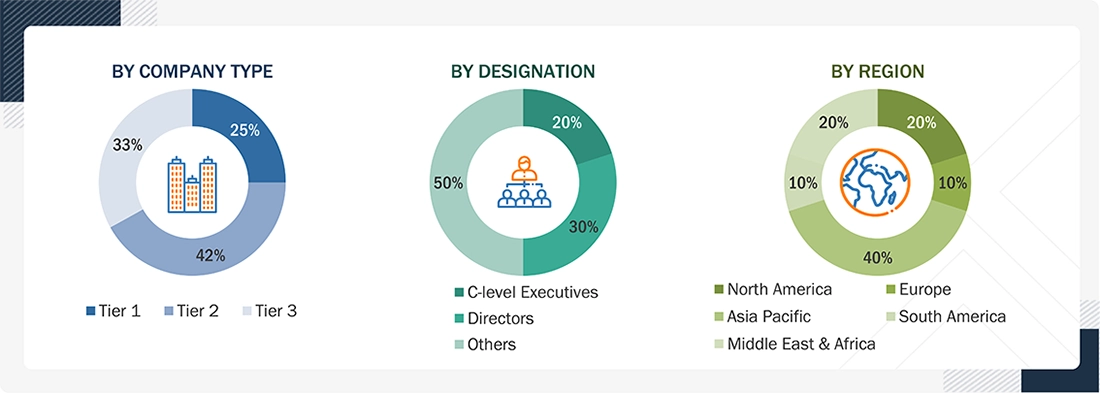
Notes: Other designations include sales, marketing, and product managers.
Tier 1: >USD 1 Billion; Tier 2: USD 500 million–1 Billion; and Tier 3: <USD 500 million
To know about the assumptions considered for the study, download the pdf brochure
Market Size Estimation
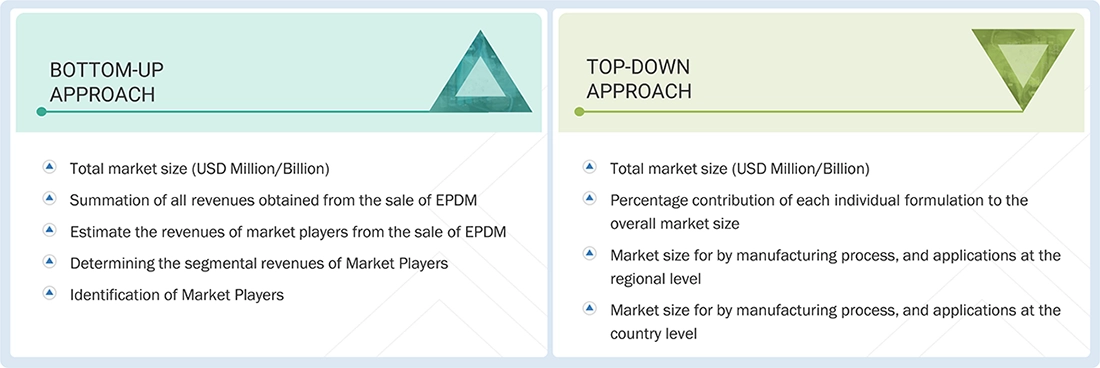
The top-down and bottom-up approaches were used to estimate and validate the size of the global EPDM market. These approaches were also used extensively to estimate the size of various dependent market segments. The research methodology used to estimate the market size included the following:
EPDM Market : Top-Down and Bottom-Up Approach
Data Triangulation
After arriving at the overall market size using the market size estimation processes, the market was split into several segments and subsegments. The data triangulation and market breakup procedures were employed, where applicable, to complete the overall market engineering process and determine the exact statistics for each market segment and subsegment. The data was triangulated by examining various factors and trends on both the demand and supply sides.
Market Definition
Ethylene propylene diene monomer, or EPDM, is a copolymer of ethylene, propylene, and non-conjugated diene monomers. EPDM is an M-class synthetic rubber under ASTM standard D-1418. It is a saturated elastomer that provides resistance against polar solvents. The three major processes used to manufacture EPDM are slurry (suspension), gas-phase, and solution, with the latter being the most common commercial method. These processes use catalysts such as Ziegler-Natta or metallocene catalysts. EPDM rubber provides resistance against heat, aging, UV, and ozone. However, EPDM has poor resistance against hydrocarbon fuel and solvents.
Key Stakeholders
- EPDM Manufacturers
- EPDM Traders, Distributors, and Suppliers
- Regulatory Bodies
- Government, Research, and Consulting Firms
- R&D Institutions
- End-use Market Participants of Different Segments of EPDM
Report Objectives
- To define, describe, and forecast the size of the global EPDM market, by manufacturing process, and application, in terms of value and volume
- To forecast the market size of segments for North America, Europe, Asia Pacific, South America, and the Middle East & Africa, along with their respective countries, in terms of value and volume
- To provide detailed information on the significant drivers, restraints, opportunities, and challenges influencing the market
- To strategically analyze micromarkets concerning individual growth trends, prospects, and their contribution to the market
- To assess the growth opportunities in the market for stakeholders and provide details on the competitive landscape for market leaders
- To strategically profile key players and comprehensively analyze their market shares and core competencies
- To analyze competitive developments, such as product launches, acquisitions, and joint ventures in the EPDM market
- To provide the impact of AI/Gen AI on the market
- To provide the macroeconomic outlook for each region covered under the study, and the impact of the 2025 US tariff on the market
Available customizations:
Given the market data, MarketsandMarkets offers customizations to meet client-specific needs.
The following customization options are available for the EPDM report:
Product Analysis
- A product matrix that gives a detailed comparison of the product portfolio of each company
Regional Analysis
- A further breakdown of the EPDM market for additional countries
Company Information
- Detailed analysis and profiling of additional market players (up to five)
Get the Full EPDM Market Report
Full forecast, segment splits, and company analysis for all EPDM Market.
- China EPDM Market
- India EPDM Market
- South Korea EPDM Market
- Thailand EPDM Market
- Indonesia EPDM Market
- Canada EPDM Market
- Mexico EPDM Market
- US EPDM Market
- Germany EPDM Market
- Poland EPDM Market
- Italy EPDM Market
- Turkey EPDM Market
- Spain EPDM Market
- France EPDM Market
- Czech Republic EPDM Market
- Saudi Arabia EPDM Market
- UAE EPDM Market
- South Africa EPDM Market
- Brazil EPDM Market
- Argentina EPDM Market
- South America EPDM Market
- Rest Of Europe EPDM Market
- Rest Of Asia Pacific EPDM Market
- GCC Countries EPDM Market
- –Rest Of GCC Countries EPDM Market
- Rest Of South America EPDM Market
Need a Tailored Report?
Customize this report to your needs
Get 10% FREE Customization
Customize This Report
