
Australia ECMO Machines Market (2025-2030)

The Australia ECMO Machines Market was valued at $7.7 Million in 2025 and projected to reach to $10.22 Million by 2030, representing a compound annual growth rate of 5.8%. Australia's ECMO machines market is positioned for steady growth through 2030, supported by the country's advanced healthcare infrastructure and increasing clinical adoption of extracorporeal membrane oxygenation technologies.


| Market Size in | USD 26.32 MN |
| Market Forecast in | |
| CAGR | |
| Forecast Period | |
| Units Considered | Value (USD MN) |
Australia ECMO Machines Market Trends and Insights
- Australia's healthcare infrastructure and increasing adoption of advanced cardiac support technologies are driving demand for extracorporeal membrane oxygenation devices across major medical centers and tertiary hospitals.
- The market in Australia reflects growing clinical recognition of ECMO as a critical intervention for severe cardiopulmonary failure and cardiogenic shock patients. During the forecast period from 2025 to 2030, Australia is expected to experience steady expansion in ECMO machine deployment, supported by rising healthcare expenditure and improved reimbursement pathways.
- Australia's aging population and prevalence of cardiovascular diseases are key factors propelling market growth.
- Additionally, Australia's investment in intensive care unit (ICU) infrastructure and training programs for ECMO specialists are enhancing the clinical capacity to support wider adoption of these life-saving devices..
Key Market Statistics
- CAGR (2025-2030) 5.8% CAGR
- Market Size, 2025 ~USD 7.7 Million
- Forecast, 2030 ~USD 10.22 Million
- Country Australia
Australia ECMO Machines Market Overview
Market Size & Growth :
Australia's ECMO machines market is valued at USD 7.7 million in 2025, with projected growth to USD 10.22 million by 2030, reflecting a steady 5.8% CAGR driven by increasing adoption in tertiary healthcare centers.
Healthcare Infrastructure Advancement :
Australia's robust healthcare system and investment in advanced cardiac support technologies are accelerating ECMO device adoption across major medical centers, particularly in cardiac and respiratory critical care units.
Tertiary Hospital Concentration :
Leading Australian tertiary hospitals and specialized cardiac centers are primary adopters of ECMO technology, with significant penetration in major cities including Sydney, Melbourne, and Brisbane.
Clinical Demand Drivers :
Rising prevalence of acute cardiac and respiratory failures, coupled with Australia's aging population and advanced medical capabilities, is fueling demand for extracorporeal membrane oxygenation support systems.
Australia ECMO Machines Market Dynamics
- Major tertiary hospitals and cardiac centers are expanding their critical care capabilities, driving investment in ECMO devices for acute cardiac and respiratory support.
- The market benefits from Australia's high healthcare spending and emphasis on advanced medical technologies.
- Regulatory support and clinical evidence supporting ECMO efficacy continue to strengthen market penetration across major medical institutions, with growth expected to remain consistent at 5.8% CAGR through the forecast period..
Market Ecosystem
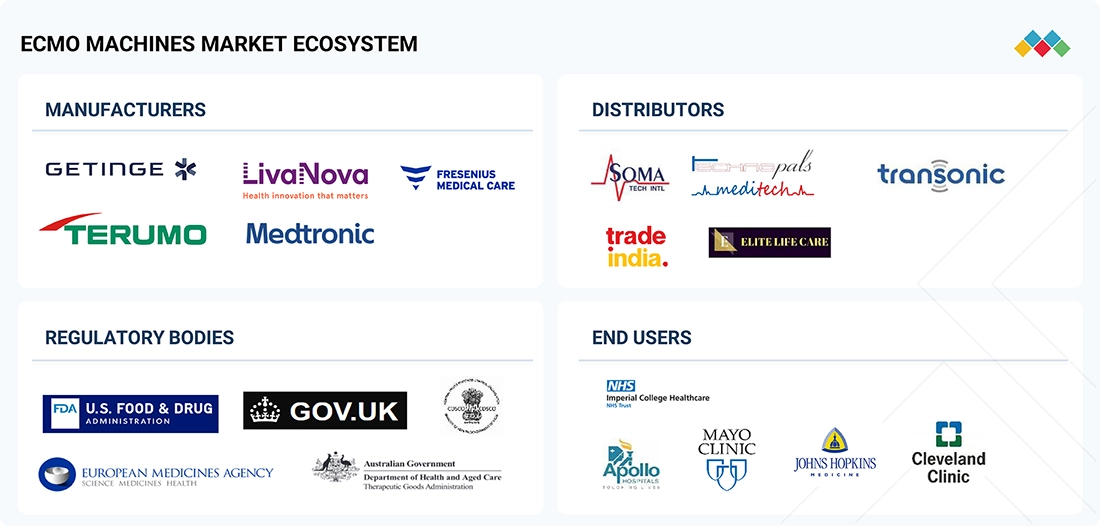
ECMO machine market: COMMERCIAL USE CASES ACROSS INDUSTRIES
| COMPANY | USE CASE DESCRIPTION | BENEFITS |
|---|---|---|
 |
ECMO systems and oxygenators for cardiac and respiratory support in ICUs, cardiac surgery, and emergency care | Provide life-saving support for patients with severe ARDS and cardiogenic shock, improve survival outcomes, and enable prolonged extracorporeal support with reliable performance |
 |
ECMO circuits, pumps, and cannulation solutions designed for critical care and surgical environments | Ensure consistent blood flow and oxygenation, reduce complications from mechanical ventilation, and support recovery in complex surgical cases. |
 |
Portable and modular ECMO systems for transport, emergency care, and long-term ICU support | Allow patient mobility and inter-hospital transfers, improve emergency responsiveness, and support extended use in critical care |
 |
ECMO machines integrated with cardiopulmonary bypass technology for cardiovascular and respiratory applications | Enable dual application in surgery and intensive care, reduce the need for multiple systems, and provide cost-efficient ECMO solutions |
 |
Advanced ECMO and extracorporeal CO2 removal (ECCO2R) platforms for lung support | Enhance respiratory support efficiency, reduce invasive ventilation risks, improve patient tolerance, and expand use in adult and pediatric cases |
Logos and trademarks shown above are the property of their respective owners. Their use here is for informational and illustrative purposes only.
Related Ecosystem
Medical Devices
- Polymerase Chain Reaction (PCR)
- Magnetic Resonance Imaging (MRI)
- Disposable Autoinjectors
- Pulse Oximeters
- Blood Pressure Monitors
- Medtronic plc
- Abbott Laboratories
- Stryker Corporation
- Becton, Dickinson and Company
- JOHNSON & JOHNSON
Key Takeaways
- Australia's ECMO machines market is valued at USD 7.7 million in 2025 and will reach USD 10.22 million by 2030 at a 5.8% CAGR.
- Australia's aging population and rising cardiovascular disease prevalence are primary drivers of ECMO adoption across tertiary care centers.
- Australia's healthcare system is investing in ICU infrastructure and specialist training to expand ECMO clinical capacity.
- Australia's improving reimbursement environment and healthcare expenditure growth support sustained market expansion through 2030.
ECMO Machines Market Report Scope
| Report Metric | Details |
|---|---|
| Base Year | 2025 |
| Fastest Growing Segment | EXTRACORPOREAL CARDIOPULMONARY RESUSCITATION (ECPR) (Application) |
| Forecast Period | 2025–2030 |
| Growth Rate | CAGR of 5.8% from 2025 to 2030 |
| Largest Segment | ADULT PATIENTS (Patient Type) |
| Market Size Base Year (Billions) | ~USD 0.65 (2025) |
| Revenue Forecast (Billions) | ~USD 0.86 (2030) |
| Segments Covered | Product, Type, Modality, Patient Type, Application, End User |
Australia ECMO Machines Market Report Segmentation
6 segment dimensions are covered across the global market.
By Product
- Components
- Machines
By Type
- Accessories
- Cannulas
- Controllers
- Oxygenators
- Pumps
By Modality
- Arteriovenous Ecmo
- Venoarterial Ecmo
- Venovenous Ecmo
By Patient Type
- Adult Patients
- Neonates
- Pediatric Patients
By Application
- Cardiac Applications
- Extracorporeal Cardiopulmonary Resuscitation (Ecpr)
- Respiratory Applications
By End User
- Academic & Research Institutions
- Hospitals
- Specialty Clinics
AUSTRALIA: ECMO MACHINES MARKET, BY END USER, 2023–2030
| Segment | 2023 | 2024 | 2025 | 2026 | 2027 | 2028 | 2029 | 2030 | CAGR (%) |
|---|---|---|---|---|---|---|---|---|---|
| ACADEMIC & RESEARCH INSTITUTIONS | 1.93 | 2 | 2.09 | 2.17 | 2.27 | 2.38 | 2.49 | 2.62 | 4.7 |
| HOSPITALS | 7.48 | 7.84 | 8.24 | 8.67 | 9.15 | 9.67 | 10.23 | 10.85 | 5.7 |
| SPECIALTY CLINICS | 1.28 | 1.32 | 1.36 | 1.4 | 1.45 | 1.5 | 1.56 | 1.63 | 3.7 |
| TOTAL | 10.68 | 11.16 | 11.69 | 12.25 | 12.87 | 13.55 | 14.29 | 15.1 | 5.3 |
Target Audience
- Medical Device Manufacturers : ECMO device manufacturers need Australia-specific market data to develop localized go-to-market strategies, identify distribution partnerships, and forecast revenue potential in this growing healthcare market.
- Healthcare Investors & PE Firms : Investment professionals require detailed Australian market analysis to evaluate acquisition targets, assess growth potential in the cardiac support device sector, and make informed capital allocation decisions.
- Hospital & Healthcare Administrators : Hospital procurement teams and clinical administrators need market intelligence to benchmark ECMO adoption rates, evaluate vendor options, and justify capital expenditure for advanced cardiac support technologies.
- Market Research & Consulting Firms : Research organizations require granular Australia market data to support client advisory services, competitive analysis, and strategic recommendations for healthcare technology stakeholders.
- Regulatory & Policy Advisors : Healthcare policy experts and regulatory consultants need country-specific market insights to inform reimbursement strategies, regulatory submissions, and healthcare policy recommendations in Australia.
Key Companies in the Australia ECMO Machines Market
| Company | HQ | Ownership | Strongest segments |
|---|---|---|---|
| GETINGE | Sweden | Public Company | Acute Care Therapies,Surgical Workflows,Life Science, |
| MEDTRONIC | Ireland | Public Company | Cardiovascular Portfolio,Neuroscience Portfolio,Medical Surgical Portfolio (incl. Diabetes), |
| TERUMO CORPORATION | Japan | Public Company | Cardiac and Vascular Company,Medical Care Solutions Company,Blood and Cell Technologies Company, |
| FRESENIUS MEDICAL CARE AG | Germany | Public Company | Dialysis services (outpatient and in-hospital ESRD/acute),Dialysis machines, cyclers, and water treatment systems,Dialysis consumables and solutions, |
| LIVANOVA PLC | United Kingdom | Public Company | Cardiopulmonary (heart-lung machines, oxygenators, autotransfusion, perfusion tubing, cannula, services),Neuromodulation (VNS Therapy for epilepsy and depression, aura6000 development), |
| NIPRO | Japan | Public Company | Dialysis products and artificial organ-related devices,Injection and infusion products, hospital and diabetic products, functional products,Pharmaceutical-Related (CDMO for injectables and oral drugs, kit products), |
| WEIGAO GROUP CO., LTD. | China | Public Company | Medical Device Products (infusion, clinical nursing, perioperative, urinary, rehab, extracorporeal circulation),Orthopedic Products (spine, joint, trauma, sports medicine, bone repair, spinal endoscope),Pharma Packaging Products (prefilled systems, packaging consumables, automatic drug delivery), |
| ABBOTT | United States | Public Company | Diagnostic Products,Medical Devices,Nutritional Products, |
| MICROPORT SCIENTIFIC CORPORATION | China | Public Company | Cardiovascular Devices,Orthopedics Devices,Cardiac Rhythm Management, |
GETINGE
Getinge is a Swedish public company founded in 1904 that employs 11,754 people and operates in the medical technology sector.
MEDTRONIC
Medtronic is a public company headquartered in Ireland, founded in 1949, with approximately 95,000 employees specializing in medical devices and healthcare solutions.
TERUMO CORPORATION
Terumo Corporation is a Japanese public company established in 1921 with 30,591 employees, operating in the medical device and healthcare industry.
FRESENIUS MEDICAL CARE AG
Fresenius Medical Care AG is a German public company founded in 1996 with 108,165 employees, providing dialysis and renal care services globally.
LIVANOVA PLC
LivaNova PLC is a United Kingdom-based public company founded in 2015 with 3,300 employees, focused on neuromodulation and cardiac surgery solutions.
NIPRO
Nipro is a Japanese public company established in 1947 with 38,593 employees, manufacturing medical devices and pharmaceutical products.
WEIGAO GROUP CO., LTD.
Weigao Group Co., Ltd. is a Chinese public company founded in 1988 with 13,307 employees, specializing in medical device manufacturing.
ABBOTT
Abbott is a United States-based public company founded in 1888 with 115,000 employees, operating across diagnostics, medical devices, nutrition, and pharmaceuticals.
MICROPORT SCIENTIFIC CORPORATION
MicroPort Scientific Corporation is a Chinese public company established in 1998 with 6,547 employees, developing and manufacturing medical devices.
Reasons to Buy this Report
- Market-Specific Sizing & Forecasts : Access precise market valuation data for Australia (USD 7.7M in 2025, USD 10.22M in 2030) with country-specific CAGR analysis to support strategic planning and investment decisions.
- Competitive Landscape Intelligence : Understand the competitive positioning of ECMO device manufacturers and suppliers within Australia's tertiary hospital network and identify key market players driving adoption.
- Healthcare Infrastructure Insights : Gain detailed understanding of Australia's healthcare system structure, tertiary hospital capabilities, and clinical adoption patterns specific to ECMO technology implementation.
- Regulatory & Reimbursement Environment : Obtain Australia-specific regulatory requirements, reimbursement pathways, and healthcare policy factors influencing ECMO device procurement and market growth trajectories.
- Growth Opportunity Identification : Identify emerging opportunities within Australia's cardiac and respiratory critical care segments, including expansion potential in secondary hospitals and specialized cardiac centers.
Frequently asked questions
What is the current size of the ECMO machines market in Australia?
Australia's ECMO machines market is estimated at USD 7.7 million in 2025.
What is the projected market size for ECMO machines in Australia by 2030?
Australia's ECMO machines market is projected to reach USD 10.22 million by 2030.
What is the CAGR for the ECMO machines market in Australia?
Australia's ECMO machines market is expected to grow at a compound annual growth rate (CAGR) of 5.8% from 2025 to 2030.
What factors are driving ECMO machine adoption in Australia?
Key drivers in Australia include an aging population, rising cardiovascular disease prevalence, increased ICU infrastructure investment, and improved reimbursement pathways for advanced cardiac support therapies.
Which healthcare facilities in Australia are primary users of ECMO machines?
Tertiary hospitals and major medical centers with advanced intensive care units (ICUs) in Australia are the primary users and adopters of ECMO machines.
RESEARCH METHODOLOGY
The study involved major activities in estimating the current market size of the ECMO machines market. Exhaustive secondary research was done to collect information on the ECMO market. The next step was to validate these findings, assumptions, and sizing with industry experts across the value chain using primary research. Different approaches, such as top-down and bottom-up, were employed to estimate the total market size. After that, the market breakup and data triangulation procedures were used to estimate the market size of the segments and subsegments of the ECMO market.
Secondary Research
This research study involved the wide use of secondary sources, directories, databases such as Dun & Bradstreet, Bloomberg Businessweek, Factiva, whitepapers, and companies’ house documents. Secondary research was undertaken to identify and collect information for this extensive, technical, market-oriented, and commercial study of the ECMO market. It was also used to obtain important information about the top players, market classification, and segmentation according to industry trends to the bottom-most level, geographic markets, and key developments related to the market. A database of the key industry leaders was also prepared using secondary research.
Primary Research
In the primary research process, various supply- and demand-side sources were interviewed to obtain qualitative and quantitative information for this report. Primary sources from the supply side included industry experts such as CEOs, vice presidents, marketing and sales directors, technology & innovation directors, engineers, and related key executives from various companies and organizations operating in the ECMO market. Primary sources from the demand side included hospitals, academic & research institutions, specialty clinics, researchers, lab technicians, purchase managers, and stakeholders in corporate & government bodies.
The following is a breakdown of the primary respondents:
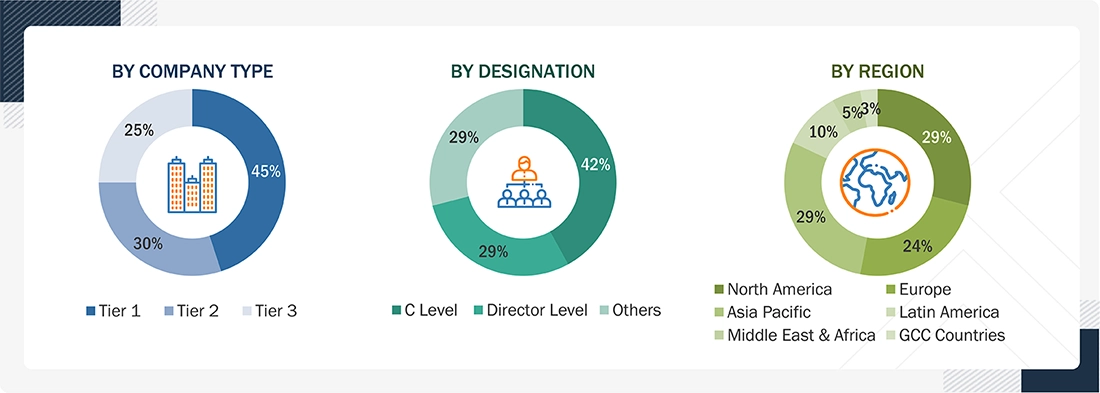
Note 1: C-level primaries include CEOs, COOs, and CTOs.
Note 2: Others include sales managers, marketing managers, and product managers.
Note 3: Companies are classified into tiers based on their total revenue. As of 2024: Tier 1=>USD 1 billion, Tier 2 = USD 500 million to USD 1 billion, Tier 3=< USD 500 million
To know about the assumptions considered for the study, download the pdf brochure
Market Size Estimation
Both top-down and bottom-up approaches were used to estimate and validate the total size of the ECMO market. These methods were also used extensively to estimate the size of various subsegments in the market. The research methodology used to estimate the market size includes the following:
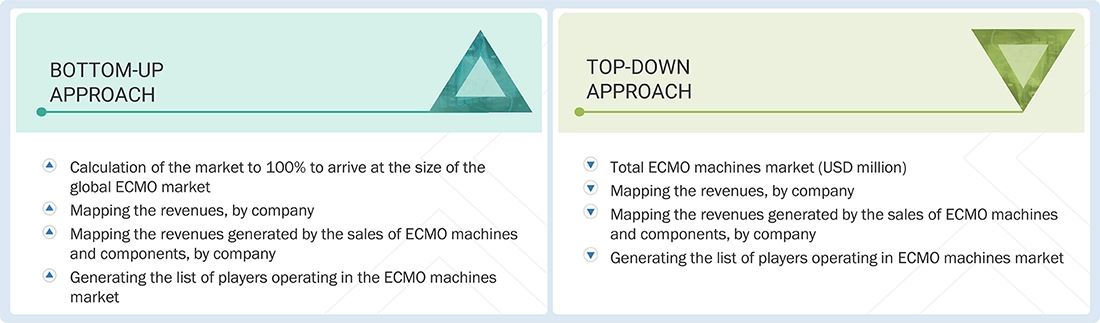
Data Triangulation
The entire market was split into three segments when the market size was determined. Data triangulation and market breakdown processes were used where necessary to complete the entire market engineering process and arrive at precise statistics for all segments.
Approach to derive the market size and estimate market growth.
Using secondary data from paid and unpaid sources, the market rankings for the major players were determined following a thorough analysis of their sales of ECMO machines and components. Due to data restrictions, the revenue share in certain cases was determined after a thorough analysis of the product portfolio of big corporations and their individual sales performance. This information was verified at each stage by in-depth interviews with professionals in the field.
Market Definition
An ECMO machine acts as an artificial heart and lung for a patient whose heart or lungs cannot provide enough blood flow or oxygen into the blood. ECMO is used after other methods of supporting the heart and lungs do not work. The goal of ECMO is to let the heart and lungs recover while the patient is supported by the ECMO machine.
Stakeholders
- Manufacturers of ECMO Machine Products and Related Devices
- Suppliers and Distributors of ECMO Machine Devices
- Hospitals, Clinics, and Medical Colleges
- Medical Device Procurement Agencies
- Government Bodies/Municipal Corporations
- Business Research and Consulting Service Providers
- Venture Capitalists
- US Food and Drug Administration (US FDA)
- European Union (EU)
Report Objectives
- To define, describe, and forecast the oxygen concentrators market based on product, modality, patient type, application, end user, and region
- To provide detailed information regarding the major factors influencing the market growth (drivers, restraints, opportunities, and challenges)
- To analyze the micromarkets with respect to individual growth trends, prospects, and contributions to the overall oxygen concentrators market
- To analyze market opportunities for stakeholders and provide details of the competitive landscape for key players
- To forecast the size of the oxygen concentrators market in six regions, namely, North America (US and Canada), Europe (Germany, UK, France, Spain, Italy, and Rest of Europe), the Asia Pacific (Japan, China, India, Australia, South Korea, and Rest of Asia Pacific), Latin America (Brazil, Mexico, and Rest of Latin America), Middle East & Africa, and GCC Countries
- To strategically profile the key players in the global market and comprehensively analyze their core competencies
- To track and analyze competitive developments, such as product launches, expansions, agreements, and acquisitions, of the leading players in the market
Get the Full ECMO Machines Market Report
Full forecast, segment splits, and company analysis for all ECMO Machines Market.
- Canada ECMO Machines Market
- US ECMO Machines Market
- Germany ECMO Machines Market
- France ECMO Machines Market
- UK ECMO Machines Market
- Italy ECMO Machines Market
- Spain ECMO Machines Market
- Japan ECMO Machines Market
- China ECMO Machines Market
- India ECMO Machines Market
- South Korea ECMO Machines Market
- Brazil ECMO Machines Market
- Mexico ECMO Machines Market
- GCC Countries ECMO Machines Market
- Rest Of Europe ECMO Machines Market
- Rest Of Asia Pacific ECMO Machines Market
- Other Countries ECMO Machines Market
Need a Tailored Report?
Customize this report to your needs
Get 10% FREE Customization
Customize This Report
