
Taiwan Fab Automation Market (2025-2030)

The Taiwan Fab Automation Market was valued at $5696.9 Million in 2025 and projected to reach to $7960.8 Million by 2030, representing a compound annual growth rate of CAGR 4.9%. Taiwan's fab automation market is poised for sustained growth driven by the island's dominance in global semiconductor manufacturing and continuous capital investments by major foundries and chipmakers.


| Market Size in | USD 26.32 MN |
| Market Forecast in | |
| CAGR | |
| Forecast Period | |
| Units Considered | Value (USD MN) |
Taiwan Fab Automation Market Trends and Insights
- Taiwan's position as a global semiconductor manufacturing hub drives sustained demand for advanced automation solutions across wafer fabrication facilities.
- The market in Taiwan reflects the island's critical role in the Asia Pacific semiconductor ecosystem, with leading foundries and memory manufacturers investing heavily in process automation and Industry 4.0 technologies. Taiwan's fab automation sector is characterized by increasing adoption of artificial intelligence, machine learning, and real-time monitoring systems to enhance manufacturing efficiency and yield optimization.
- Taiwan's semiconductor manufacturers are prioritizing automation investments to maintain competitive advantage amid rising labor costs and the need for precision in advanced node production.
- Between 2025 and 2030, Taiwan is expected to see accelerated deployment of integrated automation platforms, robotic systems, and predictive maintenance solutions across both mature and cutting-edge fabrication lines..
Key Market Statistics
- CAGR (2025-2030) CAGR 4.9%
- Market Size, 2025 ~USD 5696.9 Million
- Forecast, 2030 ~USD 7960.8 Million
- Country Taiwan
Taiwan Fab Automation Market Overview
Market Valuation :
Taiwan's fab automation market is valued at USD 5,696.9 million in 2025, with projections reaching USD 7,960.8 million by 2030, demonstrating steady growth in the region's semiconductor manufacturing infrastructure.
Growth Trajectory :
The Taiwan market exhibits a CAGR of 4.9% from 2025 to 2030, outpacing global growth expectations and reflecting the island's strategic importance in semiconductor fabrication and automation technology adoption.
Manufacturing Hub Status :
Taiwan's position as a global semiconductor manufacturing powerhouse drives continuous investment in advanced fab automation solutions, supporting leading chipmakers and foundries operating across the island.
Technology Integration :
Increasing adoption of AI-driven automation, IoT-enabled monitoring systems, and Industry 4.0 technologies in Taiwan's fabs is accelerating demand for sophisticated automation equipment and software solutions.
Taiwan Fab Automation Market Dynamics
- The market benefits from Taiwan's strategic focus on advanced node production, where automation plays a critical role in maintaining competitive advantage and operational efficiency.
- Government initiatives supporting semiconductor self-sufficiency and technology advancement further bolster market expansion.
- By 2030, Taiwan's fab automation sector will likely see increased integration of AI, machine learning, and predictive maintenance technologies, enhancing production yields and reducing downtime across fabrication facilities..
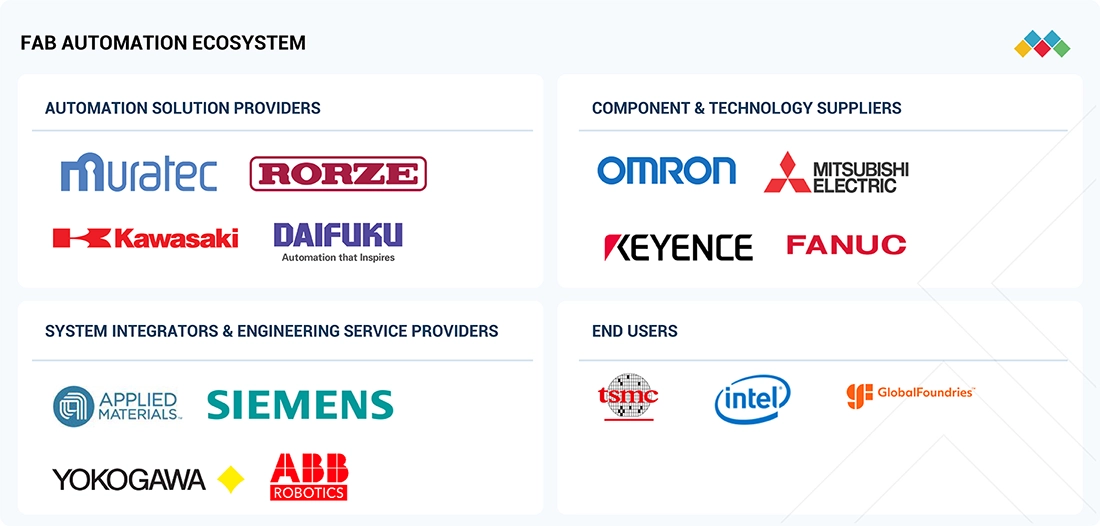
Market Ecosystem
fab-automation-market: COMMERCIAL USE CASES ACROSS INDUSTRIES
| COMPANY | USE CASE DESCRIPTION | BENEFITS |
|---|---|---|
 |
Deployment of AMHS and OHT systems in advanced 300 mm semiconductor fabs | Higher wafer-handling throughput | Reduced contamination risk | Improved cycle-time efficiency |
 |
Integration of wafer-handling robots and cleanroom transport systems in front-end fabrication lines | Enhanced precision in wafer transfer | Lower defect rates | Improved operational stability |
 |
Vacuum and atmospheric robotics deployed for ultra-clean wafer transfer in advanced-node lithography and etch processes | Minimal particle generation | High-precision positioning | Improved yield in sub-7 nm production |
 |
Industrial and cleanroom robots used in semiconductor assembly, packaging, and automated inspection workflows | Higher automation flexibility | Faster handling speed | Reduced labor dependency and operational errors |
 |
Automated wafer-handling modules integrated into metrology, inspection, and process tools across front-end fabs | Increased tool uptime | Consistent wafer placement accuracy | Enhanced throughput and equipment utilization |
Logos and trademarks shown above are the property of their respective owners. Their use here is for informational and illustrative purposes only.
Related Ecosystem
Electronics System And Components
- Sensors
- Temperature Sensors
- Pressure Sensors
- Actuators
- Image Sensors
- Lenovo
- Samsung
- Texas Instruments Incorporated
- HONEYWELL INTERNATIONAL INC.
- Teledyne Technologies Incorporated
Industrial Automation
- Sensors
- Image Sensors
- Manufacturing Execution System (MES)
- Actuators
- Flow Sensors
- Siemens ag
- ABB India Limited
- Emerson Electric Co.
- HONEYWELL INTERNATIONAL INC.
- SCHNEIDER ELECTRIC SE
Semiconductor Materials And Components
- Sensors
- Gallium Nitride (GaN)
- Digital Signal Processor (DSP)
- Natural Language Processing (NLP)
- Silicon Carbide
- Texas Instruments Incorporated
- Samsung
- APPLIED MATERIALS, INC.
- Stmicroelectronics
- Lenovo
Key Takeaways
- Taiwan's fab automation market reaches USD 5,696.9 million in 2025 with projected growth to USD 7,960.8 million by 2030.
- Taiwan's 4.9% CAGR reflects steady but measured growth driven by foundry and memory manufacturer investments in process optimization.
- Taiwan's semiconductor leadership positions the country as a critical market for advanced automation technologies and Industry 4.0 solutions.
- Taiwan's automation adoption is accelerating due to competitive pressures, advanced node requirements, and labor cost considerations.
Fab Automation Market Report Scope
| Report Metric | Details |
|---|---|
| Base Year | 2025 |
| Fastest Growing Segment | SOFTWARE (Offering) |
| Forecast Period | 2025–2030 |
| Growth Rate | CAGR of 7.3% from 2025 to 2030 |
| Largest Segment | 300 MM (Wafer Size) |
| Market Size Base Year (Billions) | ~USD 25.31 (2025) |
| Revenue Forecast (Billions) | ~USD 35.99 (2030) |
| Segments Covered | Offering, Type, Wafer Size, Deployment Type, End User, Hardware Type |
Taiwan Fab Automation Market Report Segmentation
6 segment dimensions are covered across the global market.
By Offering
- Hardware
- Services
- Software
By Type
- Advanced Process Control
- AI/ML & Predictive Analytics
- Automated Material Handling Systems
- Communication & Networking Hardware
- Digital Twin & Simulation
- Environmental Control Systems
- Equipment Control Software
- Managed Services
- Management Execution System
- Management Execution Systems
- Middleware & Communication Protocol
- Power & Utility Automation Systems
- Professional Services
- Robotics & Handling Equipment
- Yield Management Software
By Wafer Size
- 200 Mm
- 300 Mm
- <150 Mm
By Deployment Type
- Brownfield Fabs
- Greenfield Fabs
By End User
- Foundries
- Integrated Device Manufacturers
- Outsourced Semiconductor Assembly & Test Providers
- Research Fabs
By Hardware Type
- Automated Material Handling Systems
- Communication & Networking Hardware
- Environmental Control Systems
- Power & Utility Automation Systems
- Robotics & Handling Equipment
Target Audience
- Semiconductor Equipment Manufacturers : Equipment suppliers need Taiwan market data to understand demand for fab automation solutions, identify key customer segments, and develop products aligned with Taiwan's advanced manufacturing requirements.
- Foundries and Chipmakers : Taiwan-based semiconductor manufacturers require market insights to benchmark automation investments, evaluate technology trends, and optimize capital allocation for fab modernization and expansion projects.
- Automation Software Providers : Software and systems integrators need Taiwan-specific market intelligence to identify growth opportunities, understand customer pain points, and develop solutions tailored to Taiwan's fab automation ecosystem.
- Investment and Private Equity Firms : Investors evaluating opportunities in Taiwan's semiconductor sector require detailed market data to assess growth potential, identify acquisition targets, and evaluate portfolio companies' competitive positioning.
- Technology Consultants and Analysts : Consulting firms and research analysts need Taiwan market cutout data to support client advisory services, competitive analysis, and strategic recommendations for semiconductor automation initiatives.
Key Companies in the Taiwan Fab Automation Market
| Company | HQ | Ownership | Strongest segments |
|---|---|---|---|
| DAIFUKU CO., LTD. | Japan | Public Company | Storage, transport, sorting, and picking systems,Cleanroom transport and storage systems,Automobile production line systems, |
| EBARA CORPORATION | Japan | Public Company | Building Service & Industrial (pumps, fans, chillers, cooling towers),Energy and Infrastructure (pumps, compressors, turbines, cryogenic products),Environmental Solutions (waste treatment, incineration, gasification, sewerage systems), |
| RORZE CORPORATION | Japan | Public Company | Wafer handling systems (robots, EFEMs, load ports, stockers),Mask/reticle handling systems,System integration, software, and EDA/interface A solutions, |
| FANUC | Japan | Public Company | CNC Systems and Servo Drives,Industrial Robots,Robomachines (Robodrill, Roboshot, Robocut), |
| HIRATA CORPORATION | Japan | Public Company | Automotive and EV production equipment,Semiconductor-related equipment,Industrial robots and 3D vision systems, |
| KUKA AG | Germany | Private Company | Industrial robots and controllers,Collaborative and mobile robots,Turnkey production systems and manufacturing cells, |
| YASKAWA ELECTRIC CORPORATION | Japan | Public Company | Motion control (servo motors, drives, controllers, encoders),Industrial robots (arc/spot welding, handling, collaborative, biomedical, palletizing),AC drives and motor systems for appliances, infrastructure, and factories, |
| KAWASAKI HEAVY INDUSTRIES | Japan | Public Company | Powersports and Engines,Precision Machinery and Robotics,Aerospace Systems, |
| ATLAS COPCO | Sweden | Public Company | Compressor Technique,Vacuum Technique,Industrial Technique, |
| THIRA-UTECH | South Korea | Public Company | Planning and scheduling (THiRA Planner, Scheduler, SCP, DCP, Optimizer),Manufacturing execution and operations (THiRA MES, MOM, EIS, SECS-GEM),Smart logistics and robotics (THiRAbot, MCS, FMCS), |
| DAIHEN CORPORATION | Japan | Public Company | Transformers, distribution and power management equipment,Conventional welding and cutting machines,Robot-integrated welding and industrial robots, |
| BROOKS AUTOMATION | United States | Public Company | Sample Management Solutions,Multiomics Services,Consulting and Design Services, |
| MIRLE AUTOMATION | Taiwan | Public Company | Intelligent automation systems and equipment (material handling, AS/RS, FPD and glass lines),Digital technology products, industrial controllers, and intelligent control systems,Intelligent factory software, immersion systems, and analytics, |
| SYNUS TECH | South Korea | Private Company | Logistics equipment and intralogistics systems,Energy equipment and related systems,Services, integration, and aftermarket, |
DAIFUKU CO., LTD.
Daifuku Co., Ltd. is a Japanese public company founded in 1937 with 11,417 employees. The company operates as a major industrial automation and material handling solutions provider.
EBARA CORPORATION
Ebara Corporation is a Japanese public company founded in 1912 with 21,148 employees. The company operates across multiple industrial sectors including pumps, compressors, and environmental systems.
RORZE CORPORATION
Rorze Corporation is a Japanese public company founded in 1966 with 4,435 employees. The company provides automation and robotics solutions for industrial applications.
FANUC
Fanuc is a Japanese public company founded in 1950 with 10,040 employees. The company is a leading manufacturer of industrial robots and factory automation systems.
HIRATA CORPORATION
Hirata Corporation is a Japanese public company founded in 1920 with 1,984 employees. The company specializes in automation equipment and manufacturing solutions.
KUKA AG
Kuka AG is a private German company founded in 1898 with 14,985 employees. The company is a global leader in industrial robotics and automation technology.
YASKAWA ELECTRIC CORPORATION
Yaskawa Electric Corporation is a Japanese public company founded in 1915 with 12,483 employees. The company manufactures industrial robots, motion control systems, and power electronics.
KAWASAKI HEAVY INDUSTRIES
Kawasaki Heavy Industries is a Japanese public company founded in 1878 with 40,640 employees. The company operates across diverse sectors including robotics, aerospace, and industrial machinery.
ATLAS COPCO
Atlas Copco is a Swedish public company founded in 1873 with 56,473 employees. The company provides industrial equipment and solutions including compressors, vacuum systems, and power tools.
THIRA-UTECH
Thira-Utech is a South Korean public company founded in 2006 with 229 employees. The company operates in the industrial technology sector.
DAIHEN CORPORATION
Daihen Corporation is a Japanese public company founded in 1919 with 4,542 employees. The company manufactures welding equipment and industrial automation systems.
BROOKS AUTOMATION
Brooks Automation is a United States public company founded in 1978 with 2,900 employees. The company provides automation and cryogenic solutions for semiconductor and life sciences industries.
MIRLE AUTOMATION
Mirle Automation is a Taiwanese company founded in 1989 with 579 employees. The company specializes in automation equipment and manufacturing solutions.
SYNUS TECH
Synus Tech is a private South Korean company with limited available information. The company operates in the industrial technology sector.
Reasons to Buy this Report
- Taiwan-Specific Market Intelligence : Gain detailed insights into Taiwan's USD 5.7B fab automation market with country-specific growth drivers, competitive dynamics, and investment opportunities unavailable in global market reports.
- Strategic Investment Planning : Leverage accurate 2025-2030 forecasts and CAGR data to identify optimal entry points, expansion opportunities, and partnership strategies within Taiwan's semiconductor automation ecosystem.
- Competitive Positioning : Understand Taiwan's unique manufacturing landscape, key players, technology adoption rates, and market gaps to develop targeted go-to-market strategies and competitive advantages in the region.
- Supply Chain Optimization : Access Taiwan-focused data on fab automation demand patterns, equipment preferences, and technology trends to optimize supply chain decisions and vendor relationships with local manufacturers.
- Risk Mitigation : Evaluate Taiwan-specific market risks, regulatory environment, geopolitical factors, and growth sustainability to make informed business decisions and long-term strategic planning.
Frequently asked questions
What is the current size of Taiwan's fab automation market?
Taiwan's fab automation market is valued at USD 5,696.9 million in 2025, reflecting the country's significant semiconductor manufacturing base and ongoing automation investments.
What is the projected market size for Taiwan's fab automation sector by 2030?
Taiwan's fab automation market is forecast to reach USD 7,960.8 million by 2030, growing at a CAGR of 4.9% from 2025 to 2030.
Why is Taiwan's fab automation market growing at 4.9% CAGR?
Taiwan's growth rate reflects steady demand from leading foundries and memory manufacturers investing in advanced process automation, yield optimization, and Industry 4.0 technologies to maintain global competitiveness.
Which sectors drive fab automation demand in Taiwan?
Taiwan's fab automation market is primarily driven by semiconductor foundries, memory manufacturers, and integrated device manufacturers (IDMs) seeking to enhance production efficiency and support advanced node transitions.
What automation technologies are gaining traction in Taiwan's fabs?
Taiwan's fabs are increasingly adopting AI-driven monitoring systems, robotic process automation, predictive maintenance platforms, and integrated manufacturing execution systems (MES) to optimize yield and reduce downtime.
RESEARCH METHODOLOGY
The research study involved four major activities in estimating the size of the fab automation market. Exhaustive secondary research has been conducted to gather key information about the market and its peer markets. The next step has been to validate these findings and assumptions, and size them up with the help of primary research involving industry experts across the value chain. Both top-down and bottom-up approaches have been used to estimate the market size. Following this, market breakdown and data triangulation have been employed to estimate the market sizes of segments and sub-segments.
Secondary Research
During the secondary research process, various secondary sources have been consulted to identify and collect the information required for this study. The secondary sources include annual reports, press releases, investor presentations of companies, white papers, and articles from recognized authors. Secondary research has primarily been conducted to gather key information about the market’s value chain, the pool of key market players, market segmentation based on industry trends, regional outlook, and developments from both market and technology perspectives.
The fab automation market report estimates the global market size using both top-down and bottom-up approaches, as well as several dependent submarkets. Major players in the market have been identified through extensive secondary research, and their presence in the market has been determined using both secondary and primary research. All the percentage shares, splits, and breakdowns have been determined using secondary sources and verified through primary sources.
Primary Research
Extensive primary research has been conducted following an understanding of the fab automation market scenario through secondary research. Several primary interviews have been conducted with key opinion leaders from demand- and supply-side vendors across three major regions—Americas, Europe, Asia Pacific, and EMEA. Approximately 25% of the primary interviews have been conducted with demand-side vendors, while 75% have been conducted with supply-side vendors. Primary data has been collected mainly through telephonic interviews, which comprised 80% of the total primary interviews; questionnaires and emails have also been used to collect the data.
After successful interaction with industry experts, brief sessions have been conducted with highly experienced independent consultants to reinforce the findings of our primary research. This, along with the opinions of our in-house subject-matter experts, has led us to the findings described in the report.
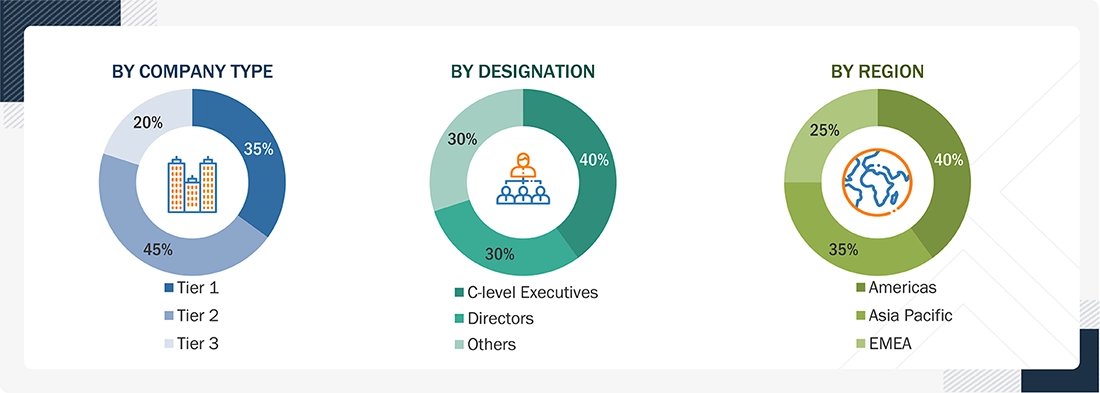
Note: “Others” includes sales, marketing, and product managers
To know about the assumptions considered for the study, download the pdf brochure
Market Size Estimation
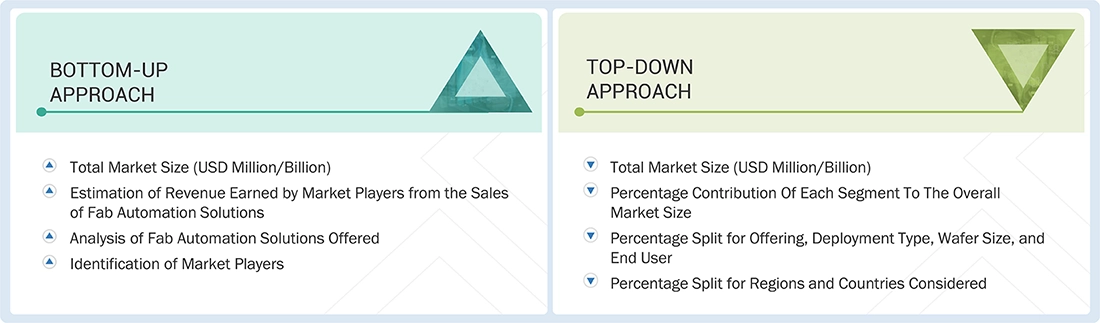
In the market engineering process, the top-down and bottom-up approaches, along with data triangulation methods, have been employed to estimate and validate the size of the fab automation market and its dependent submarkets. The research methodology used to estimate the market sizes includes the following:
- Identifying key stakeholders in the fab automation market, including semiconductor manufacturers (IDMs, foundries, OSATs), fab equipment vendors, automation solution providers, software suppliers, system integrators, and cleanroom infrastructure companies across the value chain.
- Analyzing major providers of fab automation solutions and their key offerings, including automated material handling systems (AMHS), robotics and wafer-handling equipment, environmental control systems, power and utility automation systems, manufacturing execution systems (MES), equipment control software (ECS), advanced process control (APC), yield management software (YMS), AI/ML analytics platforms, and digital-twin simulation tools.
- Studying adoption trends of fab automation across wafer sizes (<150 mm, 200 mm, 300 mm), automation layers, fab types (advanced node, mainstream node, mature node, legacy node), deployment types (greenfield, brownfield), and end users, based on offering, technology integration level, and region.
- Tracking recent market developments, including new fab announcements, government semiconductor incentive programs, automation-driven process upgrades, AI-integrated optimization platforms, and product launches in AMHS, robotics, and APC/MES software, to forecast market size and future growth trajectories accurately.
- Conducting multiple discussions with key opinion leaders across fab automation engineers, operations managers, process control experts, cleanroom specialists, and equipment vendors to understand real-time deployment patterns, integration challenges, and the growing focus on predictive operations, contamination control, and automated decision-making.
- Validating market estimates through in-depth consultations with R&D heads of automation companies, fab operations directors, software architects, and technical advisors in semiconductor ecosystem organizations, and aligning all insights with MarketsandMarkets semiconductor domain experts to ensure accuracy, robustness, and reliability of market projections.
Fab Automation Market : Top-Down and Bottom-Up Approach
Data Triangulation
After arriving at the overall market size by the market size estimation process explained in the earlier section, the overall fab automation market has been divided into several segments and subsegments. The data triangulation and market breakdown procedures have been used to complete the overall market engineering process and arrive at the exact statistics for all segments, wherever applicable. The data has been triangulated by studying various factors and trends from both demand and supply perspectives. In addition to data triangulation and market breakdown, the market has been validated through both top-down and bottom-up approaches.
Market Definition
Fab automation refers to the integrated use of hardware, software, and intelligent control systems to automate and optimize semiconductor manufacturing processes across front-end and back-end fabrication facilities. The fab automation market encompasses solutions such as automated material handling systems (AMHS), robotics, environmental and utility control systems, manufacturing execution systems (MES), advanced process control (APC), yield management software (YMS), and AI-driven analytics platforms. These technologies enable precise wafer handling, real-time process monitoring, predictive maintenance, and seamless coordination between tools and factory systems. As semiconductor production advances toward smaller nodes, higher wafer volumes, and increasingly complex device architectures, fab automation has become essential for improving throughput, enhancing yield consistency, reducing contamination risks, and supporting scalable, high-efficiency manufacturing operations worldwide.
Key Stakeholders
- Component suppliers
- Semiconductor research institutes & R&D labs
- Fab automation solution providers
- Factory software vendors
- Semiconductor equipment manufacturers
- Cleanroom & environmental control system providers
- Utility automation and facility infrastructure providers
- System integrators
- Consulting and automation engineering service firms
- Industry associations & standards organizations
- Integrated Device Manufacturers (IDMs)
- Foundries
- Outsourced Semiconductor Assembly & Test (OSAT) providers
- Government agencies & semiconductor policy bodies
Report Objectives
- To define, describe, segment, and forecast the fab automation market, by offering, deployment type, wafer size, and end user, in terms of value
- To define, describe, and segment the fab automation market across qualitative dimensions, including automation layer, fab type, and automation level
- To forecast the market, in terms of volume, for the robotics and handling equipment segment under the offering category
- To describe and forecast the market for various segments, with respect to three main regions: Americas, Asia Pacific, and Europe, the Middle East & Africa (EMEA), along with their respective countries, in terms of value
- To provide detailed information regarding drivers, restraints, opportunities, and challenges influencing the growth of the fab automation market
- To provide a detailed overview of the fab automation market’s supply chain, along with the ecosystem, technology trends, use cases, regulatory environment, Porter’s five forces analysis, the impact of Gen AI/AI, and the impact of the 2025 US tariff
- To analyze industry trends, pricing data, patents, and trade data (export and import data) related to fab automation
- To strategically analyze the micromarkets1 with respect to individual growth trends, prospects, and contributions to the total market
- To strategically profile the key players and comprehensively analyze their market share and core competencies
- To analyze opportunities for stakeholders and provide a detailed competitive landscape of the market
- To analyze competitive developments, such as product launches, expansions, contracts, partnerships, acquisitions, and research & development (R&D) activities, in the fab automation market
Customization Options:
With the given market data, MarketsandMarkets offers customizations according to the specific requirements of companies. The following customization options are available for the report:
Country-wise Information:
- Country-wise breakdown for Americas, EMEA, and Asia Pacific
Company Information:
- Detailed analysis and profiling of additional market players (up to five)
Get the Full Fab Automation Market Report
Full forecast, segment splits, and company analysis for all Fab Automation Market.
Need a Tailored Report?
Customize this report to your needs
Get 10% FREE Customization
Customize This Report
