
Indonesia Fire Stopping Materials Market (2025-2030)

The Indonesia Fire Stopping Materials Market was valued at $25.4 Million in 2025 and projected to reach to $35.3 Million by 2030, representing a compound annual growth rate of 6.8%. Indonesia's fire stopping materials market is positioned for sustained growth driven by accelerating construction activities, stricter fire safety regulations, and increased industrial development.


| Market Size in | USD 26.32 MN |
| Market Forecast in | |
| CAGR | |
| Forecast Period | |
| Units Considered | Value (USD MN) |
Indonesia Fire Stopping Materials Market Trends and Insights
- This expansion reflects Indonesia's accelerating construction and industrial development, where fire safety regulations are becoming increasingly stringent across commercial, residential, and mining sectors.
- Indonesia's growing urbanization and infrastructure investments are driving demand for advanced fire stopping solutions in high-rise buildings, manufacturing facilities, and critical infrastructure projects. The 6.8% compound annual growth rate (CAGR) positions Indonesia as a high-growth market within the Asia Pacific region, outpacing the global average of 5.7%.
- Indonesia's fire stopping materials market benefits from rising awareness of fire safety compliance, particularly in the packaging, construction, and mining industries.
- Between 2025 and 2030, Indonesia is expected to see increased adoption of intumescent sealants, mineral wool, and fire-rated foam products as building codes and occupational safety standards become more rigorous across the archipelago..
Key Market Statistics
- CAGR (2025-2030) 6.8% CAGR
- Market Size, 2025 ~USD 25.4 Million
- Forecast, 2030 ~USD 35.3 Million
- Country Indonesia
Indonesia Fire Stopping Materials Market Overview
Market Valuation Growth :
Indonesia's fire stopping materials market is valued at USD 25.4 million in 2025, with a projected CAGR of 6.8% through 2030, reaching USD 35.3 million. This outpaces the global CAGR of 5.7%, indicating Indonesia's accelerated adoption of fire safety solutions.
Regulatory Compliance Drivers :
Stringent fire safety regulations across Indonesia's commercial, residential, and mining sectors are compelling businesses to invest in certified fire stopping materials. Compliance with building codes and industrial safety standards is driving consistent market demand.
Urbanization & Construction Boom :
Rapid urbanization and infrastructure development in Indonesia are fueling construction activity, particularly in Jakarta, Surabaya, and Bandung. This expansion creates substantial demand for fire stopping materials in new commercial complexes, residential towers, and industrial facilities.
Mining Sector Expansion :
Indonesia's significant mining operations, particularly in coal and mineral extraction, require robust fire safety measures. Fire stopping materials are critical for protecting mining infrastructure and ensuring worker safety in high-risk environments.
Indonesia Fire Stopping Materials Market Dynamics
- The country's rapid urbanization, particularly in major metropolitan areas, is creating substantial demand for fire-rated materials in commercial and residential projects.
- Additionally, Indonesia's prominent mining sector continues to prioritize worker safety and infrastructure protection, further bolstering market expansion. Looking ahead to 2030, the market will benefit from enhanced building code enforcement, growing awareness of fire safety among developers and contractors, and increased investment in industrial infrastructure.
- Foreign and domestic construction firms are increasingly specifying certified fire stopping materials to meet regulatory requirements and international standards, positioning Indonesia as a high-growth market within the Southeast Asian region..
Market Ecosystem
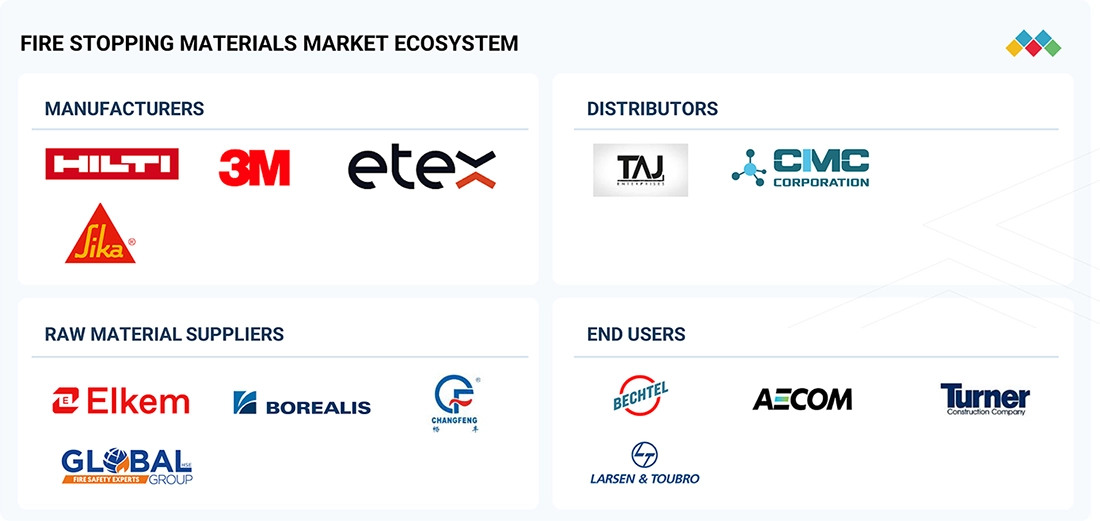
FIRE STOPPING MATERIALS MARKET: COMMERCIAL USE CASES ACROSS INDUSTRIES
| COMPANY | USE CASE DESCRIPTION | BENEFITS |
|---|---|---|
 |
Uses fire stopping materials in large data centers and fulfillment centers to seal cable penetrations, server room walls, and electrical pathways, preventing the spread of fire and smoke between compartments. | Enhances fire safety of critical IT infrastructure, protects high-value equipment, and ensures compliance with building safety regulations. |
 |
Installs fire stopping solutions in retail stores and distribution centers to seal joints, ducts, and service penetrations across large commercial spaces. | Improves occupant safety, protects assets and inventory, and maintains fire-resistance ratings in high-traffic commercial buildings. |
 |
Implements fire stopping materials in hospitals and healthcare facilities to seal pipe and cable penetrations across walls and floors in critical care environments. | Prevents fire and smoke spread, supports patient safety, and ensures compliance with strict healthcare fire protection standards. |
Logos and trademarks shown above are the property of their respective owners. Their use here is for informational and illustrative purposes only.
Related Ecosystem
Building And Construction
- HVAC System
- Acoustic Insulation
- Alkyd Resins
- Fiberglass
- Thermal Insulation
- Snc-lavalin group inc.
- Saint-gobain
- LHOIST S.A
- USG CORPORATION
- Basf se
Key Takeaways
- Indonesia's fire stopping materials market is valued at USD 25.4 million in 2025 and will reach USD 35.3 million by 2030, representing a 6.8% CAGR.
- Indonesia's market growth outpaces the global average of 5.7%, driven by rapid urbanization and stricter fire safety regulations.
- Indonesia's construction and mining sectors are primary demand drivers for fire stopping materials, particularly in high-rise and industrial applications.
- Indonesia's adoption of advanced fire-rated products is accelerating due to increased compliance requirements and infrastructure modernization initiatives.
Fire Stopping Materials Market Report Scope
| Report Metric | Details |
|---|---|
| Base Year | 2025 |
| Fastest Growing Segment | PUTTY AND PUTTY PADS (Type) |
| Forecast Period | 2025–2030 |
| Growth Rate | CAGR of 5.7% from 2025 to 2030 |
| Largest Segment | COMMERCIAL (End-Use Industry) |
| Market Size Base Year (Billions) | ~USD 1.87 (2025) |
| Revenue Forecast (Billions) | ~USD 2.47 (2030) |
| Segments Covered | Type, Application, End-Use Industry |
Indonesia Fire Stopping Materials Market Report Segmentation
3 segment dimensions are covered across the global market.
By Type
- Boards
- Cast-In Devices
- Collars
- Mortars
- Other Types
- Putty And Putty Pads
- Sealants
- Wraps/Strips
By Application
- Electrical
- Mechanical
- Other Applications
- Plumbing
By End-Use Industry
- Commercial
- Industrial
- Residential
INDONESIA: FIRE STOPPING MATERIALS MARKET, BY END-USE INDUSTRY, 2025–2030
| Segment | 2025 | 2026 | 2027 | 2028 | 2029 | 2030 | CAGR (%) |
|---|---|---|---|---|---|---|---|
| COMMERCIAL | 12.2 | 13.1 | 14.1 | 15.1 | 16.2 | 17.3 | 7.2 |
| INDUSTRIAL | 7.6 | 8.1 | 8.6 | 9.2 | 9.8 | 10.4 | 6.5 |
| RESIDENTIAL | 5.6 | 5.9 | 6.3 | 6.7 | 7.1 | 7.5 | 6.3 |
| TOTAL | 25.4 | 27.1 | 29 | 30.9 | 33.1 | 35.3 | 6.8 |
Target Audience
- Construction & Real Estate Developers : Indonesian developers need market data to understand fire safety material specifications, compliance requirements, and cost structures for commercial and residential projects. This intelligence informs procurement strategies and project budgeting.
- Fire Safety Material Manufacturers : Domestic and international manufacturers require Indonesia-specific market insights to assess demand, identify growth opportunities, and develop localized product strategies. Market size and CAGR data guide production and distribution planning.
- Mining & Industrial Operators : Mining companies and industrial facilities need comprehensive data on fire stopping material requirements, regulatory compliance, and market availability. This supports safety infrastructure investments and operational risk management.
- Building Contractors & Consultants : Contractors and engineering consultants require market intelligence on approved materials, pricing trends, and regulatory standards to advise clients and prepare accurate project specifications and cost estimates.
- Distributors & Suppliers : Material distributors and suppliers need Indonesia market data to forecast demand, optimize inventory, identify supplier relationships, and develop sales strategies aligned with regional growth trends and sector-specific requirements.
Key Companies in the Indonesia Fire Stopping Materials Market
| Company | HQ | Ownership | Strongest segments |
|---|---|---|---|
| 3M | United States | Public Company | Sealant,Wrap/Strips,Cast-in Devices, |
| SIKA AG | Switzerland | Public Company | Sealant,Mortar,Boards, |
| ETEX GROUP | Belgium | Public Company | Boards,Sealant,Mortar, |
| RPM INTERNATIONAL INC. | United States | Public Company | Sealant,Mortar,Cast-in Devices, |
| ROCKWOOL GROUP | Denmark | Public Company | Boards,Mortar,Sealant, |
| OWENS CORNING (PAROC) | United States | ||
| BOSS PASSIVE FIRE | Australia | Sealant,Collars,Wrap/Strips, | |
| SAVERTO HOLDING GMBH | Germany | Sealant,Collars,Wrap/Strips, |
3M
3M is a publicly traded American company founded in 1902 with 60,500 employees. The company is a diversified technology and manufacturing conglomerate serving multiple industries.
SIKA AG
Sika AG is a Swiss public company founded in 1910 with 33,856 employees. The company specializes in chemicals and building materials for construction and industrial applications.
ETEX GROUP
Etex Group is a Belgian public company founded in 1905 with 12,475 employees. The company manufactures and distributes building materials and solutions for construction.
RPM INTERNATIONAL INC.
RPM International Inc. is a publicly traded American company founded in 1947 with 17,778 employees. The company manufactures specialty coatings, sealants, and building materials.
ROCKWOOL GROUP
Rockwool Group is a Danish public company founded in 1909 with 11,827 employees. The company manufactures stone wool insulation and fire protection products.
OWENS CORNING (PAROC)
Owens Corning (Paroc) is an American company operating in the insulation and building materials sector.
BOSS PASSIVE FIRE
Boss Passive Fire is an Australian company specializing in passive fire protection solutions.
SAVERTO HOLDING GMBH
Saverto Holding GmbH is a German company operating in the building materials or construction sector.
Reasons to Buy this Report
- Market Size & Growth Validation : Obtain precise market valuation data for Indonesia (USD 25.4M in 2025) with verified 6.8% CAGR projections through 2030. Validate investment decisions and business expansion strategies with credible, region-specific market intelligence.
- Regulatory & Compliance Insights : Understand Indonesia's evolving fire safety regulations across commercial, residential, and mining sectors. Identify compliance requirements and standards that drive purchasing decisions, enabling better product positioning and market entry strategies.
- Sector-Specific Opportunity Analysis : Gain detailed insights into demand drivers across Indonesia's construction boom, urbanization trends, and mining operations. Identify high-growth sub-segments and geographic hotspots (Jakarta, Surabaya, Bandung) for targeted market penetration.
- Competitive Positioning Strategy : Benchmark your offerings against market growth rates and identify gaps in Indonesia's fire stopping materials supply chain. Develop competitive strategies informed by local market dynamics and regional performance metrics.
- Investment & Partnership Decisions : Make informed decisions on market entry, partnerships, and capital allocation in Indonesia. Leverage comprehensive market data to assess risk, identify growth opportunities, and prioritize resource deployment in this high-growth Southeast Asian market.
Frequently asked questions
What is the current size of Indonesia's fire stopping materials market?
Indonesia's fire stopping materials market is valued at USD 25.4 million in 2025 and is projected to grow to USD 35.3 million by 2030.
What is the growth rate of Indonesia's fire stopping materials market?
Indonesia's fire stopping materials market is growing at a compound annual growth rate (CAGR) of 6.8% from 2025 to 2030.
Which industries drive demand for fire stopping materials in Indonesia?
Indonesia's primary demand drivers include the construction, mining, packaging, and industrial gases sectors, where fire safety compliance is increasingly critical.
What types of fire stopping materials are most used in Indonesia?
Indonesia's market features intumescent sealants, mineral wool, fire-rated foam products, and other passive fire protection materials used in building penetrations and joints.
How does Indonesia's market growth compare to global trends?
Indonesia's 6.8% CAGR outpaces the global fire stopping materials market CAGR of 5.7%, reflecting stronger regional demand and regulatory momentum.
RESEARCH METHODOLOGY
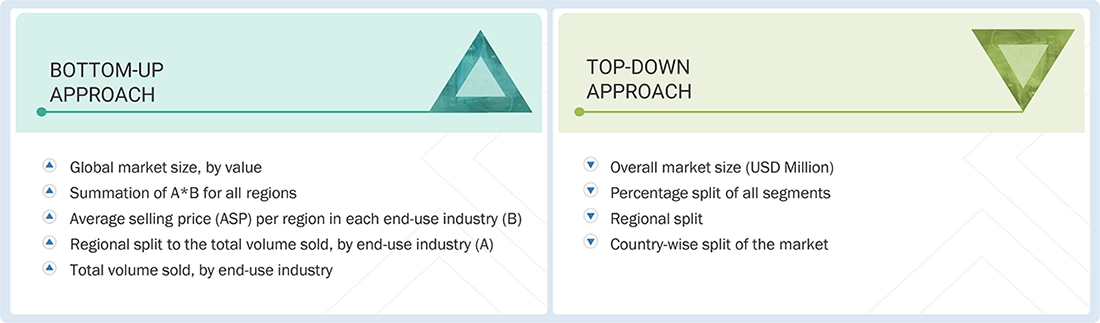
The study involves two major activities in estimating the current market size for fire stopping materials. Exhaustive secondary research was done to collect information on the market, peer market, and parent market. The next step was to validate these findings, assumptions, and sizing with industry experts across the value chain through primary research. Both top-down and bottom-up approaches were employed to estimate the complete market size. After that, market breakdown and data triangulation were used to estimate the market size of segments and subsegments.
Secondary Research
Secondary sources referred to for this research study include financial statements of companies offering fire stopping materials and information from various trade, business, and professional associations. Secondary research has been used to obtain critical information about the industry’s value chain, the total pool of key players, market classification, and segmentation according to industry trends to the bottom-most level and regional markets. The secondary data was collected and analyzed to arrive at the overall size of the fire stopping materials market, which was validated by primary respondents.
Primary Research
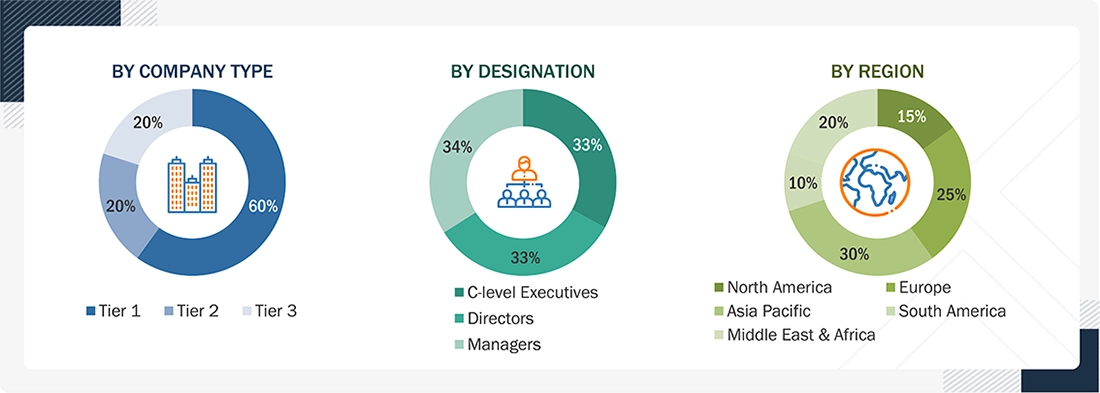
Extensive primary research was conducted after obtaining information regarding the fire stopping materials market scenario through secondary research. Several primary interviews were conducted with market experts from both the demand and supply sides across major countries of North America, Europe, Asia Pacific, the Middle East & Africa, and South America. Primary data was collected through questionnaires, emails, and telephone interviews. The primary sources from the supply side included various industry experts, such as CXOs, VPs, directors from business development, marketing, product development/innovation teams, and related key executives from fire stopping materials industry vendors; system integrators; component providers; distributors; and key opinion leaders.
Primary interviews were conducted to gather insights such as market statistics, data on revenue collected from the products and services, market breakdowns, market size estimations, market forecasting, and data triangulation. Primary research also helped in understanding the various trends related to product type, conductor material, voltage type, application, end-use industry, and region.
Stakeholders from the demand side, such as CIOs, CTOs, CSOs, and installation teams of the customers/end users who are using fire stopping materials, were interviewed to understand the buyer’s perspective on the suppliers, products, component providers, and their current usage of fire stopping materials and future outlook of their business, which will affect the overall market.
Breakup of Primary Research:
To know about the assumptions considered for the study, download the pdf brochure
Market Size Estimation
The research methodology used to estimate the size of the fire stopping materials market includes the following details. The market sizing was undertaken from the demand side. The market was upsized based on procurements and modernizations in fire stopping materials in different end-use industries at a regional level. Such procurements provide information on the demand aspects of the fire stopping materials industry for each application. For each end-use industry, all possible segments of the fire stopping materials market were integrated and mapped.
Fire Stopping Materials Market : Top-Down and Bottom-Up Approach
Data Triangulation
After arriving at the overall size from the market size estimation process explained above, the total market was split into several segments and subsegments. The data triangulation and market breakdown procedures explained below were implemented, wherever applicable, to complete the overall market engineering process and arrive at the exact statistics for various market segments and subsegments. The data was triangulated by studying various factors and trends from the demand and supply sides. Along with this, the market size was validated using both the top-down and bottom-up approaches.
Market Definition
Passive fire protection is the blanket reference to all products/systems used to enhance fire safety in buildings (fire stopping, structural protection, air ducts, cable ducts, partitions, ceilings, fire-rated glass, etc.). Fire stopping systems comprise penetration seals used to insulate services that run through fire-rated walls or ceilings.
According to the International Building Code definition, fire stopping is an assemblage consisting of a fire-resistance-rated floor, floor/ceiling, or wall assembly. Fire stopping materials or devices, or both, are installed to resist the spread of fire through the assembly for a prescribed period of time.
Key Stakeholders
- Fire stopping material manufacturers
- Raw material manufacturers
- Government and research organizations
- R&D institutions
- National and local government organizations
- Institutional investors
- Fire stopping material suppliers
- End users
Report Objectives
- To define, describe, and forecast the fire stopping materials market size in terms of value
- To provide detailed information regarding the key factors, such as drivers, restraints, opportunities, and challenges influencing market growth
- To analyze and project the global fire stopping materials market by type, application, end-use industry, and region
- To forecast the market size concerning five main regions (along with country-level data), namely, North America, Europe, Asia Pacific, the Middle East & Africa, and South America, and analyze the significant region-specific trends
- To strategically analyze micromarkets with respect to individual growth trends, prospects, and contributions of the submarkets to the overall market
- To analyze the market opportunities and the competitive landscape for stakeholders and market leaders
- To assess the recent market developments and competitive strategies, such as agreements, contracts, acquisitions, and product developments/product launches, to draw the competitive landscape
- To strategically profile the key market players and comprehensively analyze their core competencies
Available customizations:
MarketsandMarkets offers the following customizations for this market report:
- Additional country-level analysis of the fire stopping materials market
Product Analysis
- Product matrix, which provides a detailed comparison of the product portfolio of each company’s market
Get the Full Fire Stopping Materials Market Report
Full forecast, segment splits, and company analysis for all Fire Stopping Materials Market.
- US Fire Stopping Materials Market
- Canada Fire Stopping Materials Market
- Mexico Fire Stopping Materials Market
- Germany Fire Stopping Materials Market
- UK Fire Stopping Materials Market
- France Fire Stopping Materials Market
- Italy Fire Stopping Materials Market
- Russia Fire Stopping Materials Market
- Spain Fire Stopping Materials Market
- China Fire Stopping Materials Market
- Japan Fire Stopping Materials Market
- India Fire Stopping Materials Market
- South Korea Fire Stopping Materials Market
- Brazil Fire Stopping Materials Market
- Argentina Fire Stopping Materials Market
- South Africa Fire Stopping Materials Market
- Benelux Fire Stopping Materials Market
- Rest Of Europe Fire Stopping Materials Market
- Rest Of Apac Fire Stopping Materials Market
- GCC Countries Fire Stopping Materials Market
- –Rest Of GCC Countries Fire Stopping Materials Market
- Rest Of South America Fire Stopping Materials Market
Need a Tailored Report?
Customize this report to your needs
Get 10% FREE Customization
Customize This Report
