
China Fire Truck Market (2024-2029)

The China Fire Truck Market was valued at $8531 Million in 2024 and projected to reach to $9163 Million by 2029, representing a compound annual growth rate of CAGR 1.2%. China's fire truck market is positioned for steady growth driven by continued urbanization and infrastructure modernization initiatives.


| Market Size in | USD 26.32 MN |
| Market Forecast in | |
| CAGR | |
| Forecast Period | |
| Units Considered | Value (USD MN) |
China Fire Truck Market Trends and Insights
- China's fire truck sector is driven by urbanization, infrastructure development, and increasing investment in emergency response capabilities across municipalities and industrial zones.
- The market in China reflects steady demand from government procurement programs and modernization of fire departments in tier-2 and tier-3 cities. During the 2024-2029 forecast period, China's fire truck market will benefit from stricter fire safety regulations and the expansion of industrial parks requiring advanced firefighting equipment.
- China's focus on smart city initiatives and digital integration in emergency services is expected to support incremental growth.
- However, China's market growth remains moderate compared to global trends, reflecting market maturity and competitive pricing pressures within the domestic automotive and transportation sector..
Key Market Statistics
- CAGR (2024-2029) CAGR 1.2%
- Market Size, 2024 ~USD 8531 Million
- Forecast, 2029 ~USD 9163 Million
- Country China
China Fire Truck Market Overview
Market Valuation :
China's fire truck market reached USD 8,531 million in 2024, with projected growth to USD 9,163 million by 2029, representing steady expansion in the region's emergency response infrastructure.
Urbanization Driver :
Rapid urbanization across Chinese cities is fueling demand for advanced fire truck fleets, as municipalities invest heavily in modernizing emergency response capabilities to protect growing urban populations.
Industrial Zone Expansion :
Increased investment in industrial zones and manufacturing hubs across China is creating sustained demand for specialized fire trucks equipped with advanced firefighting and hazmat response capabilities.
Infrastructure Development :
Government-backed infrastructure projects and smart city initiatives are accelerating procurement of fire trucks with modern technology, supporting the market's 1.2% CAGR through 2029.
China Fire Truck Market Dynamics
- Municipal governments are prioritizing emergency response capabilities, particularly in tier-2 and tier-3 cities experiencing rapid development.
- Industrial expansion and the establishment of new manufacturing zones further support demand for specialized firefighting vehicles.
- The market's 1.2% CAGR reflects consistent investment patterns, though growth remains moderate compared to global trends.
- Future opportunities lie in integrating smart technologies, electric-powered vehicles, and advanced safety systems into China's fire truck fleet..
Market Ecosystem
Related Ecosystem
On Highway Off Highway Vehicles
- Internal Combustion Engine (ICE)
- Agricultural Tractors
- Crawler Excavator
- Battery Electric Vehicle (BEV)
- Excavators
- Visteon Corporation
- Deere & Company
- AB VOLVO PENTA
- Honda Motor Co., Ltd.
- Komatsu Ltd.
Key Takeaways
- China's fire truck market is valued at USD 8,531 million in 2024 and will reach USD 9,163 million by 2029 with a 1.2% CAGR.
- China's market growth is driven by urbanization, government procurement, and modernization of emergency response infrastructure in developing cities.
- China's adoption of smart city technologies and digital integration in fire departments will create incremental demand during the forecast period.
- China's fire truck market faces moderate growth due to market maturity and competitive pricing dynamics in the domestic automotive sector.
Fire Truck Market Report Scope
| Report Metric | Details |
|---|---|
| Base Year | 2024 |
| Fastest Growing Segment | ELECTRIC (Propulsion) |
| Forecast Period | 2024-2029 |
| Growth Rate | CAGR of 2.7% from 2024 to 2029 |
| Largest Segment | ICE (Propulsion) |
| Market Size Base Year (Billions) | ~USD 8.18 (2024) |
| Revenue Forecast (Billions) | ~USD 9.35 (2029) |
| Segments Covered | Type, Application, Propulsion, Capacity |
China Fire Truck Market Report Segmentation
4 segment dimensions are covered across the global market.
By Type
- Aerial Truck
- Aircraft Rescue And Firefighting Truck
- Aircraft Rescue And Firefighting Trucks
- Engine Pumper Truck
- Hazmat Truck
- Tender Truck
- Wildfire Truck
By Application
- Airport
- Forest
- Industrial
- Military
- Residential & Commercial
By Propulsion
- Electric
- ICE
By Capacity
- 1,001 - 2,000 Gallons
- 501 - 1,000 Gallons
- <500 Gallons
- >2,000 Gallons
Target Audience
- Fire Truck Manufacturers : Manufacturers need China-specific market data to develop localized product strategies, understand municipal procurement requirements, and identify growth opportunities in urbanizing regions and industrial zones.
- Municipal Government Procurement Teams : Government agencies require market intelligence to benchmark fire truck investments, understand industry trends, and make informed budgeting decisions for emergency response fleet modernization.
- Investment & Private Equity Firms : Investors need detailed market analysis to evaluate acquisition targets, assess growth potential, and identify strategic opportunities in China's fire truck manufacturing and distribution sectors.
- Automotive Component Suppliers : Suppliers benefit from understanding China's fire truck market demand to forecast component requirements, plan production capacity, and develop partnerships with OEMs serving municipal and industrial customers.
- Emergency Services Consultants : Consultants advising Chinese municipalities on infrastructure development require market data to recommend appropriate fire truck investments and emergency response capabilities aligned with urbanization trends.
Reasons to Buy this Report
- Market Size & Growth Projections : Access precise valuation data for China's fire truck market (USD 8,531M in 2024) with detailed 5-year forecasts to support investment decisions and business planning in this key Asian market.
- Urbanization & Infrastructure Insights : Understand how China's rapid urbanization and government infrastructure projects are creating sustained demand for fire trucks, enabling strategic positioning in high-growth municipal procurement cycles.
- Regional Competitive Analysis : Benchmark your offerings against China-specific market dynamics, including municipal budgets, industrial zone requirements, and emergency response standards to optimize product development and pricing strategies.
- Investment Opportunity Assessment : Evaluate market entry strategies and expansion potential in China's fire truck sector with comprehensive data on growth drivers, regional variations, and emerging opportunities in tier-2 and tier-3 cities.
- Technology & Innovation Trends : Identify demand patterns for advanced firefighting technologies and smart vehicle integration in China, guiding R&D investments and product innovation to capture market share in this modernizing sector.
Frequently asked questions
What is the current size of China's fire truck market?
China's fire truck market was valued at USD 8,531 million in 2024 and is expected to grow to USD 9,163 million by 2029.
What is the growth rate of China's fire truck market?
China's fire truck market is projected to grow at a compound annual growth rate (CAGR) of 1.2% from 2024 to 2029.
What are the main drivers of growth in China's fire truck market?
Key drivers in China include urbanization, government procurement programs, modernization of fire departments in tier-2 and tier-3 cities, and stricter fire safety regulations.
How is China's fire truck market expected to evolve by 2029?
China's market will benefit from smart city initiatives, digital integration in emergency services, and expansion of industrial parks, though growth will remain moderate due to market maturity.
What challenges does China's fire truck market face?
China's fire truck market faces competitive pricing pressures, market saturation in developed regions, and the need for continuous technological innovation to differentiate products.
RESEARCH METHODOLOGY
Various secondary sources, directories, and databases have been used to identify and collect information for an extensive fire truck market study. The study involved four main activities in estimating the current size of the fire truck market: secondary research, validation through primary research, assumptions, and market analysis. Exhaustive secondary research was carried out to collect information on the market, such as the number of fire trucks sold globally, upcoming technologies, capacity trucks, and electric powertrain development in fire trucks. The next step was to validate these findings, assumptions, and market analysis with industry experts across the value chain through primary research. The top-down approach was employed to estimate the complete market size for different segments considered in this study.
Secondary Research
In the secondary research process, various secondary sources, such as company annual reports, presentations, and press releases; associations, such as Fire Apparatus Manufacturers' Association (FAMA), National Fire Protection Association (NFPA), Committee of European Fire Equipment and Services Manufacturers (CEFE), European Fire Services (EFS), The European Committee of the Manufacturers of Fire Protection Equipment and Fire Fighting Vehicles (EUROFEU), Asian Firefighting and Rescue Association (AFRA), The Institution of Fire Engineers Asia (IFE Asia), Vahan, and National Institute of Statistics and Censuses (INDEC). Secondary research was used to obtain critical information about the industry's value chain, the overall pool of key players, market classification and segmentation according to industry trends to the bottom-most level, regional markets, and key developments from the market and technology-oriented perspectives.
Primary Research
In the primary research process, various primary sources from both the supply sides were interviewed to obtain qualitative and quantitative information on the market. The primary sources from the OEM side included industry experts such as CXOs, vice presidents, directors from business development, marketing, product development/innovation teams, and related key executives from various companies.
After the complete market engineering, which includes calculations for market statistics, market breakdown, market size estimations, market forecasting, and data triangulation, extensive primary research has been conducted to gather information and verify and validate the critical numbers arrived at. Primary research has also been undertaken to identify and validate the segmentation, industry trends, key players, competitive landscape, and market dynamics, such as drivers, restraints, opportunities, challenges, industry trends, and key strategies. Extensive qualitative and quantitative analysis has been performed on the complete market engineering process to list key information/insights throughout the report.
After interacting with industry experts, the team also conducted brief sessions with highly experienced independent consultants to reinforce the findings from our primaries. This and the in-house subject matter expert's opinions have led us to the conclusions described in this report's remainder.
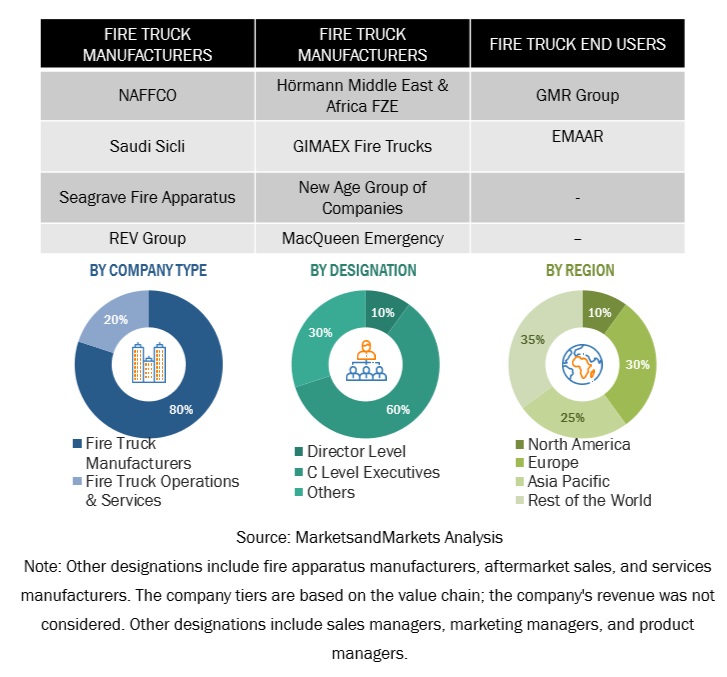
To know about the assumptions considered for the study, download the pdf brochure
Market Size Estimation
The bottom-up approach was used to estimate and validate the size of the fire truck market by type (aerial fire truck, engine pumper truck, aircraft rescue and firefighting truck, tender truck and HAZMAT truck). The market size by volume, was derived by identifying the country level equipment type sales that were derived through detailed model mapping at the country level as well as company publications (investor presentations, annual reports etc.). The sales volume and percentage share of each type was then verified with the primary respondents. Country-level fire truck sales were multiplied by country-level penetration of each type to determine the market size of fire truck by type in terms of volume. In terms of volume, the country-level fire truck market size of each type was added to derive the regional market. All the regional markets were further added to derive type from the global fire truck market. The country-level fire truck market was then multiplied by the country-level average selling price of fire truck by each type, which resulted in country-level market size. The addition of respective countries gives the regional-level market, and then the summation of regional-level markets gives the global fire truck market by type in terms of value.
The forecast of the country wise fire trucks is based on multiple factors such as OEM’s investments, new product launches, government support and regulations towards number monitoring fire stations and fire trucks, technological landscape, economic conditions, infrastructure development, increase in number of airports, and growth in population
Fire Truck Market size: Bottom-up approach (regional and vehicle type)
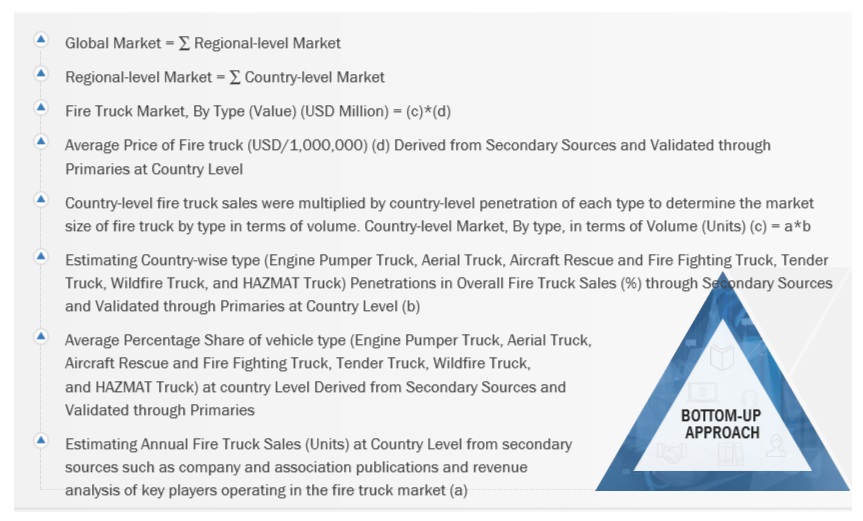
To know about the assumptions considered for the study, Request for Free Sample Report
Fire Truck Market SIZE: TOP-DOWN APPROACH (application)
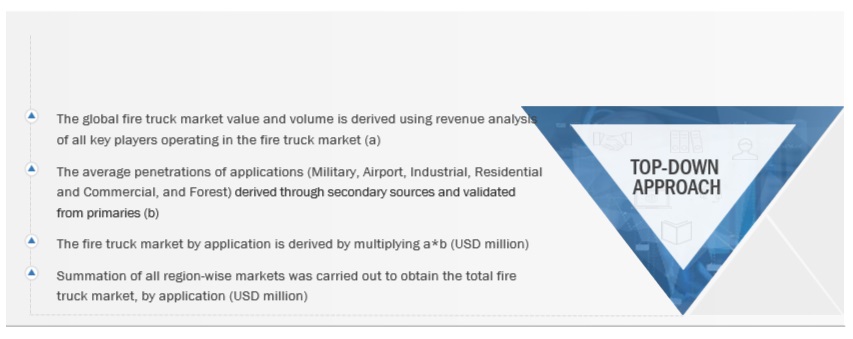
Data Triangulation
All percentage shares, splits, and breakdowns have been determined using secondary sources and verified by primary sources. All parameters that affect the markets covered in this research study have been accounted for, viewed in extensive detail, and analyzed to obtain the final quantitative and qualitative data. This data has been consolidated and enhanced with detailed input and analysis and presented in the report. The following figure illustrates this study's overall market size estimation process.
Market Definition
Definition: A car which has been built for combating fires is known as fire truck, sometimes referred to as a fire engine. When there's a fire or other emergency, it usually arrives first and transports firefighters and equipment to the scene. These fire trucks that used to put out the fires and conduct rescue operations are outfitted with water tanks, pumps, hoses, ladders, and other essential tools and equipment. These are a vital aspect of a fire department's apparatus, offering the manpower and resources required to adequately respond to and contain fire-related incidents in a community.
Fire trucks come in various types, each designed to serve a specific purpose in firefighting and emergency response. The most common types of fire trucks include engine/pumper trucks, which carry water and pump it at high pressure to extinguish fires; Aerial trucks/ladder trucks, which have an aerial ladder or platform to access elevated areas; and rescue trucks, which are equipped with specialized tools and equipment for technical rescue operations, such as vehicle extrication, confined space rescue, and hazardous materials response. Additionally, there are specialized fire trucks like tanker trucks, which carry large volumes of water to supplement the water supply at the scene, and wildfire trucks, designed for off-road firefighting in rural and forested areas. Each type of fire truck plays a crucial role in a fire department's overall firefighting and emergency response capabilities, ensuring they can effectively address various incidents and emergencies within their community.
Stakeholders
- Fire truck Manufacturers (OEMs)
- Firefighting equipment suppliers
- Battery, Motor, and Drivetrain Suppliers for Electric Fire trucks
- Other Component Suppliers for Fire trucks
- Government and Regulatory Authorities
- Fire Truck Dealers and Distributors
- Fire Truck Component Manufacturing Associations
- Traders, Distributors, and Suppliers of Fire truck Systems/Components
- Automotive Industry Associations, Government Authorities, and Research Organizations
Report Objectives
- To define, describe, and forecast the size of the fire truck market, in terms of value (USD million) and volume (Units) based on:
- To segment and forecast the market in terms of value and volume based on
- By Type (Engine Pumper Truck, Aerial truck, Aircraft Rescue and Firefighting Truck, Tender Truck, Wildfire Truck, and HAZMAT truck)
- Propulsion (Electric and ICE) at the regional as well as country level
- Application (Military, Airport, Industrial, Residential & Commercial, and Forest) at the regional level
- Capacity (<500 gallons, 501 – 1,000 gallons, 1,001 – 2,000 gallons, and >2,000 gallons) at the regional level
- Region (Asia Pacific, Europe, North America, Rest of the World)
- To understand the market dynamics (Drivers, Restraints, Opportunities, and Challenges) and conduct Patent Analysis, Pricing Analysis, Recession Impact, Key Buying Criteria, Trade Analysis, OEM analysis, Technology Analysis, ASP Analysis, Trades and Conferences, Case Study Analysis, Supply Chain Analysis, Regulatory Analysis, critical conference and events, and Ecosystem Mapping
- To understand the dynamics of the market players and distinguish them into stars, emerging leaders, pervasive players, and participants according to their product portfolio strength and business strategies.
- To strategically analyze markets concerning individual growth trends, prospects, and contributions to the total market
- To analyze recent developments, such as partnerships, supply agreements, joint ventures/mergers and acquisitions, geographic expansions, and product developments of key players in the market
AVAILABLE CUSTOMIZATIONS
FIRE TRUCK MARKET BY TYPE
- Rescue Fire Trucks
- Light Rescue Trucks
FIRE TRUCK MARKET, BY COUNTRY
- South Korea
- brazil
- Thailand
- Russia
ELECTRIC FIRE TRUCK MARKET, BY BATTERY CAPACITY
- <50 kWh
- 50 – 200 kWh
- 100 – 500 kWh
- >500 kWh
Detailed analysis and profiling of additional market players (UP TO 3)
Get the Full Fire Truck Market Report
Full forecast, segment splits, and company analysis for all Fire Truck Market.
- India Fire Truck Market
- Japan Fire Truck Market
- Singapore Fire Truck Market
- Germany Fire Truck Market
- France Fire Truck Market
- UK Fire Truck Market
- Spain Fire Truck Market
- Italy Fire Truck Market
- Switzerland Fire Truck Market
- Austria Fire Truck Market
- Canada Fire Truck Market
- Mexico Fire Truck Market
- US Fire Truck Market
- Saudi Arabia Fire Truck Market
- UAE Fire Truck Market
- South Africa Fire Truck Market
- Rest Of Europe Fire Truck Market
- Rest Of Asia Pacific Fire Truck Market
Need a Tailored Report?
Customize this report to your needs
Get 10% FREE Customization
Customize This Report
