
Asia Pacific Fixed Fire & Gas Detection Systems Market (2026-2031)

The Asia Pacific Fixed Fire & Gas Detection Systems Market was valued at $680.2 Million in 2026 and projected to reach to $978.5 Million by 2031, representing a compound annual growth rate of 7.5%. The Asia Pacific fixed fire & gas detection systems market is positioned for sustained growth, driven by rapid industrialization, urbanization, and heightened safety awareness across the region.


| Market Size in | USD 26.32 MN |
| Market Forecast in | |
| CAGR | |
| Forecast Period | |
| Units Considered | Value (USD MN) |
Asia Pacific Fixed Fire & Gas Detection Systems Market Trends and Insights
- Asia Pacific's rapid industrialization, stringent safety regulations, and increasing adoption of smart building technologies are driving demand across manufacturing, oil & gas, and commercial sectors.
- The region's 7.5% compound annual growth rate outpaces global trends, reflecting heightened investment in fire safety infrastructure and regulatory compliance across emerging economies. Asia Pacific's market growth is fueled by urbanization, rising construction activity, and heightened awareness of workplace safety standards.
- Between 2026 and 2031, Asia Pacific is expected to capture significant market share as countries modernize fire detection capabilities and integrate IoT-enabled systems.
- The region's competitive landscape features both established multinational players and regional manufacturers adapting solutions to local regulatory requirements and climate conditions..
Key Market Statistics
- CAGR (2026-2031) 7.5% CAGR
- Market Size, 2026 ~USD 680.2 Million
- Forecast, 2031 ~USD 978.5 Million
- Geography Asia Pacific
Asia Pacific Fixed Fire & Gas Detection Systems Market Overview
Rapid Industrialization Driving Adoption :
Asia Pacific's accelerating manufacturing and industrial growth is significantly boosting demand for fixed fire & gas detection systems, with the region's 7.5% CAGR outpacing the global 6.7% growth rate through 2031.
Stringent Safety Regulations :
Increasingly strict safety compliance standards across Asia Pacific countries are mandating advanced fire and gas detection solutions in manufacturing facilities, oil & gas operations, and commercial buildings.
Smart Building Technology Integration :
Growing adoption of IoT-enabled and smart building technologies in Asia Pacific is transforming fire & gas detection systems into intelligent, connected safety solutions with real-time monitoring capabilities.
Market Expansion Trajectory :
The Asia Pacific market is projected to grow from USD 680.2 million in 2026 to USD 978.5 million by 2031, representing substantial investment opportunities across multiple industrial verticals.
Asia Pacific Fixed Fire & Gas Detection Systems Market Dynamics
- Manufacturing hubs in China and India, combined with expanding oil & gas operations, are creating substantial demand for advanced detection technologies.
- Regulatory frameworks are becoming increasingly stringent, compelling organizations to upgrade legacy systems with modern, compliant solutions. Smart building initiatives and digital transformation trends are reshaping the market landscape, with end-users increasingly adopting integrated, IoT-enabled detection systems.
- The region's 7.5% CAGR reflects strong market fundamentals and presents significant opportunities for technology providers, system integrators, and safety solution vendors targeting Asia Pacific's diverse industrial and commercial sectors..
Market Ecosystem
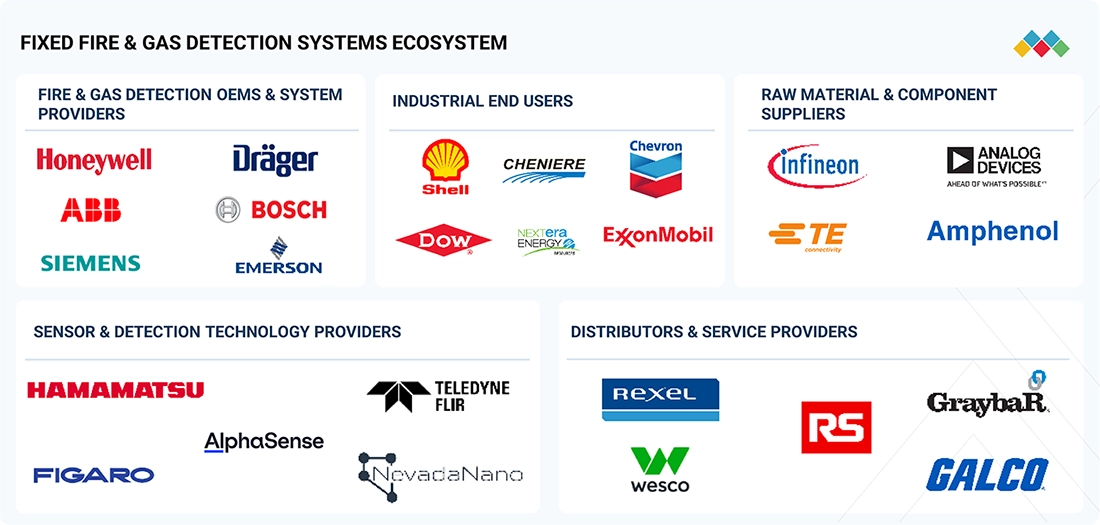
FIXED FIRE AND GAS DETECTION SYSTEMS MARKET: COMMERCIAL USE CASES ACROSS INDUSTRIES
| COMPANY | USE CASE DESCRIPTION | BENEFITS |
|---|---|---|
 |
LANXESS upgraded its Baytown chemical facility with Honeywell's integrated HS-81 Fire & Gas Controller, consolidating multiple legacy fire and gas systems into a single SIL-certified platform for centralized monitoring and control. | Improved fire and gas detection reliability, eliminated nuisance alarms, reduced maintenance requirements, optimized control room operations, and enhanced overall plant safety. |
 |
A major LNG terminal deployed MSA Safety's Senscient ELDS CH4 Laser Open Path Gas Detectors to replace conventional infrared detectors and strengthen methane leak detection across critical process areas. | Eliminated false alarms, improved methane detection accuracy under challenging environmental conditions, minimized operational disruptions, and enhanced personnel and asset protection. |
 |
Scottish Water implemented Crowcon's XgardIQ fixed gas detectors and Gasmaster control panels to upgrade chlorine gas monitoring systems across its water treatment facilities and meet updated safety regulations. | Strengthened worker safety, ensured regulatory compliance, reduced maintenance requirements, enabled continuous chlorine leak monitoring, and improved emergency response capabilities. |
 |
AAR MRO Services installed Det-Tronics X3301 Multispectrum IR Flame Detectors and Eagle Quantum Premier® controllers to provide advanced fire protection for large aircraft maintenance hangars. | Reduced false alarms, optimized detector coverage, simplified maintenance, enabled rapid fire detection, and improved protection of personnel, aircraft, and critical infrastructure. |
Logos and trademarks shown above are the property of their respective owners. Their use here is for informational and illustrative purposes only.
Related Ecosystem
Digitalization And Iot
- Sensors
- Remote Monitoring
- Supply Chain Management
- Passenger Information System (PIS)
- Platform as A Service (PaaS)
- International Business Machines Corporation
- Cisco Systems, Inc.
- MICROSOFT CORPORATION
- Oracle Corporation
- Siemens ag
Key Takeaways
- Asia Pacific's fixed fire & gas detection systems market will grow from USD 680.2M (2026) to USD 978.5M (2031) at a 7.5% CAGR.
- Asia Pacific's growth rate exceeds the global average, driven by industrialization and stricter safety regulations across the region.
- Smart building integration and IoT-enabled detection systems are accelerating adoption in Asia Pacific's commercial and industrial sectors.
- Asia Pacific's emerging economies present significant opportunities for both multinational and regional fire safety solution providers.
Fixed Fire & Gas Detection Systems Market Report Scope
| Report Metric | Details |
|---|---|
| Base Year | 2026 |
| Fastest Growing Segment | ACOUSTIC DETECTION (Technology Type) |
| Forecast Period | 2026-2031 |
| Growth Rate | CAGR of 6.7% from 2026 to 2031 |
| Largest Segment | FIRE & FLAME DETECTION (Hazard Type) |
| Market Size Base Year (Billions) | ~USD 7.85 (2026) |
| Revenue Forecast (Billions) | ~USD 10.86 (2031) |
| Segments Covered | Product, Type, Technology Type, Hazard Type, End User, Fire Detection System, Fixed Gas Detection System, Fire & Gas Control System, Fire Alarm & Notification System |
Asia Pacific Fixed Fire & Gas Detection Systems Market Report Segmentation
9 segment dimensions are covered across the global market.
By Product
- Fire & Gas Control Systems
- Fire Alarm & Notification Systems
- Fire Detection Systems
- Fixed Gas Detection Systems
By Type
- Beacons/Strobes
- Combustible Gas Detection Systems
- Fire & Gas Controllers
- Fire Alarm Panels
- Flame Detection Systems
- Heat Detection Systems
- Human Machine Interfaces (Hmis)
- Notification Devices
- Open-Path Gas Detection Systems
- Oxygen Detection Systems
- Safety Logic Solvers
- Smoke Detection Systems
- Sounders
- Toxic Gas Detection Systems
- Ultrasonic Gas Leak Detection Systems
- Video Fire Detection Systems
By Technology Type
- Acoustic Detection
- Catalytic Bead Detection
- Electrochemical Detection
- Other Technologies
- Photoionization Detection (Pid)
- Tunable Diode Laser Absorption Spectroscopy (Tdlas)
By Hazard Type
- Fire & Flame Detection
- Flammable & Explosive Gas Detection
- Toxic Gas Detection
By End User
- Chemicals & Petrochemicals
- Data Centers
- Food & Beverage
- Food & Beverages
- Manufacturing
- Marine & Offshore
- Mining & Metals
- Oil & Gas
- Pharmaceuticals & Life Sciences
- Power Generation & Energy Infrastructure
- Transportation
- Water & Wastewater Treatment
By Fire Detection System
- Flame Detection Systems
- Heat Detection Systems
- Smoke Detection Systems
- Video Fire Detection Systems
By Fixed Gas Detection System
- Combustible Gas Detection Systems
- Open-Path Gas Detection Systems
- Oxygen Detection Systems
- Toxic Gas Detection Systems
- Ultrasonic Gas Leak Detection Systems
By Fire & Gas Control System
- Fire & Gas Controllers
- Human Machine Interfaces (Hmis)
- Safety Logic Solvers
By Fire Alarm & Notification System
- Beacons/Strobes
- Fire Alarm Panels
- Notification Devices
- Sounders
Target Audience
- Fire & Gas Detection System Manufacturers : Manufacturers need Asia Pacific market intelligence to identify growth opportunities, understand regional regulatory requirements, and develop localized product strategies for the expanding 7.5% CAGR market.
- System Integrators & Solution Providers : Integrators require detailed market data to assess demand across Asia Pacific's manufacturing, oil & gas, and commercial sectors, and to position smart building and IoT-enabled solutions effectively.
- Industrial & Commercial Facility Operators : Facility managers and safety officers need market insights to evaluate detection system options, understand compliance requirements, and benchmark solutions against industry standards in their regions.
- Investment & Private Equity Firms : Investors targeting Asia Pacific's safety technology sector require comprehensive market sizing, growth forecasts, and competitive analysis to evaluate acquisition targets and portfolio companies.
- Regulatory & Compliance Consultants : Consultants advising organizations on safety compliance need Asia Pacific-specific regulatory intelligence and market data to guide clients through detection system implementation and upgrades.
Countries within Asia Pacific - compare and drill down
| Country | 2025 size (native) |
|---|---|
| China | USD 1210.3 Million |
| Japan | USD 531.8 Million |
| India | USD 698.9 Million |
| UAE | USD 312.4 Million |
Country market size visualization
Reasons to Buy this Report
- Regional Market Sizing & Forecasts : Access precise market valuations for Asia Pacific (USD 680.2M in 2026, USD 978.5M in 2031) with country-level breakdowns for China, Japan, India, and UAE to inform regional expansion strategies.
- Competitive Landscape Intelligence : Understand market dynamics specific to Asia Pacific, including key players, technology trends, and competitive positioning across manufacturing, oil & gas, and commercial sectors driving the 7.5% CAGR.
- Regulatory & Compliance Insights : Gain detailed understanding of stringent safety regulations and compliance requirements across Asia Pacific countries that are mandating adoption of advanced fire and gas detection systems.
- Growth Opportunity Identification : Identify high-growth segments and emerging opportunities in Asia Pacific's rapidly industrializing markets, including smart building integration and IoT-enabled detection solutions.
- Strategic Decision Support : Leverage Asia Pacific-specific market data to support investment decisions, partnership strategies, and go-to-market planning for fire & gas detection system providers and integrators.
Frequently asked questions
What is the current market size of fixed fire & gas detection systems in Asia Pacific?
Asia Pacific's fixed fire & gas detection systems market is valued at USD 680.2 million in 2026 and is projected to grow to USD 978.5 million by 2031.
What is the expected growth rate for Asia Pacific's fire detection market?
Asia Pacific's market is expected to grow at a compound annual growth rate (CAGR) of 7.5% from 2026 to 2031, outpacing global averages.
Which industries are driving demand in Asia Pacific's fire detection market?
Key industries in Asia Pacific include manufacturing, oil & gas, commercial real estate, and hospitality sectors, all requiring advanced fire safety compliance.
What technological trends are shaping Asia Pacific's fire detection systems market?
Asia Pacific is seeing increased adoption of IoT-enabled systems, smart building integration, cloud-based monitoring, and AI-powered analytics for fire detection.
Why is Asia Pacific's fire detection market growing faster than the global average?
Asia Pacific's rapid industrialization, urbanization, stricter regulatory frameworks, and rising safety awareness are driving faster adoption compared to global trends.
RESEARCH METHODOLOGY
This research study on the fixed fire & gas detection systems market involved extensive secondary research using company annual reports, investor presentations, industry journals, regulatory publications, technical papers, safety standards, government publications, and paid databases. Primary research was conducted with industry experts and key stakeholders across the value chain, including manufacturers, system integrators, distributors, technology providers, and end users. In-depth interviews with executives and subject matter experts were carried out to validate market estimates, understand industry trends, and assess future market opportunities.
Secondary Research
The secondary research process involved collecting information from a wide range of publicly available and proprietary sources. These included annual reports, financial statements, press releases, investor presentations, white papers, technical publications, regulatory documents, industry associations, government websites, and company websites. Information from recognized organizations such as NFPA, OSHA, IEC, ISO, API, and other industry bodies was also referred to for understanding safety standards, regulations, technology trends, and industry developments. Secondary research helped identify key market participants, product portfolios, technology adoption trends, regional developments, competitive strategies, and industry outlook.
Primary Research
The primary research process included interviews with participants from both the supply and demand sides of the market to obtain qualitative and quantitative insights. On the supply side, respondents included executives from manufacturers of fixed fire detection systems, fixed gas detection systems, fire & gas controllers, and fire alarm & notification systems, along with system integrators, distributors, and technology providers. On the demand side, interviews were conducted with representatives from oil & gas, chemicals & petrochemicals, power generation, manufacturing, mining, marine & offshore, water & wastewater, pharmaceuticals, transportation, food & beverage, and data center industries. Discussions with industry consultants and regulatory experts were also conducted to validate market trends, technology adoption, and future growth opportunities.
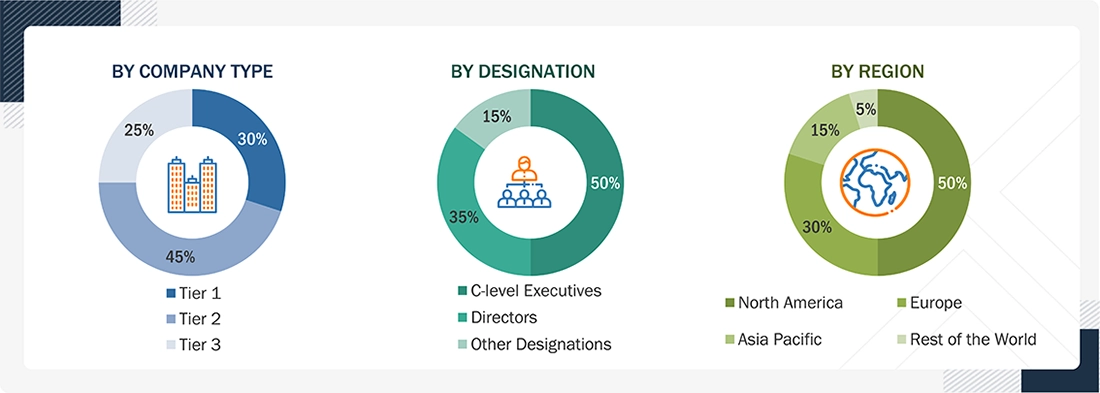
Note: Tier 1 companies’ revenues are more than USD 10 billion; tier 2 companies’ revenues range between USD 1 and 10 billion; and tier 3 companies’ revenues range between USD 500 million and USD 1 billion. Other designations include sales managers, marketing managers, and product managers.
To know about the assumptions considered for the study, download the pdf brochure
Market Size Estimation
Multiple approaches were adopted to estimate and forecast the data center solutions market. The first approach involved estimating the market size by companies’ revenue generated through the sale of data center solutions.
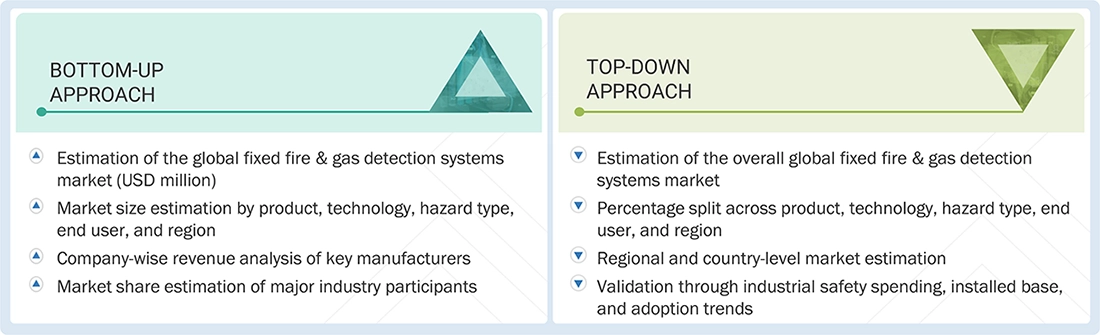
Market Size Estimation Methodology: Top-down Approach
The top-down approach began with identifying leading companies operating in the global fixed fire & gas detection systems market and evaluating their revenues generated from relevant product offerings through annual reports, financial disclosures, investor presentations, paid databases, and primary interviews. Vendor revenues attributable to fixed fire detection systems, fixed gas detection systems, fire & gas control systems, and fire alarm & notification systems were analyzed across different regions and end-use industries. Market estimates were validated through discussions with industry experts and further triangulated using MarketsandMarkets' proprietary research framework to ensure consistency and accuracy.
Market Size Estimation Methodology: Bottom-up Approach
In the bottom-up approach, the adoption of fixed fire & gas detection systems across major end-use industries and geographic regions was analyzed to estimate the overall market size. The installed base, replacement demand, new industrial projects, regulatory requirements, and technology adoption trends were assessed for each application. Revenue generated by individual companies from relevant product categories was aggregated at the regional and global levels. Market estimates were validated through primary interviews and cross-verified with secondary research findings to ensure reliable market sizing and forecasting.
Based on the market numbers, the regional split was determined by primary and secondary sources. The procedure included an analysis of the data center solutions market’s regional penetration. Based on secondary research, the regional spending on Information and Communications Technology (ICT), socioeconomic analysis of each country, strategic vendor analysis of major data center solution providers, and organic and inorganic business development activities of regional and global players were estimated.
Data Triangulation
After estimating the overall market size using both top-down and bottom-up approaches, the findings were validated through data triangulation. Information obtained from secondary research, primary interviews, and company-level revenue analysis was compared and reconciled to derive the final market estimates. The validated market size was then segmented by product, technology, hazard type, end user, and region using percentage splits derived from both primary and secondary research, ensuring consistency across all market segments and subsegments.
Market Definition
A fixed fire & gas detection system is a permanently installed safety system designed to continuously monitor industrial facilities for the presence of fire, combustible gases, toxic gases, and oxygen deficiency. It uses a network of detectors, sensors, controllers, and alarm devices to provide early detection, trigger alerts, and initiate protective actions. These systems help safeguard personnel, assets, and operations while ensuring compliance with industrial safety standards and regulations.
Key Stakeholders
- Fixed fire & gas detection system manufacturers
- Sensor and detector component manufacturers
- Fire alarm and notification device manufacturers
- Safety controller, PLC, and HMI providers
- System integrators (SIs) and engineering, procurement & construction (EPC) contractors
- Industrial automation and process safety solution providers
- Distributors, value-added resellers (VARs), and channel partners
- Oil & gas, chemicals & petrochemicals, and power generation companies
- Mining & metals, marine & offshore, manufacturing, and water & wastewater operators
- Pharmaceutical, food & beverage, transportation, and data center operators
- Regulatory bodies, certification agencies, and standards organizations (e.g., IEC, NFPA, ATEX, UL, FM, OSHA, SIL certification bodies)
- Industrial safety consultants, testing, inspection, and certification (TIC) organizations
Report Objectives
- To define, describe, and forecast the fixed fire & gas detection systems market by product (fire detection systems, fixed gas detection systems, fire & gas control systems, and fire alarm & notification systems), technology (electrochemical detection, catalytic bead detection, infrared detection (NDIR), tunable diode laser absorption spectroscopy (TDLAS), photoionization detection (PID), acoustic detection, and others), hazard type (flammable & explosive gas detection, toxic gas detection, oxygen monitoring, and fire & flame detection), end user (oil & gas, chemicals & petrochemicals, power generation & energy infrastructure, mining & metals, marine & offshore, manufacturing, water & wastewater treatment, pharmaceuticals & life sciences, transportation, food & beverage, data centers, and others), and region
- To forecast the market size across North America, Europe, Asia Pacific, Middle East & Africa, and Latin America
- To analyze market segments and subsegments with respect to growth trends, market share, and future opportunities
- To identify and analyze the major market drivers, restraints, opportunities, and challenges influencing market growth
- To analyze technology trends, regulatory developments, and product innovations shaping the market
- To evaluate competitive developments, including product launches, partnerships, collaborations, mergers & acquisitions, and investments
- To profile key market participants and analyze their product portfolios, business strategies, competitive positioning, and recent developments
Available customizations:
With the given market data, MarketsandMarkets offers customizations as per the company’s specific needs. The following customization options are available for the report:
Product Analysis
- The product matrix provides a detailed comparison of the product portfolio of each company.
Geographic Analysis based on feasibility
- Further breakdown of the North American fixed fire & gas detection systems market
- Further breakdown of the European fixed fire & gas detection systems market
- Further breakdown of the Asia Pacific fixed fire & gas detection systems market
- Further breakdown of the Middle East & Africa fixed fire & gas detection systems market
- Further breakdown of the Latin American fixed fire & gas detection systems market
Company Information
- Detailed profiling and competitive analysis of up to five additional market participants.
- Expanded analysis of product portfolios, recent developments, strategic initiatives, and competitive positioning of selected companies.
Get the Full Fixed Fire & Gas Detection Systems Market Report
Full forecast, segment splits, and company analysis for all Fixed Fire & Gas Detection Systems Market.
- South Africa Fixed Fire & Gas Detection Systems Market
- Brazil Fixed Fire & Gas Detection Systems Market
- Mexico Fixed Fire & Gas Detection Systems Market
- Rest Of Europe Fixed Fire & Gas Detection Systems Market
- Rest Of Asia Pacific Fixed Fire & Gas Detection Systems Market
- Rest Of Latin America Fixed Fire & Gas Detection Systems Market
- GCC Fixed Fire & Gas Detection Systems Market
- Kingdom Of Saudi Arabia Fixed Fire & Gas Detection Systems Market
- Rest Of GCC Fixed Fire & Gas Detection Systems Market
- Canada Fixed Fire & Gas Detection Systems Market
- US Fixed Fire & Gas Detection Systems Market
- UK Fixed Fire & Gas Detection Systems Market
- Germany Fixed Fire & Gas Detection Systems Market
- France Fixed Fire & Gas Detection Systems Market
- Italy Fixed Fire & Gas Detection Systems Market
- China Fixed Fire & Gas Detection Systems Market
- Japan Fixed Fire & Gas Detection Systems Market
- India Fixed Fire & Gas Detection Systems Market
- UAE Fixed Fire & Gas Detection Systems Market
Need a Tailored Report?
Customize this report to your needs
Get 10% FREE Customization
Customize This Report
