
South Korea Fixed-Wing VTOL UAV Market (2025-2030)

The South Korea Fixed-Wing VTOL UAV Market was valued at $11.5 Million in 2025 and projected to reach to $18.8 Million by 2030, representing a compound annual growth rate of 10.4%. South Korea's fixed-wing VTOL UAV market is poised for sustained growth through 2030, driven by escalating defense spending and technological advancement.


| Market Size in | USD 26.32 MN |
| Market Forecast in | |
| CAGR | |
| Forecast Period | |
| Units Considered | Value (USD MN) |
South Korea Fixed-Wing VTOL UAV Market Trends and Insights
- South Korea's strategic focus on advanced aerospace technologies and defense modernization is driving adoption of fixed-wing VTOL systems across military and commercial applications.
- The market in South Korea benefits from strong government investment in autonomous systems and the country's established aerospace manufacturing ecosystem. South Korea's 10.4% compound annual growth rate reflects increasing demand for hybrid UAV solutions that combine vertical takeoff capabilities with fixed-wing efficiency.
- South Korea's defense sector is prioritizing next-generation surveillance and reconnaissance platforms, while commercial sectors in South Korea are exploring logistics and infrastructure inspection applications.
- The competitive landscape in South Korea includes both domestic innovators and international partnerships, positioning the country as a key regional hub for fixed-wing VTOL technology development and deployment..
Key Market Statistics
- CAGR (2025-2030) 10.4% CAGR
- Market Size, 2025 ~USD 11.5 Million
- Forecast, 2030 ~USD 18.8 Million
- Country South Korea
South Korea Fixed-Wing VTOL UAV Market Overview
Defense Modernization Driver :
South Korea's military modernization initiatives and border security concerns are accelerating fixed-wing VTOL UAV adoption for surveillance, reconnaissance, and tactical operations across the peninsula.
Government Investment Support :
Strong government backing through defense budgets and aerospace development programs is fueling R&D investments and procurement of advanced fixed-wing VTOL systems by South Korean defense agencies.
Commercial Sector Expansion :
Beyond military applications, South Korea's commercial sector is increasingly deploying fixed-wing VTOL UAVs for infrastructure inspection, disaster management, and logistics in urban and remote areas.
Technology Leadership Positioning :
South Korea's advanced aerospace and electronics industries are positioning the nation as a regional hub for fixed-wing VTOL UAV development, manufacturing, and export capabilities.
South Korea Fixed-Wing VTOL UAV Market Dynamics
- The market's 10.4% CAGR reflects strong demand from military modernization programs and emerging commercial applications.
- Government initiatives supporting autonomous systems development and defense procurement will continue to bolster market expansion.
- South Korea's competitive advantage in electronics and aerospace manufacturing positions domestic companies to capture significant market share while also attracting international partnerships and investments in the fixed-wing VTOL sector..
Market Ecosystem
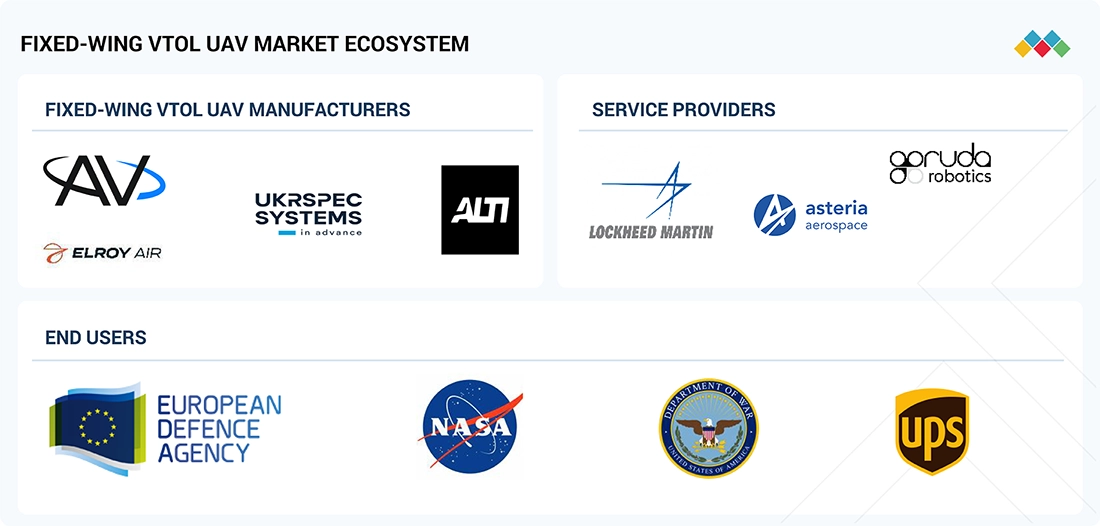
fixed-wing-vtol-uav-market: COMMERCIAL USE CASES ACROSS INDUSTRIES
| COMPANY | USE CASE DESCRIPTION | BENEFITS |
|---|---|---|
 |
Develops fixed-wing VTOL UAVs such as the Jump 20 to enhance tactical endurance and ISR mission capability through runway-independent operation and modular payload integration. | Improves operational flexibility and autonomy for defense users, enabling extended surveillance and reconnaissance missions in remote or contested environments |
 |
Designs hybrid fixed-wing VTOL UAVs like the CW-007 for commercial-grade aerial mapping, inspection, and monitoring with long-duration flight stability and automated navigation | Enhances data precision and mission efficiency across industrial operations while reducing operator workload through autonomous flight management |
 |
Produces modular fixed-wing VTOL UAVs such as the PD-2 UAS optimized for tactical reconnaissance, border surveillance, and crisis response applications | Delivers high mission reliability and multi-sensor adaptability, ensuring persistent situational awareness and reduced ground infrastructure needs |
 |
Develops the Aerosonde HQ, a fixed-wing VTOL UAV designed for long-endurance intelligence, surveillance, and reconnaissance missions with hybrid take-off capability and autonomous flight control | Enhances mission persistence and operational versatility, allowing continuous ISR operations from confined or unprepared sites with reduced logistical footprint and improved mission readiness |
Logos and trademarks shown above are the property of their respective owners. Their use here is for informational and illustrative purposes only.
Related Ecosystem
Unmanned Systems
- Rotary Wing Aircraft
- Fixed-Wing Drones
- Sensors
- Fuel Cell
- Fixed Wing Aircraft
- LOCKHEED MARTIN CORPORATION
- Northrop Grumman Corporation
- ISRAEL AEROSPACE INDUSTRIES LTD
- Elbit Systems Ltd.
- Thales group
Key Takeaways
- South Korea's fixed-wing VTOL UAV market will grow from USD 11.5M (2025) to USD 18.8M (2030) at a 10.4% CAGR.
- South Korea's defense modernization initiatives are the primary driver of fixed-wing VTOL UAV adoption and investment.
- South Korea's established aerospace manufacturing base provides competitive advantages in domestic production and technology integration.
- South Korea's commercial sector expansion in logistics and infrastructure inspection represents emerging growth opportunities beyond defense applications.
Fixed-Wing VTOL UAV Market Report Scope
| Report Metric | Details |
|---|---|
| Base Year | 2025 |
| Fastest Growing Segment | DELIVERY (Military Application) |
| Forecast Period | 2025–2030 |
| Growth Rate | CAGR of 11.7% from 2025 to 2030 |
| Largest Segment | OEM (Point Of Sale) |
| Market Size Base Year (Billions) | ~USD 0.69 (2025) |
| Revenue Forecast (Billions) | ~USD 1.2 (2030) |
| Segments Covered | Application, Military Application, Commercial Application, Government & Law Enforcement Application, Government & Law Enforcement, Endurance, Mtow, Mode Of Operation, Propulsion, Range, Point Of Sale |
South Korea Fixed-Wing VTOL UAV Market Report Segmentation
11 segment dimensions are covered across the global market.
By Application
- Commercial
- Government & Law Enforcement
- Military
By Military Application
- Combat Operations
- Delivery
- Intelligence, Surveillance, And Reconnaissance (Isr)
By Commercial Application
- Aerial Imaging
- Agriculture
- Inspection & Monitoring
- Product Delivery
- Remote Sensing
- Surveying & Mapping
By Government & Law Enforcement Application
- Border Management
- Firefighting & Disaster Management
- Maritime Security
- Police Operations & Investigation
- Search & Rescue
- Traffic Monitoring
By Government & Law Enforcement
- Border Management
- Firefighting & Disaster Management
- Maritime Security
- Police Operations & Investigation
- Search & Rescue
- Traffic Monitoring
By Endurance
- 5 - 10 Hours
- < 5 Hours
- > 10 Hours
By Mtow
- 25 - 170 Kilograms
- 25-170 Kilograms
- <25 Kilograms
- >170 Kilograms
By Mode Of Operation
- Fully Autonomous
- Optionally Piloted
- Remotely Piloted
By Propulsion
- Electric
- Gasoline
- Hybrid
By Range
- Beyond Visual Line Of Sight
- Extended Visual Line Of Sight
- Visual Line Of Sight
By Point Of Sale
- Aftermarket
- OEM
Target Audience
- South Korean Defense Contractors : Defense manufacturers and system integrators need detailed market insights to align product development, secure government contracts, and capitalize on military modernization spending in fixed-wing VTOL systems.
- International Aerospace Companies : Global aerospace firms seeking to enter or expand in South Korea require market-specific data on demand drivers, regulatory environment, and partnership opportunities in the growing VTOL UAV sector.
- Government & Military Agencies : South Korean defense ministries and military branches need market analysis to inform procurement strategies, technology roadmaps, and budget allocation for fixed-wing VTOL UAV capabilities.
- Commercial UAV Operators : South Korean companies in infrastructure, logistics, and emergency services need market insights to evaluate fixed-wing VTOL UAV investments and identify operational applications for competitive advantage.
- Investment & Venture Capital Firms : Investors targeting South Korea's aerospace and defense technology sector require detailed market forecasts and growth drivers to identify promising startups and portfolio companies in the fixed-wing VTOL UAV space.
Key Companies in the South Korea Fixed-Wing VTOL UAV Market
| Company | HQ | Ownership | Strongest segments |
|---|---|---|---|
| ALTI | United States | Public Company | Discretionary investment management,Non-discretionary investment advisory,Trust, estate, and fiduciary services, |
| AEROVIRONMENT, INC. | United States | Public Company | Small & Medium UAS (airborne ISR),Loitering Munitions & Precision Strike,Counter-UAS & Electronic Warfare, |
| LOCKHEED MARTIN CORPORATION | United States | Public Company | Aeronautics (combat and mobility aircraft, UAVs),Missiles and Fire Control,Rotary and Mission Systems, |
| IDEAFORGE TECHNOLOGY INC. | India | Public Company | Tactical and VTOL fixed-wing UAV platforms (NETRA, SWITCH, NETRA 5, SWITCH V2),Quadcopter and small UAVs (NETRA V4PRO, Q4i, Q6, ZOLT),Long-range logistics UAVs (YETI and delivery payloads), |
| JOUAV | China | Public Company | Industrial UAV platforms (airframes + controllers),Payloads and sensors,Software platforms (FlightSurv, Eagle Map, Jocloud), |
ALTI
ALTI is a United States-based public company founded in 1980 with 490 employees, operating in the aerospace and technology sectors.
AEROVIRONMENT, INC.
AeroVironment, Inc. is a United States-based public company founded in 1971 with 4,041 employees, specializing in unmanned aircraft systems and energy infrastructure solutions.
LOCKHEED MARTIN CORPORATION
Lockheed Martin Corporation is a United States-based public company founded in 1912 with 123,000 employees, serving as a global aerospace, defense, and security company.
IDEAFORGE TECHNOLOGY INC.
Ideaforge Technology Inc. is an India-based public company founded in 2007 with 513 employees, specializing in unmanned aerial vehicle design and manufacturing.
JOUAV
JOUAV is a China-based public company founded in 2010 with 851 employees, specializing in unmanned aerial vehicle manufacturing and solutions.
Reasons to Buy this Report
- Market Size & Growth Validation : Obtain precise market valuation data for South Korea (USD 11.5M in 2025, USD 18.8M in 2030) with verified CAGR of 10.4% to support investment decisions and business planning in this high-growth market.
- Defense Procurement Intelligence : Access detailed insights into South Korean military modernization programs, defense budgets, and procurement strategies driving fixed-wing VTOL UAV adoption for enhanced competitive positioning.
- Commercial Opportunity Assessment : Identify emerging commercial applications and use cases in South Korea's infrastructure, logistics, and disaster management sectors to diversify revenue streams beyond military contracts.
- Competitive Landscape Analysis : Understand South Korea's domestic manufacturers, technology leaders, and international competitors operating in the fixed-wing VTOL UAV space to inform market entry and partnership strategies.
- Regional Market Positioning : Leverage South Korea-specific data to benchmark performance against global trends (11.7% CAGR) and identify regional advantages for market expansion and technology export opportunities.
Frequently asked questions
What is the current market size of fixed-wing VTOL UAVs in South Korea?
South Korea's fixed-wing VTOL UAV market is valued at USD 11.5 million in 2025, with verified data confirming this baseline for regional analysis.
What is the projected market size for South Korea by 2030?
South Korea's fixed-wing VTOL UAV market is forecast to reach USD 18.8 million by 2030, representing significant expansion over the five-year period.
What is the growth rate for South Korea's fixed-wing VTOL UAV market?
South Korea's fixed-wing VTOL UAV market is expected to grow at a compound annual growth rate of 10.4% from 2025 to 2030.
Which sectors are driving demand for fixed-wing VTOL UAVs in South Korea?
South Korea's defense sector leads demand through modernization programs, while commercial applications in logistics, infrastructure inspection, and surveillance are emerging growth segments.
What competitive advantages does South Korea have in the fixed-wing VTOL UAV market?
South Korea benefits from advanced aerospace manufacturing capabilities, strong government R&D investment, skilled technical workforce, and established defense industry partnerships that support fixed-wing VTOL development.
RESEARCH METHODOLOGY
The study involved four key stages to estimate the current size of the global fixed-wing VTOL UAV market. Comprehensive secondary research was first undertaken to gather information on the fixed-wing VTOL UAV industry, its adjacent unmanned systems markets, and its broader aerospace context. This stage included collecting data on market dynamics, product portfolios, operational trends, and technological advancements. The findings, assumptions, and preliminary sizing were then validated through primary research involving interviews with key stakeholders across the value chain, including OEMs, subsystem manufacturers, technology developers, and end users. Both top-down and bottom-up analytical approaches were applied to ensure consistency, followed by data triangulation to finalize market estimates and segment-level sizing.
Secondary Research
During the secondary research phase, data were collected from a wide range of credible public and proprietary sources to establish the foundation of the market assessment. Sources included government databases and defense procurement reports; corporate filings, annual reports, and press releases from UAV manufacturers; investor presentations; and certified market studies. Additional insights were drawn from aerospace and defense journals, research publications, and articles authored by recognized experts, along with directories and industry databases focusing on unmanned aerial systems and autonomous flight technologies.
Primary Research
Extensive primary research was conducted to validate data collected through secondary sources and to refine market segmentation. Interviews were carried out with industry experts representing both demand and supply sides across key regions, including North America, Europe, the Asia Pacific, the Middle East, Africa, and Latin America. Participants included UAV manufacturers, propulsion system suppliers, defense procurement officials, and regulatory authorities. Primary information was gathered through structured questionnaires, emails, and telephonic discussions to obtain first-hand perspectives on technological developments, regional demand patterns, and market growth trajectories.

To know about the assumptions considered for the study, download the pdf brochure
Market Size Estimation
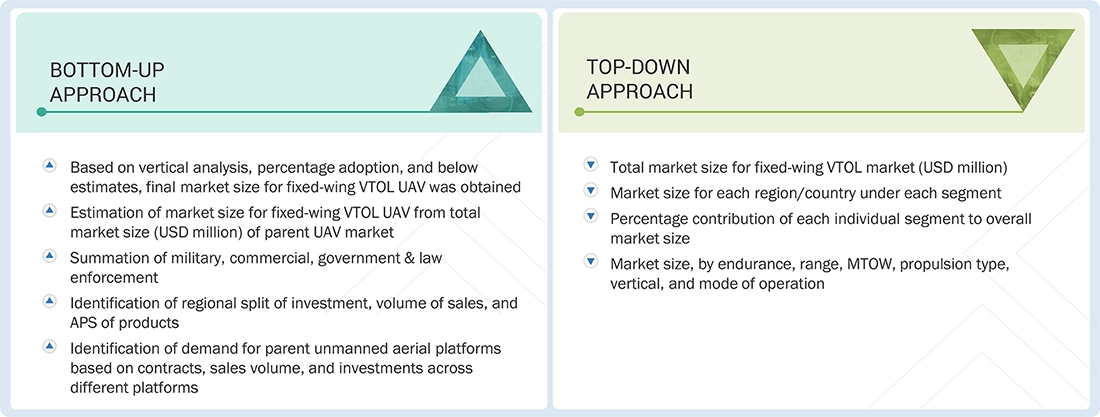
The top-down and bottom-up approaches were employed to estimate and validate the size of the global fixed-wing VTOL UAV market. The research methodology used to determine market size included the
following steps and considerations:
- Key players in the fixed-wing VTOL UAV market were identified through secondary research, and their market shares were determined through a combination of primary and secondary research. This included a study of the annual and financial reports of the top market players, as well as extensive interviews with leaders, including directors, engineers, marketing executives, and other key stakeholders of leading companies operating in the market.
- All percentage shares, splits, and breakdowns were determined using secondary sources and verified through primary sources.
- All possible parameters that affect the markets covered in this research study were accounted for, viewed in extensive detail, verified through primary research, and analyzed to obtain the final quantitative and qualitative data on the fixed-wing VTOL UAV market. This data was consolidated, enhanced with detailed inputs, analyzed by MarketsandMarkets, and presented in this report.
Fixed-Wing VTOL UAV Market : Top-Down and Bottom-Up Approach
Data Triangulation
After determining the overall market size, the total market was divided into several segments and subsegments. The data triangulation and market breakdown procedures explained below were implemented, wherever applicable, to complete the overall market engineering process and arrive at the estimated market numbers for the market segments and subsegments. The data was triangulated by studying various factors and trends from the demand and supply sides. Additionally, the market size was validated using top-down and bottom-up approaches.
Market Definition
The fixed-wing VTOL UAV market encompasses unmanned aerial systems that integrate the aerodynamic efficiency of fixed-wing aircraft with the vertical take-off and landing capability of rotary-wing platforms. These UAVs are designed to operate without the need for runways, enabling both vertical lift and sustained forward flight. This hybrid configuration allows for extended endurance, higher cruising speeds, and greater payload capacity compared to conventional multirotor UAVs. Fixed-wing VTOL UAVs are employed across military, commercial, and governmental applications, including ISR, mapping, logistics, and disaster management.
Fixed-wing VTOL UAVs are equipped with advanced propulsion systems, autonomous navigation, and modular payload interfaces. They offer enhanced operational flexibility and cost efficiency. The growing demand for long-endurance unmanned platforms, combined with advancements in hybrid propulsion and AI-based control systems, is driving the expansion of the global fixed-wing VTOL UAV market.
Key Stakeholders
- Raw Material Suppliers
- Heat Exchanger Manufacturers
- Aircraft System Manufacturers
- System Integrators
- Technology Support Providers
- Distributors and Component Suppliers
- Maintenance, Repair, and Overhaul (MRO) Companies
- Government and Regulatory Agencies
- Research and Development Organizations
Report Objectives
- To define, describe, and forecast the fixed-wing VTOL UAV market based on application, range, MTOW, mode of operation, endurance, propulsion, point of sale, and region
- To forecast the size of different segments of the market with respect to North America, Europe, Asia Pacific, the Middle East, and the Rest of the World
- To identify and analyze the drivers, restraints, opportunities, and challenges influencing the growth of the market
- To identify industry trends, market trends, and technology trends currently prevailing in the market
- To analyze micro markets with respect to individual growth trends, prospects, and their contribution to the overall market
- To analyze the degree of competition in the market by analyzing recent developments adopted by leading market players
- To provide a detailed competitive landscape of the market, along with a ranking analysis of key players, and an analysis of startup companies in the market
- To strategically profile the key market players and comprehensively analyze their core competencies
- To provide a detailed competitive landscape of the market, along with a market share analysis and revenue analysis of key players
Available Customizations
MarketsandMarkets offers the following customizations for this market report:
- Additional country-level analysis of the fixed-wing VTOL UAV market
- Profiling of other market players (up to 5)
Product Analysis
- Product matrix, which provides a detailed comparison of the product portfolio of each company in the fixed-wing VTOL UAV market
Get the Full Fixed-Wing VTOL UAV Market Report
Full forecast, segment splits, and company analysis for all Fixed-Wing VTOL UAV Market.
- Canada Fixed-Wing VTOL UAV Market
- US Fixed-Wing VTOL UAV Market
- UK Fixed-Wing VTOL UAV Market
- France Fixed-Wing VTOL UAV Market
- Germany Fixed-Wing VTOL UAV Market
- Italy Fixed-Wing VTOL UAV Market
- Russia Fixed-Wing VTOL UAV Market
- Sweden Fixed-Wing VTOL UAV Market
- China Fixed-Wing VTOL UAV Market
- India Fixed-Wing VTOL UAV Market
- Japan Fixed-Wing VTOL UAV Market
- Australia Fixed-Wing VTOL UAV Market
- Israel Fixed-Wing VTOL UAV Market
- Saudi Arabia Fixed-Wing VTOL UAV Market
- Turkey Fixed-Wing VTOL UAV Market
- UAE Fixed-Wing VTOL UAV Market
- Rest Of Europe Fixed-Wing VTOL UAV Market
- Rest Of Asia Pacific Fixed-Wing VTOL UAV Market
- Rest Of Middle East Fixed-Wing VTOL UAV Market
Need a Tailored Report?
Customize this report to your needs
Get 10% FREE Customization
Customize This Report
