
Asia Pacific Flexible Packaging Market (2025-2030)

The Asia Pacific Flexible Packaging Market was valued at $158267.4 Million in 2025 and projected to reach to $199836.3 Million by 2030, representing a compound annual growth rate of 4.8%. Asia Pacific's flexible packaging market is positioned for robust growth through 2030, driven by rapid industrialization, urbanization, and rising disposable incomes across emerging economies.


| Market Size in | USD 26.32 MN |
| Market Forecast in | |
| CAGR | |
| Forecast Period | |
| Units Considered | Value (USD MN) |
Asia Pacific Flexible Packaging Market Trends and Insights
- The region's flexible packaging market is estimated at USD 158,267.4 million in 2025 and is projected to expand to USD 199,836.3 million by 2030, growing at a compound annual growth rate (CAGR) of 4.8%.
- This robust expansion in Asia Pacific reflects rising consumer demand for convenient, lightweight, and sustainable packaging solutions across food and beverage, pharmaceuticals, and personal care sectors. Asia Pacific's flexible packaging growth is driven by rapid urbanization, increasing disposable incomes, and shifting consumer preferences toward packaged goods in emerging economies.
- The region's manufacturing capabilities and cost-competitive production make Asia Pacific a hub for flexible packaging innovation and supply.
- Between 2025 and 2030, Asia Pacific is expected to maintain its growth momentum, supported by regulatory initiatives promoting sustainable packaging and technological advancements in barrier films and laminates..
Key Market Statistics
- CAGR (2025-2030) 4.8% CAGR
- Market Size, 2025 ~USD 158267.4 Million
- Forecast, 2030 ~USD 199836.3 Million
- Geography Asia Pacific
Asia Pacific Flexible Packaging Market Overview
Market Dominance :
Asia Pacific commands a substantial share of the global flexible packaging market, with an estimated value of USD 158,267.4 million in 2025, reflecting the region's critical importance to worldwide packaging demand.
Strong Growth Trajectory :
The region is projected to grow from USD 158,267.4 million in 2025 to USD 199,836.3 million by 2030, representing a CAGR of 4.8%, outpacing the global average of 4.2%.
China & India Leadership :
China (USD 28,470.2 million) and India (USD 18,379.4 million) are the largest markets in Asia Pacific, together accounting for a significant portion of regional flexible packaging demand driven by manufacturing and consumer goods expansion.
Rising Consumer Demand :
Increasing consumer spending, e-commerce growth, and food & beverage sector expansion across Asia Pacific are driving sustained demand for flexible packaging solutions in the region.
Asia Pacific Flexible Packaging Market Dynamics
- China and India lead the region with substantial market values, supported by thriving manufacturing sectors and growing consumer goods industries.
- The region's CAGR of 4.8% reflects strong demand from food & beverage, pharmaceuticals, and e-commerce sectors.
- Sustainability initiatives and technological innovations in flexible packaging are reshaping the competitive landscape, with manufacturers increasingly adopting eco-friendly materials and advanced production techniques to meet regulatory requirements and consumer preferences..
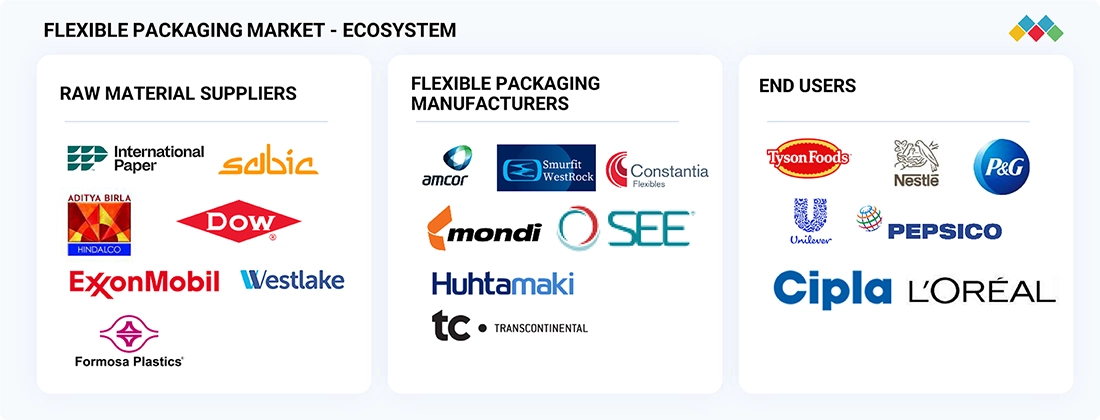
Market Ecosystem
Flexible Packaging Market: COMMERCIAL USE CASES ACROSS INDUSTRIES
| COMPANY | USE CASE DESCRIPTION | BENEFITS |
|---|---|---|
 |
AI tools to assist packaging design: rapid generation of design options, trend/material suggestions, consumer insights, balancing sustainability + aesthetics | Enables faster design iterations, improves aesthetic appeal, balances sustainability with functionality |
 |
AI-powered waste analytics via collaboration with startup Greyparrot; computer vision to detect/classify waste in recycling/resource recovery facilities; helps in upstream packaging design/sustainability decision-making | Enhances recycling efficiency, supports sustainable packaging decisions, reduces material waste and environmental impact |
 |
AI in packaging automation and right-sizing systems (eCommerce fulfillment, automated cartoning, reducing voids, optimizing corrugated or flexible pack usage) to use less material and improve throughput | Reduces material usage, lowers shipping costs, improves throughput, and optimizes packaging for eCommerce fulfillment |
Logos and trademarks shown above are the property of their respective owners. Their use here is for informational and illustrative purposes only.
Related Ecosystem
Packaging
- Ampoules
- Gravure Process
- Rigid Packaging
- Aerosols
- Aseptic Filling and Sealing Equipment
- Amcor plc
- Essentra plc
- Berry Global Group, Inc.
- Mondi plc
- SEALED AIR CORPORATION
Key Takeaways
- Asia Pacific flexible packaging market valued at USD 158,267.4 million in 2025, expanding to USD 199,836.3 million by 2030.
- Asia Pacific is growing at 4.8% CAGR, outpacing the global average of 4.2%, driven by urbanization and rising consumer demand.
- Asia Pacific's manufacturing strength and cost competitiveness position the region as a global production and innovation hub for flexible packaging.
- Sustainability trends and regulatory pressures in Asia Pacific are accelerating adoption of eco-friendly flexible packaging materials and designs.
Flexible Packaging Market Report Scope
| Report Metric | Details |
|---|---|
| Base Year | 2025 |
| Fastest Growing Segment | DIGITAL PRINTING (Printing Technology) |
| Forecast Period | 2025–2030 |
| Growth Rate | CAGR of 4.2% from 2025 to 2030 |
| Largest Segment | PLASTIC (Material) |
| Market Size Base Year (Billions) | ~USD 300.88 (2025) |
| Revenue Forecast (Billions) | ~USD 369.6 (2030) |
| Segments Covered | Material, Packaging Type, Printing Technology, Application |
Asia Pacific Flexible Packaging Market Report Segmentation
4 segment dimensions are covered across the global market.
By Material
- Metal
- Paper
- Plastic
By Packaging Type
- Bags
- Films & Wraps
- Other Packaging Types
- Pouches
- Rollstock
By Printing Technology
- Digital Printing
- Flexography
- Other Printing Technologies
- Rotogravure
By Application
- Beverages
- Food
- Other Applications
- Personal Care & Cosmetics
- Pharmaceutical & Healthcare
Target Audience
- Packaging Manufacturers : Identify expansion opportunities in Asia Pacific's high-growth markets, understand regional demand trends, and benchmark production capacity requirements against market forecasts through 2030.
- Food & Beverage Companies : Assess flexible packaging sourcing strategies across Asia Pacific, evaluate supplier landscapes in China and India, and align packaging procurement with regional market growth projections.
- Investment & Private Equity Firms : Evaluate acquisition targets and investment opportunities in Asia Pacific's flexible packaging sector, leveraging market size data and growth forecasts to support due diligence and valuation models.
- Supply Chain & Logistics Providers : Optimize distribution networks and warehouse locations based on Asia Pacific market concentration in China and India, and plan capacity for projected USD 41.6B market growth by 2030.
- Regulatory & Sustainability Consultants : Advise clients on compliance requirements and sustainable packaging adoption across Asia Pacific markets, using regional market data to prioritize high-impact geographies and emerging regulations.
Key Companies in the Asia Pacific Flexible Packaging Market
| Company | HQ | Ownership | Strongest segments |
|---|---|---|---|
| AMCOR PLC | Switzerland | Public Company | Pouches,Bags,Roll stock, |
| SMURFIT WESTROCK | Ireland | Public Company | Pouches,Bags,Roll stock, |
| MONDI | United Kingdom | Public Company | Pouches,Bags (including paper bags and industrial sacks),Roll stock, |
| TOPPAN HOLDINGS INC. | Japan | Public Company | Pouches,Bags,Roll stock, |
| SEALED AIR | United States | Private Company | Food flexible packaging (barrier bags, pouches, films, trays),Protective flexible packaging (inflatable, shrink, bagging systems),Liquid and fluids packaging (LIQUIBOX and related), |
| HUHTAMAKI | Finland | Public Company | Pouches (stand-up, spouted, valve, 4-side seal),Bags and wicketed bags,Roll stock, films & wraps, |
| CONSTANTIA FLEXIBLES | Austria | Private Company | Pouches,Bags,Roll stock, |
| TRANSCONTINENTAL INC. | Canada | Public Company | Pouches (stand-up, flat, specialty),Bags (pre-made, wicketed, industrial),Roll stock, |
| UFLEX LIMITED | India | Public Company | Films & wraps (BOPET, BOPP, CPP, metallized, special effects, Alox coated),Flexible laminates, roll stock, and flexo/gravure printed rolls,Pouches, bags, flexitubes, and pre-formed formats, |
| PRINTPACK | United States | Private Company | Pouches and Bags,Roll Stock,Films & Wraps, |
AMCOR PLC
Amcor PLC is a Switzerland-based public company founded in 1926 that employs 77,000 people. The company operates in the packaging industry.
SMURFIT WESTROCK
Smurfit Westrock is an Ireland-based public company founded in 1934 with 97,000 employees. The company operates in the packaging and paper products sector.
MONDI
Mondi is a United Kingdom-based public company founded in 2007 with 24,040 employees. The company operates in the packaging and paper industry.
TOPPAN HOLDINGS INC.
Toppan Holdings Inc. is a Japan-based public company founded in 1900 with 54,371 employees. The company operates in the printing and packaging sectors.
SEALED AIR
Sealed Air is a United States-based private company founded in 1960 with 16,100 employees. The company operates in the protective packaging industry.
HUHTAMAKI
Huhtamaki is a Finland-based public company founded in 1920 with 17,417 employees. The company operates in the food packaging and foodservice products sector.
CONSTANTIA FLEXIBLES
Constantia Flexibles is an Austria-based private company founded in 2009 with 9,835 employees. The company operates in the flexible packaging industry.
TRANSCONTINENTAL INC.
Transcontinental Inc. is a Canada-based public company founded in 1976 with 7,600 employees. The company operates in the packaging and printing sectors.
UFLEX LIMITED
Uflex Limited is an India-based public company founded in 1983 with 7,619 employees. The company operates in the flexible packaging industry.
PRINTPACK
Printpack is a United States-based private company founded in 1956. The company operates in the flexible packaging industry.
Countries within Asia Pacific - compare and drill down
| Country | 2025 size (native) |
|---|---|
| China | USD 28470.2 Million |
| India | USD 18379.4 Million |
| Japan | USD 3442.6 Million |
| South Korea | USD 1782.6 Million |
Country market size visualization
Reasons to Buy this Report
- Regional Market Sizing : Obtain precise market valuations for Asia Pacific flexible packaging at USD 158.3B (2025) and USD 199.8B (2030), enabling accurate budget allocation and investment decisions specific to the region.
- Country-Level Insights : Access detailed market data for China, India, Japan, and South Korea, identifying high-growth opportunities and competitive dynamics within Asia Pacific's largest flexible packaging markets.
- Growth Rate Benchmarking : Compare Asia Pacific's 4.8% CAGR against the global 4.2% average to understand regional outperformance and prioritize expansion strategies in faster-growing Asian markets.
- Competitive Positioning : Develop targeted go-to-market strategies by understanding Asia Pacific's unique demand drivers, regulatory landscape, and consumer preferences distinct from other global regions.
- Forecast-Driven Planning : Leverage 2030 projections to plan capacity investments, supply chain optimization, and product development initiatives aligned with Asia Pacific's anticipated USD 41.6B market expansion.
Frequently asked questions
What is the current size of the flexible packaging market in Asia Pacific?
The Asia Pacific flexible packaging market is estimated at USD 158,267.4 million in 2025 and is projected to reach USD 199,836.3 million by 2030.
What is the growth rate of flexible packaging in Asia Pacific?
Asia Pacific's flexible packaging market is growing at a CAGR of 4.8% from 2025 to 2030, which exceeds the global average CAGR of 4.2%.
What are the main drivers of flexible packaging growth in Asia Pacific?
Key drivers include rapid urbanization, increasing disposable incomes, growing demand for convenient packaged goods, and regulatory emphasis on sustainable packaging solutions across the region.
Which sectors are driving demand for flexible packaging in Asia Pacific?
Food and beverage, pharmaceuticals, personal care, and e-commerce sectors are the primary drivers of flexible packaging demand in Asia Pacific.
Why is Asia Pacific a significant hub for flexible packaging production?
Asia Pacific's cost-competitive manufacturing, advanced production capabilities, large consumer base, and proximity to raw material suppliers make it a global leader in flexible packaging production and innovation.
RESEARCH METHODOLOGY
The study involved four major activities to estimate the current size of the global flexible packaging market. Extensive secondary research was conducted to gather information on the market, related product markets, and the parent product group market. The next step was to validate these findings, assumptions, and sizes with industry experts across the flexible packaging value chain through primary research. Both top-down and bottom-up approaches were used to estimate the overall market size. Subsequently, market segmentation and data triangulation procedures were employed to determine the sizes of different market segments.
Secondary Research
The market for companies offering flexible packaging is assessed using secondary data from both paid and free sources. This includes analyzing the product portfolios of leading companies in the industry and rating them based on their performance and quality. Various secondary sources such as Business Standard, Bloomberg, World Bank, and Factiva were used to gather information for this study on the flexible packaging market. During the secondary research process, multiple sources were consulted to collect relevant data. These sources included annual reports, press releases, and investor presentations from flexible packaging vendors, as well as forums, reputable publications, and whitepapers. This research provided essential insights into the industry’s value chain, the key players, market classification, and segmentation from both market and technology perspectives.
Primary Research
During the primary research process, various sources from both the supply and demand sides were interviewed to gather qualitative and quantitative information for this report. Supply-side sources included industry experts such as Chief Executive Officers (CEOs), Vice Presidents (VPs), marketing directors, technology and innovation directors, and other key executives from several major companies and organizations in the flexible packaging market. After completing market engineering— which involved calculations for market statistics, market breakdowns, market size estimates, market forecasting, and data triangulation— extensive primary research was conducted to verify and validate the critical figures. Additional primary research was also carried out to identify segmentation types, industry trends, the competitive landscape of flexible packaging from various market players, and key market dynamics, including drivers, restraints, opportunities, challenges, industry trends, and strategies employed by key players. Throughout the market engineering process, top-down and bottom-up approaches, along with several data triangulation techniques, were extensively used to perform market estimation and forecasting for all market segments and subsegments included in this report. Both qualitative and quantitative analyses were thoroughly performed throughout the entire market engineering process to extract key insights and information for the report.
Following is the breakdown of primary respondents:

Notes: Other designations include sales, marketing, and product managers.
Tier 1: >USD 1 Billion; Tier 2: USD 500 million–1 Billion; and Tier 3: < USD 500 million
To know about the assumptions considered for the study, download the pdf brochure
Market Size Estimation
The top-down and bottom-up methods were used to estimate and verify the size of the global flexible packaging market. These methods were also extensively employed to estimate the size of various related market segments. The research approach used to determine the market size included the following.

Data Triangulation
After estimating the overall market size using the specified processes, the market was divided into several segments and subsegments. Data triangulation and market breakup methods were used, where applicable, to complete the overall market analysis and determine precise statistics for each segment and subsegment. The data was triangulated by examining various factors and trends from both the demand and supply sides.
Market Definition
The flexible packaging market encompasses the production, distribution, and use of packaging solutions made from flexible materials such as plastics, paper, aluminum, and laminates that can be easily shaped, folded, or molded without damaging the product. These packaging formats, including pouches, bags, rollstock, films, and wraps, provide lightweight, cost-effective, and space-saving alternatives to rigid packaging, while also offering protection, longer shelf life, and convenience. Flexible packaging serves a variety of end-use industries such as food and beverages, pharmaceuticals, personal care, and industrial products, delivering better barrier properties, portability, and visual appeal. Growing demand is fueled by trends toward sustainability, the growth of e-commerce, and consumer preferences for innovative, resealable, and eco-friendly packaging options.
Stakeholders
- Raw material suppliers
- Flexible packaging manufacturers
- Manufacturing technology providers
- Industry associations
- Traders, distributors, and suppliers
- Non-governmental organizations (NGOs), government and regional agencies, and research organizations
Report Objectives
- To define, describe, and forecast the size of the global flexible packaging market by material, packaging type, printing technology, application, and region in terms of value and volume
- To provide detailed information on the significant drivers, restraints, opportunities, and challenges influencing the market
- To strategically analyze micromarkets concerning individual growth trends, prospects, and their contribution to the market
- To assess the growth opportunities in the market for stakeholders and provide details on the competitive landscape for market leaders
- To forecast the market size of segments for North America, Europe, Asia Pacific, South America, and the Middle East & Africa
- To strategically profile key players and comprehensively analyze their market shares and core competencies
- To analyze competitive developments such as product launches, expansions, and acquisitions in the flexible packaging market
- To provide the impact of AI on the market
Get the Full Flexible Packaging Market Report
Full forecast, segment splits, and company analysis for all Flexible Packaging Market.
- US Flexible Packaging Market
- Canada Flexible Packaging Market
- Mexico Flexible Packaging Market
- Germany Flexible Packaging Market
- UK Flexible Packaging Market
- France Flexible Packaging Market
- Russia Flexible Packaging Market
- Spain Flexible Packaging Market
- Italy Flexible Packaging Market
- China Flexible Packaging Market
- India Flexible Packaging Market
- Japan Flexible Packaging Market
- South Korea Flexible Packaging Market
- Brazil Flexible Packaging Market
- Argentina Flexible Packaging Market
- Chile Flexible Packaging Market
- South Africa Flexible Packaging Market
Need a Tailored Report?
Customize this report to your needs
Get 10% FREE Customization
Customize This Report
