
US Flow Cytometry Market (2025-2030)

The US Flow Cytometry Market was valued at $949.1 Million in 2025 and projected to reach to $2030.4 Million by 2030, representing a compound annual growth rate of 10.0%. The US flow cytometry market is positioned for sustained growth through 2030, driven by increasing prevalence of blood cancers, immunological disorders, and the expanding use of flow cytometry in personalized medicine and immunotherapy monitoring.


| Market Size in | USD 26.32 MN |
| Market Forecast in | |
| CAGR | |
| Forecast Period | |
| Units Considered | Value (USD MN) |
US Flow Cytometry Market Trends and Insights
- This 10.0% compound annual growth rate reflects strong demand across US research institutions, clinical diagnostics, and pharmaceutical development sectors.
- The US market benefits from advanced healthcare infrastructure, significant R&D investment, and widespread adoption of flow cytometry in immunology and oncology applications. Driving growth in the US are increasing prevalence of blood disorders and cancers, rising demand for personalized medicine, and technological innovations in cytometry instrumentation.
- The US pharmaceutical and biotechnology industries continue to leverage flow cytometry for drug development and biomarker discovery.
- Healthcare facilities across the US are upgrading to next-generation systems, while academic medical centers expand their cytometry capabilities to support precision diagnostics and immunotherapy research..
Key Market Statistics
- CAGR (2025-2030) 10.0% CAGR
- Market Size, 2025 ~USD 949.1 Million
- Forecast, 2030 ~USD 2030.4 Million
- Country US
US Flow Cytometry Market Overview
Market Valuation Growth :
The US flow cytometry market is valued at $949.1 million in 2025 and is projected to reach $2,030.4 million by 2030, representing a robust 10.0% CAGR, outpacing the global growth rate of 8.7%.
Strong R&D Investment :
US research institutions and pharmaceutical companies maintain substantial R&D budgets, driving demand for advanced flow cytometry instruments and reagents for drug development and clinical research applications.
Clinical Diagnostics Expansion :
Growing adoption of flow cytometry in US clinical laboratories for immunophenotyping, hematologic malignancy diagnosis, and immune monitoring reflects increasing healthcare spending and diagnostic sophistication.
Advanced Healthcare Infrastructure :
The US benefits from state-of-the-art medical facilities, regulatory support, and high healthcare expenditure, creating favorable conditions for adoption of cutting-edge flow cytometry technologies and platforms.
US Flow Cytometry Market Dynamics
- Technological advancements in multi-parameter analysis and automation are enhancing clinical efficiency and expanding applications beyond traditional hematology into immunology and cell therapy.
- Investment in precision medicine initiatives and growing adoption in academic medical centers will further accelerate market expansion.
- The competitive landscape remains dynamic with both established players and emerging innovators introducing next-generation platforms..
Market Ecosystem
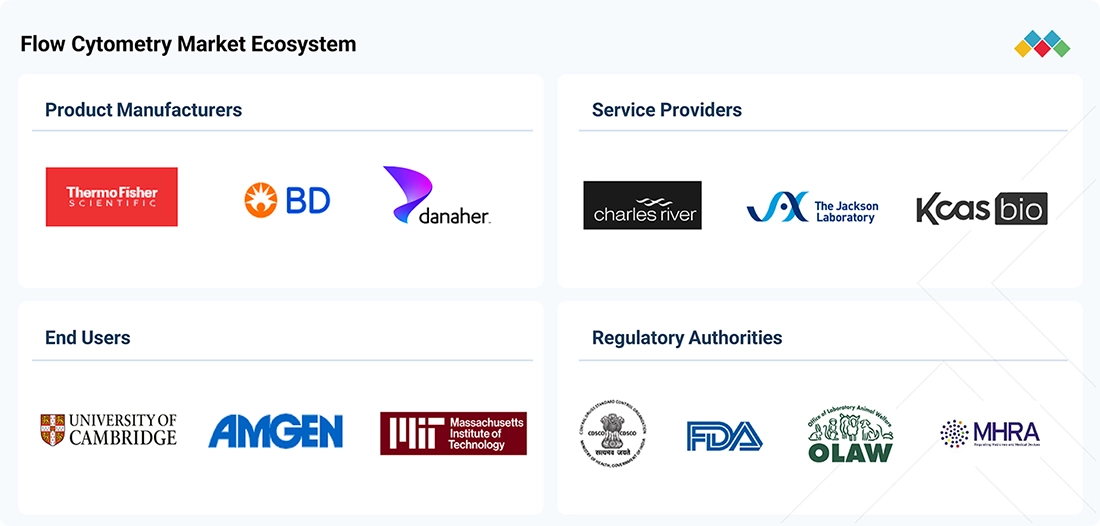
FLOW CYTOMETRY MARKET: COMMERCIAL USE CASES ACROSS INDUSTRIES
| COMPANY | USE CASE DESCRIPTION | BENEFITS |
|---|---|---|
 |
BD flow cytometry platforms, fluorochrome-conjugated antibodies, and multicolor panels are used for high-parameter immunophenotyping, immune-cell characterization, oncology research, and translational studies. Multicolor flow cytometry enables simultaneous analysis of multiple cell-surface and intracellular markers at the single-cell level. | High-dimensional cellular profiling | Improved identification of complex immune-cell populations | Supports standardized research and translational workflows. |
 |
CytoFLEX flow cytometers and CytoFLEX SRT cell sorters support multiparameter cell analysis, immunophenotyping, nanoparticle detection, and cell sorting across biomedical research. The CytoFLEX platform combines high sensitivity and broad dynamic range, while the SRT system supports benchtop sorting workflows. | Sensitive detection of dim populations | Flexible multicolor analysis | Streamlined cell analysis and sorting workflows. |
 |
The Invitrogen Bigfoot Spectral Cell Sorter is used for high-parameter spectral flow cytometry and high-throughput cell sorting, allowing researchers to distinguish and isolate complex cellular subpopulations using conventional compensation or spectral unmixing. | High-throughput cell sorting | Greater resolution of complex cell populations | Supports high-parameter and spectral workflows |
Logos and trademarks shown above are the property of their respective owners. Their use here is for informational and illustrative purposes only.
Related Ecosystem
Biotechnology
- Reagents
- Polymerase Chain Reaction (PCR)
- Stem Cells
- Assay Kits
- Flow Cytometers
- Thermo Fisher Scientific Inc.
- Merck KGaA
- Danaher Corporation
- Agilent Technologies, Inc.
- Bio-Rad Laboratories, Inc.
Key Takeaways
- The US flow cytometry market is valued at $949.1 million in 2025 and is expected to more than double to $2,030.4 million by 2030.
- The US market grows at a 10.0% CAGR, outpacing global growth and reflecting strong healthcare investment and clinical adoption.
- US demand is driven by rising cancer and immunological disorder prevalence, personalized medicine initiatives, and pharmaceutical R&D expansion.
- The US leads in technological innovation and adoption of advanced flow cytometry systems across hospitals, research centers, and biotech firms.
Flow Cytometry Market Report Scope
| Report Metric | Details |
|---|---|
| Base Year | 2025 |
| Fastest Growing Segment | ANTIBODIES (Type) |
| Forecast Period | 2025–2030 |
| Growth Rate | CAGR of 8.7% from 2025 to 2030 |
| Largest Segment | REAGENTS & CONSUMABLES (Offering) |
| Market Size Base Year (Billions) | ~USD 5.05 (2025) |
| Revenue Forecast (Billions) | ~USD 7.67 (2030) |
| Segments Covered | Offering, Type |
US Flow Cytometry Market Report Segmentation
2 segment dimensions are covered across the global market.
By Offering
- Accessories
- Instruments
- Reagents & Consumables
- Services
- Software
By Type
- Antibodies
- Assays & Kits
- Cell Analyzers
- Cell Sorters
- Other Reagents & Consumables
US: FLOW CYTOMETRY MARKET, BY END USER, 2023–2033
| Segment | 2023 | 2024 | 2025 | 2026 | 2027 | 2029 | 2031 | 2033 | CAGR (%) |
|---|---|---|---|---|---|---|---|---|---|
| ACADEMIC & RESEARCH INSTITUTES | 688.1 | 718.2 | 757.2 | 816.9 | 898.8 | 1088.2 | 1334.3 | 1674.6 | 10.4 |
| HOSPITALS & CLINICAL TESTING LABORATORIES | 645.7 | 668.1 | 698.1 | 746.7 | 814.5 | 969.4 | 1168.8 | 1442.7 | 9.5 |
| PHARMACEUTICAL & BIOTECHNOLOGY COMPANIES | 356.8 | 363.8 | 374.5 | 394.5 | 423.7 | 488.5 | 569.9 | 679.9 | 7.7 |
| TOTAL | 1690.7 | 1750.1 | 1829.8 | 1958.1 | 2137.1 | 2546.2 | 3073 | 3797.3 | 9.6 |
Target Audience
- Medical Device Manufacturers : Flow cytometry instrument and reagent manufacturers need US-specific market data to optimize product positioning, pricing strategies, and distribution channels in the world's largest healthcare market.
- Clinical Laboratory Operators : Hospital networks and diagnostic laboratories require market insights to justify capital investments in flow cytometry equipment, assess competitive offerings, and plan service expansion.
- Pharmaceutical & Biotech Companies : Drug developers and biotech firms need US market intelligence to understand flow cytometry adoption in clinical trials, immunotherapy development, and companion diagnostics.
- Healthcare Investors & Consultants : Investment firms and management consultants require validated US market data and growth forecasts to evaluate investment opportunities and advise healthcare sector clients.
- Research Institutions & Universities : Academic medical centers and research organizations need market analysis to understand funding trends, technology adoption patterns, and competitive research capabilities in the US.
Key Companies in the US Flow Cytometry Market
| Company | HQ | Ownership | Strongest segments |
|---|---|---|---|
| ABCAM PLC | United Kingdom | Private Company | Primary and secondary antibodies,Conjugated antibodies and conjugation kits,Singleplex immunoassays, |
| BECKMAN COULTER | United States | Private Company | Clinical core lab (chemistry, hematology, immunoassay, urinalysis, integrated systems),Flow cytometry and cellular analysis (clinical and research),Life science research tools (centrifugation, capillary electrophoresis, liquid handling, genomics), |
| INTUITIVE SURGICAL INC | United States | Public Company | da Vinci capital systems,da Vinci instruments, stapling, energy, and accessories,Service, training, and digital programs, |
| BECTON, DICKINSON AND COMPANY | United States | Public Company | Medical Essentials (syringes, needles, IV and vascular access, sharps),Connected Care (infusion pumps, medication management, pharmacy automation, informatics),BioPharma Systems (prefillable drug delivery systems), |
| DANAHER CORPORATION | United States | Public Company | Biotechnology (bioprocessing and related solutions),Life Sciences (research tools and genomic medicines),Diagnostics (clinical instruments and consumables), |
| THERMO FISHER SCIENTIFIC INC. | United States | Public Company | Life Sciences Solutions (reagents, instruments, consumables),Analytical Instruments,Specialty Diagnostics, |
| AGILENT TECHNOLOGIES, INC. | United States | Public Company | Life Sciences and Diagnostics Markets,Agilent CrossLab,Applied Markets, |
| SONY CORPORATION | Japan | Public Company | Game & Network Services,Music,Pictures, |
| BIO-RAD LABORATORIES, INC. | United States | Public Company | Clinical Diagnostics,Life Science Research Instruments and Reagents, |
| ENZO BIOCHEM INC. | United States | Private Company | Labels, dyes, and genomic probes,Antibodies and immunoassays,Biochemicals and proteins, |
| SYSMEX CORPORATION | Japan | Public Company | Hematology analyzers and reagents (XN-Series, XN-V, ProCyte Dx for Research),Coagulation diagnostics,Urinalysis and blood gas/electrolyte, |
| CYTEK BIOSCIENCES | United States | Public Company | Aurora / Aurora Evo / Aurora CS spectral systems,Northern Lights and conventional flow cytometers (Guava, Muse, easyCyte),Amnis imaging flow cytometers, |
| BIOMéRIEUX | France | Public Company | Syndromic and low-plex PCR (BIOFIRE, SPOTFIRE, ARGENE),Microbiology ID/AST systems and reagents (VITEK 2, VITEK MS, VITEK REVEAL, API, ETEST),Culture media, CHROMID range, and BACT/ALERT VIRTUO, |
| SARTORIUS AG | Germany | Public Company | Bioprocess solutions (bioreactors, fermenters, filtration, process chromatography, fluid management),Lab products and services (filtration, purification, water systems, weighing, pipettes, microbiological testing, OEM),Analytical and cell analysis solutions (BLI, cytometry screening, PAT, live-cell imaging, SPR, cell selection), |
| UNION BIOMETRICA, INC. | United States | Private Company | COPAS and related throughput instruments,Contract biological services and assay development,Consumables, support, and upgrades, |
| TAKARA BIO INC. | Japan | Private Company | Genetic and cellular research reagents,Instruments (PCR and cellular analysis devices),In vitro diagnostics (including COVID-19 testing), |
ABCAM PLC
Abcam PLC is a United Kingdom-based private company founded in 1998 with 1,760 employees, specializing in life sciences research products and services.
BECKMAN COULTER
Beckman Coulter is a United States-based private company founded in 1935 with 11,900 employees, manufacturing laboratory instruments and diagnostic equipment.
INTUITIVE SURGICAL INC
Intuitive Surgical Inc. is a publicly traded United States company founded in 1995 with 17,021 employees, known for developing robotic-assisted surgical systems.
BECTON, DICKINSON AND COMPANY
Becton, Dickinson and Company is a publicly traded United States company founded in 1897 with 72,000 employees, manufacturing medical devices, laboratory equipment, and diagnostic products.
DANAHER CORPORATION
Danaher Corporation is a publicly traded United States conglomerate founded in 1969 with 59,000 employees, operating across multiple industries including life sciences and diagnostics.
THERMO FISHER SCIENTIFIC INC.
Thermo Fisher Scientific Inc. is a publicly traded United States company founded in 1956 with 125,000 employees, providing laboratory equipment, reagents, and analytical instruments globally.
AGILENT TECHNOLOGIES, INC.
Agilent Technologies, Inc. is a publicly traded United States company founded in 1999 with 18,000 employees, specializing in life sciences, diagnostics, and analytical instruments.
SONY CORPORATION
Sony Corporation is a publicly traded Japanese company founded in 1946 with 94,900 employees, operating across electronics, entertainment, and other diversified business segments.
BIO-RAD LABORATORIES, INC.
Bio-Rad Laboratories, Inc. is a publicly traded United States company founded in 1952 with 7,450 employees, manufacturing clinical diagnostics and life science research products.
ENZO BIOCHEM INC.
Enzo Biochem Inc. is a United States-based private company founded in 1976 with 131 employees, focused on molecular diagnostics and life sciences research.
SYSMEX CORPORATION
Sysmex Corporation is a publicly traded Japanese company founded in 1968 with 10,861 employees, manufacturing hematology and clinical diagnostics instruments.
CYTEK BIOSCIENCES
Cytek Biosciences is a publicly traded United States company founded in 1992 with 678 employees, developing flow cytometry and cell analysis technologies.
BIOMéRIEUX
bioMérieux is a publicly traded French company founded in 1963 with 14,894 employees, specializing in in vitro diagnostics and microbiology testing solutions.
SARTORIUS AG
Sartorius AG is a publicly traded German company founded in 1870 with 14,242 employees, manufacturing laboratory and bioprocess equipment for life sciences applications.
UNION BIOMETRICA, INC.
Union Biometrica, Inc. is a United States-based private company founded in 1998 with 21 employees, specializing in automated imaging and analysis systems for small organisms.
TAKARA BIO INC.
Takara Bio Inc. is a Japanese private company founded in 2002 with 1,779 employees, providing molecular biology reagents and biotechnology research tools.
Reasons to Buy this Report
- Market Size & Growth Validation : Obtain precise US market valuation ($949.1M in 2025) and verified 10% CAGR forecast through 2030, enabling accurate financial planning and investment decisions specific to the American market.
- Competitive Landscape Intelligence : Understand market dynamics, key players, and competitive positioning within the US flow cytometry sector to identify partnership opportunities and market entry strategies.
- Segment & Application Insights : Access detailed breakdown of US market segments including clinical diagnostics, research applications, and pharmaceutical development to target high-growth opportunities and customer segments.
- Regulatory & Infrastructure Analysis : Gain insights into US healthcare infrastructure, FDA regulations, and reimbursement landscape that directly impact flow cytometry adoption and market expansion strategies.
- Strategic Growth Opportunities : Identify emerging trends in personalized medicine, immunotherapy monitoring, and automation technologies driving US market growth to inform product development and commercialization strategies.
Frequently asked questions
What is the current size of the US flow cytometry market?
The US flow cytometry market is estimated at $949.1 million in 2025 and is projected to grow to $2,030.4 million by 2030.
What is the growth rate of the US flow cytometry market?
The US flow cytometry market is growing at a compound annual growth rate (CAGR) of 10.0% from 2025 to 2030.
What are the primary drivers of growth in the US flow cytometry market?
Key drivers include rising prevalence of cancer and blood disorders, increased adoption of personalized medicine, technological advancements in instrumentation, and expanded pharmaceutical and biotech R&D activities across the US.
Which sectors in the US are the largest users of flow cytometry?
The US pharmaceutical and biotechnology industries, clinical diagnostic laboratories, academic medical centers, and hospital immunology departments are the primary users of flow cytometry technology.
How does the US flow cytometry market compare to global trends?
The US market grows at 10.0% CAGR, exceeding the global CAGR of 8.7%, reflecting the US's advanced healthcare infrastructure, high R&D spending, and early adoption of innovative diagnostic technologies.
RESEARCH METHODOLOGY
This research study extensively utilized secondary sources, directories, and databases to identify and collect valuable information for analyzing the global flow cytometry market. In-depth interviews were conducted with various primary respondents, including key industry participants, subject-matter experts (SMEs), C-level executives at key market players, and industry consultants, to obtain and verify critical qualitative & quantitative information and to assess the market's growth prospects. The global market size estimated through secondary research was triangulated with primary research inputs to determine the final market size.
Secondary Research
Secondary research was primarily used to identify and collect information for the comprehensive technical, market-oriented, and commercial study of the flow cytometry market. The secondary sources used for this study include World Health Organization (WHO), the Organisation for Economic Co-operation and Development (OECD), the Global Cancer Observatory (GLOBOCAN), the World Bank, Eurostat, the Joint United Nations Programme on HIV/AIDS (UNAIDS), the National Institutes of Health (NIH), Institute for Health Metrics and Evaluation (US), International Society for Advancement of Cytometry (US), US FDA, Health Canada, EuroStemCell, German Cancer Research Center, NHS (UK), Cancer Research UK (UK), Stem Cell Foundation, French National Research Agency (France), Italian National Institute of Health, National Cancer Center Japan, Ministry of Science & Technology (India), Australasian Cytometry Society (Australia), the Cytometry Society (India), International Clinical Cytometry Society (US), and African Cancer Registry Network; Lens. Org. National Center for Biotechnology Information (NCBI), corporate filings such as annual reports, SEC filings, investor presentations, and financial statements; research journals; press releases; and trade, business, and professional associations, among others. These sources were also used to obtain key information on major players, market classification and segmentation aligned with industry trends, regional/country-level markets, market developments, and technology perspectives.
Primary Research
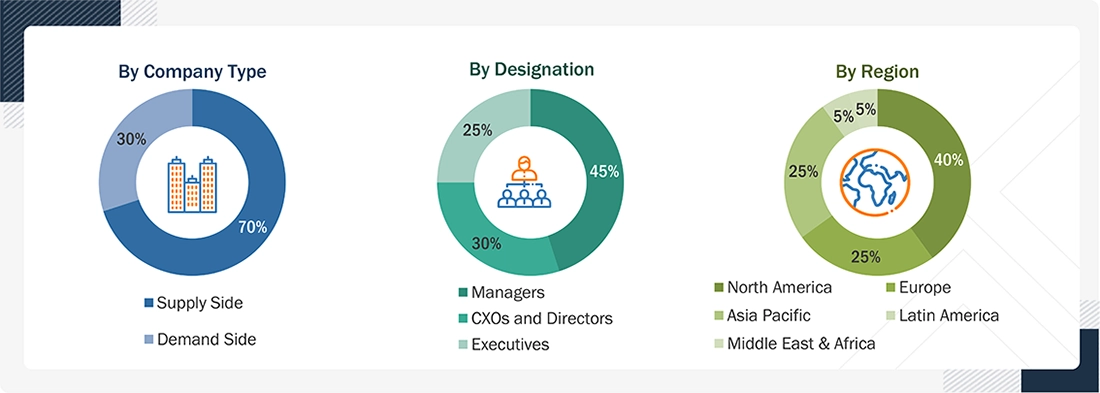
In-depth interviews were conducted with various primary respondents, including key industry participants, subject-matter experts (SMEs), C-level executives of key market players, and industry consultants, to obtain and verify critical qualitative & quantitative information and assess the market’s prospects. Various primary sources from the supply & demand sides of the market were interviewed to obtain qualitative and quantitative information.
To know about the assumptions considered for the study, download the pdf brochure
Market Size Estimation
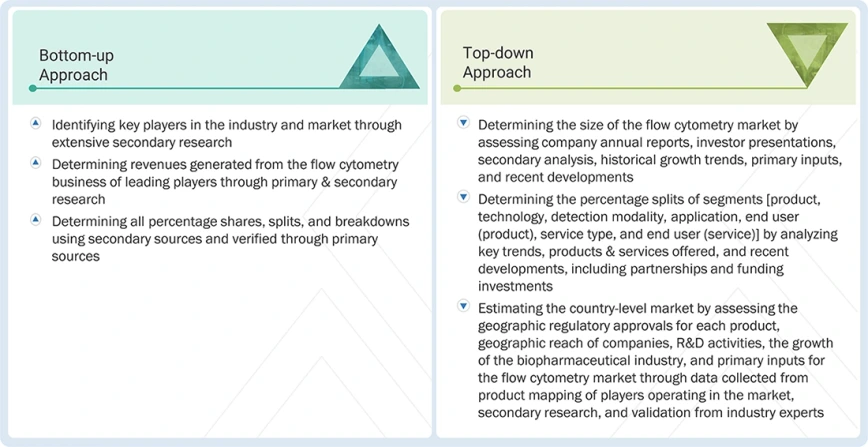
The top-down and bottom-up approaches were used to estimate & validate the total size of the flow cytometry market. These methods were also used extensively to estimate the size of various market segments.
Flow Cytometry Market : Top-Down and Bottom-Up Approach
Data Triangulation
After evaluating the overall market size through the market size estimation process, the total market was segmented into several subsegments. Data triangulation and market breakdown procedures were used, whenever applicable, to complete the overall market engineering process and obtain precise statistics for all segments and subsegments. The data was triangulated by analyzing various factors and trends from the demand and supply sides.
Market Definition
The flow cytometry market is defined as the use of products such as reagents & consumables, instruments, software, accessories, and related services for the identification, characterization, quantification, and sorting of cells and other microscopic particles based on their physical and biochemical properties. Flow cytometry enables multiparameter analysis of characteristics such as cell size, granularity, surface and intracellular markers, DNA/RNA content, cell cycle, viability, apoptosis, proliferation, and functional responses. The report scope includes cell analyzers, cell sorters, antibodies, fluorophores, assays & kits, calibration and control materials, software, accessories, and outsourced flow cytometry services used for cell analysis and sorting workflows. These products and services, applied across research, clinical, pharmaceutical & biotechnology, and industrial applications, are within the report's scope.
Key Stakeholders
- Pharmaceutical & biotechnology companies
- Contract research organizations (CROs)
- Contract development and manufacturing organizations (CDMOs)
- Life science companies
- Academic & research institutes
- Private research institutes
- Venture capitalists & investors
- Market research & consulting firms
- Government associations
- Medical institutions & universities
- Hospitals & clinics
Report Objectives
- To define, describe, and forecast the flow cytometry market based on product, technology, detection modality, application, end user (product), service type, end user (service), and region
- To provide detailed information regarding the major factors influencing the market growth (such as drivers, restraints, opportunities, and challenges)
- To strategically analyze micromarkets concerning individual growth trends, prospects, and contributions to the overall flow cytometry market
- To analyze the opportunities in the market for stakeholders and provide details of the competitive landscape for market leaders
- To forecast the size of the market segments concerning six main regions: North America, Europe, the Asia Pacific, Latin America, the Middle East, and Africa
- To strategically profile the key players in the flow cytometry market and comprehensively analyze their core competencies and market rankings
- To track and analyze competitive developments such as product launches, acquisitions, expansions, agreements, partnerships, and collaborations in the flow cytometry market
- To benchmark players within the flow cytometry market using the ‘Company Evaluation Matrix' framework, which analyzes market players based on various parameters within the broad categories of business and product/service strategy
Available customizations:
With the given market data, MarketsandMarkets offers customizations per the company’s specific needs. The following customization options are available for this report:
Geographic Analysis
- Further breakdown of the Rest of Europe flow cytometry market, by country
- Further breakdown of the Rest of Asia Pacific flow cytometry market, by country
- Further breakdown of the Rest of Latin America flow cytometry market, by country
- Further breakdown of the Rest of Middle East flow cytometry market, by country
Company Information
- Detailed analysis and profiling of additional market players (up to five)
Get the Full Flow Cytometry Market Report
Full forecast, segment splits, and company analysis for all Flow Cytometry Market.
- Rest Of Europe Flow Cytometry Market
- Rest Of Asia Pacific Flow Cytometry Market
- Rest Of Latin America Flow Cytometry Market
- GCC Countries Flow Cytometry Market
- Rest Of Middle East Flow Cytometry Market
- Rest Of GCC Countries Flow Cytometry Market
- Canada Flow Cytometry Market
- Germany Flow Cytometry Market
- UK Flow Cytometry Market
- France Flow Cytometry Market
- Italy Flow Cytometry Market
- Spain Flow Cytometry Market
- China Flow Cytometry Market
- Japan Flow Cytometry Market
- India Flow Cytometry Market
- Australia Flow Cytometry Market
- South Korea Flow Cytometry Market
- Singapore Flow Cytometry Market
- Indonesia Flow Cytometry Market
- Brazil Flow Cytometry Market
- Mexico Flow Cytometry Market
- Saudi Arabia Flow Cytometry Market
- UAE Flow Cytometry Market
Need a Tailored Report?
Customize this report to your needs
Get 10% FREE Customization
Customize This Report
