
Rest Of Asia Pacific Foldable Display Market (2024-2029)

The Rest Of Asia Pacific Foldable Display Market was valued at $217.1 Million in 2024 and projected to reach to $712 Million by 2029, representing a compound annual growth rate of 26.8%. Rest Of Asia Pacific is positioned as a high-growth foldable display market, driven by expanding middle-class demographics and increasing disposable incomes across emerging economies.


| Market Size in | USD 26.32 MN |
| Market Forecast in | |
| CAGR | |
| Forecast Period | |
| Units Considered | Value (USD MN) |
Rest Of Asia Pacific Foldable Display Market Trends and Insights
- Rest Of Asia Pacific represents a critical growth region for foldable technology adoption, driven by rising consumer demand for innovative mobile devices and increasing smartphone penetration across emerging economies.
- Rest Of Asia Pacific's 26.8% compound annual growth rate significantly outpaces global trends, reflecting strong regional investment in semiconductor manufacturing and consumer electronics innovation. Rest Of Asia Pacific's foldable display market is characterized by accelerating technology adoption among middle-income consumers and expanding production capacity from regional manufacturers.
- Rest Of Asia Pacific benefits from proximity to major component suppliers and established electronics ecosystems that support rapid commercialization of foldable devices.
- Rest Of Asia Pacific's forecast period (2024-2029) will witness intensified competition, increased device affordability, and broader market penetration beyond premium segments, positioning the region as a key driver of global foldable display growth..
Key Market Statistics
- CAGR (2024-2029) 26.8% CAGR
- Market Size, 2024 ~USD 217.1 Million
- Forecast, 2029 ~USD 712 Million
- Country Rest Of Asia Pacific
Rest Of Asia Pacific Foldable Display Market Overview
Rapid Market Expansion :
Rest Of Asia Pacific's foldable display market is growing at 26.8% CAGR, significantly outpacing the global rate of 23.6%, reflecting strong regional adoption momentum and emerging market potential.
Emerging Economy Penetration :
Rising smartphone penetration across Southeast Asia, South Asia, and Oceania is driving foldable technology adoption among middle-class consumers seeking premium mobile experiences at competitive price points.
Market Scale Projection :
The region's foldable display market is projected to grow from $217.1 million in 2024 to $712.0 million by 2029, representing a 228% increase and establishing Rest Of Asia Pacific as a key growth engine.
Innovation-Driven Demand :
Increasing consumer appetite for innovative mobile devices and next-generation technology in Rest Of Asia Pacific is accelerating OEM investments in foldable form factors and display manufacturing capabilities.
Rest Of Asia Pacific Foldable Display Market Dynamics
- The region's 26.8% CAGR reflects strong consumer interest in premium mobile innovations and the proliferation of 5G connectivity, which enhances demand for advanced devices.
- Local smartphone manufacturers and international brands are intensifying competition, leading to more affordable foldable options and accelerated market penetration. By 2029, the market is expected to reach $712.0 million, supported by improving supply chain infrastructure, declining component costs, and growing brand awareness.
- Key growth drivers include rising e-commerce adoption, expanding retail distribution networks, and increasing technology literacy among consumers.
- Rest Of Asia Pacific's young demographic profile and early adoption of cutting-edge technology position the region as a critical market for foldable display manufacturers seeking to capture emerging market share..
Market Ecosystem
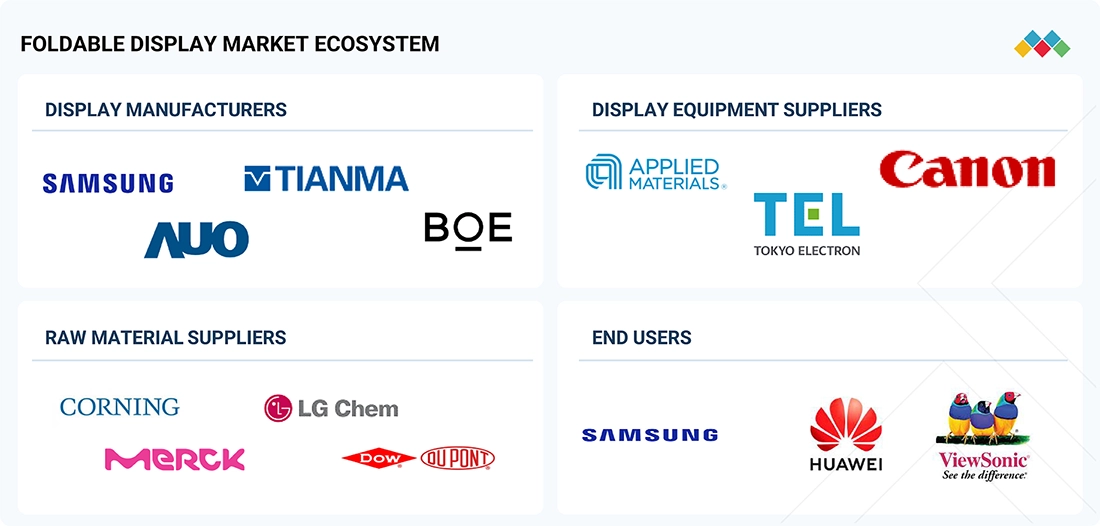
FOLDABLE DISPLAY MARKET SIZE, SHARE, INDUSTRY AND INDUSTRY TRENDS: COMMERCIAL USE CASES ACROSS INDUSTRIES
| COMPANY | USE CASE DESCRIPTION | BENEFITS |
|---|---|---|
 |
Deployed foldable OLED displays in the Galaxy Fold 5G to differentiate smartphones and stimulate upgrade demand, supported by a targeted digital campaign highlighting the device’s unique folding mechanism and large-screen experience. | 20% weight reduction compared to traditional aluminum, improved fuel efficiency, and reduced maintenance cost. |
 |
Publicized Foldable OLED panels for laptops and 360° foldable displays, including screens capable of folding in both directions, with tested durability of over 200,000 folds. | Demonstrated technical maturity and reliability of foldable panels in new categories like portable computing and flexible form-factor IT devices. |
 |
Deployed an industry-first 135″ foldable all-in-one LED display solution kit with a collapsible screen and integrated components, enabling rapid setup and flexible transport for business use cases such as exhibitions, conferences, and rental deployments. | Significantly enhances mobility and ease of installation by reducing packaging size by nearly half, fits into standard freight elevators, and cuts shipping and logistics costs. |
Logos and trademarks shown above are the property of their respective owners. Their use here is for informational and illustrative purposes only.
Related Ecosystem
Display Technology
- Augmented Reality
- Liquid Crystal Display (LCD)
- Sensors
- Virtual Reality Devices
- Liquid Crystal on Silicon (LCOS)
- VIVITEK CORPORATION
- Samsung
- Lenovo
- Panasonic Holdings Corporation
- Lg corp
Key Takeaways
- Rest Of Asia Pacific's foldable display market will grow from $217.1M (2024) to $712.0M (2029) at a 26.8% CAGR, outpacing global growth rates.
- Rest Of Asia Pacific's emerging economies are driving mass-market adoption of foldable devices beyond premium consumer segments.
- Rest Of Asia Pacific's regional manufacturing ecosystem and supply chain proximity accelerate commercialization and reduce production costs.
- Rest Of Asia Pacific will capture significant market share through competitive pricing strategies and localized product innovation by 2029.
Foldable Display Market Report Scope
| Report Metric | Details |
|---|---|
| Base Year | 2024 |
| Fastest Growing Segment | OTHER TECHNOLOGIES (Technology) |
| Forecast Period | 2024-2029 |
| Growth Rate | CAGR of 23.6% from 2024 to 2029 |
| Largest Segment | OLED (Technology) |
| Market Size Base Year (Billions) | ~USD 4.58 (2024) |
| Revenue Forecast (Billions) | ~USD 13.2 (2029) |
| Segments Covered | Technology, Application, Technology Type, Panel Size |
Rest Of Asia Pacific Foldable Display Market Report Segmentation
4 segment dimensions are covered across the global market.
By Technology
- Oled
- Other Technologies
- Other Technologies (Micro-Led And Direct-View Led)
- Other Technologies(Micro-Led And Direct-View Led)
By Application
- Digital Signage And Other Large Display Devices
- Digital Signage And Other Large Displays Devices
- Laptops And Tablets
- Smartphones
By Technology Type
- Direct-View Led
- Micro-Led
By Panel Size
- Above 20 Inches
- Up To 20 Inches
Target Audience
- Display Manufacturers & Component Suppliers : Need region-specific demand forecasts and supply chain insights to optimize production capacity, plan R&D investments, and establish manufacturing partnerships aligned with Rest Of Asia Pacific's rapid 26.8% growth trajectory.
- Smartphone OEMs & Device Makers : Require detailed market segmentation and consumer preference data for Rest Of Asia Pacific to guide product development, pricing strategies, and go-to-market plans for foldable device launches in emerging economies.
- Investment & Private Equity Firms : Seek comprehensive market analysis and growth projections for Rest Of Asia Pacific to identify high-potential investment opportunities in foldable display technology companies, startups, and manufacturing ventures.
- Technology Retailers & Distributors : Need market trends, consumer demand patterns, and competitive intelligence specific to Rest Of Asia Pacific to optimize inventory management, channel strategies, and sales forecasting for foldable display products.
- Strategic Consultants & Business Analysts : Require granular regional data and market insights for Rest Of Asia Pacific to support client advisory services, competitive benchmarking, and strategic planning initiatives in the foldable display sector.
Reasons to Buy this Report
- Regional Growth Opportunity Identification : Gain detailed insights into Rest Of Asia Pacific's 26.8% CAGR trajectory and understand which emerging economies within the region offer the highest foldable display adoption potential for market entry and expansion strategies.
- Competitive Landscape Intelligence : Access comprehensive analysis of local and international competitors operating in Rest Of Asia Pacific, including market positioning, pricing strategies, and distribution networks specific to emerging markets in the region.
- Consumer Demand Segmentation : Understand Rest Of Asia Pacific consumer preferences, purchasing behaviors, and demographic profiles driving foldable technology adoption across diverse emerging economies and income segments within the region.
- Investment and Partnership Decisions : Make informed decisions on manufacturing partnerships, supply chain investments, and market entry strategies tailored to Rest Of Asia Pacific's unique regulatory environment, infrastructure capabilities, and growth timelines.
- Revenue Forecasting and Planning : Leverage precise market size projections ($217.1M to $712.0M by 2029) for Rest Of Asia Pacific to develop accurate financial models, budget allocations, and long-term business strategies specific to this high-growth region.
Frequently asked questions
What is the current market size of foldable displays in Rest Of Asia Pacific?
Rest Of Asia Pacific's foldable display market was valued at $217.1 million in 2024 and is expected to grow substantially through 2029.
What is the projected market size for Rest Of Asia Pacific foldable displays by 2029?
Rest Of Asia Pacific's foldable display market is forecasted to reach $712.0 million by 2029, representing significant regional expansion.
What is the CAGR for Rest Of Asia Pacific's foldable display market?
Rest Of Asia Pacific's foldable display market is growing at a compound annual growth rate of 26.8% from 2024 to 2029.
Why is Rest Of Asia Pacific experiencing faster foldable display growth than global averages?
Rest Of Asia Pacific benefits from established electronics manufacturing infrastructure, rising middle-class consumer bases, and competitive regional pricing strategies that accelerate foldable device adoption.
Which factors are driving foldable display demand in Rest Of Asia Pacific?
Rest Of Asia Pacific's growth is driven by increasing smartphone penetration, consumer preference for innovative devices, expanding production capacity, and declining foldable technology costs.
RESEARCH METHODOLOGY
The research study involved 4 major activities in estimating the size of the foldable display market. Exhaustive secondary research has been done to collect important information about the market and peer markets. The validation of these findings, assumptions, and sizing with the help of primary research with industry experts across the value chain has been the next step. Both top-down and bottom-up approaches have been used to estimate the market size. Post which the market breakdown and data triangulation have been adopted to estimate the market sizes of segments and sub-segments.
Secondary Research
In the secondary research process, various secondary sources have been referred to for identifying and collecting information required for this study. The secondary sources include annual reports, press releases, and investor presentations of companies, white papers, and articles from recognized authors. Secondary research has been mainly done to obtain key information about the market’s value chain, the pool of key market players, market segmentation according to industry trends, regional outlook, and developments from both market and technology perspectives.
Primary Research
In primary research, various primary sources from both supply and demand sides have been interviewed to obtain the qualitative and quantitative insights required for this report. Primary sources from the supply side include experts such as CEOs, vice presidents, marketing directors, manufacturers, technology and innovation directors, end users, and related executives from multiple key companies and organizations operating in the foldable display ecosystem.
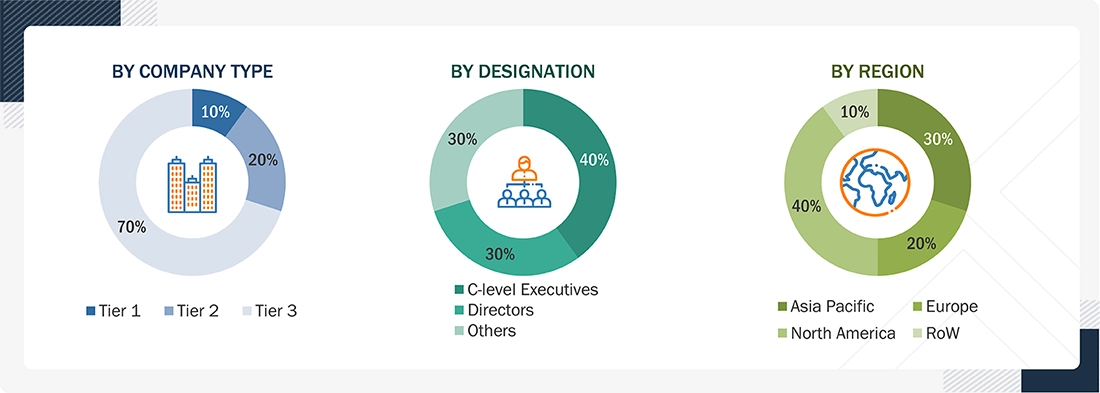
To know about the assumptions considered for the study, download the pdf brochure
Market Size Estimation
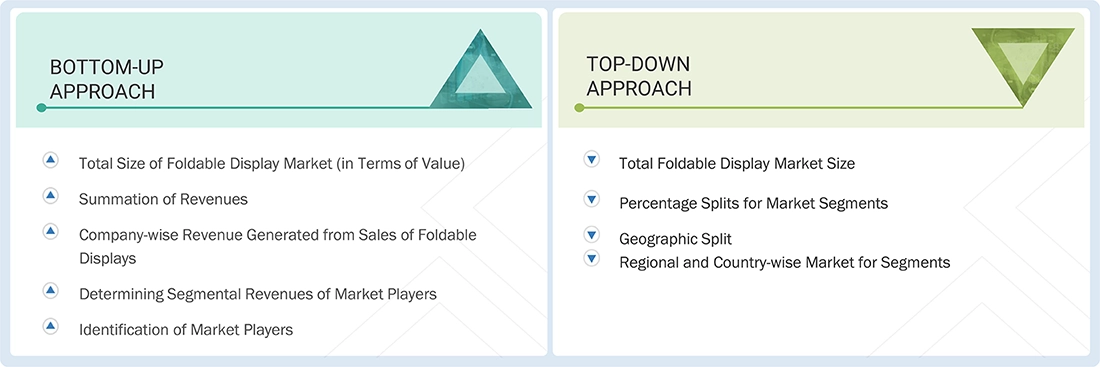
In the market engineering process, both top-down and bottom-up approaches have been used, along with data triangulation methods, to estimate and validate the size of the foldable display market and other dependent submarkets. The research methodology used to estimate the market sizes includes the following:
- Identifying stakeholders in the foldable display market that influence the entire market, along with participants across the value chain.
- Analyzing major manufacturers of foldable display panels and studying their product portfolios
- Analyzing trends related to the adoption of foldable displays
- Tracking the recent and upcoming developments in the market that include investments, R&D activities, product launches, partnerships, collaborations, and expansions as well as forecasting the market size based on these developments and other critical parameters
- Carrying out multiple discussions with key opinion leaders to identify the adoption trends of foldable display market
- Segmenting the overall market into various other market segments
- Validating the estimates at every level through discussions with key opinion leaders, such as chief executives (CXOs), directors, and operation managers, and finally with the domain experts at MarketsandMarkets
Market Size Estimation Methodology-Bottom-up Approach and Top-Down Approach
Data Triangulation
After arriving at the overall market size by the market size estimation process explained in the earlier section, the overall foldable display market has been divided into several segments and subsegments. The data triangulation and market breakdown procedures have been used to complete the overall market engineering process and arrive at the exact statistics for all segments, wherever applicable. The data has been triangulated by studying various factors and trends from both the demand and supply sides. Along with data triangulation and market breakdown, the market has been validated by top-down and bottom-up approaches.
Market Definition
The foldable display market designs, manufactures, and distributes foldable display panels that can be folded or bent without losing their display capabilities. A foldable display principally comprises high-end materials like flexible AMOLED or pOLED panels with a thin substrate and protective layers. These are engineered displays that bend without losing resolution or color accuracy. They serve a wide variety of devices and applications that include smartphones, tablets, laptops, wearables, and even large-format displays. Foldable displays would be most fitting in compact devices requiring greater portability without the loss of screen size and come with some remarkable benefits such as advanced user experience, increased screen real estate in portable form, and innovative product design. The greatest advantages of foldable displays are to offer large, high-quality screens in compact form factors while increasing device usability and opening up new design possibilities that cannot be achieved with traditional rigid screens.
Stakeholders
- OEMs
- Electronics Retailers
- Foldable Display Panel Manufacturers
- Foldable Device Manufacturers
- Material and Component Suppliers
- Technology Solution Providers
- Software Developers
- Marketing and Advertising Firms
- Distributors and Resellers
- Service Providers
- Regulatory Bodies
- Research and Development Institutes
- End Users
The main objectives of this study are as follows:
- To define, describe, and forecast the size of the foldable display market, by technology, panel size, application, and region, in terms of value
- To forecast the size of the foldable display market, by technology, in terms of volume, at the regional level
- To forecast the size of various segments with respect to four regions, namely North America, Europe, Asia Pacific, and the Rest of the World
- To identify and analyze key drivers, restraints, opportunities, and challenges influencing the growth of the foldable display market
- To study the value chain and related industry segments of the foldable display market
- To strategically analyze the micromarkets1 with respect to individual growth trends, prospects, and contributions to the overall market
- To analyze trends and disruptions impacting customers’ businesses’ pricing trends, patents and innovations, trade data, regulatory landscape, Porter’s five forces, case studies, key stakeholders and buying criteria, technology trends, market ecosystem, and key conferences and events related to the foldable display market
- To analyze opportunities for various stakeholders by identifying the high-growth segments of the market
- To strategically profile the key players and comprehensively analyze their market position in terms of revenue, market share, and core competencies2, along with detailing the competitive landscape for the market leaders
- To analyze competitive developments such as product launches, partnerships, collaborations, expansions, and research and development (R&D) activities carried out by players in the foldable display market
Available Customizations:
With the given market data, MarketsandMarkets offers customizations according to the specific requirements of companies. The following customization options are available for the report:
- Country-wise Information:
- Analysis for additional countries (up to five)
Company Information:
- Detailed analysis and profiling of additional market players (up to five)
Get the Full Foldable Display Market Report
Full forecast, segment splits, and company analysis for all Foldable Display Market.
- Canada Foldable Display Market
- Mexico Foldable Display Market
- US Foldable Display Market
- France Foldable Display Market
- Germany Foldable Display Market
- UK Foldable Display Market
- China Foldable Display Market
- Japan Foldable Display Market
- South Korea Foldable Display Market
- Rest Of Europe Foldable Display Market
Need a Tailored Report?
Customize this report to your needs
Get 10% FREE Customization
Customize This Report
