
Italy Food Certification Market (2024-2029)

The Italy Food Certification Market was valued at $168 Million in 2024 and projected to reach to $214.4 Million by 2029, representing a compound annual growth rate of 5.0%. Italy's food certification market is positioned for steady growth, driven by the country's export-dependent food industry and strict EU regulatory frameworks.


| Market Size in | USD 26.32 MN |
| Market Forecast in | |
| CAGR | |
| Forecast Period | |
| Units Considered | Value (USD MN) |
Italy Food Certification Market Trends and Insights
- Italy's strong agricultural heritage and export-driven food industry drive demand for robust certification standards across dairy, pasta, olive oil, and wine sectors.
- Regulatory compliance with EU food safety directives and growing consumer preference for certified authentic Italian products fuel market expansion in Italy. The Italian food certification landscape reflects the country's commitment to quality assurance and protected designation of origin (PDO) standards.
- Italy's certification market benefits from stringent traceability requirements and increasing adoption of third-party auditing services among Italian food manufacturers and exporters.
- Between 2024 and 2029, Italy's market will be shaped by digital certification technologies, sustainability certifications, and enhanced supply chain transparency initiatives..
Key Market Statistics
- CAGR (2024-2029) 5.0% CAGR
- Market Size, 2024 ~USD 168 Million
- Forecast, 2029 ~USD 214.4 Million
- Country Italy
Italy Food Certification Market Overview
Strong Agricultural Export Base :
Italy's renowned food exports, including Parmigiano Reggiano, Prosciutto di Parma, and extra virgin olive oil, drive continuous demand for third-party certifications to maintain competitive advantage in global markets and meet international buyer requirements.
EU Regulatory Compliance Pressure :
Stringent EU food safety directives (FSSC 22000, IFS, BRC) mandate certification across Italian food producers, creating sustained market growth as companies invest in compliance infrastructure and audit services to avoid penalties and market access restrictions.
Wine & Dairy Sector Leadership :
Italy's dominant position in wine production (Chianti, Barolo) and premium dairy products necessitates specialized certifications for geographical indication (GI) protection, organic standards, and quality assurance, supporting market expansion in these high-value segments.
Growing Organic & Sustainability Demand :
Italian consumers and international buyers increasingly seek organic and sustainability certifications. The market reflects rising adoption of IFOAM, EU Organic, and environmental certifications across Italian farms and food processors responding to premium market positioning.
Italy Food Certification Market Dynamics
- The $168.0 million market in 2024 is expected to reach $214.4 million by 2029 at a 5.0% CAGR, reflecting sustained investment in compliance and quality assurance across dairy, pasta, olive oil, and wine sectors.
- Italian producers increasingly recognize certification as essential for market access, brand differentiation, and consumer trust in competitive global markets. The outlook is supported by rising demand for organic and sustainability certifications, particularly among younger consumers and international retailers.
- Additionally, digital traceability solutions and blockchain-based certification verification are emerging as growth drivers.
- However, market expansion may face headwinds from certification costs for small and medium-sized enterprises (SMEs), which dominate Italy's food production landscape.
- Strategic government support and industry consolidation initiatives will be critical to sustaining market momentum through 2029..
Market Ecosystem
Related Ecosystem
Food Safety And Tic
- Dairy Products
- Polymerase Chain Reaction (PCR)
- Campylobacter
- Enzyme-Linked Immunosorbent Assay (ELISA)
- Safety Testing
- Intertek Group plc
- EUROFINS SCIENTIFIC SE
- Sgs s.a.
- Als limited
- PROMEGA CORPORATION
Testing Inspection And Certification
- Eddy Current Testing (ECT)
- Safety Testing
- Signal Generators
- Acoustic Emission Testing (AET)
- Automated Test Equipment
- Sgs s.a.
- Intertek Group plc
- Bureau veritas s.a.
- TUV RHEINLAND AG
- TUV SUD AG
Key Takeaways
- Italy's food certification market reached $168.0 million in 2024 with a projected value of $214.4 million by 2029.
- Italy's market grows at a 5.0% CAGR, driven by EU regulatory compliance and PDO protection standards.
- Italy's export-oriented food sector demands advanced traceability and third-party certification services.
- Digital certification and sustainability standards are emerging growth drivers in Italy's market through 2029.
Food Certification Market Report Scope
| Report Metric | Details |
|---|---|
| Base Year | 2024 |
| Fastest Growing Segment | SERVICES (Offering) |
| Forecast Period | 2024-2029 |
| Growth Rate | CAGR of 5.7% from 2024 to 2029 |
| Largest Segment | HIGH-RISK (Risk Category) |
| Market Size Base Year (Billions) | ~USD 5.85 (2024) |
| Revenue Forecast (Billions) | ~USD 7.72 (2029) |
| Segments Covered | Certification Type, Subtype, Application, Subapplication, End User, Certification Scope, Price Sensitivity, Safety & Quality Certifications Subtype, Dietary & Lifestyle Certifications Subtype, Offering, Risk Category |
Italy Food Certification Market Report Segmentation
11 segment dimensions are covered across the global market.
By Certification Type
- Dietary & Lifestyle Certifications
- Other Certification Types
- Safety & Quality Certifications
By Subtype
- Allergen-Free
- Gluten-Free
- Non-Gmo
- Organic
- Other Subtypes
- Vegan
By Application
- Bakery & Confectionery
- Beverages
- Dairy Products
- Fruits & Vegetables
- Infant Food Products
- Meat, Poultry, And Seafood Products
- Nutraceuticals & Supplements
- Other Applications
- 'Free-From' Foods
By Subapplication
- Alcoholic Beverages
- Fresh
- Frozen
- Non-Alcoholic Beverages
- Processed
By End User
- Food & Beverage Manufacturers
- Growers
- Other End Users
- Restaurants & Foodservice Chains
- Retail & Supermarkets
By Certification Scope
- Company-Wide Certification
- Multiple Product Certification
- Single Product Certification
By Price Sensitivity
- Cost-Effective Certifications
- Premium Certifications
By Safety & Quality Certifications Subtype
- Brc
- Ifs
- Iso 22000
- Sqf
- Xiso 22000
By Dietary & Lifestyle Certifications Subtype
- Halal
- Kosher
- 'Free-From' Certifications
- "'Free-From' Certifications
By Offering
- Certificate Types
- Services
By Risk Category
- High-Risk
- Low-Risk
ITALY: FOOD CERTIFICATION MARKET, BY APPLICATION, 2024–2029
| Segment | 2024 | 2025 | 2026 | 2027 | 2028 | 2029 | CAGR (%) |
|---|---|---|---|---|---|---|---|
| BAKERY & CONFECTIONERY | 20.2 | 21 | 22 | 23.1 | 24.2 | 25.5 | 4.8 |
| BEVERAGES | 15.7 | 16.2 | 16.7 | 17.4 | 18 | 18.8 | 3.7 |
| DAIRY PRODUCTS | 33.4 | 34.9 | 36.7 | 38.5 | 40.6 | 42.8 | 5.1 |
| FRUITS & VEGETABLES | 10.3 | 10.7 | 11.1 | 11.6 | 12.1 | 12.6 | 4.2 |
| INFANT FOOD PRODUCTS | 16.5 | 17.2 | 18 | 18.9 | 19.9 | 21 | 5 |
| MEAT, POULTRY, AND SEAFOOD PRODUCTS | 48.4 | 50.9 | 53.6 | 56.5 | 59.7 | 63.2 | 5.5 |
| NUTRACEUTICALS & SUPPLEMENTS | 5.8 | 6.1 | 6.4 | 6.8 | 7.2 | 7.6 | 5.6 |
| OTHER APPLICATIONS | 4 | 4.1 | 4.2 | 4.4 | 4.5 | 4.7 | 3.4 |
| ‘FREE-FROM’ FOODS | 13.9 | 14.6 | 15.3 | 16.2 | 17.1 | 18.1 | 5.5 |
| TOTAL | 168 | 175.7 | 184.1 | 193.3 | 203.4 | 214.4 | 5 |
Target Audience
- Food Certification Bodies & Auditors : Italian and international certification organizations need market-specific data to understand demand trends, pricing dynamics, and service gaps across Italian food sectors, enabling strategic service expansion and competitive positioning in this growing market.
- Food & Beverage Producers & Exporters : Italian food manufacturers require insights into certification requirements, compliance costs, and market trends to make informed investment decisions, optimize certification portfolios, and maintain competitive advantage in export markets.
- Consulting & Compliance Service Providers : Consultants and compliance firms targeting Italian food companies need detailed market analysis to identify client segments, develop service offerings, and demonstrate ROI for certification and regulatory compliance solutions.
- Technology & Software Solution Vendors : Providers of traceability, blockchain, and digital certification platforms need Italy-specific market insights to understand adoption rates, regulatory drivers, and SME digitalization trends to tailor solutions for Italian food producers.
- Government & Trade Organizations : Italian government agencies, trade associations, and export promotion bodies require market data to design support programs, identify industry challenges, and develop policies that strengthen the competitiveness of Italian food exports globally.
Reasons to Buy this Report
- Italy-Specific Market Sizing & Forecasts : Access precise valuation data for Italy's food certification market ($168M in 2024, $214.4M by 2029) with country-level CAGR analysis, enabling accurate budget allocation and investment planning for Italian market entry or expansion.
- Sector-Specific Insights for Key Industries : Detailed analysis of certification demand across Italy's dominant food sectors—dairy, pasta, olive oil, and wine—with segment-level growth drivers, regulatory requirements, and competitive dynamics specific to Italian producers and exporters.
- EU Regulatory Compliance Roadmap : Comprehensive overview of EU food safety directives and Italian implementation requirements (FSSC 22000, IFS, BRC standards), helping certification bodies, consultants, and food companies navigate compliance obligations and identify service opportunities.
- SME Market Opportunity Assessment : Strategic insights into Italy's fragmented SME-dominated food production landscape, identifying gaps in affordable certification services, digital solutions, and support programs that represent untapped market opportunities for service providers.
- Competitive & Growth Strategy Development : Data-driven intelligence on organic certification adoption, sustainability trends, and emerging digital traceability solutions in Italy, enabling stakeholders to develop targeted strategies aligned with market evolution and consumer preferences through 2029.
Frequently asked questions
What is the current size of Italy's food certification market?
Italy's food certification market was valued at $168.0 million in 2024 and is expected to reach $214.4 million by 2029.
What is the growth rate of Italy's food certification market?
Italy's food certification market is projected to grow at a compound annual growth rate (CAGR) of 5.0% from 2024 to 2029.
Which food sectors drive certification demand in Italy?
Italy's dairy, pasta, olive oil, and wine sectors are primary drivers of food certification demand due to export requirements and PDO standards.
What regulatory factors influence Italy's certification market?
Italy's market is shaped by EU food safety directives, protected designation of origin (PDO) requirements, and stringent traceability regulations.
What emerging trends are shaping Italy's food certification market?
Digital certification technologies, sustainability certifications, and enhanced supply chain transparency are key emerging trends in Italy's market.
RESEARCH METHODOLOGY
This research study involved the extensive use of secondary sources—directories and databases such as Bloomberg Businessweek and Factiva—to identify and collect information useful for a technical, market-oriented, and commercial study of the food certification market. In-depth interviews were conducted with various primary respondents—such as key industry participants, subject matter experts (SMEs), C-level executives of key market players, and industry consultants—to obtain and verify critical qualitative and quantitative information as well as to assess prospects.
Secondary Research
In the secondary research process, various sources, such as the International Organization for Standardization, The Global Food Safety Initiative (GFSI), Food and Drug Administration (FDA), United States Department of Agriculture (USDA), The Institute of Food Technologists (IFT), Centers for Disease Control and Prevention (CDC), European Food Safety Authority (EFSA), European Federation of National Associations of Measurement, Testing and Analytical Laboratories (EUROLAB), Food Safety and Standards Authority of India (FSSAI), and Food Standards Australia New Zealand (FSANZ) were referred to identify and collect information for this study. The secondary sources also include clinical studies and medical journals, press releases, investor presentations of companies, white papers, certified publications, articles by recognized authors and regulatory bodies, trade directories, and paid databases.
Secondary research was mainly conducted to obtain critical information about the industry’s supply chain, the total pool of key players, and market classification & segmentation according to the industry trends to the bottom-most level and geographical markets. It was also used to obtain information about the key developments from a market-oriented perspective.
Primary Research
The market comprises several stakeholders in the supply chain, which include raw material suppliers, equipment suppliers, and food certification systems, kits, and consumables manufacturers. Various primary sources from both the supply and demand sides of the market were interviewed to obtain qualitative and quantitative information. The primary interviewees from the supply-side include food certification manufacturers. The primary sources from the demand-side include distributors, importers, exporters, and end consumers.
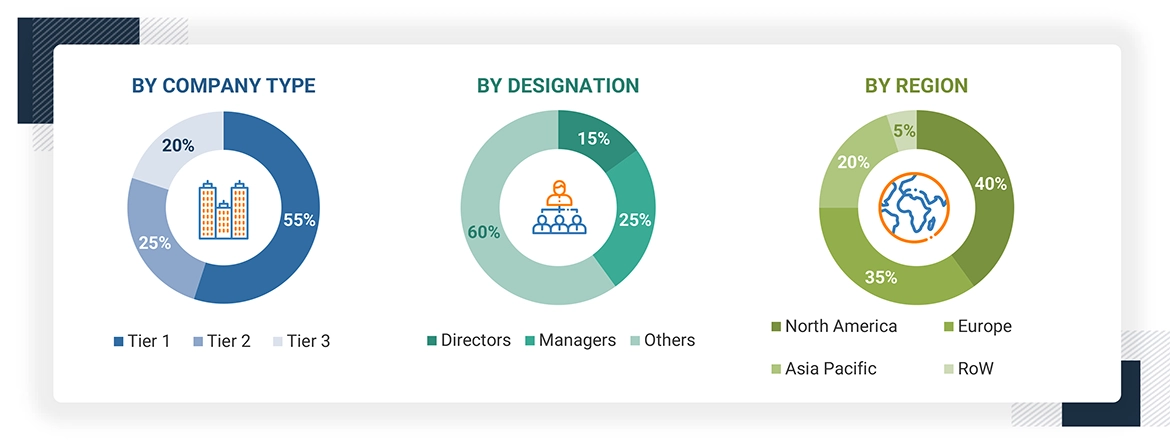
*RoW includes the South America Middle East and Africa.
To know about the assumptions considered for the study, download the pdf brochure
Market Size Estimation
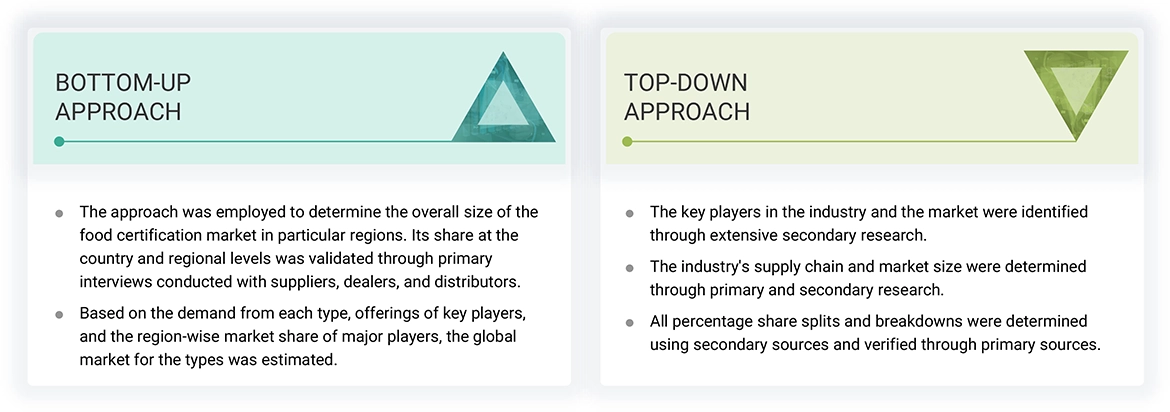
Both the top-down and bottom-up approaches have been used to estimate and validate the total size of the food certification market. These approaches were extensively to determine the size of the subsegments in the market. The research methodology used to estimate the market size includes the following details:
Food Certification Market : Top-Down and Bottom-Up Approach
Data Triangulation
After arriving at the overall market size from the estimation process explained above, the total market was split into several segments and subsegments. The data triangulation and market breakdown procedures were employed, wherever applicable, to estimate the overall food certification market and arrive at the exact statistics for all segments and subsegments. The data was triangulated by studying various factors and trends from the demand and supply sides. Along with this, the market size was validated using both the top-down and bottom-up approaches.
Market Definition
The food certification market involves the certification of food products, production processes, and supply chains to ensure compliance with standards related to safety, quality, sustainability, and regulatory requirements. Certification bodies like ISO, BRC, and SQF provide independent assessments, covering food safety, product quality, sustainability practices, religious compliance (Halal, Kosher), and "free-from" standards (e.g., gluten-free). Key end-users include food and beverage manufacturers, retailers, restaurants, growers, and logistics providers. This market is driven by rising consumer demand for safe, sustainable food, stringent regulatory frameworks, and the need for compliance in global food trade. Certifications help businesses ensure product credibility, enhance consumer trust, and facilitate market differentiation.
Stakeholders
- Food certification service providers
- Food technologists
- Food product manufacturers
- Raw material suppliers
Report Objectives
MARKET INTELLIGENCE
- To determine and project the size of the food certification market with respect to the certification type, application, end-user, certification scope, price sensitivity and region, over five years, ranging from 2024 to 2029.
- To identify the attractive opportunities in the market by determining the largest and fastest-growing segments across the key regions
-
To analyze the demand-side factors based on the following:
- Impact of macro-and micro-economic factors on the market
- Shifts in demand patterns across different subsegments and regions.
COMPETITIVE INTELLIGENCE
- To identify and profile the key market players in the food certification market.
- To determine the market share of key players operating in the food certification market
-
To provide a comparative analysis of the market leaders based on the following:
- Service offerings
- Business strategies
- Strengths and weaknesses
- Key financials
- To understand the competitive landscape and identify the major growth strategies adopted by players across the key regions.
Available Customizations
With the given market data, MarketsandMarkets offers customizations according to company-specific scientific needs.
The following customization options are available for the report:
Product Analysis
- Product Matrix, which gives a detailed comparison of the product portfolio of each company
Geographic Analysis as per Feasibility
- Further breakdown of the Rest of Europe market for food certification into the Czech Republic, The Netherlands, Belgium, Hungary, Romania, and Ireland
- Further breakdown of the Rest of South America market for food certification into Chile, Colombia, Paraguay, and Peru
- Further breakdown of other countries in the RoW market for food certification into the Middle East & Africa
Company Information
- Detailed analyses and profiling of additional market players (up to five)
Get the Full Food Certification Market Report
Full forecast, segment splits, and company analysis for all Food Certification Market.
- Japan Food Certification Market
- South Korea Food Certification Market
- Brazil Food Certification Market
- Argentina Food Certification Market
- South Africa Food Certification Market
- Rest Of Europe Food Certification Market
- Rest Of Asia Pacific Food Certification Market
- Middle East Food Certification Market
- Rest Of Africa Food Certification Market
- Rest Of South America Food Certification Market
- US Food Certification Market
- Canada Food Certification Market
- Mexico Food Certification Market
- UK Food Certification Market
- Germany Food Certification Market
- France Food Certification Market
- Spain Food Certification Market
- Poland Food Certification Market
- China Food Certification Market
- India Food Certification Market
Need a Tailored Report?
Customize this report to your needs
Get 10% FREE Customization
Customize This Report
