
North America Food Inspection Devices Market (2025-2030)

The North America Food Inspection Devices Market was valued at $1010.4 Million in 2025 and projected to reach to $1437.1 Million by 2030, representing a compound annual growth rate of 7.3%. North America's food inspection devices market is experiencing steady expansion driven by intensifying regulatory pressures, particularly from FDA and FSMA requirements that mandate comprehensive food safety protocols.


| Market Size in | USD 26.32 MN |
| Market Forecast in | |
| CAGR | |
| Forecast Period | |
| Units Considered | Value (USD MN) |
North America Food Inspection Devices Market Trends and Insights
- This growth in North America reflects increasing regulatory compliance requirements, heightened food safety standards, and rising consumer demand for quality assurance across the region's food and beverage sector.
- North America's advanced technological infrastructure and established semiconductor capabilities position the region as a key hub for innovation in automated inspection solutions. The North America market benefits from strong investment in food safety technologies and the presence of major food processing facilities requiring sophisticated inspection equipment.
- Between 2025 and 2030, North America is expected to see accelerated adoption of AI-powered and machine vision-based inspection devices driven by industry 4.0 initiatives.
- North America's regulatory environment, including FDA and CFIA standards, continues to drive demand for reliable, real-time food inspection capabilities across manufacturing and distribution networks..
Key Market Statistics
- CAGR (2025-2030) 7.3% CAGR
- Market Size, 2025 ~USD 1010.4 Million
- Forecast, 2030 ~USD 1437.1 Million
- Geography North America
North America Food Inspection Devices Market Overview
Dominant US Market Leadership :
The US commands the North American food inspection devices market with $1,105.7 million in 2025, representing over 109% of the regional valuation and driving innovation in advanced inspection technologies across the continent.
Regulatory Compliance Acceleration :
Stringent FDA regulations and FSMA compliance requirements in North America are propelling adoption of automated inspection systems, with food manufacturers investing heavily to meet evolving safety standards and avoid costly recalls.
Canada's Growing Contribution :
Canada's food inspection devices market reaches $175.9 million in 2025, supported by robust food processing industries and Canadian Food Inspection Agency (CFIA) mandates driving technology adoption across dairy, meat, and produce sectors.
Mexico's Emerging Opportunity :
Mexico's market valued at $155.5 million in 2025 presents significant growth potential as the country strengthens food safety protocols and increases exports to the US, necessitating advanced inspection capabilities.
North America Food Inspection Devices Market Dynamics
- The region's mature food and beverage sector, combined with consumer expectations for quality assurance, creates sustained demand for sophisticated inspection technologies including X-ray systems, metal detectors, and AI-powered vision systems. The 7.3% CAGR through 2030 reflects North America's position as a technology-forward region where manufacturers prioritize preventive quality control over reactive recalls.
- Investment in automation, integration of IoT and machine learning capabilities, and expansion into emerging markets like Mexico will continue to fuel market growth, with the US remaining the primary growth engine while Canada and Mexico capture increasing market share..
Market Ecosystem
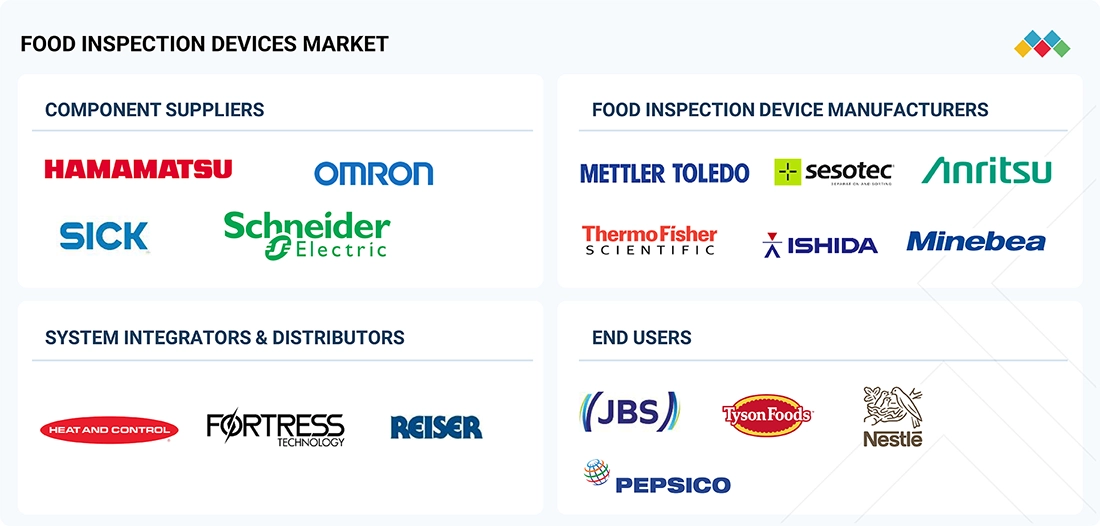
Food Inspection Devices Market: COMMERCIAL USE CASES ACROSS INDUSTRIES
| COMPANY | USE CASE DESCRIPTION | BENEFITS |
|---|---|---|
 |
Advanced X-ray, metal detection, and checkweighing for contamination, weight verification, and quality checks | High detection sensitivity | Compliance with global food safety standards (BRC, IFS) | Modular, automated systems | Real-time data analytics for process optimization |
 |
X-ray, metal detection, and spectroscopy systems for contaminant detection and product integrity verification | Superior analytical accuracy | Robust contamination detection | Integrated Data Management | High throughput for large-scale food processing |
 |
Checkweighers, X-ray, and vision systems for weight control, seal integrity, and foreign object detection | High-speed inspection | Precision weighing | Reliable packaging quality | Enhanced productivity through automation and digital monitoring |
 |
X-ray and metal detection for contamination control and package quality consistency | High-resolution imaging | Advanced detection algorithms | Reduced false rejects | Compliance with international safety and quality regulations |
 |
Metal detectors, checkweighers, and X-ray systems for automated end-of-line contamination and weight checks | Durable, hygienic designs | Easy integration with production lines | User-friendly interface | Global service support and regulatory compliance |
Logos and trademarks shown above are the property of their respective owners. Their use here is for informational and illustrative purposes only.
Related Ecosystem
Electronics System And Components
- Sensors
- Temperature Sensors
- Pressure Sensors
- Actuators
- Image Sensors
- Lenovo
- Samsung
- Texas Instruments Incorporated
- HONEYWELL INTERNATIONAL INC.
- Teledyne Technologies Incorporated
Key Takeaways
- North America's food inspection devices market will grow from $1,010.4M (2025) to $1,437.1M (2030) at a 7.3% CAGR.
- North America's stringent regulatory frameworks and food safety standards are primary drivers of market expansion.
- AI and machine vision technologies are accelerating adoption of advanced inspection solutions across North America's food processing sector.
- North America's established semiconductor infrastructure supports innovation and competitive advantage in automated inspection device development.
Food Inspection Devices Market Report Scope
| Report Metric | Details |
|---|---|
| Base Year | 2025 |
| Fastest Growing Segment | SPECTROSCOPY DEVICES (Product) |
| Forecast Period | 2025-2030 |
| Growth Rate | CAGR of 9.3% from 2025 to 2030 |
| Largest Segment | AUTOMATED/COMPUTERIZED SYSTEMS (Technology) |
| Market Size Base Year (Billions) | ~USD 3.26 (2025) |
| Revenue Forecast (Billions) | ~USD 5.08 (2030) |
| Segments Covered | Product, Vertical, Food Category, Technology |
North America Food Inspection Devices Market Report Segmentation
4 segment dimensions are covered across the global market.
By Product
- Checkweighers
- Metal Detectors
- Microbial Detection Systems
- Other Devices
- Spectroscopy Devices
- Vision Inspection Systems
- X-Ray Inspection Devices
By Vertical
- Food Manufacturers & Processors
- Food Packaging Companies
- Government Agencies, Food Safety Authorities, And Other Verticals
- Retail Chains & Hypermarkets
By Food Category
- Bakery & Confectionery
- Catering & Ready-To-Eat Meals
- Dairy
- Meat
- Poultry & Seafood
By Technology
- Automated/Computerized Systems
- Manual Inspection Devices
Target Audience
- Food & Beverage Manufacturers : North American F&B producers need this data to understand inspection technology investments required for FDA/FSMA compliance, optimize supply chain quality control, and reduce recall risks in a highly regulated market.
- Inspection Equipment Vendors : Technology providers require North America-specific market intelligence to identify customer segments, competitive positioning, and regional growth opportunities across the US, Canada, and Mexico markets.
- Food Safety Consultants : Compliance and quality assurance consultants use this market data to advise clients on technology adoption trends, regulatory drivers, and best-practice inspection solutions specific to North American operations.
- Private Equity & Investment Firms : Investors evaluating food tech and inspection equipment companies need North America market forecasts to assess portfolio company growth potential and identify acquisition targets in this 7.3% CAGR market.
- Food Retail & Distribution Networks : Large retailers and distributors require market insights to understand supplier inspection capabilities, set quality standards, and evaluate technology partnerships that ensure product safety across North American supply chains.
Countries within North America - compare and drill down
| Country | 2025 size (native) |
|---|---|
| US | USD 1105.7 Million |
| Canada | USD 175.9 Million |
| Mexico | USD 155.5 Million |
Country market size visualization
Reasons to Buy this Report
- Granular North American Market Segmentation : Access detailed market sizing and forecasts specific to the US ($1,105.7M), Canada ($175.9M), and Mexico ($155.5M), enabling precise market entry strategies and regional investment decisions.
- Regulatory Landscape Intelligence : Understand FDA, FSMA, and CFIA compliance requirements driving technology adoption across North America, with insights into how regulations shape purchasing decisions and market dynamics in each country.
- Competitive Positioning Data : Benchmark your solutions against regional competitors and identify market gaps in the fastest-growing North American segments, from automated vision systems to AI-enabled inspection platforms.
- Growth Opportunity Identification : Leverage the 7.3% CAGR forecast to identify high-potential subsegments and emerging applications in North America's food processing, beverage, and export-focused industries through 2030.
- Strategic Expansion Planning : Develop market entry or expansion strategies for Canada and Mexico markets, which represent $331.4M in combined 2025 value with distinct regulatory environments and growth trajectories.
Frequently asked questions
What is the current market size of food inspection devices in North America?
North America's food inspection devices market is valued at $1,010.4 million in 2025.
What is the projected market size for North America by 2030?
North America's food inspection devices market is projected to reach $1,437.1 million by 2030.
What is the growth rate for food inspection devices in North America?
North America's food inspection devices market is expected to grow at a compound annual growth rate of 7.3% from 2025 to 2030.
What factors are driving growth in North America's food inspection devices market?
Growth in North America is driven by stringent regulatory compliance (FDA, CFIA), rising food safety standards, consumer demand for quality assurance, and adoption of AI and machine vision technologies.
Which technologies are most prevalent in North America's food inspection market?
North America's market is increasingly dominated by AI-powered solutions, machine vision systems, and automated inspection devices aligned with Industry 4.0 standards.
RESEARCH METHODOLOGY
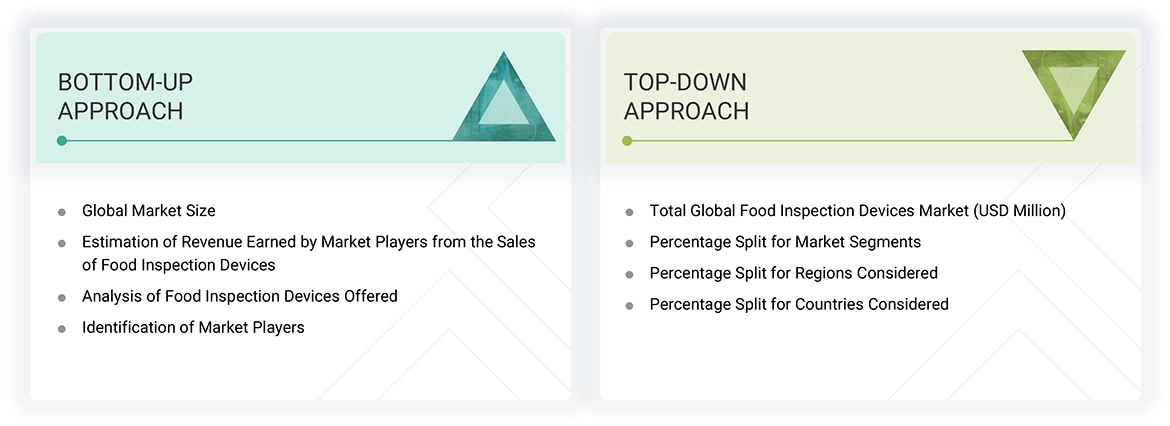
The research study involved four major activities in estimating the size of the food inspection devices market. Exhaustive secondary research has been done to collect important information about the market and peer markets. The next step has been to validate these findings and assumptions and size them with the help of primary research with industry experts across the value chain. Both top-down and bottom-up approaches have been used to estimate the market size. Post which, the market breakdown and data triangulation have been adopted to estimate the market sizes of segments and sub-segments.
Secondary Research
In the secondary research process, various secondary sources were referred to identify and collect the information required for this study. The secondary sources include annual reports, press releases, investor presentations of companies, white papers, and articles from recognized authors. Secondary research has been mainly done to obtain key information about the market’s value chain, the pool of key market players, market segmentation according to industry trends, regional outlook, and developments from both market and technology-oriented perspectives.
The food inspection devices market report estimates the global market size using both the top-down and bottom-up approaches, along with several other dependent submarkets. The major players in the market were identified using extensive secondary research, and their presence in the market was determined using secondary and primary research. All the percentage shares, splits, and breakdowns have been determined using secondary sources and verified through primary sources.
Primary Research
Extensive primary research has been conducted after understanding the food inspection devices market scenario through secondary research. Several primary interviews have been conducted with key opinion leaders from demand- and supply-side vendors across four major regions—North America, Europe, Asia Pacific, and the Rest of the World. Approximately 25% of the primary interviews have been conducted with the demand-side vendors and 75% with the supply-side vendors. Primary data has been collected mainly through telephonic interviews, which account for 80% of the total primary interviews. Questionnaires and emails have also been used to collect the data.
After successful interaction with industry experts, brief sessions were conducted with highly experienced independent consultants to reinforce the findings of our primary research. This, along with the in-house subject matter experts’ opinions, has led us to the findings as described in the report.
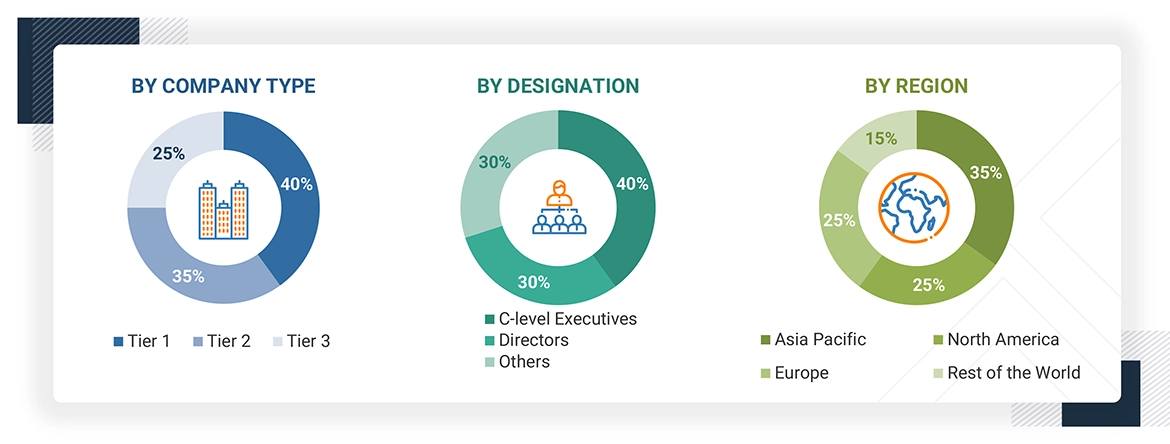
Note: “Others” includes sales, marketing, and product managers.
To know about the assumptions considered for the study, download the pdf brochure
Market Size Estimation
In the market engineering process, top-down and bottom-up approaches and data triangulation methods have been used to estimate and validate the size of the food inspection devices market and other dependent submarkets. The research methodology used to estimate the market sizes includes the following:
- Identifying stakeholders in the food inspection devices market, including certification bodies, regulatory authorities, accreditation agencies, consulting firms, and industry participants across the value chain
- Analyzing major providers of food inspection devices and their key offerings, including x-ray inspection devices, metal detectors, spectroscopy devices, checkweighers, vision inspection systems, microbial detection systems, and other food inspection devices
- Studying trends of food inspection devices across food categories such as meat, poultry & seafood, dairy, bakery & confectionery, and catering & ready-to-eat meals, based on product, technology, vertical, and region
- Tracking recent market developments, including regulatory updates from agencies like the U.S. FDA, EFSA (Europe), and FSSAI (India), introduction of advanced inspection technologies (e.g., AI-integrated X-ray and spectroscopy systems), and product launches of key players to accurately forecast market size and growth trends
- Conducting multiple discussions with key opinion leaders across equipment manufacturers, food processors, quality assurance consultants, and regulatory auditors to understand real-time adoption dynamics, operational challenges, and the shifting focus toward automation, compliance, and traceability in food inspection workflows
- Validating market estimates through in-depth consultations with industry experts—ranging from R&D heads of leading device manufacturers to quality heads of food processing units and technical advisors at regulatory bodies—and finally aligning insights with the domain experts at MarketsandMarkets to ensure robustness and precision in market projections
Food Inspection Devices Market : Top-Down and Bottom-Up Approach
Data Triangulation
After arriving at the overall market size by the market size estimation process explained in the earlier section, the overall food inspection devices market has been divided into several segments and subsegments. The data triangulation and market breakdown procedures have been used to complete the overall market engineering process and arrive at the exact statistics for all segments, wherever applicable. The data has been triangulated by studying various factors and trends from both the demand and supply side perspectives. Along with data triangulation and market breakdown, the market has been validated through the top-down and bottom-up approaches.
Market Definition
The food inspection devices market comprises a diverse array of technologically sophisticated systems designed to detect, monitor, and prevent contamination or defects throughout various stages of food production and packaging. These devices are essential for ensuring food safety, maintaining quality standards, and achieving regulatory compliance. They utilize advanced technologies such as X-ray imaging, metal detection, vision inspection, spectroscopy, and microbial detection.
Increasingly, food inspection systems are being integrated into automated production environments to facilitate real-time monitoring, reduce the incidence of product recalls, and enhance overall operational efficiency. These systems are deployed by food manufacturers, processors, packaging companies, and retailers to identify foreign objects, verify weight accuracy, assess packaging integrity, and confirm product compliance with industry norms and regulatory requirements.
The market is undergoing significant transformation, propelled by heightened consumer awareness, stricter regulatory frameworks, and escalating demand for safe, traceable, and high-quality food products. This shift is driving the adoption of predictive, data-centric solutions powered by artificial intelligence (AI), the Internet of Things (IoT), and machine learning. Consequently, food inspection devices are evolving from traditional manual systems into strategic assets that not only mitigate compliance risks and protect brand equity but also contribute to greater productivity and profitability across the global food supply chain.
Key Stakeholders
- Equipment Manufacturers and OEMs
- System Integrators and Automation Solution Providers
- Digital Solution Providers
- Calibration, Validation, and Maintenance Service Providers
- Food Safety and Quality Auditing Firms
- Regulatory Authorities and Food Safety Agencies
- Industry Associations and Technical Consortiums
- Research Institutions and Academic Bodies
- Food Processing and Packaging Companies
- Retail Chains, Hypermarkets, and Foodservice Operators
- End-use Industries
Report Objectives
- To define, describe, segment, and forecast the size of the food inspection devices market, by product, technology, vertical, food category, and region, in terms of value
- To forecast the market size for the product segment for metal detectors, in terms of volume
- To forecast the size of various segments for four regions: North America, Asia Pacific, Europe, and the Rest of the World (RoW), in terms of value
- To offer detailed information on drivers, restraints, opportunities, and challenges influencing market growth
- To provide a detailed overview of the food inspection devices market value chain
- To strategically analyze the micromarkets1 concerning individual growth trends, prospects, and contributions to the overall market
- To study the impact of AI/Gen AI on the market under study, along with the macroeconomic outlook for each region
- To analyze opportunities for various stakeholders by identifying the high-growth segments of the market
- To benchmark the key players and analyze their market position in terms of revenue, market share, and core competencies2 and provide a detailed competitive landscape for the market leaders
- To analyze competitive developments such as product launches carried out by players in the food inspection devices market
Available customizations:
With the given market data, MarketsandMarkets offers customizations according to the specific requirements of companies. The following customization options are available for the report:
Country-wise Information:
- Country-wise breakdown for North America, Europe, Asia Pacific, and Rest of the World
Company Information:
- Detailed analysis and profiling of additional market players (up to five)
Get the Full Food Inspection Devices Market Report
Full forecast, segment splits, and company analysis for all Food Inspection Devices Market.
- US Food Inspection Devices Market
- Canada Food Inspection Devices Market
- Mexico Food Inspection Devices Market
- Germany Food Inspection Devices Market
- UK Food Inspection Devices Market
- France Food Inspection Devices Market
- Italy Food Inspection Devices Market
- Spain Food Inspection Devices Market
- Poland Food Inspection Devices Market
- China Food Inspection Devices Market
- Japan Food Inspection Devices Market
- South Korea Food Inspection Devices Market
- India Food Inspection Devices Market
- Australia Food Inspection Devices Market
- Indonesia Food Inspection Devices Market
- Thailand Food Inspection Devices Market
- Malaysia Food Inspection Devices Market
- Vietnam Food Inspection Devices Market
- Nordics Food Inspection Devices Market
- Rest Of Europe Food Inspection Devices Market
- Rest Of Asia Pacific Food Inspection Devices Market
- Bahrain Food Inspection Devices Market
- Kuwait Food Inspection Devices Market
- Oman Food Inspection Devices Market
- Qatar Food Inspection Devices Market
- Rest Of Middle East Food Inspection Devices Market
- Saudi Arabia Food Inspection Devices Market
- UAE Food Inspection Devices Market
- Rest Of Africa Food Inspection Devices Market
- South Africa Food Inspection Devices Market
Need a Tailored Report?
Customize this report to your needs
Get 10% FREE Customization
Customize This Report
