
France Fragrance Ingredients Market (2024-2029)

The France Fragrance Ingredients Market was valued at $1017.2 Million in 2024 and projected to reach to $1276.1 Million by 2029, representing a compound annual growth rate of 4.6%. France's fragrance ingredients market is poised for steady expansion through 2029, supported by the country's established reputation in luxury perfumery and cosmetics innovation.


| Market Size in | USD 26.32 MN |
| Market Forecast in | |
| CAGR | |
| Forecast Period | |
| Units Considered | Value (USD MN) |
France Fragrance Ingredients Market Trends and Insights
- France maintains a significant position within the European fragrance ingredients sector, driven by the country's heritage in perfumery and cosmetics manufacturing.
- The market in France reflects strong demand from both domestic and international beauty and personal care brands seeking premium fragrance solutions. The fragrance ingredients market in France is supported by robust consumer preferences for natural and sustainable ingredients, aligning with broader European regulatory trends and consumer consciousness.
- France's established supply chain infrastructure and concentration of flavor and fragrance manufacturers position the country as a key hub for ingredient sourcing and innovation.
- Between 2024 and 2029, France is expected to benefit from increased investment in R&D and the growing adoption of clean-label and eco-friendly fragrance formulations across the food and beverage sector..
Key Market Statistics
- CAGR (2024-2029) 4.6% CAGR
- Market Size, 2024 ~USD 1017.2 Million
- Forecast, 2029 ~USD 1276.1 Million
- Country France
France Fragrance Ingredients Market Overview
Market Valuation :
France's fragrance ingredients market is valued at USD 1,017.2 million in 2024, reflecting the country's strong position as a European hub for perfumery and cosmetics manufacturing.
Growth Trajectory :
The French market is projected to reach USD 1,276.1 million by 2029, representing a CAGR of 4.6%, outpacing global growth rates and demonstrating robust domestic demand.
Heritage & Expertise :
France's centuries-old perfumery tradition and established cosmetics manufacturing base provide competitive advantages in fragrance ingredient innovation and quality standards.
Regional Leadership :
France maintains a significant position within the European fragrance ingredients sector, driven by strong demand from luxury brands, cosmetics manufacturers, and export markets.
France Fragrance Ingredients Market Dynamics
- The 4.6% CAGR reflects consistent demand from both domestic manufacturers and international export opportunities, particularly within the premium segment.
- France's strategic location within Europe and its skilled workforce continue to attract investment in fragrance ingredient production and R&D facilities. Key growth drivers include increasing consumer preference for natural and sustainable fragrance ingredients, rising demand from the cosmetics and personal care sectors, and France's role as a distribution hub for European markets.
- The market is expected to benefit from technological advancements in ingredient extraction and synthesis, as well as regulatory compliance with EU cosmetics standards, positioning France as a reliable supplier for high-quality fragrance ingredients..
Market Ecosystem
Related Ecosystem
Flavors Colors And Fragrances
- Dairy Products
- Anthocyanins
- Butyl Acetate
- Butyl Acrylate
- Glycol Ethers
- AZELIS HOLDINGS SA
- Amway
- DUAS RODAS INDUSTRIAL LTDA.
- Givaudan
- INTERNATIONAL FLAVORS & FRAGRANCES INC.
Key Takeaways
- France's fragrance ingredients market is valued at USD 1,017.2 million in 2024 and will reach USD 1,276.1 million by 2029.
- France is experiencing a 4.6% CAGR, reflecting steady growth driven by premium product demand and sustainability trends.
- France's established perfumery heritage and manufacturing infrastructure position it as a key European fragrance ingredients hub.
- Natural and eco-friendly fragrance ingredients are gaining traction in France, supported by regulatory frameworks and consumer preferences.
Fragrance Ingredients Market Report Scope
| Report Metric | Details |
|---|---|
| Base Year | 2024 |
| Fastest Growing Segment | PROPRIETARY INGREDIENTS (Ingredient Type) |
| Forecast Period | 2024-2029 |
| Growth Rate | CAGR of 5.1% from 2024 to 2029 |
| Largest Segment | LIQUID (Form) |
| Market Size Base Year (Billions) | ~USD 17.11 (2024) |
| Revenue Forecast (Billions) | ~USD 21.94 (2029) |
| Segments Covered | Source, Type, Ingredient Type, Application, Form, Natural Source, Synthetic Source |
France Fragrance Ingredients Market Report Segmentation
7 segment dimensions are covered across the global market.
By Source
- Natural
- Synthetic
By Type
- Citrus
- Floral
- Fruity
- Oriental
- Other Natural Sources
- Other Synthetic Sources
- Woody
By Ingredient Type
- Commodity Ingredients
- Proprietary Ingredients
- Specialty Ingredients
By Application
- Cosmetics
- Food & Beverages
- Household Products
- Industrial
- Other Applications
- Personal Care Products
By Form
- Liquid
- Powder
By Natural Source
- Citrus
- Floral
- Fruity
- Loral
- Oriental
- Other Natural Sources
- Woody
By Synthetic Source
- Citrus
- Floral
- Fruity
- Oriental
- Other Synthetic Sources
- Woody
Target Audience
- Fragrance Ingredient Manufacturers : Producers and suppliers need France-specific market data to optimize production capacity, identify distribution opportunities, and benchmark performance against regional competitors.
- Cosmetics & Personal Care Companies : Formulators and brand owners require detailed insights into France's ingredient availability, pricing trends, and supplier landscape to source quality ingredients and manage costs.
- Investment & Private Equity Firms : Investors evaluating opportunities in the European fragrance sector need France market analysis to assess growth potential, valuation benchmarks, and acquisition targets.
- Market Entry & Expansion Strategists : Companies planning European expansion require France-specific forecasts and market dynamics to develop localized strategies and allocate resources effectively.
- Trade & Industry Associations : Industry bodies and regulatory organizations need comprehensive France market data to support policy development, member advocacy, and sector benchmarking initiatives.
Reasons to Buy this Report
- Precise Market Sizing : Access validated market valuations for France (USD 1,017.2M in 2024) with accurate 5-year forecasts, enabling confident investment and expansion planning in this key European market.
- Competitive Intelligence : Understand France's fragrance ingredients landscape, including local supplier dynamics, manufacturing capabilities, and competitive positioning within the broader European market.
- Growth Opportunity Identification : Leverage the 4.6% CAGR data to identify high-potential segments and regional opportunities for product launches, partnerships, and market penetration strategies specific to France.
- Strategic Market Entry : Develop informed go-to-market strategies for France by understanding local demand drivers, regulatory requirements, and the country's role as a European distribution and manufacturing hub.
- Forecast-Driven Planning : Utilize 2029 projections (USD 1,276.1M) to align supply chain investments, production capacity, and resource allocation with anticipated market growth in France.
Frequently asked questions
What is the current size of the fragrance ingredients market in France?
The fragrance ingredients market in France is valued at USD 1,017.2 million in 2024.
What is the projected market size for fragrance ingredients in France by 2029?
France's fragrance ingredients market is projected to reach USD 1,276.1 million by 2029.
What is the CAGR for the fragrance ingredients market in France?
The fragrance ingredients market in France is growing at a CAGR of 4.6% from 2024 to 2029.
What factors are driving growth in France's fragrance ingredients market?
Growth in France is driven by demand for natural and sustainable ingredients, strong regulatory support for clean-label products, and the country's established perfumery and manufacturing infrastructure.
Why is France significant in the European fragrance ingredients market?
France is significant due to its long-standing heritage in perfumery, concentration of flavor and fragrance manufacturers, and established supply chain networks that serve both domestic and international markets.
RESEARCH METHODOLOGY
The research study involved extensive secondary sources, directories, and databases such as Bloomberg Businessweek and Factiva to identify and collect information useful for a technical, market-oriented, and commercial study of the fragrance ingredients market. In-depth interviews were conducted with various primary respondents—such as key industry participants, subject matter experts (SMEs), C-level executives of key market players, and industry consultants—to obtain and verify critical qualitative and quantitative information and assess prospects.
Secondary Research
The secondary sources referred for this research study include government sources, such as the Food and Agriculture Organization (FAO), the European Chemicals Agency (ECHA), International Fragrance Association (IFRA), and various national ministries of the fragrance ingredient department, corporate filings (such as annual reports, press releases, investor presentations, and financial statements), and trade, business, and professional associations such as In the secondary research process, various organizations such as the Japanese Cosmetic Industry Association (JCIA), Good Food Institute (GFI), and Associazione Italiana delle Imprese Cosmetiche (Cosmetica Italia), were referred to identify and collect information for this study.
Secondary research was mainly used to obtain key information about the industry's supply chain—the total pool of key players, market classification, and segmentation according to the industry trends and key developments from market-oriented perspectives.
Primary Research
The fragrance ingredients market comprises several stakeholders, including raw material suppliers, ingredient suppliers, end-product manufacturers, and regulatory organizations in the supply chain. Various primary sources from both the supply and demand sides of the market were interviewed to obtain qualitative and quantitative information. Primary interviewees from the supply side include research institutions involved in R&D to introduce technology, distributors, wholesalers, importers & exporters of processed ingredients manufacturers and technology providers. Primary sources from the demand-side include key opinion leaders, executives, vice presidents, and CEOs through questionnaires, emails, and telephonic interviews.
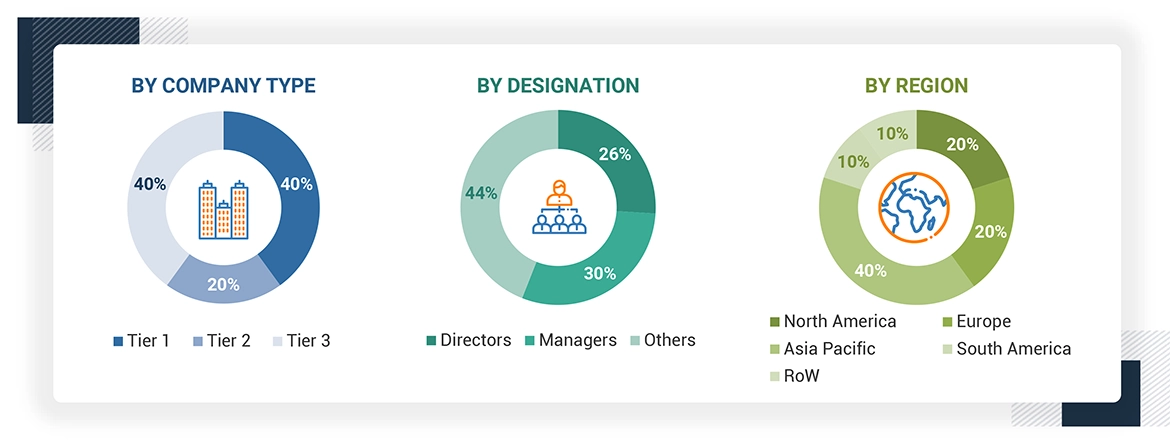
Note: Three tiers of the companies are defined based on their total revenues in 2022 or 2023, according to the availability of financial data.
Tier 1: Revenue > USD 1 billion
Tier 2: USD 100 million ≤ Revenue ≤ USD 1 billion
Tier 3: Revenue < USD 100 million
To know about the assumptions considered for the study, download the pdf brochure
Market Size Estimation
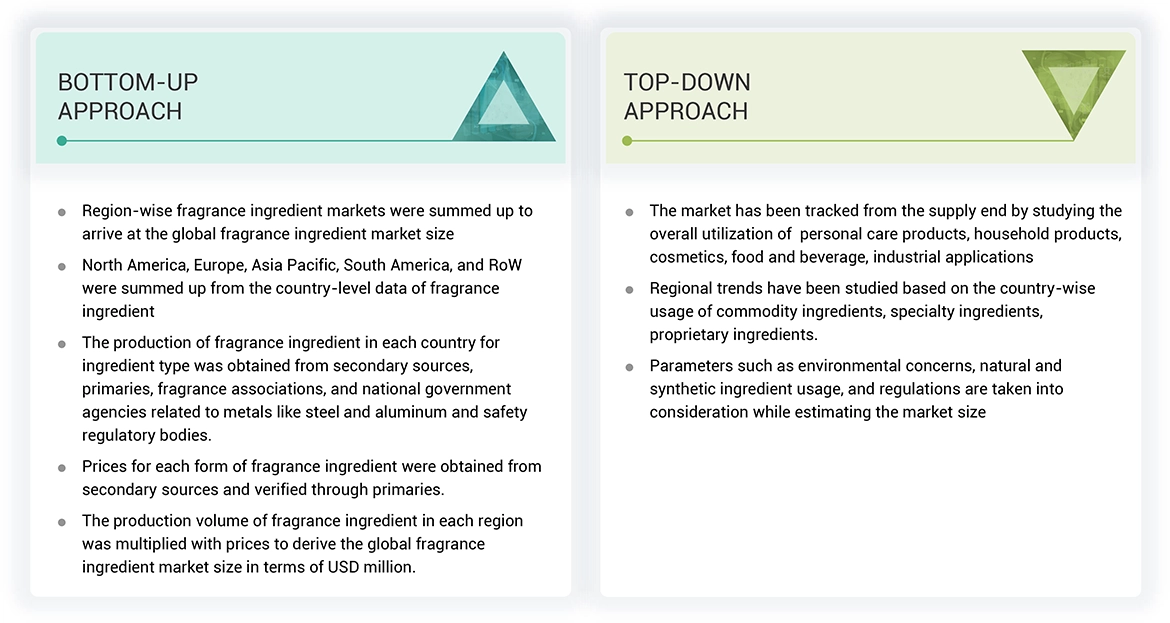
Both the top-down and bottom-up approaches have been used to estimate and validate the total size of the fragrance ingredients market. These approaches were extensive to determine the size of the subsegments in the market. The research methodology used to estimate the market size includes the following details:
-
Top-down approach:
- The key players in the industry and the market were identified through extensive secondary research.
- The industry's supply chain and market size were determined through primary and secondary research.
- All percentage share splits and breakdowns were determined using secondary sources and verified through primary sources.
- The parent market—the fragrance ingredients market—was considered to validate fragrance ingredients further.
-
Bottom-up approach:
- The market sizes were analyzed based on each type of fragrance ingredient share at regional and country levels. Thus, the global market for fragrance ingredients was estimated with a bottom-up approach of the type at the country level.
- Based on the demand for the mode of application, offerings of key players, and the region-wise market share of major players, the global market for the mode of application was estimated.
- Other factors considered include the penetration rate of fragrance ingredients in end-user applications such as personal care and cosmetics.
- All macroeconomic and microeconomic factors affecting the growth of the fragrance ingredients market were considered while estimating the market size.
- All possible parameters that affect the market covered in this research study were accounted for, viewed in extensive detail, verified through primary research, and analyzed to obtain final quantitative and qualitative data.
Fragrance Ingredients Market: Top-Down and Bottom-Up Approach
Data Triangulation
After arriving at the overall market size from the estimation process explained above, the total market was split into several segments and subsegments. The data triangulation and market breakdown procedures were employed, wherever applicable, to estimate the overall fragrance ingredients market and arrive at the exact statistics for all segments and subsegments. The data was triangulated by studying various factors and trends from the demand and supply sides. Along with this, the market size was validated using both the top-down and bottom-up approaches.
Market Definition
According to The International Fragrance Association (IFRA) defines a fragrance ingredient as a basic substance used to add an odor or cover up a malodor in a fragrance mixture. A fragrance is a chemical mixture that has a smell or odor- but it is so much more besides, encompassing cultural, historical, social, economic and emotional value.
The fragrance ingredients market involves the production and use of natural and synthetic compounds to create scents for products in personal care, household goods, cosmetics, food and beverages, and industrial applications. These ingredients are classified by source into natural (from plants, flowers, fruits) and synthetic (man-made compounds). The market is also segmented by ingredient type into commodity (widely available), specialty (distinctive, premium), and proprietary ingredients (exclusive, patented). Fragrance ingredients come in liquid and powder forms, with liquids used in perfumes and sprays, and powders in products like detergents and deodorants. Demand is driven by growth in sectors like personal care, alongside trends favoring natural, sustainable, and premium products.
Stakeholders
- Perfume manufacturers
- Food and Beverage manufacturers
- Cosmetics manufacturers
- Perosnal Care Product manufacturers
- Fragrance Ingredient importers and exporters
- Intermediary suppliers include traders and distributors of purfumes and cosmetics.
- Government and research organizations
-
Associations and industry bodies:
- Fragrance Creators Association (FCA)
- Cosmetic, Toiletry, and Perfumery Association (CTPA)
- Fragrance and Flavour Association of India (FAFAI)
- Food and Agriculture Organization (FAO)
- United States Department of Agriculture (USDA)
- European Food Safety Authority (EFSA)
- Organization for Economic Co-operation and Development (OECD)
- Venture capitalists and investors
Report Objectives
-
MARKET INTELLIGENCE
- To determine and project the size of the fragrance ingredients market by source, ingredient type, application and region over five years, ranging from 2024 to 2029.
- To identify attractive opportunities in the market by determining the largest and fastest-growing segments across regions.
- To analyze the demand-side factors based on the following:
- Impact of macro and microeconomic factors on the market.
- Shifts in demand patterns across different subsegments and regions.
- To recognize the key drivers and restraints impacting the global fragrance ingredients market.
-
COMPETITIVE INTELLIGENCE
- To profile the key players of the fragrance ingredients market and comprehensively analyze their market positions and core competencies
- To provide a comparative analysis of the market leaders based on the following:
- Product offerings
- Business strategies
- Strengths, weaknesses, opportunities, and threats
- Key financials
- To understand the competitive landscape and identify the major growth strategies adopted by players across the key regions
- To provide insights on the key investments in product innovations and patent registrations
Available Customizations
With the given market data, MarketsandMarkets offers customizations according to company-specific scientific needs.
The following customization options are available for the report:
Product Analysis
- Product Matrix, which gives a detailed comparison of the product portfolio of each company.
Geographic Analysis as per Feasibility
- Further breakdown of the Rest of the European fragrance ingredients market, by key country
- Further breakdown of the Rest of the South American fragrance ingredients market market, by key country
- Further breakdown of the Rest of Asia Pacific fragrance ingredients market market, by key country
Company Information
- Detailed analyses and profiling of additional market players
Get the Full Fragrance Ingredients Market Report
Full forecast, segment splits, and company analysis for all Fragrance Ingredients Market.
- Italy Fragrance Ingredients Market
- Spain Fragrance Ingredients Market
- China Fragrance Ingredients Market
- India Fragrance Ingredients Market
- Japan Fragrance Ingredients Market
- Brazil Fragrance Ingredients Market
- Argentina Fragrance Ingredients Market
- Rest Of Europe Fragrance Ingredients Market
- Rest Of Asia Pacific Fragrance Ingredients Market
- Rest Of South America Fragrance Ingredients Market
- Saudi Arabia Fragrance Ingredients Market
- Turkey Fragrance Ingredients Market
- UAE Fragrance Ingredients Market
- US Fragrance Ingredients Market
- Canada Fragrance Ingredients Market
- Mexico Fragrance Ingredients Market
- Germany Fragrance Ingredients Market
- UK Fragrance Ingredients Market
Need a Tailored Report?
Customize this report to your needs
Get 10% FREE Customization
Customize This Report
