
Europe Pharmaceutical Drying Equipment Market (2024-2029)

The Europe Pharmaceutical Drying Equipment Market was valued at $1783.6 Million in 2024 and projected to reach to $2416.6 Million by 2029, representing a compound annual growth rate of 6.3%. Europe's pharmaceutical drying equipment market is poised for sustained growth through 2029, supported by the region's commitment to pharmaceutical excellence and regulatory compliance.


| Market Size in | USD 26.32 MN |
| Market Forecast in | |
| CAGR | |
| Forecast Period | |
| Units Considered | Value (USD MN) |
Europe Pharmaceutical Drying Equipment Market Trends and Insights
- This 6.3% compound annual growth rate reflects Europe's robust pharmaceutical manufacturing infrastructure and stringent regulatory requirements that drive investment in advanced drying technologies.
- Europe's established pharmaceutical sector, combined with increasing demand for biologics and specialty drugs, continues to fuel adoption of sophisticated drying equipment across the region. The European market benefits from strong regulatory frameworks, including EU Good Manufacturing Practice (GMP) standards, which necessitate high-quality drying solutions for pharmaceutical production.
- Europe's commitment to innovation and sustainability in pharmaceutical manufacturing further accelerates the adoption of energy-efficient and environmentally compliant drying equipment.
- Between 2024 and 2029, Europe is expected to maintain its position as a critical hub for pharmaceutical manufacturing, with drying equipment investments supporting the production of vaccines, biologics, and advanced therapeutics across the continent..
Key Market Statistics
- CAGR (2024-2029) 6.3% CAGR
- Market Size, 2024 ~USD 1783.6 Million
- Forecast, 2029 ~USD 2416.6 Million
- Geography Europe
Europe Pharmaceutical Drying Equipment Market Overview
Market Valuation & Growth :
Europe's pharmaceutical drying equipment market is valued at $1,783.6 million in 2024, with a projected expansion to $2,416.6 million by 2029, representing a steady 6.3% CAGR driven by continuous pharmaceutical manufacturing investments.
Regulatory Compliance Driver :
Stringent European regulatory requirements, including GMP and EMA standards, mandate advanced drying technologies in pharmaceutical production, creating sustained demand for high-quality equipment across the region.
Manufacturing Infrastructure :
Europe's robust and established pharmaceutical manufacturing base, supported by leading markets in Germany, UK, and France, provides a strong foundation for drying equipment adoption and technological advancement.
Regional Market Leaders :
Germany leads European market with $184.38 million, followed by the UK ($143.02 million) and France ($110.39 million), reflecting concentrated pharmaceutical production and innovation hubs across Western Europe.
Europe Pharmaceutical Drying Equipment Market Dynamics
- The 6.3% CAGR reflects steady investment in modernizing manufacturing facilities and adopting advanced drying technologies to meet stringent quality standards.
- Key drivers include increasing pharmaceutical production volumes, expansion of biologics manufacturing, and the need for equipment upgrades in aging facilities. The market outlook remains positive as European manufacturers prioritize efficiency, sustainability, and compliance with evolving regulations.
- Investment in R&D for innovative drying solutions, coupled with the region's focus on reducing environmental impact, will continue to fuel market expansion.
- Strategic partnerships between equipment manufacturers and pharmaceutical companies will further accelerate technology adoption across the continent..
Market Ecosystem
Related Ecosystem
Key Takeaways
- Europe's pharmaceutical drying equipment market is valued at $1,783.6 million in 2024 and is forecast to reach $2,416.6 million by 2029, representing a 6.3% CAGR.
- Europe's stringent regulatory environment and GMP compliance requirements drive consistent demand for advanced drying technologies across the region.
- The growth in Europe's biologics and specialty pharmaceutical production is a primary driver of drying equipment adoption through 2029.
- Europe's focus on sustainability and energy efficiency is shaping the development of next-generation drying equipment solutions in the pharmaceutical sector.
Pharmaceutical Drying Equipment Market Report Scope
| Report Metric | Details |
|---|---|
| Base Year | 2024 |
| Fastest Growing Segment | FREEZE DRYERS (Type) |
| Forecast Period | 2024-2029 |
| Growth Rate | CAGR of 7.1% from 2024 to 2029 |
| Largest Segment | PHARMACEUTICAL AND BIOTECH COMPANIES (End User) |
| Market Size Base Year (Billions) | ~USD 5.81 (2024) |
| Revenue Forecast (Billions) | ~USD 8.18 (2029) |
| Segments Covered | Type, Scale Of Operation, End User |
Europe Pharmaceutical Drying Equipment Market Report Segmentation
3 segment dimensions are covered across the global market.
By Type
- Fluidized Bed Dryers
- Freeze Dryers
- Other Dryers
- Spray Dryers
- Vacuum Dryers
By Scale Of Operation
- Industrial-Scale Equipment
- Laboratory-Scale Equipment
- Pilot-Scale Equipment
By End User
- Contract Development And Manufacturing Organizations
- Pharmaceutical And Biotech Companies
- Research Academies And Universities
EUROPE: PHARMACEUTICAL DRYING EQUIPMENT MARKET, BY END USER,2022–2029
| Segment | 2022 | 2023 | 2024 | 2025 | 2026 | 2027 | 2028 | 2029 | CAGR (%) |
|---|---|---|---|---|---|---|---|---|---|
| CONTRACT DEVELOPMENT AND MANUFACTURING ORGANIZATIONS | 614.7 | 649.2 | 687 | 729.8 | 776.8 | 828.5 | 884.5 | 945.2 | 6.6 |
| PHARMACEUTICAL AND BIOTECH COMPANIES | 943.7 | 992.1 | 1045.2 | 1105.3 | 1171.2 | 1243.4 | 1321.4 | 1405.8 | 6.1 |
| RESEARCH ACADEMIES AND UNIVERSITIES | 47.4 | 49.3 | 51.4 | 53.8 | 56.4 | 59.2 | 62.3 | 65.6 | 5 |
| TOTAL | 1605.9 | 1690.7 | 1783.6 | 1888.9 | 2004.4 | 2131.1 | 2268.2 | 2416.6 | 6.3 |
REST OF EUROPE: PHARMACEUTICAL DRYING EQUIPMENT MARKET, BY END USER, 2022–2029
| Segment | 2022 | 2023 | 2024 | 2025 | 2026 | 2027 | 2028 | 2029 | CAGR (%) |
|---|---|---|---|---|---|---|---|---|---|
| CONTRACT DEVELOPMENT AND MANUFACTURING ORGANIZATIONS | 215.4 | 222.6 | 230.3 | 239.1 | 248.7 | 259.1 | 270.1 | 281.7 | 4.1 |
| PHARMACEUTICAL AND BIOTECH COMPANIES | 327.4 | 336.6 | 346.8 | 358.4 | 371.1 | 384.8 | 399.3 | 414.6 | 3.6 |
| RESEARCH ACADEMIES AND UNIVERSITIES | 16.8 | 17.1 | 17.4 | 17.8 | 18.2 | 18.7 | 19.2 | 19.7 | 2.5 |
| TOTAL | 559.6 | 576.3 | 594.4 | 615.3 | 638 | 662.6 | 688.6 | 716 | 3.8 |
Target Audience
- Pharmaceutical Manufacturers : European pharma producers need market intelligence to plan equipment upgrades, optimize drying processes, and ensure compliance with regional regulations while managing capital expenditure efficiently.
- Equipment Manufacturers & Suppliers : Drying equipment vendors require detailed market sizing and country-level data to identify growth opportunities, prioritize market entry strategies, and develop region-specific product offerings for Europe.
- Investment & Private Equity Firms : Investors evaluating pharmaceutical manufacturing or equipment supply opportunities need comprehensive European market data to assess growth potential, competitive dynamics, and ROI across the region.
- Regulatory & Compliance Consultants : Consultants advising pharmaceutical companies on GMP compliance and facility modernization require market context to recommend appropriate drying technologies and justify investment decisions to stakeholders.
- Market Research & Strategy Teams : Corporate strategy and business development teams need European market segmentation and forecasts to support competitive analysis, market entry planning, and long-term strategic positioning decisions.
Countries within Europe - compare and drill down
| Country | 2025 size (native) |
|---|---|
| Germany | USD 184.38 Million |
| France | USD 110.39 Million |
| UK | USD 143.02 Million |
| Italy | USD 100.99 Million |
| Spain | USD 49.67 Million |
| Rest Of Europe | USD 249.6 Million |
Country market size visualization
Reasons to Buy this Report
- Market Size & Forecast Data : Access precise valuation of Europe's $1,783.6M market with detailed 5-year forecasts to $2,416.6M, enabling accurate budgeting and investment planning for pharmaceutical equipment procurement.
- Country-Level Insights : Detailed breakdown of leading European markets including Germany ($184.38M), UK ($143.02M), and France ($110.39M), identifying high-opportunity regions for equipment manufacturers and suppliers.
- Regulatory & Compliance Context : Understand how European GMP standards and EMA regulations drive drying equipment demand, helping stakeholders align product development with regional compliance requirements and market expectations.
- Competitive Landscape Analysis : Identify market dynamics across Europe's fragmented pharmaceutical manufacturing sector, revealing opportunities for differentiation and strategic positioning in key industrial hubs.
- Growth Driver Intelligence : Leverage insights on manufacturing infrastructure expansion, biologics production growth, and sustainability initiatives shaping European pharmaceutical drying equipment investments through 2029.
Frequently asked questions
What is the current size of Europe's pharmaceutical drying equipment market?
Europe's pharmaceutical drying equipment market was valued at $1,783.6 million in 2024 and is expected to grow to $2,416.6 million by 2029.
What is the projected growth rate for Europe's pharmaceutical drying equipment market?
Europe's pharmaceutical drying equipment market is projected to grow at a compound annual growth rate (CAGR) of 6.3% from 2024 to 2029.
What regulatory factors influence Europe's pharmaceutical drying equipment market?
Europe's strict EU Good Manufacturing Practice (GMP) standards and regulatory compliance requirements mandate the use of high-quality drying equipment, driving market growth across the region.
Which pharmaceutical segments are driving growth in Europe's drying equipment market?
Europe's increasing production of biologics, vaccines, and specialty pharmaceuticals is a key driver of drying equipment demand and market expansion through 2029.
How is sustainability impacting Europe's pharmaceutical drying equipment market?
Europe's emphasis on energy-efficient and environmentally compliant manufacturing is accelerating the adoption of sustainable drying technologies in the pharmaceutical sector.
RESEARCH METHODOLOGY
This study involved the extensive use of both primary and secondary sources. The research process involved the study of various factors affecting the industry to identify the segmentation types, industry trends, key players, competitive landscape, fundamental market dynamics, and key player strategies.
Secondary Research
The secondary research process involves the widespread use of secondary sources, directories, databases (such as Bloomberg Businessweek, Factiva, and D&B Hoovers), white papers, annual reports, company house documents, investor presentations, SEC filings of companies and publications from government sources [such as National Institutes of Health (NIH), US FDA, US Census Bureau, World Health Organization (WHO), International Trade Administration (ITA), Global Burden of Disease Study , International Diabetes Federation (IDF), and Centers for Medicare and Medicaid Services (CMS) were referred to identify and collect information for the global pharmaceutical drying equipment market study. It was also used to obtain important information about the key players and market classification & segmentation according to industry trends to the bottom-most level and key developments related to market and technology perspectives. A database of the key industry leaders was also prepared using secondary research.
Primary Research
In the primary research process, various sources from both the supply and demand sides were interviewed to obtain qualitative and quantitative information for this report. The primary sources from the supply side include industry experts such as CEOs, vice presidents, marketing and sales directors, technology & innovation directors, and related key executives from various key companies and organizations in the pharmaceutical drying equipment market. The primary sources from the demand side include pharmaceutical, biopharmaceutical companies, contract development and manufacturing organizations, and research academics and universities. Primary research was conducted to validate the market segmentation, identify key players in the market, and gather insights on key industry trends & key market dynamics.
A breakdown of the primary respondents is provided below:
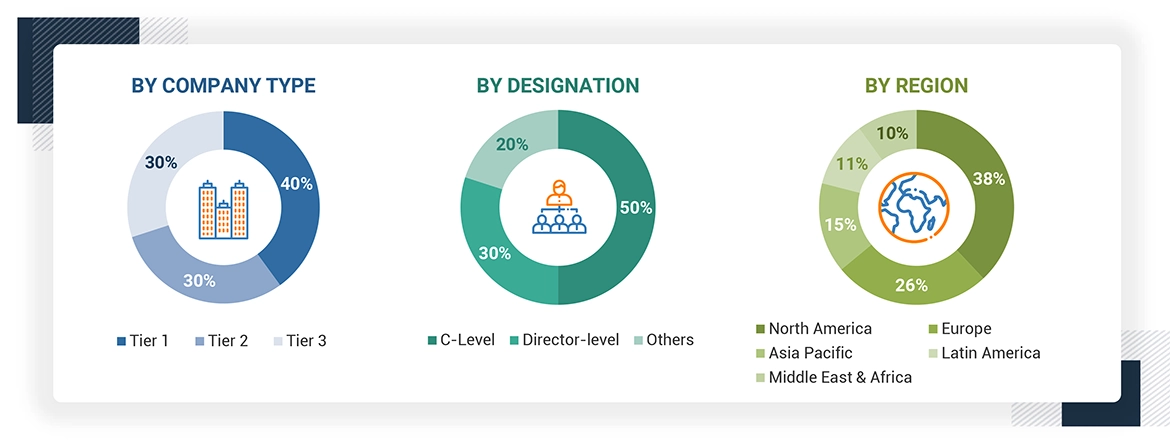
*C-level primaries include CEOs, CFOs, COOs, and VPs.
*Others include sales managers, marketing managers, business development managers, product managers, distributors, and suppliers.
Note: Companies are classified into tiers based on their total revenue. As of 2023, Tier 1 = >USD 10.00 billion, Tier 2 = USD 1.00 billion to USD 10.00 billion, and Tier 3 = < USD 1.00 billion.
Source: MarketsandMarkets Analysis
To know about the assumptions considered for the study, download the pdf brochure
Market Size Estimation
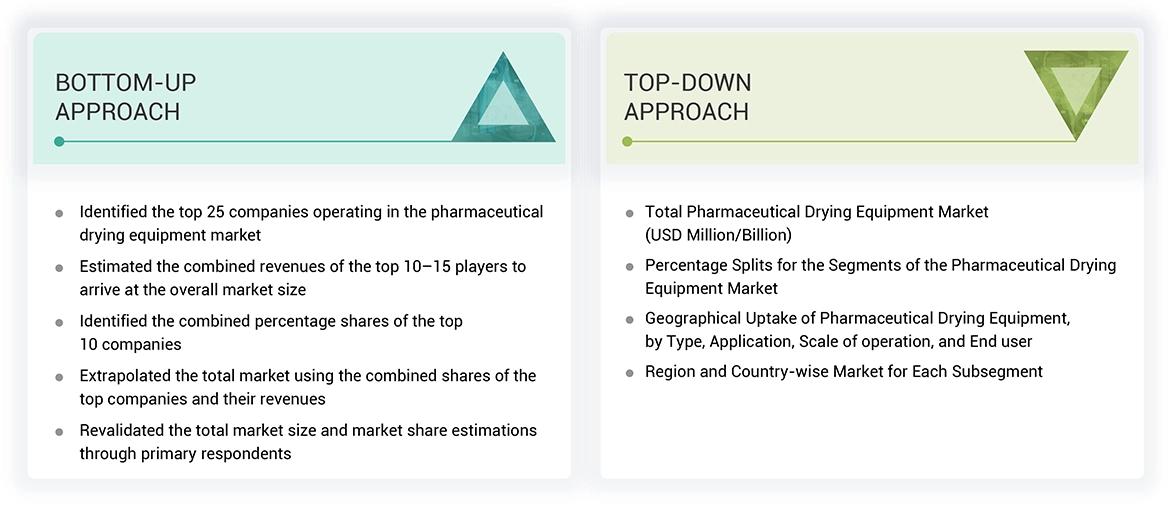
For the global market value, annual revenues were calculated based on the revenue mapping of major product manufacturers and OEMs active in the global pharmaceutical drying equipment market. All the major product manufacturers were identified at the global and/or country/regional level. Revenue mapping for the respective business segments/sub-segments was done for the major players. Also, the global pharmaceutical drying equipment market was split into various segments and sub-segments based on:
- List of major players operating in the products market at the regional and/or country level
- Product mapping of various pharmaceutical drying equipment manufacturers at the regional and/or country level
- Mapping of annual revenue generated by listed major players from pain management devices(or the nearest reported business unit/product category)
- Revenue mapping of major players to cover at least 70-75% of the global market share as of 2023
- Extrapolation of the revenue mapping of the listed major players to derive the global market value of the respective segments/subsegments
- Summation of the market value of all segments/subsegments to arrive at the global point-of-care diagnostics market
The above-mentioned data was consolidated and added with detailed inputs and analysis from MarketsandMarkets and presented in this report.
Market Size Estimation (Bottom Up approach & Top down approach)
Data Triangulation
After arriving at the overall size of the global pharmaceutical drying equipment market through the above-mentioned methodology, this market was split into several segments and subsegments. The data triangulation and market breakdown procedures were employed, wherever applicable, to complete the overall market engineering process and arrive at the exact market value data for the key segments and subsegments. The extrapolated market data was triangulated by studying various macro indicators and regional trends from both demand- and supply-side participants.
Market Definition
Pharmaceutical drying equipment is used to remove solvents, such as water, from drug formulations through the application of heat. This process ensures the stability and efficacy of the final product by preventing chemical and microbiological deterioration. Common methods include air drying, vacuum drying, freeze-drying, and spray drying. These methods are crucial in both research and large-scale manufacturing to produce dry solid masses or powders, maintaining the quality and safety of active pharmaceutical ingredients (APIs).
Stakeholders
- Pharmaceutical drying equipment Manufacturers
- Freeze-drying/lyophilization equipment vendors/service providers
- Research and consulting firms
- Venture capitalists
- Government agencies
- Raw material suppliers
- Regulatory bodies
- Commercial research & development (R&D) institutions and financial institutions
- Importers and exporters of pharmaceutical drying equipment
- Traders, distributors, and suppliers
- Government and research organizations
- Trade associations and industry bodies
Report Objectives
- To define, describe, and forecast the pharmaceutical drying equipment market based on type, scale of operation, end user, and region.
- To forecast the market size based on five key regions: North America, Europe, Asia Pacific, Latin America, and Middle East & Africa.
- To strategically analyze the industry trends, technology trends, pricing analysis, regulatory scenario, supply/value chain, ecosystem mapping, porter’s five forces, patent analysis, key stakeholders and buying criteria, and conference and events.
- To provide detailed information regarding the major factors influencing the growth of this market (such as drivers, restraints, opportunities, and challenges)
- To analyze the micromarkets with respect to individual growth trends, prospects, and contributions to the overall pharmaceutical drying equipment market.
- To analyze the opportunities for stakeholders and provide details of the competitive landscape for market leaders.
- To strategically profile key players in the pharmaceutical drying equipment market and comprehensively analyze their core competencies.
- To track and analyze competitive developments such as product launches & approvals, partnerships, agreements, collaborations, joint ventures, expansions, and acquisitions in the overall pharmaceutical drying equipment market.
- To benchmark players within the market using the proprietary “Competitive Evaluation Matrix” framework, which analyzes market players on various parameters within the broad categories of business and product/service strategy
- To analyze the generative AI impact on the pharmaceutical drying equipment market
Get the Full Pharmaceutical Drying Equipment Market Report
Full forecast, segment splits, and company analysis for all Pharmaceutical Drying Equipment Market.
- US Pharmaceutical Drying Equipment Market
- Canada Pharmaceutical Drying Equipment Market
- Germany Pharmaceutical Drying Equipment Market
- France Pharmaceutical Drying Equipment Market
- UK Pharmaceutical Drying Equipment Market
- Italy Pharmaceutical Drying Equipment Market
- Spain Pharmaceutical Drying Equipment Market
- China Pharmaceutical Drying Equipment Market
- Japan Pharmaceutical Drying Equipment Market
- India Pharmaceutical Drying Equipment Market
- Australia Pharmaceutical Drying Equipment Market
- South Korea Pharmaceutical Drying Equipment Market
- Brazil Pharmaceutical Drying Equipment Market
- Mexico Pharmaceutical Drying Equipment Market
- Rest Of Europe Pharmaceutical Drying Equipment Market
- Rest Of Asia Pacific Pharmaceutical Drying Equipment Market
- Rest Of Latin America Pharmaceutical Drying Equipment Market
Need a Tailored Report?
Customize this report to your needs
Get 10% FREE Customization
Customize This Report
