
GCC Countries FRP Rebar Market (2025-2030)

The GCC Countries FRP Rebar Market was valued at $42.66 Million in 2025 and projected to reach to $75.59 Million by 2030, representing a compound annual growth rate of 12.1%. The FRP Rebar market in GCC Countries is poised for exceptional growth through 2030, driven by large-scale infrastructure investments and the region's focus on sustainable construction materials.


| Market Size in | USD 26.32 MN |
| Market Forecast in | |
| CAGR | |
| Forecast Period | |
| Units Considered | Value (USD MN) |
GCC Countries FRP Rebar Market Trends and Insights
- This represents a compound annual growth rate (CAGR) of 12.1%, significantly outpacing global trends and reflecting strong regional demand for advanced composite reinforcement solutions.
- GCC Countries' construction and infrastructure sectors are increasingly adopting fiber-reinforced polymer rebar due to superior corrosion resistance and durability in harsh desert and coastal environments. GCC Countries' strategic investments in mega-projects, including smart cities and renewable energy infrastructure, are driving accelerated adoption of FRP rebar technology.
- The region's emphasis on sustainable building materials and long-term cost efficiency aligns with FRP rebar's performance advantages.
- Between 2025 and 2030, GCC Countries is expected to consolidate its position as a key growth market within the Middle East Africa region, supported by regulatory frameworks promoting advanced construction materials and rising awareness among engineers and contractors..
Key Market Statistics
- CAGR (2025-2030) 12.1% CAGR
- Market Size, 2025 ~USD 42.66 Million
- Forecast, 2030 ~USD 75.59 Million
- Country GCC Countries
GCC Countries FRP Rebar Market Overview
Outpacing Global Growth :
GCC Countries' FRP Rebar market grows at 12.1% CAGR, exceeding the global rate of 11.5%, driven by accelerated infrastructure modernization and construction activity across the region.
Significant Market Expansion :
Market valuation is projected to nearly double from USD 42.66 million in 2025 to USD 75.59 million by 2030, reflecting strong regional adoption of composite reinforcement technologies.
Construction Sector Momentum :
GCC Countries' ambitious mega-projects, including smart cities and transportation infrastructure, are driving substantial demand for corrosion-resistant FRP rebar solutions in harsh desert climates.
Regional Competitive Advantage :
Strategic location, oil-backed economies, and government investment in diversification initiatives position GCC as a high-growth hub for advanced composite material adoption.
GCC Countries FRP Rebar Market Dynamics
- Government initiatives promoting economic diversification, coupled with increasing awareness of FRP rebar's superior durability in corrosive coastal and desert environments, are accelerating market penetration across the UAE, Saudi Arabia, and Qatar. Key growth catalysts include the expansion of port facilities, highway networks, and commercial real estate developments.
- The region's preference for long-lasting, maintenance-free reinforcement solutions aligns perfectly with FRP rebar's value proposition, positioning GCC Countries as a critical growth market for composite material suppliers and construction stakeholders..
Market Ecosystem
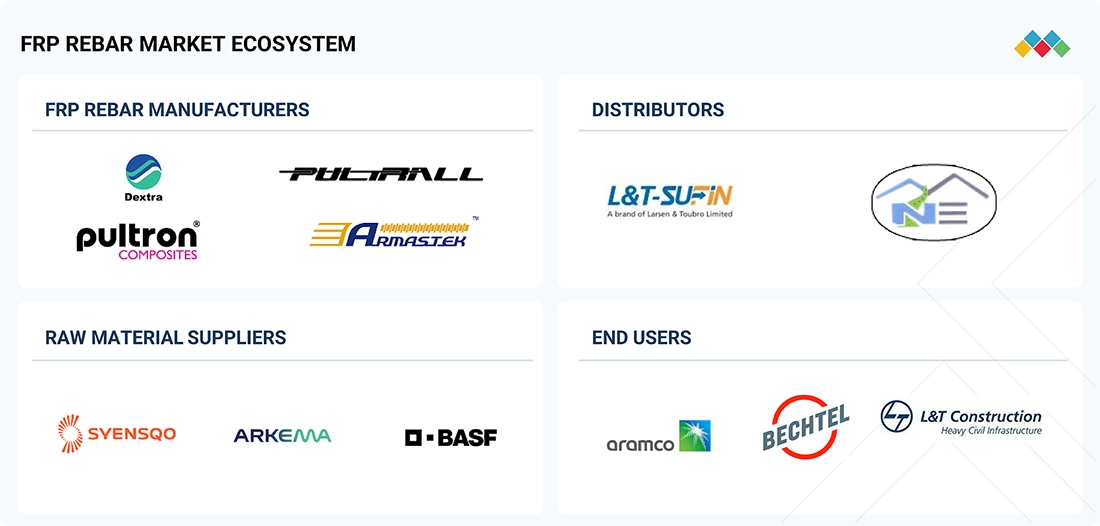
FRP Rebar Market: COMMERCIAL USE CASES ACROSS INDUSTRIES
| COMPANY | USE CASE DESCRIPTION | BENEFITS |
|---|---|---|
 |
Construction of the 23km-long Jizan Flood Mitigation Channel in Jizan Economic City, using GFRP rebar as concrete reinforcement throughout the entire project - the world's largest project constructed using FRP rebar. | Complete corrosion resistance in harsh coastal environment, elimination of maintenance costs over project lifespan, and alignment with non-metallic initiative for sustainable infrastructure development. |
 |
Construction of modular FRP quarantine and isolation units for a 500-bed Greenfield hospital project in Kasargod, Kerala, using FRP sandwich sheets for walls, roof panels, and doors in collaboration with Tata Consulting Engineers | Lightweight construction with high strength-to-weight ratio, complete corrosion resistance and weatherproof performance, easier and cheaper transportation, and maintenance-free service life for healthcare infrastructure. |
 |
Integration of GFRP rebar in tunnel linings for the Mumbai Coastal Road Project and Versova-Ghatkopar Metro line, allowing TBM cutting through reinforcement without requiring steel cutter modifications | Faster tunnel boring machine advance rates, minimized mechanical wear on equipment, and long-term structural integrity in high-humidity subsurface conditions. |
Logos and trademarks shown above are the property of their respective owners. Their use here is for informational and illustrative purposes only.
Related Ecosystem
Resins And Polymers
- Polycarbonate
- Acrylonitrile Butadiene Styrene (ABS)
- Epoxy Resin
- Light Commercial Vehicles (LCVs)
- Polypropylene (PP)
- Basf se
- DOW CHEMICAL COMPANY
- Solvay sa
- Saudi arabia basic industries corporation (sabic)
- DuPont de Nemours, Inc.
Key Takeaways
- GCC Countries FRP Rebar Market is valued at USD 42.66 million in 2025, growing at a 12.1% CAGR through 2030.
- GCC Countries' harsh environmental conditions and mega-infrastructure projects drive strong demand for corrosion-resistant FRP rebar solutions.
- By 2030, GCC Countries market is forecast to reach USD 75.59 million, reflecting accelerating adoption in construction and renewable energy sectors.
- GCC Countries' regulatory support for sustainable materials and long-term infrastructure durability positions the region as a high-growth market within Middle East Africa.
FRP Rebar Market Report Scope
| Report Metric | Details |
|---|---|
| Base Year | 2025 |
| Fastest Growing Segment | EPOXY (Resin Type) |
| Forecast Period | 2025-2030 |
| Growth Rate | CAGR of 11.5% from 2025 to 2030 |
| Largest Segment | GLASS FIBER (Fiber Type) |
| Market Size Base Year (Billions) | ~USD 0.69 (2025) |
| Revenue Forecast (Billions) | ~USD 1.19 (2030) |
| Segments Covered | Fiber Type, Resin Type, Tensile Strength, Diameter, Surface Treatment, Application |
GCC Countries FRP Rebar Market Report Segmentation
6 segment dimensions are covered across the global market.
By Fiber Type
- Basalt Fiber
- Carbon Fiber
- Glass Fiber
By Resin Type
- Epoxy
- Other Resin Types
- Vinyl Ester
By Tensile Strength
- High Strength (>2,000 Mpa)
- Low Strength (<1,000 Mpa)
- Low Strength (<1000 Mpa)
- Medium Strength (1,000-2,000 Mpa)
By Diameter
- 10-20 Mm
- <10 Mm
- >20 Mm
By Surface Treatment
- Other Surface Treatments
- Ribbed
- Sand Coated
By Application
- Highways, Bridges & Buildings
- Marine Structures & Waterfronts
- Other Applications
- Water Treatment Plants
Target Audience
- Construction & Infrastructure Developers : GCC-based developers need market intelligence on FRP rebar adoption trends, project specifications, and supplier capabilities to integrate advanced materials into mega-projects and ensure competitive advantage.
- Material Suppliers & Manufacturers : Global and regional FRP rebar producers require GCC-specific demand forecasts, customer preferences, and competitive positioning data to optimize production capacity and market share strategies.
- Engineering & Consulting Firms : Regional engineering consultants need detailed market insights and technical adoption trends in GCC Countries to advise clients on material selection and project feasibility for infrastructure initiatives.
- Investment & Private Equity Firms : Investors evaluating opportunities in GCC construction materials sector require comprehensive market sizing, growth projections, and competitive dynamics to assess portfolio companies and acquisition targets.
- Government & Policy Makers : GCC government agencies and economic development bodies need market data to inform infrastructure policies, material standards, and investment incentives supporting regional construction sector growth.
Reasons to Buy this Report
- Regional Market Sizing & Forecasts : Access precise market valuations for GCC Countries (USD 42.66M in 2025, USD 75.59M in 2030) with country-level breakdowns for UAE, Saudi Arabia, Qatar, Kuwait, Bahrain, and Oman to inform investment decisions.
- Growth Driver Analysis : Understand region-specific catalysts including mega-projects, government diversification policies, and climate-driven demand for corrosion-resistant materials unique to GCC construction landscapes.
- Competitive Landscape Intelligence : Identify key players, market share distribution, and competitive strategies tailored to GCC Countries' regulatory environment and procurement preferences for composite reinforcement solutions.
- Strategic Market Entry Guidance : Leverage GCC-specific insights on distribution channels, customer segments, pricing strategies, and partnership opportunities to successfully penetrate this high-growth regional market.
- Risk & Opportunity Assessment : Evaluate market barriers, regulatory frameworks, supply chain dynamics, and emerging opportunities specific to GCC Countries to optimize resource allocation and minimize market entry risks.
Frequently asked questions
What is the current market size of FRP Rebar in GCC Countries?
The FRP Rebar Market in GCC Countries is valued at USD 42.66 million in 2025, with verified data confirming strong regional demand for advanced composite reinforcement materials.
What is the projected market size for FRP Rebar in GCC Countries by 2030?
GCC Countries' FRP Rebar Market is forecast to reach USD 75.59 million by 2030, representing a 12.1% compound annual growth rate over the five-year period.
Why is GCC Countries experiencing faster FRP Rebar growth than the global average?
GCC Countries' 12.1% CAGR exceeds the global 11.5% rate due to aggressive infrastructure development, mega-projects, harsh environmental conditions requiring corrosion-resistant materials, and regional regulatory support for sustainable construction solutions.
What are the primary drivers of FRP Rebar adoption in GCC Countries?
Key drivers in GCC Countries include smart city initiatives, renewable energy infrastructure investments, coastal and desert environmental challenges, long-term durability requirements, and increasing engineer and contractor awareness of composite reinforcement benefits.
How does GCC Countries compare to other Middle East Africa markets for FRP Rebar?
GCC Countries represents a significant portion of the Middle East Africa FRP Rebar market, with its 12.1% CAGR and USD 42.66 million base valuation positioning it as a high-growth regional leader driven by advanced infrastructure and sustainability initiatives.
RESEARCH METHODOLOGY
The study involves two major activities in estimating the current market size for the FRP rebar market. Exhaustive secondary research was done to collect information on the market, peer market, and parent market. The next step was to validate these findings, assumptions, and sizing with industry experts across the value chain through primary research. Both top-down and bottom-up approaches were employed to estimate the complete market size. After that, market breakdown and data triangulation were used to estimate the market size of segments and subsegments.
Secondary Research
Secondary sources referred to for this research study include financial statements of companies offering FRP rebar and information from various trade, business, and professional associations. Secondary research has been used to obtain critical information about the industry’s value chain, the total pool of key players, market classification, and segmentation according to industry trends to the bottom-most level and regional markets. The secondary data was collected and analyzed to arrive at the overall size of the FRP rebar market, which was validated by primary respondents.
Primary Research
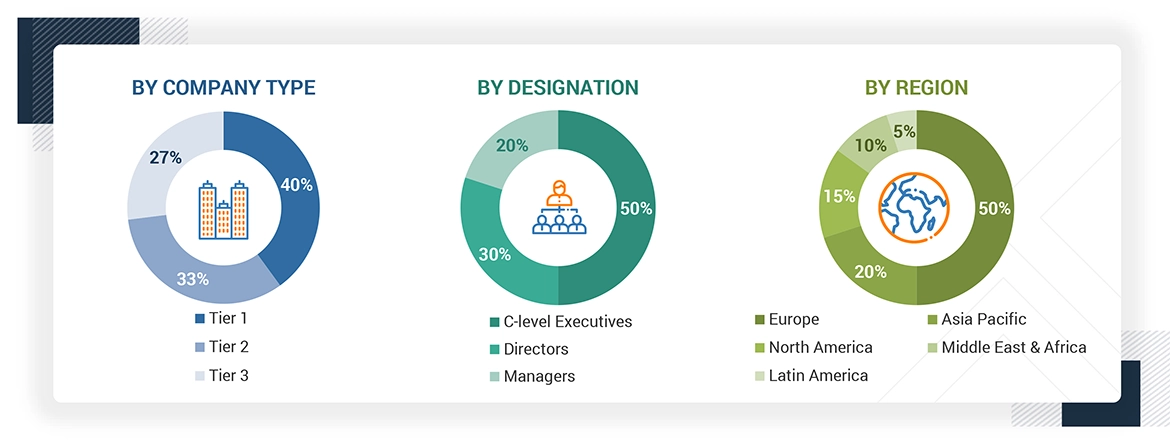
Extensive primary research was conducted after obtaining information regarding the FRP rebar market scenario through secondary research. Several primary interviews were conducted with market experts from both the demand and supply sides across major countries of North America, Europe, Asia Pacific, the Middle East & Africa, and Latin America. Primary data was collected through questionnaires, emails, and telephonic interviews. The primary sources from the supply side included various industry experts, such as chief experience officers (CXOs), vice presidents (VPs), business development/marketing directors, product development/innovation teams, related key executives from the FRP rebar industry, system integrators, component providers, distributors, and key opinion leaders. Primary interviews were conducted to gather insights such as market statistics, data on revenue collected from the products and services, market breakdowns, market size estimations, market forecasting, and data triangulation. Primary research also helped in understanding the various trends related to fiber type, resin type, diameter, surface treatment, tensile strength, application, and region. Stakeholders from the demand side, including CIOs, CTOs, CSOs, and installation teams of customers/end users for FRP rebar services, were interviewed to understand the buyer’s perspective on the suppliers, products, component providers, and their current usage of FRP rebar and future outlook of their business which will affect the overall market.
Breakup of Primary Research:
To know about the assumptions considered for the study, download the pdf brochure
Market Size Estimation
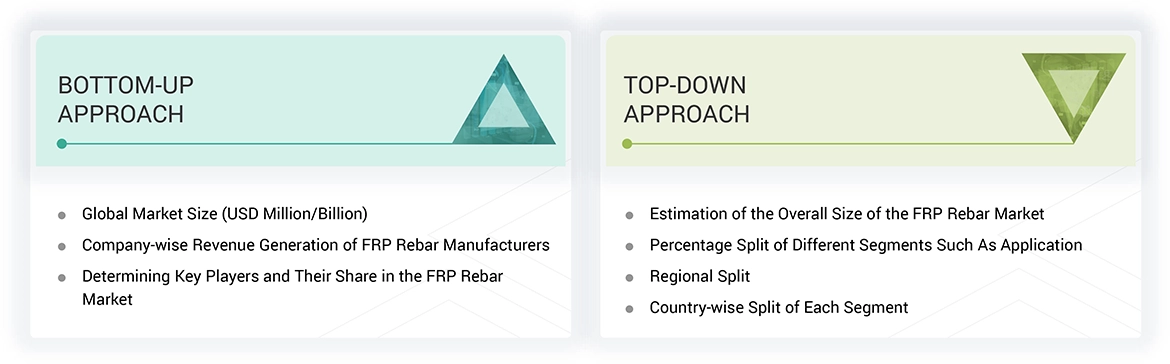
The research methodology used to estimate the size of the FRP rebar market includes the following details. The market size was determined from the demand side. The market was upsized based on the demand for FRP rebar in different applications at the regional level. Such procurements provide information on the demand aspects of the FRP rebar industry for each application. For each application, all possible segments of the FRP rebar market were integrated and mapped.
Data Triangulation
After arriving at the overall size from the market size estimation process explained above, the total market was split into several segments and subsegments. The data triangulation and market breakdown procedures explained below were implemented, wherever applicable, to complete the overall market engineering process and arrive at the exact statistics for various market segments and subsegments. The data was triangulated by studying various factors and trends from the demand and supply sides. Along with this, the market size was validated using both the top-down and bottom-up approaches.
Market Definition
FRP rebar is an advanced type of rebar that boasts a unique composite structure. It is crafted from a polymer matrix—often consisting of materials such as epoxy, vinyl ester, or polyester—and is reinforced with high-strength fibers, including glass (GFRP), carbon (CFRP), aramid, or basalt. This innovative combination results in a lightweight yet robust reinforcement solution that is highly resistant to corrosion, making it particularly suitable for challenging environments like coastal areas, chemical plants, or industrial settings where traditional steel rebar is prone to degradation over time. The exceptional tensile strength of FRP rebar not only enhances structural integrity but also contributes to longer-lasting and more durable construction applications, paving the way for advanced engineering solutions in a variety of sectors.
Stakeholders
- FRP Rebar Manufacturers
- FRP Rebar Distributors and Suppliers
- Universities, Governments, and Research Organizations
- Associations and Industrial Bodies
- R&D Institutes
- Environmental Support Agencies
- Investment Banks and Private Equity Firms
- Research and Consulting Firms
Report Objectives
- To define, describe, and forecast the FRP rebar market size in terms of volume and value
- To provide detailed information regarding the key factors, such as drivers, restraints, opportunities, and challenges influencing market growth
- To analyze and project the global FRP rebar market by fiber type, resin type, tensile strength, diameter, surface treatment, application, and region
- To forecast the market size concerning five main regions (along with country-level data), namely, North America, Europe, Asia Pacific, the Middle East & Africa, and Latin America, and analyze the significant region-specific trends
- To strategically analyze micromarkets with respect to individual growth trends, prospects, and contributions of the submarkets to the overall market
- To analyze the market opportunities and the competitive landscape for stakeholders and market leaders
- To assess recent market developments and competitive strategies, such as agreements, contracts, acquisitions, and product developments/product launches, to draw the competitive landscape
- To strategically profile the key market players and comprehensively analyze their core competencies
Get the Full FRP Rebar Market Report
Full forecast, segment splits, and company analysis for all FRP Rebar Market.
- Canada FRP Rebar Market
- US FRP Rebar Market
- Germany FRP Rebar Market
- France FRP Rebar Market
- UK FRP Rebar Market
- Italy FRP Rebar Market
- Russia FRP Rebar Market
- China FRP Rebar Market
- South Korea FRP Rebar Market
- India FRP Rebar Market
- Japan FRP Rebar Market
- South Africa FRP Rebar Market
- Mexico FRP Rebar Market
- Brazil FRP Rebar Market
- Rest Of Europe FRP Rebar Market
- Rest Of Asia Pacific FRP Rebar Market
- Rest Of Latin America FRP Rebar Market
- -Rest Of The GCC Countries FRP Rebar Market
Need a Tailored Report?
Customize this report to your needs
Get 10% FREE Customization
Customize This Report
