
North America Future of E-Powertrain (2024-2029)

The North America Future of E-Powertrain was valued at $2678 Million in 2024 and projected to reach to $5410 Million by 2029, representing a compound annual growth rate of 9.2%. North America's e-powertrain market is positioned for sustained growth through 2029, driven by increasingly stringent environmental regulations and a fundamental shift in consumer preferences toward electrified vehicles.


| Market Size in | USD 26.32 MN |
| Market Forecast in | |
| CAGR | |
| Forecast Period | |
| Units Considered | Value (USD MN) |
North America Future of E-Powertrain Trends and Insights
- This 9.2% compound annual growth rate reflects North America's accelerating transition toward electrified vehicle powertrains, driven by stringent emissions regulations, consumer demand for sustainable mobility, and substantial OEM investment in electric and hybrid technologies.
- North America's automotive sector is increasingly prioritizing e-powertrain development as a cornerstone of long-term competitiveness and regulatory compliance. The North America e-powertrain market encompasses battery electric vehicles (BEVs), plug-in hybrids (PHEVs), and hybrid electric vehicles (HEVs), with North America's major automakers and suppliers scaling production capacity to meet rising demand.
- Between 2024 and 2029, North America is expected to see significant infrastructure expansion, including charging networks and battery manufacturing facilities, further supporting market penetration.
- North America's regional advantages-including technological expertise, established supply chains, and government incentives-position the region as a critical hub for e-powertrain innovation and commercialization..
Key Market Statistics
- CAGR (2024-2029) 9.2% CAGR
- Market Size, 2024 ~USD 2678 Million
- Forecast, 2029 ~USD 5410 Million
- Geography North America
North America Future of E-Powertrain Overview
Market Valuation Growth :
North America's e-powertrain market is valued at $2,678 million in 2024, with projections reaching $5,410 million by 2029, representing a doubling of market size over five years.
Regional CAGR Performance :
The North American market is expanding at 9.2% CAGR, outpacing global growth expectations and demonstrating strong regional adoption of electrified powertrain technologies.
Regulatory & Consumer Drivers :
Stringent EPA emissions regulations, state-level EV mandates, and rising consumer preference for sustainable mobility are accelerating OEM investments in e-powertrain development across North America.
OEM Investment Surge :
Major automotive manufacturers are substantially increasing capital allocation toward electrified powertrain R&D and production facilities in North America to meet market demand and regulatory requirements.
North America Future of E-Powertrain Dynamics
- The region's mature automotive infrastructure and high purchasing power create favorable conditions for premium EV adoption and advanced powertrain technologies.
- Major OEMs are establishing regional manufacturing hubs and supply chains to capitalize on this transition, while government incentives continue to support market expansion. The forecast period will witness intensified competition among powertrain suppliers, accelerated battery technology integration, and the emergence of next-generation hybrid and fully electric solutions.
- North America's commitment to carbon neutrality goals and the growing availability of charging infrastructure will further propel market penetration.
- Investment in domestic supply chains and talent development will be critical for regional players to maintain competitive advantage in this rapidly evolving landscape..
Market Ecosystem
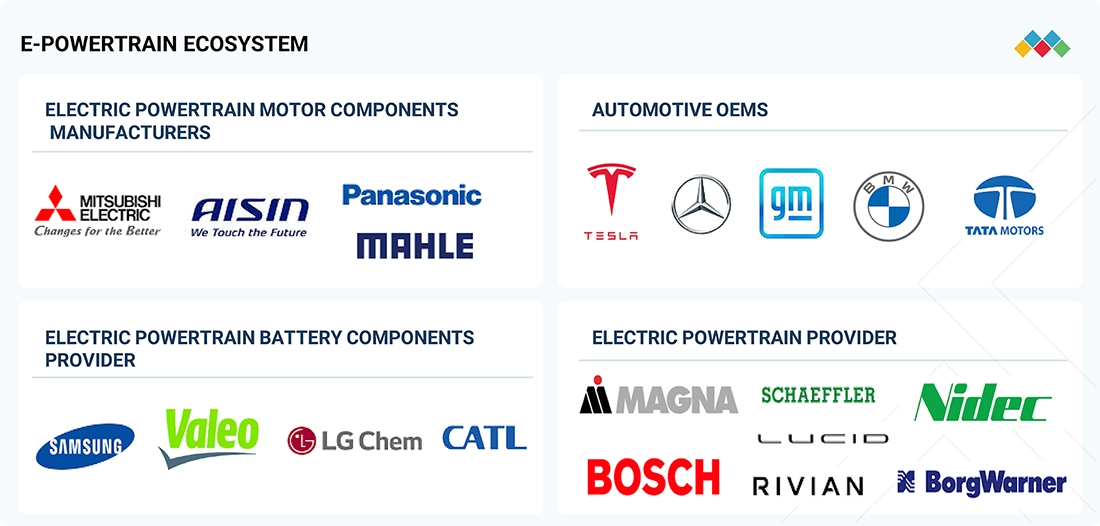
Future of E-Powertrain Market: COMMERCIAL USE CASES ACROSS INDUSTRIES
| COMPANY | USE CASE DESCRIPTION | BENEFITS |
|---|---|---|
 |
Develop and supply high-efficiency e-motors, inverters, and control units with advanced materials and integrated cooling solutions for EV platforms. | Improve energy efficiency, enhance power density, and reduce system weight for extended range and performance. |
 |
Design and manufacture advanced battery systems, including thermal management units, BMS, and high-voltage connectors tailored for integrated powertrains. | Enhance battery safety, lifespan, and efficiency while supporting faster charging and optimized vehicle packaging. |
 |
Integrate modular and scalable e-powertrain systems (e-axles, integrated drive units) across passenger and commercial vehicle portfolios. | Enable higher production flexibility, reduced manufacturing costs, and improved vehicle performance and range. |
 |
Supply complete e-drive systems and retrofit solutions for electric and hybrid vehicles, including 3-in-1 or 5-in-1 integrated configurations. | Simplify powertrain architecture, lower costs, and accelerate electrification through efficient, compact system integration. |
Logos and trademarks shown above are the property of their respective owners. Their use here is for informational and illustrative purposes only.
Related Ecosystem
Key Takeaways
- North America's e-powertrain market will nearly double from $2,678M (2024) to $5,410M (2029), representing a 9.2% CAGR.
- North America's regulatory environment and consumer preference for electrified vehicles are primary catalysts for sustained market growth.
- North America's OEM investments in battery technology and manufacturing capacity will accelerate e-powertrain adoption across vehicle segments.
- North America's charging infrastructure expansion and government incentives will reduce barriers to e-powertrain market penetration by 2029.
Future of E-Powertrain Report Scope
| Report Metric | Details |
|---|---|
| Base Year | 2024 |
| Fastest Growing Segment | COMMERCIAL VEHICLES (Vehicle Type) |
| Forecast Period | 2024-2029 |
| Growth Rate | CAGR of 13.8% from 2024 to 2029 |
| Largest Segment | INVERTER (Component) |
| Market Size Base Year (Billions) | ~USD 0.02 (2024) |
| Revenue Forecast (Billions) | ~USD 0.0513 (2029) |
| Segments Covered | Vehicle Type, Propulsion, Component, Integration Type |
North America Future of E-Powertrain Report Segmentation
4 segment dimensions are covered across the global market.
By Vehicle Type
- Commercial Vehicles
- Passenger Cars
By Propulsion
- Bev
- Phev
By Component
- Batteries
- Battery Management System
- Control Unit
- Inverter
- Motor
- On-Board Charger
- Power Distribution Module
By Integration Type
- Integrated
- Non-Integrated
Target Audience
- Automotive OEMs : Require detailed North American market data to guide powertrain development investments, manufacturing facility planning, and competitive positioning in the region's rapidly evolving EV landscape.
- Powertrain Component Suppliers : Need regional market forecasts and technology trends to align supply chain strategies, capacity planning, and product innovation with North American OEM demand and regulatory requirements.
- Investment & Private Equity Firms : Seek comprehensive North American e-powertrain market analysis to evaluate investment opportunities, assess portfolio company growth potential, and identify emerging technology leaders in the region.
- Government & Policy Makers : Utilize market insights to inform EV adoption incentive programs, infrastructure investment decisions, and regulatory frameworks supporting North America's electrification goals.
- Consulting & Strategy Firms : Require granular North American market data and forecasts to support client advisory services, competitive benchmarking, and strategic planning in the automotive electrification sector.
Countries within North America - compare and drill down
| Country | 2025 size (native) |
|---|
Country market size visualization
Reasons to Buy this Report
- Regional Market Sizing & Forecasts : Obtain precise valuation data specific to North America's e-powertrain market with detailed 5-year projections, enabling accurate budget allocation and investment planning for regional operations.
- Competitive Landscape Intelligence : Understand OEM strategies, supply chain dynamics, and competitive positioning within North America's electrification ecosystem to identify partnership and acquisition opportunities.
- Regulatory & Policy Analysis : Access comprehensive insights into EPA regulations, state-level EV mandates, and government incentive programs shaping North America's e-powertrain adoption trajectory.
- Technology & Innovation Trends : Identify emerging powertrain technologies, battery innovations, and hybrid solutions gaining traction in North America to inform product development and R&D investment decisions.
- Market Entry & Expansion Strategy : Leverage regional demand drivers, consumer behavior insights, and infrastructure development data to develop targeted go-to-market strategies for North American expansion.
Frequently asked questions
What is the projected market size for e-powertrains in North America by 2029?
North America's e-powertrain market is forecast to reach $5,410 million by 2029, up from $2,678 million in 2024.
What is the CAGR for North America's e-powertrain market?
North America's e-powertrain market is expected to grow at a compound annual growth rate of 9.2% between 2024 and 2029.
What factors are driving growth in North America's e-powertrain market?
North America's e-powertrain growth is driven by emissions regulations, consumer demand for sustainable vehicles, OEM investments, and expanding charging infrastructure.
Which vehicle types are included in North America's e-powertrain market?
North America's e-powertrain market encompasses battery electric vehicles (BEVs), plug-in hybrids (PHEVs), and hybrid electric vehicles (HEVs).
How does North America's e-powertrain growth compare to global trends?
North America's 9.2% CAGR is below the global average of 13.8%, reflecting a more mature but still expanding regional market with established OEM capabilities.
RESEARCH METHODOLOGY
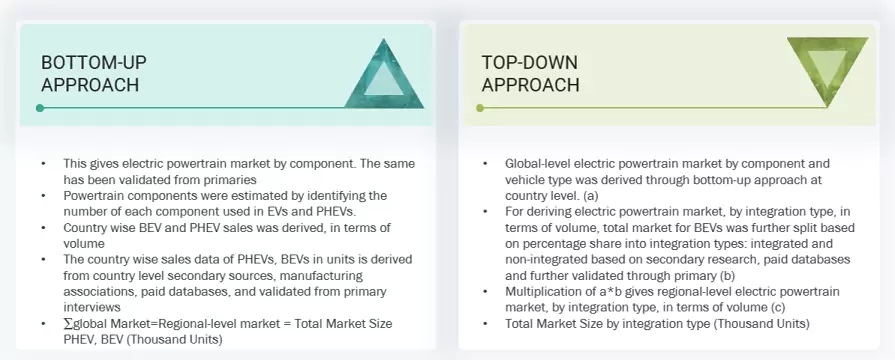
The study involved analyzing the recent developments, trends, and performance of the players and the electric powertrain market in 2024, along with the projections for 2032. The analysis was based on the sales volume of the EVs around the world. The study also analyzes the primary targets for EVs, market adoption, advancement in powertrain technologies, and government electrification goals—exhaustive secondary research collected information on the market, peer, and parent markets. The next step was to validate these findings, assumptions, and sizing with the industry experts. The bottom-up and top-down approaches were employed to estimate the market size in EV sales for the segments considered.
Secondary Research
In the secondary research process, various secondary sources such as company annual reports/presentations, press releases, industry association publications such as National Highway Traffic Safety Administration (NHTSA), European Automobile Manufacturers’ Association (ACEA), California Department of Motor Vehicles, White papers published by various industry experts, Corporate filings (such as annual reports, investor presentations, and financial statements), Trade, business, and related associations, International Organization for Standardization (ISO), articles, directories, technical handbooks, World Economic Outlook, trade websites, and technical articles are used to identify and collect information useful for an extensive commercial study of the global electric powertrain market.
Market Size Estimation
The bottom-up and top-down approaches were used to estimate and validate the size of the electric powertrain market. Country-wise BEV and PHEV sales were derived from various secondary sources, such as country-wise manufacturing associations and paid databases.
The market for BEVs and PHEVs was forecasted based on factors such as government and OEM targets, emission regulations, investments by OEMs & Tier-1 companies is taken into consideration which is further validated through primary research.
Once the base numbers were projected, the powertrain components were estimated by identifying the number of each element used in EVs and PHEVs. This gives the volume of the electric powertrain market by component.
The integrated vs. non-integrated system market was forecasted based on secondary sources like country-wise manufacturing associations, paid databases, etc., further validated through primary research. Factors considered for the forecast of this market include companies’ investment in weight and cost reduction, increasing investments towards electric powertrain, the adoption rate of integrated systems, overall supply chain readiness for integrated components, government’s support for e-powertrain (Subsidies and incentives for electric powertrain), future integrated powertrain launch announcements, etc.
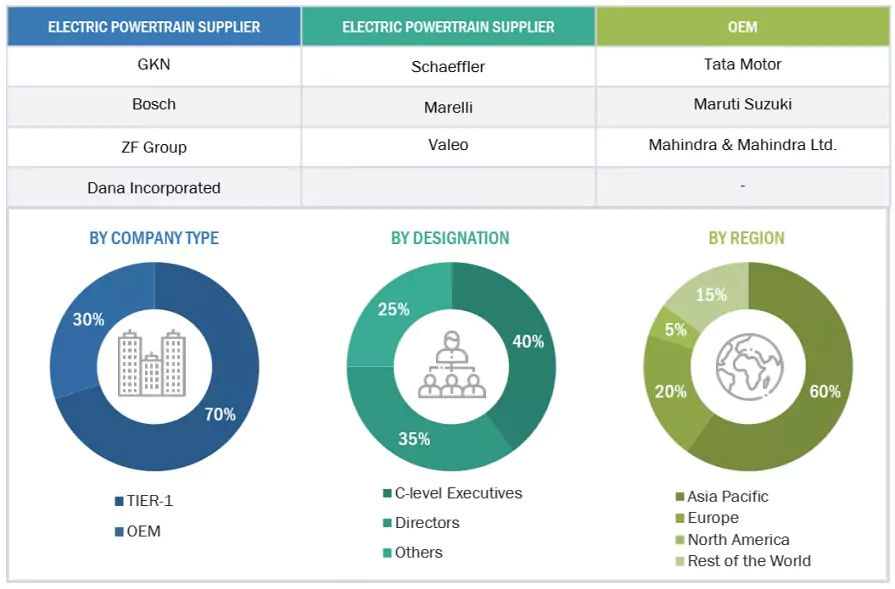
Note 1: Others include sales managers, marketing managers, and product managers.
Note 2: Tier 1 companies’ revenues are more than USD 10 billion; tier 2 companies’ revenues range between USD 1 and 10 billion; and tier 3 companies’ revenues range between USD 500 million and USD 1 billion.
Source: Industry Experts
To know about the assumptions considered for the study, download the pdf brochure
Future of E-Powertrain Market : Top-Down and Bottom-Up Approach
Market Definition
BEV Powertrain: A battery electric vehicle (BEV) powertrain is used in EVs that rely solely on electricity for propulsion. Unlike hybrid cars, BEVs do not have an internal combustion engine and operate entirely on electric power stored in a high-voltage battery pack. The components of a BEV powertrain include electric motors/generators, batteries, battery management systems, on-board chargers, inverters, and power distribution modules.
PHEV Powertrain: A plug-in hybrid electric vehicle (PHEV) powertrain combines an internal combustion engine (ICE) with an electric motor and a battery pack. PHEVs are designed to operate in electric and hybrid models, offering the flexibility of driving on electric power alone or using the internal combustion engine for an extended range. The main components of a PHEV powertrain include motors/generators, batteries, battery management systems, control units, inverters, power distribution modules, and onboard chargers. While PHEV powertrain components share similarities with HEV powertrain components, the larger battery pack, charging capabilities, and extended electric-only range are the key differentiating factors that enable PHEVs to offer a more excellent electric driving experience.
Stakeholders
- Automobile Organizations/Associations
- Electric powertrain manufacturers and suppliers
- Regional manufacturing associations and automobile associations
- Automotive OEMs and electric vehicle manufacturers
- Component suppliers for electric powertrains
- Regional emission standard regulatory authorities
- Research Professionals
Report Objectives
- To analyze the electric powertrain market performance till 2032
- To provide critical developments expected to take place till 2030 and beyond.
- Identify the technological trends likely to impact the market during the forecast period.
- To identify significant growth segments and growth opportunities till 2032.
- To project the electric powertrain sales from 2024 to 2032
- To track and analyze competitive developments such as deals (joint ventures, mergers & acquisitions, partnerships, collaborations), product developments, and other activities carried out by key industry participants.
Get the Full Future of E-Powertrain Report
Full forecast, segment splits, and company analysis for all Future of E-Powertrain.
Need a Tailored Report?
Customize this report to your needs
Get 10% FREE Customization
Customize This Report
