
Brazil Game-based Learning Market (2025-2030)

The Brazil Game-based Learning Market was valued at $229.7 Million in 2025 and projected to reach to $607.3 Million by 2030, representing a compound annual growth rate of 21.5%. Brazil's game-based learning market is positioned for significant expansion through 2030, driven by increasing digitalization of educational institutions and growing recognition of gamification's effectiveness in student engagement.


| Market Size in | USD 26.32 MN |
| Market Forecast in | |
| CAGR | |
| Forecast Period | |
| Units Considered | Value (USD MN) |
Brazil Game-based Learning Market Trends and Insights
- This represents a compound annual growth rate of 21.5%, reflecting strong demand for interactive and engaging educational technologies across Brazil's K-12 and higher education sectors.
- Brazil's digital transformation in education, coupled with increasing smartphone penetration and government initiatives to modernize learning environments, is driving adoption of game-based platforms among educators and students. The Brazilian market benefits from a large, young population and rising investment in EdTech infrastructure.
- Brazil's education sector is increasingly recognizing gamification as a tool to improve student engagement, retention, and learning outcomes.
- Between 2025 and 2030, Brazil is expected to see accelerated deployment of game-based learning solutions in both public and private institutions, supported by growing venture capital interest and partnerships between local EdTech startups and international providers. Brazil's competitive landscape includes both homegrown developers and multinational platforms adapting content for Portuguese-speaking audiences.
- The market's growth trajectory positions Brazil as a key growth engine within Latin America's broader game-based learning expansion..
Key Market Statistics
- CAGR (2025-2030) 21.5% CAGR
- Market Size, 2025 ~USD 229.7 Million
- Forecast, 2030 ~USD 607.3 Million
- Country Brazil
Brazil Game-based Learning Market Overview
Market Valuation Growth :
Brazil's game-based learning market is valued at USD 229.7 million in 2025, with projections reaching USD 607.3 million by 2030, demonstrating strong investor confidence and market expansion potential.
Accelerated CAGR Performance :
At 21.5% CAGR through 2030, Brazil's market growth outpaces many emerging markets, driven by increased adoption of digital learning solutions in K-12 and higher education institutions across the country.
Digital Education Transformation :
Brazil's ongoing digital transformation in education is creating substantial demand for interactive and gamified learning platforms, particularly in urban centers and progressive educational institutions seeking modern pedagogical approaches.
Sector Expansion Opportunities :
Both K-12 and higher education sectors in Brazil are actively investing in game-based learning technologies, creating diverse revenue streams and adoption pathways across public and private educational institutions.
Brazil Game-based Learning Market Dynamics
- Government initiatives promoting digital literacy and EdTech adoption, combined with rising smartphone penetration and internet accessibility, are creating favorable conditions for market growth.
- The K-12 sector represents a primary growth driver, with educators increasingly implementing game-based solutions to enhance learning outcomes and student motivation. The market's 21.5% CAGR reflects sustained investment from both domestic and international EdTech providers targeting Brazil's large student population.
- Challenges including infrastructure disparities between urban and rural areas and varying adoption rates across socioeconomic segments present both obstacles and opportunities for tailored solutions.
- Strategic partnerships between educational institutions, technology providers, and government bodies are expected to accelerate market penetration and standardization of game-based learning practices throughout Brazil's education system..
Market Ecosystem
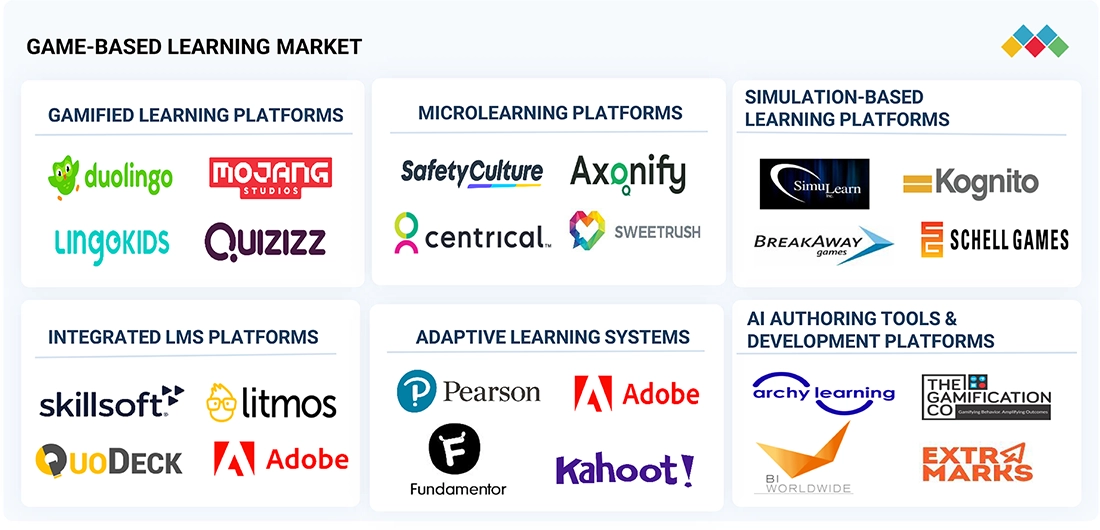
Game-based Learning Market: COMMERCIAL USE CASES ACROSS INDUSTRIES
| COMPANY | USE CASE DESCRIPTION | BENEFITS |
|---|---|---|
 |
Hyundai Spain implemented Gamelearn's multilingual game-based learning platform to enhance employee development. The cloud-based solution eliminated time constraints and physical classroom requirements, offering games in English, Spanish, French, and German. | Hyundai improved employee professional development and productivity through game-based learning. The approach enabled measurement of training effectiveness throughout the process. The multilingual platform provided flexibility and broad accessibility for global operations. |
 |
Clifton Public Schools implemented Prodigy Math Game for 10,700 diverse students. The adaptable platform allowed students to participate at their own pace, providing real-time data and detailed progress reports for teachers. | Students showed increased engagement and improved math performance, especially lower-performing learners. Students mastered nearly double the math skills per month compared to the previous year. Prodigy's reporting enhanced communication and fostered data-driven instruction. |
 |
Professor Toni Marie integrated Kahoot! into nutrition education for 1,200 students. She utilized AI features including PDF-to-kahoot generator and question generator to streamline teaching and create varied, dynamic question formats. | Kahoot! with AI increased student engagement and improved lecture content retention. AI features provided considerable time savings in lesson preparation while offering fresh perspectives and creative touches, enhancing the overall learning experience. |
 |
Maruti Suzuki partnered with Tenneo (formerly G-Cube) for digital learning transformation. The solution included online courses with videos, animations, and interactive games, as well as providing reports and skill gap analyses across departments. | Digital training aligned with learners' specific needs and improved skill development. Interactive content like mini-games boosted engagement. The modern LMS drastically reduced infrastructure costs while enhancing learning efficiency and optimizing operational expenditure. |
Logos and trademarks shown above are the property of their respective owners. Their use here is for informational and illustrative purposes only.
Related Ecosystem
Software And Services
- Natural Language Processing (NLP)
- Machine Learning
- Supply Chain Management
- Predictive Analytics
- Image Sensors
- International Business Machines Corporation
- MICROSOFT CORPORATION
- Oracle Corporation
- SAP SE
- Amazon.com, Inc.
Key Takeaways
- Brazil's game-based learning market will grow from USD 229.7M (2025) to USD 607.3M (2030) at a 21.5% CAGR.
- Brazil's large youth population and digital infrastructure investments are primary catalysts for market expansion.
- Brazil's education sector is increasingly adopting gamification to enhance student engagement and learning outcomes.
- Brazil's market includes both local EdTech startups and international providers competing for market share.
Game-based Learning Market Report Scope
| Report Metric | Details |
|---|---|
| Base Year | 2025 |
| Fastest Growing Segment | AI-DRIVEN LEARNING GAMES (Game Type) |
| Forecast Period | 2025–2030 |
| Growth Rate | CAGR of 23.4% from 2025 to 2030 |
| Largest Segment | CLOUD (Deployment Mode) |
| Market Size Base Year (Billions) | ~USD 6.23 (2025) |
| Revenue Forecast (Billions) | ~USD 17.82 (2030) |
| Segments Covered | Offering, Software, Services, Professional Services, Deployment Mode, Game Type, Integration Type, Application, Academic Education, Corporate And Workforce Training, Medical & Healthcare Training, Personalized Learning & Development, Skill-Based & Subject-Specific Learning, Corporate & Workforce Training |
Brazil Game-based Learning Market Report Segmentation
14 segment dimensions are covered across the global market.
By Offering
- Services
- Software
By Software
- Gamified Learning Platforms
- Integrated Lms Platforms
- Microlearning Platforms
- Other Software
- Simulation-Based Learning Platforms
By Services
- Managed Services
- Professional Services
By Professional Services
- Consulting Services
- Support & Maintenance
- System Integration & Implementation
By Deployment Mode
- Cloud
- On-Premises
By Game Type
- AI-Driven Learning Games
- Ar & Vr Games
- Language & Communication Games
- Location-Based Education Games
- Location-Based Educational Games
- Other Game Types
- Quiz, Logic, And Strategy Games
- Role-Playing & Narrative-Based Games
- Simulation & Scenario-Based Games
- Skill-Based, Assessment & Evaluation Games
By Integration Type
- Gaming Consoles
- Immersive Hardware
- Interactive Display Interfaces
- Mobile-Based Deployment
- Web-Based Deployment
By Application
- Academic Education
- Corporate & Workforce Training
- Medical & Healthcare Training
- Personalized Learning & Development
- Skill-Based & Subject-Specific Learning
By Academic Education
- Higher Education
- K-12
- Other Academic Education
By Corporate And Workforce Training
- Bfsi
- Manufacturing
- Other Corporate & Workforce Training
- Retail & E-Commerce
- Technology & Software
- Telecommunications
By Medical & Healthcare Training
- Clinical Skills Simulation
- Safety & Compliance
By Personalized Learning & Development
- Cognitive & Emotional Development
- Mindfulness, Therapy & Wellness Games
- Neurodiversity & Special Needs Learning
- Social-Emotional Learning
- Social-Emotional Learning (Sel)
By Skill-Based & Subject-Specific Learning
- Coding & Programming
- Language Learning
- Other Skill-Based & Subject-Specific Learning
- Stem & Subject-Specific Games
By Corporate & Workforce Training
- Bfsi
- Manufacturing
- Other Corporate & Workforce Training
- Retail & E-Commerce
- Technology & Software
- Telecommunications
Target Audience
- EdTech Companies & Startups : Game-based learning providers and EdTech startups need Brazil-specific market data to validate expansion strategies, identify partnership opportunities, and understand competitive positioning in this high-growth emerging market.
- Educational Institutions : K-12 schools and higher education institutions in Brazil require market insights to benchmark technology adoption, evaluate game-based learning solutions, and justify budget allocations for digital transformation initiatives.
- Investment & Venture Capital Firms : Investors targeting Brazil's EdTech sector need comprehensive market analysis, growth projections, and sector dynamics to identify promising investment opportunities and assess portfolio company performance against market benchmarks.
- Government & Policy Makers : Brazilian education ministry officials and policymakers need market data to inform digital education initiatives, funding decisions, and regulatory frameworks supporting game-based learning adoption across public institutions.
- Technology & Publishing Conglomerates : Large corporations in education, technology, and publishing sectors require Brazil market intelligence to evaluate acquisition targets, develop localized solutions, and strategically expand their EdTech portfolios in Latin America.
Key Companies in the Brazil Game-based Learning Market
| Company | HQ | Ownership | Strongest segments |
|---|---|---|---|
| HORNBILL FX | FX/CFD trading revenue (spreads & commissions),Prop-style funded accounts / performance-linked fees,Education, signals, and value-added services, | ||
| QUODECK TECHNOLOGIES | India | Private Company | SaaS Learning & Gamification Platform Subscriptions,Custom Gamified Content & Learning Campaign Design,Implementation, Integration & Managed Services, |
| SWEETRUSH | United States | Private Company | Custom eLearning & Blended Learning Solutions,Learning Strategy, Consulting & Experience Design,Learning Technology Integration & Platforms Support, |
HORNBILL FX
Insufficient data available for company description.
QUODECK TECHNOLOGIES
QUODECK TECHNOLOGIES is a private company based in India, founded in 2010.
SWEETRUSH
SWEETRUSH is a private company based in the United States, founded in 2001.
Reasons to Buy this Report
- Market Size & Growth Validation : Obtain precise market valuation data for Brazil (USD 229.7M in 2025) with verified 5-year forecasts, enabling accurate budget allocation and ROI projections for EdTech investments in this high-growth market.
- Competitive Positioning Intelligence : Understand Brazil's market dynamics, competitive landscape, and differentiation opportunities to develop targeted go-to-market strategies and identify white-space opportunities in the K-12 and higher education segments.
- Sector-Specific Insights : Access detailed analysis of K-12 and higher education adoption patterns, institutional buying behaviors, and technology preferences specific to Brazil's educational ecosystem and regional characteristics.
- Investment Decision Support : Leverage comprehensive market data and growth projections (21.5% CAGR) to support investment decisions, partnership evaluations, and expansion planning for EdTech ventures targeting Brazil's education sector.
- Risk Mitigation & Opportunity Mapping : Identify market barriers, infrastructure challenges, and adoption drivers unique to Brazil, enabling informed risk assessment and strategic planning for sustainable market entry and scaling operations.
Frequently asked questions
What is the current size of Brazil's game-based learning market?
Brazil's game-based learning market is valued at USD 229.7 million in 2025.
What is the projected market size for Brazil by 2030?
Brazil's game-based learning market is projected to reach USD 607.3 million by 2030.
What is the CAGR for Brazil's game-based learning market?
Brazil's game-based learning market is expected to grow at a compound annual growth rate of 21.5% from 2025 to 2030.
What factors are driving growth in Brazil's game-based learning market?
Brazil's market growth is driven by digital transformation in education, high smartphone penetration, government modernization initiatives, and recognition of gamification's effectiveness in improving student engagement.
Who are the key players in Brazil's game-based learning market?
Brazil's market includes local EdTech startups, multinational platforms, and international providers adapting content for Portuguese-speaking audiences.
RESEARCH METHODOLOGY
This research study on the game-based learning market involved extensive secondary sources, directories, IEEE Communication-Efficient: Algorithms and Systems, International Journal of Game-Based Learning (IJGBL), British Journal of Educational Technology (BJET), International Journal of Serious Games, and paid databases. Primary sources were mainly industry experts from the core and related industries, preferred game-based learning providers, third-party service providers, consulting service providers, end users, and other commercial enterprises. In-depth interviews were conducted with various primary respondents, including key industry participants and subject matter experts, to obtain and verify critical qualitative and quantitative information and assess the market’s prospects.
Secondary Research
In the secondary research process, various sources were referred to identify and collect information for this study. Secondary sources included annual reports, press releases, and investor presentations of companies; white papers, journals, and certified publications; and articles from recognized authors, directories, and databases. The data was also collected from other secondary sources, such as journals, government websites, blogs, and vendors’ websites. Additionally, the game-based learning spending of various countries was extracted from the respective sources.
Primary Research
In the primary research process, various primary sources from the supply and demand sides were interviewed to obtain qualitative and quantitative information on the market. The primary sources from the supply side included various industry experts, such as Chief Experience Officers (CXOs), Vice Presidents (VPs), and directors specializing in business development, marketing, and game-based learning providers. They also included key executives from game-based learning solution vendors, system integrators (SIs), professional service providers, industry associations, and other key opinion leaders.
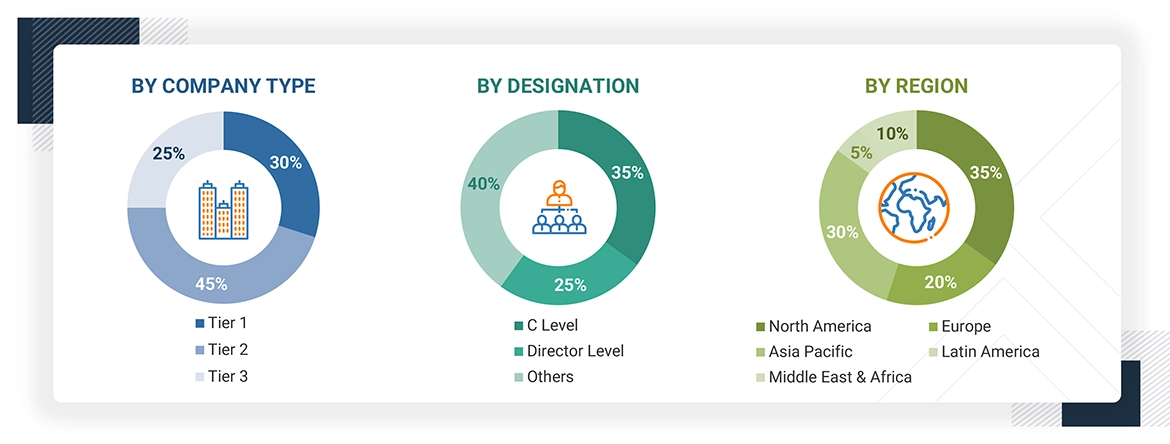
Note 1: Others include sales managers, marketing managers, and product managers.
Note 2: Tier 1 companies’ revenues are more than USD 10 billion; tier 2 companies’ revenues range between USD 1 and 10 billion; and tier 3 companies’ revenues range between USD 500 million and USD 1 billion.
Source: Industry Experts
To know about the assumptions considered for the study, download the pdf brochure
Market Size Estimation
Multiple approaches were adopted to estimate and forecast the game-based learning market. The first approach involved estimating the market size by companies’ revenue generated by selling game-based learning products.
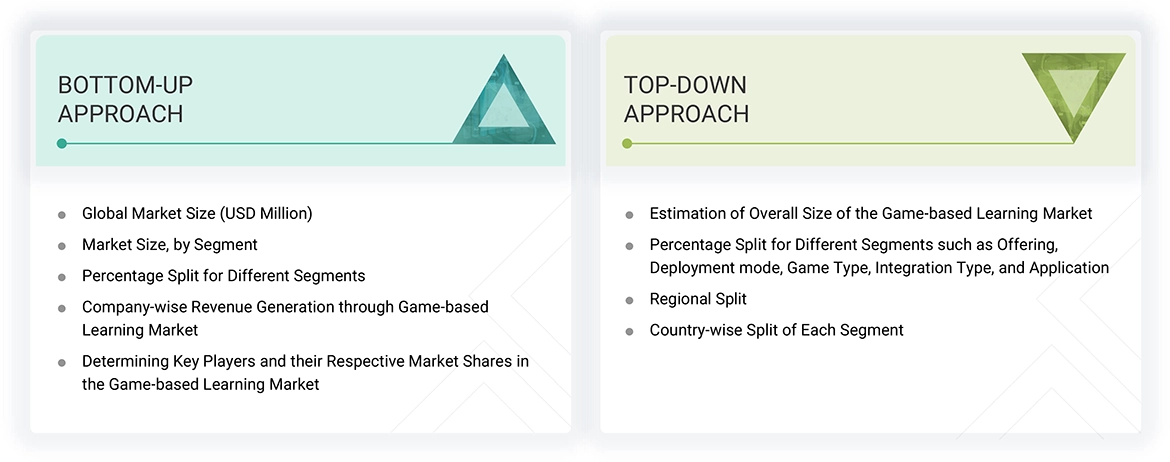
Market Size Estimation Methodology- Top-down approach
In the top-down approach, an exhaustive list of all the vendors offering products in the game-based learning market was prepared. The revenue contribution of the market vendors was estimated through annual reports, press releases, funding, investor presentations, paid databases, and primary interviews. Each vendor’s offerings were evaluated based on software, services, deployment mode, game type, integration type, application, and region. The markets were triangulated through primary and secondary research. The primary procedure included extensive interviews for key insights from industry leaders, such as CIOs, CEOs, VPs, directors, and marketing executives. The market numbers were further triangulated with the existing MarketsandMarkets’ repository for validation.
Market Size Estimation Methodology-Bottom-up approach
In the bottom-up approach, the adoption rate of game-based learning products among various verticals in key countries relative to the regions that contribute most to market share was identified. For cross-validation, the adoption of game-based learning products among enterprises, along with different use cases concerning their regions, was identified and extrapolated. Use cases identified in different regions were given weightage for the market size calculation.
Based on the market numbers, the regional split was determined by primary and secondary sources. The procedure included an analysis of the game-based learning market’s regional penetration. Based on secondary research, the regional spending on Information and Communications Technology (ICT), socio-economic analysis of each country, strategic vendor analysis of major game-based learning providers, and organic and inorganic business development activities of regional and global players were estimated.
Game-based Learning Market : Top-Down and Bottom-Up Approach
Data Triangulation
After determining the overall market size using the market size estimation processes as explained above, the market was split into several segments and subsegments. Data triangulation and market breakup procedures were employed, wherever applicable, to complete the overall market engineering process and arrive at the exact statistics of each market segment and subsegment. The overall market size was then used in the top-down procedure to estimate the size of other individual markets via percentage splits of the market segmentation.
Market Definition
Game-based learning is an instructional approach that incorporates game elements and mechanics to enhance learning outcomes. It involves using digital or physical games to teach concepts, promote engagement, and reinforce knowledge across various domains, such as education, corporate training, and healthcare.
Stakeholders
- Game-based learning solution providers
- Game-based learning content developers
- Learning management system (LMS) providers
- Educational institutions
- Corporate training departments
- Independent software vendors (ISVs)
- Government education departments
- E-learning platform providers
- Instructional designers and gamification experts
- EdTech investors and venture capitalists
Report Objectives
- To define, describe, and predict the game-based learning market by offering, deployment mode, game type, integration type, application, and region
- To provide detailed information about major factors (drivers, restraints, opportunities, and industry-specific challenges) influencing market growth
- To analyze opportunities in the market and provide details of the competitive landscape for stakeholders and market leaders
- To forecast the market size of segments for North America, Europe, Asia Pacific, Middle East & Africa, and Latin America
- To profile key players and comprehensively analyze their market rankings and core competencies
- To analyze competitive developments, such as partnerships, new product launches, mergers, and acquisitions, in the game-based learning market
Available Customizations
With the given market data, MarketsandMarkets offers customizations to meet the company’s specific needs. The following customization options are available for the report:
Product Analysis
- The product matrix provides a detailed comparison of the product portfolio of each company.
Geographic Analysis as per Feasibility
- Further breakup of the North American Game-based Learning Market
- Further breakup of the European Market
- Further breakup of the Asia Pacific Market
- Further breakup of the Middle East & Africa Market
- Further breakup of the Latin American Market
Company Information
- Detailed analysis and profiling of additional market players (up to five)
Get the Full Game-based Learning Market Report
Full forecast, segment splits, and company analysis for all Game-based Learning Market.
- US Game-based Learning Market
- Canada Game-based Learning Market
- UK Game-based Learning Market
- Germany Game-based Learning Market
- France Game-based Learning Market
- Italy Game-based Learning Market
- Spain Game-based Learning Market
- China Game-based Learning Market
- India Game-based Learning Market
- Japan Game-based Learning Market
- South Korea Game-based Learning Market
- Singapore Game-based Learning Market
- Saudi Arabia Game-based Learning Market
- UAE Game-based Learning Market
- Qatar Game-based Learning Market
- South Africa Game-based Learning Market
- Mexico Game-based Learning Market
- Argentina Game-based Learning Market
Need a Tailored Report?
Customize this report to your needs
Get 10% FREE Customization
Customize This Report
