
US Gas Detection Market (2025-2030)

The US Gas Detection Market was valued at $582.4 Million in 2025 and projected to reach to $733.6 Million by 2030, representing a compound annual growth rate of 4.7%. The US gas detection market is poised for steady growth through 2030, driven by robust regulatory frameworks and industrial expansion.


| Market Size in | USD 26.32 MN |
| Market Forecast in | |
| CAGR | |
| Forecast Period | |
| Units Considered | Value (USD MN) |
US Gas Detection Market Trends and Insights
- The US market benefits from stringent occupational safety regulations, industrial expansion in manufacturing and chemical sectors, and increasing adoption of advanced detection technologies across semiconductor and electronics facilities.
- Demand in the US is driven by heightened workplace safety standards and the need for real-time monitoring solutions in hazardous environments. Growth in the US gas detection market is supported by technological innovations, including IoT-enabled sensors and wireless monitoring systems that enhance operational efficiency.
- The US semiconductor and electronics industry's emphasis on worker protection and environmental compliance continues to fuel market expansion through 2030.
- Investment in industrial automation and smart factory initiatives across the US further accelerates adoption of sophisticated gas detection systems..
Key Market Statistics
- CAGR (2025-2030) 4.7% CAGR
- Market Size, 2025 ~USD 582.4 Million
- Forecast, 2030 ~USD 733.6 Million
- Country US
US Gas Detection Market Overview
Market Size & Growth :
The US gas detection market is valued at $582.4 million in 2025 and is projected to reach $733.6 million by 2030, representing a steady CAGR of 4.7% over the forecast period.
Regulatory Compliance Drivers :
Stringent OSHA regulations and occupational safety standards in the US mandate gas detection systems across industrial facilities, driving consistent market demand and compliance investments.
Sector Expansion :
Growth in US manufacturing, chemical processing, and semiconductor fabrication sectors is accelerating adoption of advanced gas detection technologies for worker safety and environmental protection.
Technology Adoption :
Increasing deployment of IoT-enabled, real-time monitoring systems and smart detection solutions in US industrial facilities is enhancing market growth and operational efficiency.
US Gas Detection Market Dynamics
- Manufacturing and semiconductor sectors continue to invest in advanced safety infrastructure, with particular emphasis on real-time monitoring and predictive analytics.
- The market benefits from strong enforcement of occupational safety standards and growing awareness of workplace hazard management.
- Technological innovations in wireless connectivity and cloud-based monitoring platforms are expected to accelerate adoption rates across mid-sized and large industrial operations throughout the forecast period..
Market Ecosystem
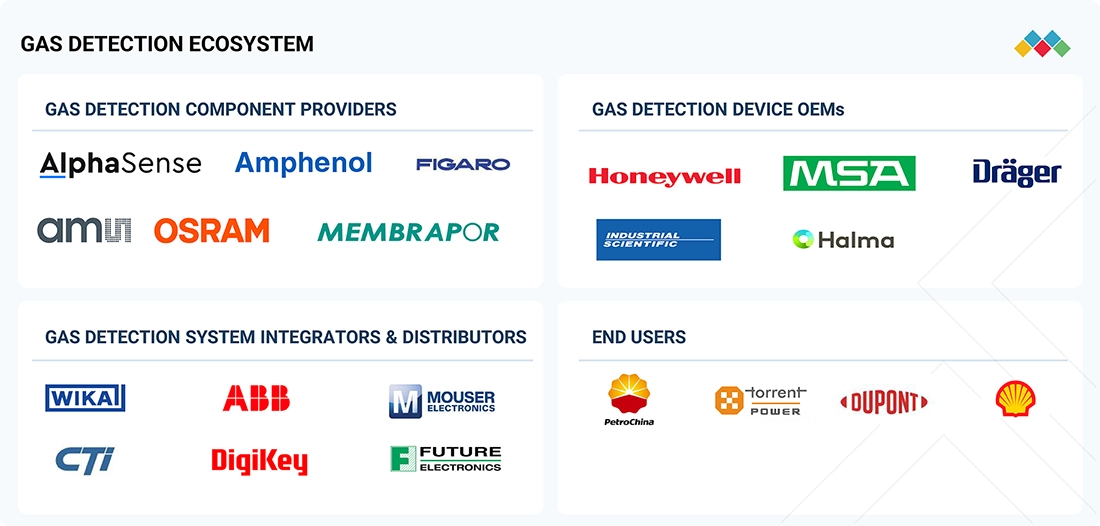
gas-detection-market: COMMERCIAL USE CASES ACROSS INDUSTRIES
| COMPANY | USE CASE DESCRIPTION | BENEFITS |
|---|---|---|
 |
Upstream/midstream oil & gas, petrochemical plants, utilities, confined-space monitoring, and large industrial facilities. | Fast deployment at scale| Deep enterprise integration|Single-vendor lifecycle support (procure → install → service). |
 |
Mining, construction, chemical, utilities and maintenance teams requiring rugged personal monitors. | High reliability in harsh environments|Strong service & distribution model reduces OPEX risk for rollouts. |
 |
Petrochemical tank farms, chemical plants, confined space entry, industrial hygiene and emergency response teams. | Proven system engineering for complex sites| Lowers integration risk and improves safety governance/compliance. |
 |
Field operations, contractors, municipal utilities, confined space and entry monitoring with workforce analytics. | Rapid ROI via worker-centric telemetry|Simplified fleet management and data-driven compliance reportin |
 |
Cold-storage (refrigerants), HVAC, chemical plants, utilities and general industrial safety monitoring | Flexible modular products reduce inventory complexity| Niche expertise (refrigerants/warehouse) speeds targeted deployments. |
Logos and trademarks shown above are the property of their respective owners. Their use here is for informational and illustrative purposes only.
Related Ecosystem
Electrical System And Components
- Natural Language Processing (NLP)
- Sensors
- Machine Learning
- Temperature Sensors
- Actuators
- ABB India Limited
- Siemens ag
- SCHNEIDER ELECTRIC SE
- Eaton Corporation plc
- General Electric Company
Electronics System And Components
- Sensors
- Temperature Sensors
- Pressure Sensors
- Actuators
- Image Sensors
- Lenovo
- Samsung
- Texas Instruments Incorporated
- HONEYWELL INTERNATIONAL INC.
- Teledyne Technologies Incorporated
Industrial Automation
- Sensors
- Image Sensors
- Manufacturing Execution System (MES)
- Actuators
- Flow Sensors
- Siemens ag
- ABB India Limited
- Emerson Electric Co.
- HONEYWELL INTERNATIONAL INC.
- SCHNEIDER ELECTRIC SE
Key Takeaways
- The US gas detection market reaches $582.4 million in 2025 and is forecast to expand to $733.6 million by 2030 at a 4.7% CAGR.
- Stringent US occupational safety regulations and OSHA compliance requirements drive consistent demand for gas detection solutions.
- The US semiconductor and electronics sector increasingly adopts IoT-enabled and wireless gas detection technologies for real-time monitoring.
- Industrial automation and smart factory initiatives across the US accelerate adoption of advanced gas detection systems through 2030.
Gas Detection Market Report Scope
| Report Metric | Details |
|---|---|
| Base Year | 2025 |
| Fastest Growing Segment | HYDROGEN (Gas Type) |
| Forecast Period | 2025–2030 |
| Growth Rate | CAGR of 6.1% from 2025 to 2030 |
| Largest Segment | MULTI-GAS (Device Type) |
| Market Size Base Year (Billions) | ~USD 3.85 (2025) |
| Revenue Forecast (Billions) | ~USD 5.18 (2030) |
| Segments Covered | Device Type, Installation Type, Gas Type, Vertical, Technology, Application |
US Gas Detection Market Report Segmentation
6 segment dimensions are covered across the global market.
By Device Type
- Multi-Gas
- Single Gas
By Installation Type
- Fixed
- Portable
By Gas Type
- Ammonia (Nh3)
- Carbon Dioxide (Co2)
- Carbon Monoxide (Co)
- Chlorine (Cl)
- Hydrocarbons
- Hydrogen
- Hydrogen Sulfide (H2S)
- Methane (Ch4)
- Nitrogen Oxide (Nox)
- Oxygen (O2)
- Volatile Organic Compounds
By Vertical
- Building & Construction
- Chemical & Petrochemicals
- Manufacturing & Industrial
- Mining
- Oil & Gas
- Power Generation
By Technology
- Catalytic
- Electrochemical
- Infrared
- Mos/Solid-State
- Photoionization
By Application
- Automotive
- Electronics & Semiconductor
- Food & Beverages
- Pharmaceuticals & Healthcare
US: FIXED GAS DETECTION MARKET FOR MANUFACTURING & INDUSTRIAL, BY APPLICATION, 2025–2030
| Segment | 2025 | 2026 | 2027 | 2028 | 2029 | 2030 | CAGR (%) |
|---|---|---|---|---|---|---|---|
| AUTOMOTIVE | 30.1 | 31.6 | 33.3 | 35.2 | 37.2 | 39.4 | 5.5 |
| ELECTRONICS & SEMICONDUCTOR | 34 | 36.3 | 38.8 | 41.5 | 44.5 | 47.7 | 7 |
| FOOD & BEVERAGES | 25.8 | 27.5 | 29.3 | 31.3 | 33.5 | 35.9 | 6.9 |
| PHARMACEUTICALS & HEALTHCARE | 34 | 36 | 38.1 | 40.4 | 42.9 | 45.7 | 6.1 |
| TOTAL | 123.9 | 131.4 | 139.6 | 148.5 | 158.2 | 168.7 | 6.4 |
Target Audience
- Industrial Safety Managers : Need comprehensive market data to justify safety technology investments, evaluate vendor solutions, and ensure workplace compliance with US occupational safety regulations.
- Gas Detection Equipment Manufacturers : Require detailed US market forecasts and segment analysis to guide product development, pricing strategies, and distribution channel decisions for competitive positioning.
- Semiconductor & Electronics Facility Operators : Seek market intelligence on advanced detection technologies and best practices to optimize facility safety systems and meet stringent operational standards.
- Investment & Private Equity Firms : Need accurate market sizing and growth projections to evaluate acquisition opportunities and assess the viability of gas detection companies operating in the US market.
- Regulatory & Compliance Consultants : Require current market data and regulatory trends to advise clients on safety technology adoption, compliance requirements, and industry best practices in the US.
Key Companies in the US Gas Detection Market
| Company | HQ | Ownership | Strongest segments |
|---|---|---|---|
| HONEYWELL INTERNATIONAL INC | United States | Public Company | Fixed gas detection systems,Portable and personal gas detectors,Software, analytics, and services, |
| MSA | United States | Public Company | Fixed gas and flame detection systems,Portable multi-gas detectors,Portable single-gas detectors, |
| DRäGERWERK AG & CO. KGAA | Germany | Public Company | Fixed gas detection systems,Portable multi-gas detectors,Portable single-gas detectors, |
| INDUSTRIAL SCIENTIFIC | United States | Private Company | Portable multi-gas detectors (electrochemical, catalytic, IR, MOS, PID),Portable single-gas detectors,Fixed gas detection systems, |
| HALMA PLC | United Kingdom | Public Company | Fixed gas detection systems,Portable gas detectors,Single-gas devices, |
| ABB | India | Public Company | Fixed gas detection systems,Portable gas detectors,Multi-gas devices and systems, |
| SIEMENS | Germany | Public Company | Fixed gas detection systems,Portable gas detectors,Single-gas detectors, |
| TELEDYNE TECHNOLOGIES INCORPORATED | United States | Public Company | Fixed gas detection systems,Portable gas detection devices,Single-gas detectors, |
| EMERSON ELECTRIC CO | United States | Public Company | Fixed gas detection systems,Portable gas detectors,Electrochemical and catalytic sensors, |
| THERMO FISHER SCIENTIFIC INC | United States | Public Company | Fixed gas detection systems,Portable gas detectors,Electrochemical sensors and modules, |
| YOKOGAWA ELECTRIC CORPORATION | Japan | Public Company | Fixed gas detection systems,Portable gas detectors,Electrochemical-based devices, |
| GFG | Luxembourg | Public Company | Portable gas detectors (single and multi-gas),Fixed gas detection systems,Sensors and components (electrochemical, catalytic, MOS, IR, PID), |
HONEYWELL INTERNATIONAL INC
Honeywell International Inc is a diversified technology and manufacturing company founded in 1885 and headquartered in the United States. With 101,000 employees, the publicly traded company operates across multiple industrial sectors including aerospace, building technologies, and performance materials.
MSA
MSA is a United States-based public company founded in 1914 with 5,300 employees. The company specializes in safety equipment and protective solutions for industrial and professional markets.
DRäGERWERK AG & CO. KGAA
Drägerwerk AG & Co. KGaA is a German public company established in 1889 with 16,033 employees. The company manufactures medical and safety technology products, including respiratory protection and gas detection equipment.
INDUSTRIAL SCIENTIFIC
Industrial Scientific is a privately held United States company founded in 1985 with 215 employees. The company develops gas detection and safety monitoring solutions for industrial applications.
HALMA PLC
Halma PLC is a United Kingdom-based public company founded in 1894 with 9,000 employees. The company operates in safety, environmental, and infrastructure sectors through a portfolio of specialized businesses.
ABB
ABB is a publicly traded company founded in 1883 with 111,900 employees operating in India. The company provides electrification, industrial automation, and robotics solutions globally.
SIEMENS
Siemens is a German multinational public company founded in 1847 with 310,312 employees. The company operates across electrification, automation, and digitalization sectors serving diverse industrial and infrastructure markets.
TELEDYNE TECHNOLOGIES INCORPORATED
Teledyne Technologies Incorporated is a United States-based public company founded in 1960 with 15,800 employees. The company provides instrumentation, digital imaging, and aerospace and defense electronics solutions.
EMERSON ELECTRIC CO
Emerson Electric Co is a United States public company founded in 1890 with 71,000 employees. The company manufactures and provides technology solutions for climate, energy, and industrial automation applications.
THERMO FISHER SCIENTIFIC INC
Thermo Fisher Scientific Inc is a United States-based public company founded in 1956 with 125,000 employees. The company is a global leader in serving science, providing laboratory equipment, reagents, and analytical instruments.
YOKOGAWA ELECTRIC CORPORATION
Yokogawa Electric Corporation is a Japanese public company founded in 1915 with 18,313 employees. The company specializes in industrial automation, control systems, and measurement technology solutions.
GFG
GFG is a Luxembourg-based public company founded in 2011 with 3,212 employees. The company operates in industrial and technology-related sectors.
Reasons to Buy this Report
- Regulatory Compliance Intelligence : Understand OSHA requirements and state-level regulations shaping the US gas detection landscape to ensure your products and services meet evolving compliance standards.
- Market Sizing & Forecasting : Access precise US market valuations ($582.4M in 2025) and growth projections through 2030 to inform strategic planning, investment decisions, and revenue forecasting.
- Sector-Specific Opportunities : Identify high-growth segments within US manufacturing, chemical, and semiconductor industries to target expansion efforts and develop tailored solutions for key verticals.
- Competitive Positioning : Benchmark your offerings against market trends and technology adoption rates in the US to optimize product development and go-to-market strategies.
- Investment & Partnership Strategy : Leverage detailed US market insights to identify acquisition targets, partnership opportunities, and geographic expansion priorities within the semiconductor and electronics sectors.
Frequently asked questions
What is the current size of the US gas detection market?
The US gas detection market is valued at $582.4 million in 2025 and is expected to reach $733.6 million by 2030.
What is the growth rate of the US gas detection market?
The US gas detection market is projected to grow at a compound annual growth rate (CAGR) of 4.7% from 2025 to 2030.
What are the primary drivers of growth in the US gas detection market?
Key drivers include stringent US occupational safety regulations, industrial expansion, technological innovations in IoT and wireless sensors, and increased adoption in semiconductor and electronics facilities.
Which industries in the US are the largest consumers of gas detection systems?
The US semiconductor and electronics, manufacturing, chemical processing, and oil and gas industries are the primary consumers of gas detection solutions.
What technological trends are shaping the US gas detection market?
IoT-enabled sensors, wireless monitoring systems, real-time data analytics, and integration with smart factory initiatives are transforming the US gas detection landscape.
RESEARCH METHODOLOGY
The research process for this study involved the systematic gathering, recording, and analysis of data on customers and companies operating in the gas detection market. This process involved the extensive use of secondary sources, directories, and databases (Factiva and Oanda) to identify and collect valuable information for the comprehensive, technical, market-oriented, and commercial study of the gas detection market.
In-depth interviews were conducted with primary respondents, including experts from core and related industries, as well as preferred manufacturers, to gather and verify critical qualitative and quantitative information and assess growth prospects. Key players in the gas detection market were identified through secondary research, and their market rankings were determined through primary and secondary research. This research involved studying the annual reports of top players and conducting interviews with key industry experts, including CEOs, directors, and marketing executives.
Secondary Research
Various sources were used in the secondary research process to identify and collect information crucial for this study. These include company annual reports, press releases, investor presentations, white papers, technology journals, certified publications, articles by recognized authors, directories, and databases. Secondary research was primarily used to gather key information about the industry’s value chain, the total pool of market players, market classification according to industry trends at the most detailed level, regional markets, and key developments from market and technology-oriented perspectives.
Primary Research
Primary research was conducted to identify the segmentation types, key players, competitive landscape, and key market dynamics, such as drivers, restraints, opportunities, challenges, and industry trends, along with key strategies adopted by players operating in the gas detection market. Extensive qualitative and quantitative analyses were performed on the complete market engineering process to list key information and insights throughout the report.
Extensive primary research has been conducted after acquiring knowledge about the gas detection market scenarios through secondary research. Several primary interviews have been conducted with experts from the demand and supply sides across four major geographic regions: North America, Europe, Asia Pacific, and RoW. Approximately 60% and 40% of the primary interviews were conducted from the supply and demand sides. These primary data have been collected through questionnaires, emails, and telephonic interviews.
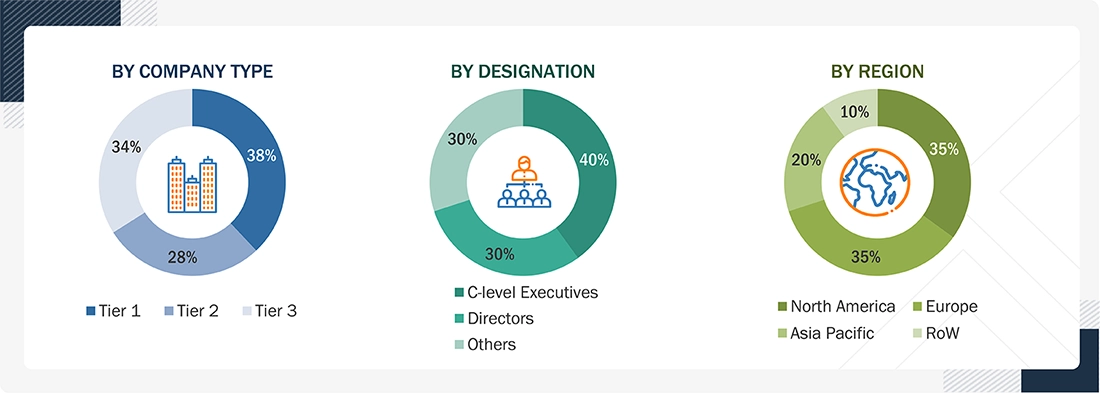
Note: The three tiers of the companies have been defined based on their total/segmental revenue as of 2024: Tier 1 = >USD 1 billion, Tier 2 = USD 1 billion–USD 500 million, and Tier 3 = USD 500 million. ‘Others’ include sales, marketing, and product managers.
To know about the assumptions considered for the study, download the pdf brochure
Market Size Estimation
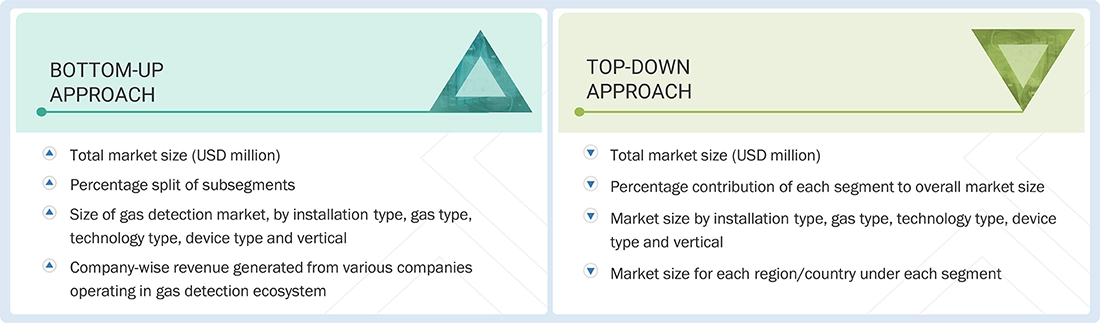
In the comprehensive market engineering process, the top-down and bottom-up approaches and several data triangulation methods were implemented to estimate and validate the size of the gas detection market and various other dependent submarkets. Key players in the market were identified through secondary research, and their market share in the respective regions was determined through primary and secondary research. This entire research methodology included the study of annual and financial reports of the top players and interviews with experts (CEOs, VPs, directors, and marketing executives) for key insights (quantitative and qualitative).
All percentage shares, splits, and breakdowns were determined using secondary sources and verified through primary sources. All the possible parameters that affect the markets covered in this research study were accounted for, viewed in detail, verified through primary research, and analyzed to obtain the final quantitative and qualitative data. This data was consolidated and supplemented with detailed inputs and analysis from MarketsandMarkets and presented in this report.
Gas Detection Market : Top-Down and Bottom-Up Approach
Data Triangulation
After determining the overall market size through the market size estimation process, as explained above, the total market has been divided into several segments and subsegments. Market breakdown and data triangulation procedures have been employed to complete the overall market engineering process and obtain precise statistics for all segments and subsegments. The data have been triangulated by studying various factors and trends from the demand and supply sides. Additionally, the market has been validated using both top-down and bottom-up approaches.
Market Definition
Gas detection is the process of identifying and measuring the presence of hazardous gases in an environment to ensure safety, operational continuity, and regulatory compliance. It involves using specialized sensors and devices such as fixed detectors, portable monitors, and multi-gas instruments to detect toxic, combustible, or oxygen-deficient atmospheres before they reach dangerous levels.
Key Stakeholders
- Hardware system integrators
- Sensor providers
- Raw material suppliers
- Original equipment manufacturers (OEMs) and systems integrators
- Research organizations and consulting companies
- Government bodies, such as regulating authorities and policymakers
- Venture capitalists and private equity firms
- Associations, organizations, and alliances
- End users (Mnaufacturing & Industrial, Mining, Oil & Gas , Chemicals, Power, etc)
Report Objectives
- To describe and forecast the size of the gas detection market, by installation type, technology type, device type, gas type, and vertical, in terms of value
- To estimate the size of the gas detection market, by installation type, in terms of volume
- To forecast the market for various segments with regard to four main regions: North America, Europe, Asia Pacific, and RoW, along with their respective countries, in terms of value
- To provide detailed information regarding the major factors, such as drivers, restraints, opportunities, and challenges, influencing the growth of the gas detection market
- To analyze the micromarkets with respect to individual growth trends, prospects, and contributions to the total market
- To study the complete supply chain and allied industry segments, and perform a value chain analysis of the gas detection landscape
- To strategically analyze the regulatory landscape, tariffs, standards, patents, Porter’s Five Forces, import and export scenarios, trade values, and case studies pertaining to the market under study
- To analyze the impact of AI/Gen AI and the 2025 US tariff impact and the macroeconomic outlook for regions covered under the study
- To analyze the opportunities in the market for various stakeholders by identifying the high-growth segments of the gas detection market
- To profile key players and comprehensively analyze their market position in terms of ranking and core competencies, along with detailing the competitive landscape for market leaders
- To analyze competitive developments, such as product launches, acquisitions, partnerships, and expansions, in the gas detection market
Customization Options
With the given market data, MarketsandMarkets offers customizations according to the company’s specific needs. The following customization options are available for the report:
Get the Full Gas Detection Market Report
Full forecast, segment splits, and company analysis for all Gas Detection Market.
- Canada Gas Detection Market
- Mexico Gas Detection Market
- Germany Gas Detection Market
- UK Gas Detection Market
- France Gas Detection Market
- Italy Gas Detection Market
- China Gas Detection Market
- Japan Gas Detection Market
- South Korea Gas Detection Market
- India Gas Detection Market
- Rest Of Europe Gas Detection Market
- Rest Of Asia Pacific Gas Detection Market
Need a Tailored Report?
Customize this report to your needs
Get 10% FREE Customization
Customize This Report
