
Canada Geosynthetics Market (2026-2031)

The Canada Geosynthetics Market was valued at $324 Million in 2026 and projected to reach to $391 Million by 2031, representing a compound annual growth rate of 3.8%. Canada's geosynthetics market is poised for moderate but consistent growth through 2031, driven by ongoing infrastructure modernization and environmental compliance initiatives.


| Market Size in | USD 26.32 MN |
| Market Forecast in | |
| CAGR | |
| Forecast Period | |
| Units Considered | Value (USD MN) |
Canada Geosynthetics Market Trends and Insights
- This moderate growth trajectory reflects Canada's steady demand for geosynthetic materials across infrastructure, environmental remediation, and civil engineering applications.
- Canada's market expansion is driven by increased investment in transportation infrastructure, landfill management, and soil stabilization projects across provinces. The Canadian geosynthetics sector benefits from stringent environmental regulations and a growing emphasis on sustainable construction practices.
- Canada's aging infrastructure and climate-related challenges are spurring adoption of geosynthetic solutions for erosion control, drainage systems, and reinforcement applications.
- Between 2026 and 2031, Canada is expected to see incremental market penetration in both traditional and emerging applications, supported by domestic manufacturing capabilities and regional supply chain resilience. Canada's geosynthetics market remains competitive yet fragmented, with opportunities concentrated in major metropolitan areas and resource-intensive regions.
- The country's commitment to infrastructure modernization and environmental stewardship positions Canada as a stable, growth-oriented market within the North American geosynthetics landscape..
Key Market Statistics
- CAGR (2026-2031) 3.8% CAGR
- Market Size, 2026 ~USD 324 Million
- Forecast, 2031 ~USD 391 Million
- Country Canada
Canada Geosynthetics Market Overview
Market Size & Growth :
Canada's geosynthetics market is valued at $324.0 million in 2026 and is projected to reach $391.0 million by 2031, with a CAGR of 3.8%, reflecting steady demand across infrastructure and civil engineering sectors.
Infrastructure Development :
Increased investment in Canadian transportation infrastructure, including highway rehabilitation and bridge reinforcement projects, is driving demand for geosynthetic materials in soil stabilization and erosion control applications.
Environmental Remediation Focus :
Growing emphasis on environmental protection and landfill management in Canada is boosting adoption of geosynthetic liners, barriers, and drainage systems for contamination prevention and waste containment.
Regional Market Dynamics :
Canada's geosynthetics market growth lags the global CAGR of 6.2%, indicating a more conservative adoption rate influenced by regional construction cycles, regulatory frameworks, and climate-specific engineering requirements.
Canada Geosynthetics Market Dynamics
- The country's aging transportation networks and increased focus on sustainable construction practices are creating steady demand for geosynthetic solutions in reinforcement, drainage, and containment applications.
- Provincial and federal infrastructure investments, particularly in Atlantic Canada and Western regions, will support market expansion.
- However, growth remains tempered compared to global markets due to Canada's mature construction sector and selective adoption patterns.
- The market will benefit from technological advancements in high-performance geosynthetics and increased awareness of their cost-effectiveness in long-term infrastructure projects..
Market Ecosystem

GEOSYNTHETICS MARKET: COMMERCIAL USE CASES ACROSS INDUSTRIES
| COMPANY | USE CASE DESCRIPTION | BENEFITS |
|---|---|---|
 |
The company provides a comprehensive portfolio of geosynthetics which includes geomembranesand geosynthetic clay linersand geotextilesand geogrids that serve landfill containment and mining operations and water reservoirs and infrastructure reinforcement. Its solutions are engineered to deliver high-performance containment systems which will protect the environment. | The products deliver superior chemical resistance and substrate protection and material strength which enables them to withstand extreme environmental conditions while providing permanent containment solutions. The solutions create environmental protection benefits while increasing operational productivity and helping businesses meet international environmental requirements. |
 |
The company provides complete geosynthetic and hybrid solutions which include geogrids, geotextiles, erosion control systems and geocomposites for use in slope stabilization, retaining structures, coastal protection and hydraulic engineering applications. | The systems deliver better reinforcement protection together with erosion control and improved drainage capabilities, which leads to stronger infrastructure resilience. The new system enables speedier installation processes while decreasing material usage and improving operational safety, which results in extended performance under difficult geotechnical conditions. |
Logos and trademarks shown above are the property of their respective owners. Their use here is for informational and illustrative purposes only.
Related Ecosystem
Fibers And Composites
- Polyetheretherketone (PEEK)
- Polyphenylene Sulfide (PPS)
- Epoxy Resin
- Polycarbonate
- Polyester Resin
- Toray Industries, Inc.
- Teijin Limited
- Hexcel Corporation
- Sgl carbon se
- Solvay sa
Key Takeaways
- Canada's geosynthetics market is valued at $324.0 million in 2026 and will reach $391.0 million by 2031 at a 3.8% CAGR.
- Canada's market growth is driven by infrastructure modernization, environmental regulations, and increased adoption in civil engineering projects.
- Canada benefits from domestic manufacturing capabilities and regional supply chain resilience supporting market stability.
- Canada's geosynthetics sector is concentrated in major metropolitan areas with opportunities in erosion control, drainage, and soil reinforcement applications.
Geosynthetics Market Report Scope
| Report Metric | Details |
|---|---|
| Base Year | 2026 |
| Fastest Growing Segment | GEOMEMBRANE (Product Type) |
| Forecast Period | 2026–2031 |
| Growth Rate | CAGR of 6.2% from 2026 to 2031 |
| Largest Segment | WASTE MANAGEMENT (End Use) |
| Market Size Base Year (Billions) | ~USD 13.44 (2026) |
| Revenue Forecast (Billions) | ~USD 18.15 (2031) |
| Segments Covered | Product Type, End Use |
Canada Geosynthetics Market Report Segmentation
2 segment dimensions are covered across the global market.
By Product Type
- Geocomposites
- Geogrids
- Geomembrane
- Geomembranes
- Geonets
- Geotextile
- Geotextiles
- Other Product Types
- Other Types
By End Use
- Civil
- Civil Construction
- Other End Uses
- Transportation
- Transportation Infrastructure
- Waste Management
- Water Management
Target Audience
- Construction & Infrastructure Companies : Canadian construction firms and infrastructure developers need market data to assess geosynthetics adoption rates, identify growth opportunities in highway, bridge, and foundation projects, and plan product sourcing strategies.
- Geosynthetics Manufacturers & Suppliers : Producers and distributors of geotextiles, geomembranes, and related products require Canada-specific market intelligence to optimize production capacity, target sales efforts, and develop competitive positioning in the regional market.
- Environmental & Engineering Consultants : Engineering firms and environmental consultants serving Canadian clients need market insights to understand geosynthetics adoption trends, recommend appropriate solutions for remediation projects, and stay current with industry developments.
- Government & Regulatory Bodies : Canadian federal and provincial agencies responsible for infrastructure planning and environmental protection require market data to inform policy decisions, infrastructure investment priorities, and sustainability initiatives.
- Investment & Financial Analysts : Investors, equity analysts, and financial institutions evaluating opportunities in Canada's construction and materials sectors need reliable market forecasts to assess growth potential and make informed investment decisions.
Key Companies in the Canada Geosynthetics Market
| Company | HQ | Ownership | Strongest segments |
|---|---|---|---|
| TENSAR CORPORATION | United States | Private Company | Polymer geogrids and pavement reinforcement systems,Permanent rolled erosion-control and turf-reinforcement mats,Bio-degradable rolled mats and mulch products, |
| SCG CHEMICALS | Thailand | Private Company | Polyethylene resins (HDPE, MDPE, LDPE, LLDPE, wax),Polypropylene resins (homo, impact, random copolymers),PVC resins and paste PVC, |
| OFFICINE MACCAFERRI SPA | Italy | Private Company | Retaining walls and soil reinforcement systems,Hydraulic and coastal protection works,Rockfall and snow avalanche mitigation systems, |
| SOLENO | United States | Private Company | VYKAT XR for Prader–Willi Syndrome,Other rare-disease pipeline and platform activities, |
TENSAR CORPORATION
Tensar Corporation is a private company founded in 1983 in the United States with 715 employees. The company specializes in geosynthetic solutions and engineered products for infrastructure and construction applications.
SCG CHEMICALS
SCG Chemicals is a Thailand-based private company established in 1983 operating in the chemical manufacturing sector.
OFFICINE MACCAFERRI SPA
Officine Maccaferri SPA is an Italian private company founded in 1879 with 202 employees, providing geotechnical and civil engineering solutions.
SOLENO
Soleno is a United States-based private company founded in 1999 with 182 employees, operating in the geosynthetics or industrial materials sector.
Reasons to Buy this Report
- Accurate Market Sizing : Obtain precise valuation data for Canada's geosynthetics market with verified 2026 baseline ($324M) and 2031 projections ($391M), enabling accurate budget allocation and investment planning for Canadian operations.
- Regional Growth Intelligence : Understand Canada-specific growth drivers including infrastructure spending, environmental regulations, and climate factors that differentiate the Canadian market from global trends and inform localized business strategies.
- Competitive Positioning : Benchmark your market share against Canada's 3.8% CAGR trajectory to identify growth opportunities, assess competitive intensity, and develop targeted strategies for market penetration in key Canadian provinces.
- Sector-Specific Insights : Access detailed analysis of geosynthetics demand across Canadian infrastructure, environmental remediation, and civil engineering sectors to identify high-potential application areas and customer segments.
- Strategic Decision Support : Leverage Canada-focused market data to support investment decisions, partnership evaluations, and expansion planning with confidence in localized market dynamics and growth forecasts through 2031.
Frequently asked questions
What is the current size of Canada's geosynthetics market?
Canada's geosynthetics market is estimated at $324.0 million in 2026 and is projected to grow to $391.0 million by 2031.
What is the growth rate of Canada's geosynthetics market?
Canada's geosynthetics market is expected to grow at a compound annual growth rate (CAGR) of 3.8% from 2026 to 2031.
What are the primary drivers of growth in Canada's geosynthetics market?
Canada's market growth is driven by infrastructure modernization, stringent environmental regulations, aging infrastructure renewal, and increased adoption in civil engineering and environmental remediation applications.
Which applications dominate Canada's geosynthetics market?
Canada's geosynthetics market is dominated by applications in transportation infrastructure, landfill management, erosion control, drainage systems, and soil stabilization projects.
How does Canada's geosynthetics market compare to North America?
Canada represents a stable, moderate-growth segment within North America, with a 3.8% CAGR reflecting steady demand supported by domestic manufacturing and regional supply chain capabilities.
RESEARCH METHODOLOGY
The study involved four major activities to estimate the current size of the global geosynthetics market. Exhaustive secondary research was conducted to gather information on the market, the peer product market, and the parent product group market. The next step was to validate these findings, assumptions, and sizes with the industry experts across the value chain of geosynthetics through primary research. The top-down and bottom-up approaches were employed to estimate the overall size of the geosynthetics market. After that, market breakdown and data triangulation procedures were used to determine the size of different segments of the market.
Secondary Research
The market for companies offering geosynthetics is arrived at by secondary data available through paid and unpaid sources, analyzing the product portfolios of the major companies in the ecosystem, and rating the companies by their performance and quality. Various secondary sources, such as Business Standard, Bloomberg, World Bank, and Factiva, were referred to identify and collect information for this study on the geosynthetics market. In the secondary research process, various secondary sources were referred to identify and collect information related to the study. Secondary sources included annual reports, press releases, and investor presentations of door vendors, forums, certified publications, and whitepapers. The secondary research was used to obtain critical information on the industry’s value chain, the total pool of key players, market classification, and segmentation from the market and technology-oriented perspectives.
Primary Research
In the primary research process, various primary sources from both the supply and demand sides were interviewed to obtain qualitative and quantitative information for this report. The primary sources from the supply side included industry experts, such as chief executive officers (CEOs), vice presidents (VPs), marketing directors, technology and innovation directors, and related key executives from several key companies and organizations operating in the geosynthetics market. After the complete market engineering (calculations for market statistics, market breakdown, market size estimations, market forecasting, and data triangulation), extensive primary research was conducted to gather information and verify and validate the critical numbers arrived at. Primary research was also conducted to identify the segmentation types, industry trends, competitive landscape of geosynthetics offered by various market players, and key market dynamics, such as drivers, restraints, opportunities, challenges, industry trends, and key player strategies. In the complete market engineering process, the top-down and bottom-up approaches and several data triangulation methods were extensively used to perform the market estimation and market forecasting for the overall market segments and subsegments listed in this report. Extensive qualitative and quantitative analysis was performed on the complete market engineering process to list the key information/insights throughout the report.
To know about the assumptions considered for the study, download the pdf brochure
Market Size Estimation
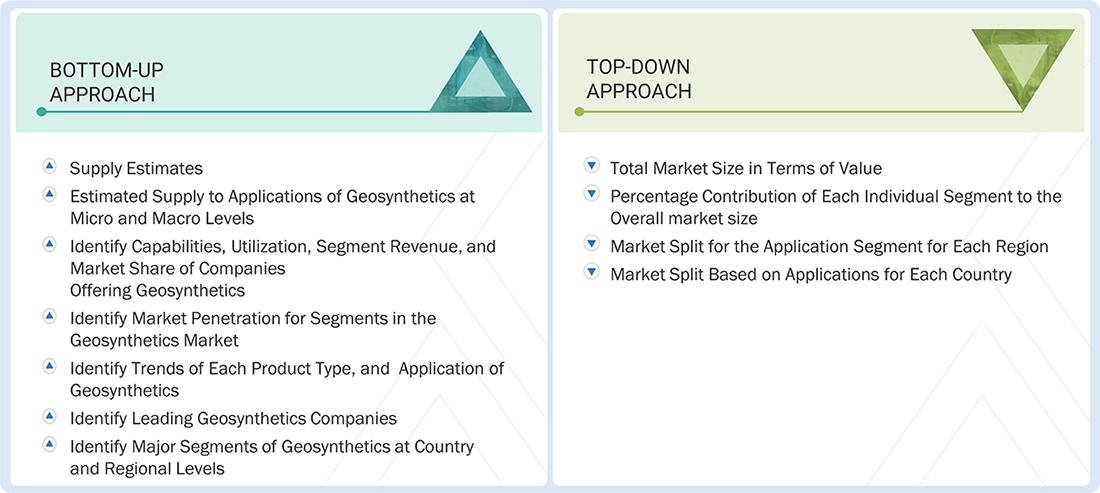
The top-down and bottom-up approaches were used to estimate and validate the size of the global geosynthetics market. These approaches were also used extensively to estimate the size of various dependent market segments. The research methodology used to estimate the market size included the following:
Geosynthetics Market : Top-Down and Bottom-Up Approach
Data Triangulation
After arriving at the overall market size using the market size estimation processes, the market was split into several segments. The data triangulation and market breakup procedures were employed, wherever applicable, to complete the overall market engineering process and arrive at the exact statistics of each market segment. The data was triangulated by studying various factors and trends from both the demand and supply sides.
Market Definition
Geosynthetics is a class of synthetic polymer-based materials which engineers use for various civil engineering and environmental projects to improve the performance and durability and sustainability of their work through soil and rock and geotechnical system applications. The materials which include geotextiles and geomembranes and geogrids and geosynthetic clay liners (GCLs) and geonets and geocomposites have been designed to execute essential tasks which include separation and filtration and drainage and reinforcement and containment and erosion control. Geosynthetics find extensive use in multiple fields which include road construction and landfills and mining and water management and coastal protection because they provide benefits which include cost savings and decreased material requirements and better structural performance and longer equipment durability. Modern infrastructure development and sustainable construction practices depend on this material because it provides solutions for both environmental and engineering problems.
Key Stakeholders
- Geosynthetics Manufacturers
- Raw Material Suppliers
- Converters & Processors
- Distributors & Traders
- Industry Associations & Regulatory Bodies
- End Users
Report Objectives
- To define, describe, and forecast the size of the geosynthetics market, based on type, application, and region in terms of value and volume
- To provide detailed information on the significant drivers, restraints, opportunities, and challenges influencing the market
- To strategically analyze micromarkets concerning individual growth trends, prospects, and their contribution to the market
- To assess the growth opportunities in the market for stakeholders and provide details on the competitive landscape for market leaders
- To forecast the market size of segments and subsegments for North America, Europe, Asia Pacific, South America, and the Middle East & Africa
- To strategically profile the key players and comprehensively analyze their market shares and core competencies
- To analyze competitive developments such as product launches, expansions, partnerships, and agreements in the geosynthetics market
- To provide the impact of AI/Gen AI on the market
Available customizations:
With the given market data, MarketsandMarkets offers customizations according to client-specific needs.
Company Information
-
Detailed analysis and profiling of additional market players (up to five)
Get the Full Geosynthetics Market Report
Full forecast, segment splits, and company analysis for all Geosynthetics Market.
- Mexico Geosynthetics Market
- Germany Geosynthetics Market
- France Geosynthetics Market
- Spain Geosynthetics Market
- UK Geosynthetics Market
- Italy Geosynthetics Market
- China Geosynthetics Market
- Japan Geosynthetics Market
- India Geosynthetics Market
- South Korea Geosynthetics Market
- South Africa Geosynthetics Market
- Brazil Geosynthetics Market
- Argentina Geosynthetics Market
- Rest Of Europe Geosynthetics Market
- Rest Of Asia Pacific Geosynthetics Market
- GCC Geosynthetics Market
- –Rest Of GCC Geosynthetics Market
- Rest Of South America Geosynthetics Market
- US Geosynthetics Market
Need a Tailored Report?
Customize this report to your needs
Get 10% FREE Customization
Customize This Report
