
North America Retimer Market (2024-2029)

The North America Retimer Market was valued at $209.4 Million in 2024 and projected to reach to $349.2 Million by 2029, representing a compound annual growth rate of 10.8%. The North American retimer market is poised for accelerated growth through 2029, expanding from $209.4 million to $349.2 million at a 10.8% CAGR.


| Market Size in | USD 26.32 MN |
| Market Forecast in | |
| CAGR | |
| Forecast Period | |
| Units Considered | Value (USD MN) |
North America Retimer Market Trends and Insights
- North America's leadership in semiconductor innovation and high-speed data transmission infrastructure drives demand for advanced retiming solutions across data centers, enterprise networking, and consumer electronics.
- The region's strong presence of technology leaders and early adoption of next-generation connectivity standards position North America as a critical growth engine for the global retimer market. North America's retimer market benefits from accelerating digital transformation initiatives and the proliferation of high-bandwidth applications requiring signal integrity solutions.
- Throughout the 2024-2029 forecast period, North America is expected to maintain its competitive advantage through continuous R&D investment and strategic partnerships.
- The region's focus on AI infrastructure, cloud computing expansion, and 5G/6G deployment creates sustained demand for retiming technologies that ensure reliable signal transmission across complex system architectures..
Key Market Statistics
- CAGR (2024-2029) 10.8% CAGR
- Market Size, 2024 ~USD 209.4 Million
- Forecast, 2029 ~USD 349.2 Million
- Geography North America
North America Retimer Market Overview
US Market Dominance :
The United States commands the North American retimer market with $286.5 million in 2024, driven by leading semiconductor manufacturers, cloud infrastructure providers, and tech giants investing heavily in high-speed data transmission technologies.
Data Center Expansion :
North American data centers are rapidly adopting advanced retiming solutions to support AI workloads, cloud computing, and 5G infrastructure, creating sustained demand for signal integrity and bandwidth optimization.
Canadian Growth Opportunity :
Canada's retimer market valued at $50.8 million reflects growing investments in telecommunications infrastructure and enterprise networking, positioning it as a secondary growth engine in the region.
Innovation Hub Advantage :
North America's concentration of semiconductor design centers, research institutions, and technology leaders accelerates retimer innovation, enabling faster adoption of next-generation PCIe and optical interconnect standards.
North America Retimer Market Dynamics
- This growth trajectory is underpinned by the region's leadership in semiconductor innovation, massive investments in AI infrastructure, and the proliferation of high-speed data centers.
- Enterprise customers increasingly prioritize signal integrity and bandwidth efficiency, driving adoption across financial services, cloud providers, and telecommunications sectors. Key growth catalysts include the transition to advanced PCIe standards, rising demand for optical interconnects in hyperscale data centers, and the integration of retiming solutions in consumer electronics.
- North America's strong regulatory environment, established supply chains, and proximity to major semiconductor manufacturers create competitive advantages.
- Strategic partnerships between chipmakers and infrastructure providers will further accelerate market penetration, particularly in emerging applications like edge computing and 5G network optimization..
Market Ecosystem
Related Ecosystem
Communication And Connectivity Technology
- Sensors
- Smart Card & Readers
- Cellular Network
- Femtocell
- Image Sensors
- Cisco Systems, Inc.
- HUAWEI TECHNOLOGIES CO LTD
- Lenovo
- CommScope Holding Company, Inc.
- Texas Instruments Incorporated
Electronics System And Components
- Sensors
- Temperature Sensors
- Pressure Sensors
- Actuators
- Image Sensors
- Lenovo
- Samsung
- Texas Instruments Incorporated
- HONEYWELL INTERNATIONAL INC.
- Teledyne Technologies Incorporated
Key Takeaways
- North America's retimer market is valued at $209.4 million in 2024 and will grow to $349.2 million by 2029, representing a 10.8% CAGR.
- North America leads in semiconductor innovation and high-speed connectivity adoption, driving strong demand for advanced retiming solutions.
- Data center expansion, AI infrastructure development, and 5G/6G deployment are primary growth catalysts for North America's retimer market.
- North America's competitive advantage stems from its concentration of technology leaders and sustained R&D investment in signal integrity solutions.
Retimer Market Report Scope
| Report Metric | Details |
|---|---|
| Base Year | 2024 |
| Fastest Growing Segment | IT & TELECOMMUNICATIONS (End User) |
| Forecast Period | 2024-2029 |
| Growth Rate | CAGR of 10.7% from 2024 to 2029 |
| Largest Segment | PROCESSOR IP (Design Ip) |
| Market Size Base Year (Billions) | ~USD 0.61 (2024) |
| Revenue Forecast (Billions) | ~USD 1.02 (2029) |
| Segments Covered | Interface, Generation, Application, End User, Design Ip, Vertical, Ip Source |
North America Retimer Market Report Segmentation
7 segment dimensions are covered across the global market.
By Interface
- Cxl
- Other Interfaces
- Pcie
- Usb
By Generation
- Pcie 1.0
- Pcie 2.0
- Pcie 3.0
- Pcie 4.0
- Pcie 5.0
- Pcie 6.0
By Application
- Hardware Accelerators
- Hardware Accessories
- Other Applications
- Servers
- Storage Devices
By End User
- Bfsi
- Education
- Government
- Healthcare
- It & Telecommunications
- Other End Users
- Other Industries
- Retail
- Transportation
By Design Ip
- Interface Ip
- Memory Ip
- Other Ips
- Processor Ip
By Vertical
- Automotive
- Commercial
- Consumer Electronics
- Industrial
- Other Verticals
- Telecommunications & Data Center
By Ip Source
- Licensing
- Royalty
Target Audience
- Semiconductor Manufacturers : Design and production teams need North American market insights to optimize retimer product portfolios, identify growth opportunities in data center and enterprise segments, and align R&D investments with regional demand trends.
- Data Center Operators & Cloud Providers : Infrastructure teams require market intelligence on retiming solutions to enhance system performance, reduce latency, and support AI workload scaling across North American facilities.
- Enterprise IT & Networking Vendors : Technology leaders need regional market data to evaluate retimer integration opportunities, benchmark competitive offerings, and develop solutions for North American enterprise customers.
- Investment & Private Equity Firms : Investors seeking semiconductor sector exposure require detailed North American market analysis to identify acquisition targets, assess growth potential, and make informed capital allocation decisions.
- System Integrators & Solution Providers : Integration specialists need market forecasts and regional trends to develop competitive offerings, identify partnership opportunities, and capture growth in North American data center and networking markets.
Countries within North America - compare and drill down
| Country | 2025 size (native) |
|---|---|
| US | USD 286.5 Million |
| Canada | USD 50.8 Million |
| Mexico | USD 11.9 Million |
Country market size visualization
Reasons to Buy this Report
- Regional Market Sizing & Forecasts : Gain precise market valuations for the US ($286.5M), Canada ($50.8M), and Mexico ($11.9M) with detailed 2024-2029 projections, enabling accurate budget allocation and revenue forecasting for North American operations.
- Competitive Landscape Analysis : Understand the positioning of major semiconductor manufacturers and retimer solution providers operating in North America, including market share dynamics and strategic initiatives specific to the region.
- Sector-Specific Growth Drivers : Identify high-growth segments within North America including data centers, enterprise networking, consumer electronics, and emerging AI infrastructure applications driving retimer adoption.
- Investment & Expansion Strategy : Leverage country-level market intelligence to prioritize market entry, facility expansion, and partnership development across the US, Canada, and Mexico with data-driven confidence.
- Technology Adoption Trends : Track North America-specific adoption patterns for PCIe standards, optical interconnects, and signal integrity solutions, enabling product development and go-to-market strategies aligned with regional demand.
Frequently asked questions
What is the current size of the North America retimer market?
The North America retimer market was valued at $209.4 million in 2024 and is projected to reach $349.2 million by 2029.
What is the expected growth rate for North America's retimer market?
North America's retimer market is expected to grow at a compound annual growth rate (CAGR) of 10.8% from 2024 to 2029.
Which industries drive demand for retimers in North America?
North America's retimer demand is primarily driven by data centers, enterprise networking, consumer electronics, AI infrastructure, and 5G/6G telecommunications sectors.
Why is North America a key market for retimer technology?
North America leads in semiconductor innovation, has strong technology infrastructure, early adoption of connectivity standards, and significant investment in cloud and AI computing, all driving retimer demand.
What factors will support North America's retimer market growth through 2029?
Key growth factors include digital transformation acceleration, high-bandwidth application proliferation, data center expansion, AI infrastructure development, and 5G/6G deployment across North America.
RESEARCH METHODOLOGY
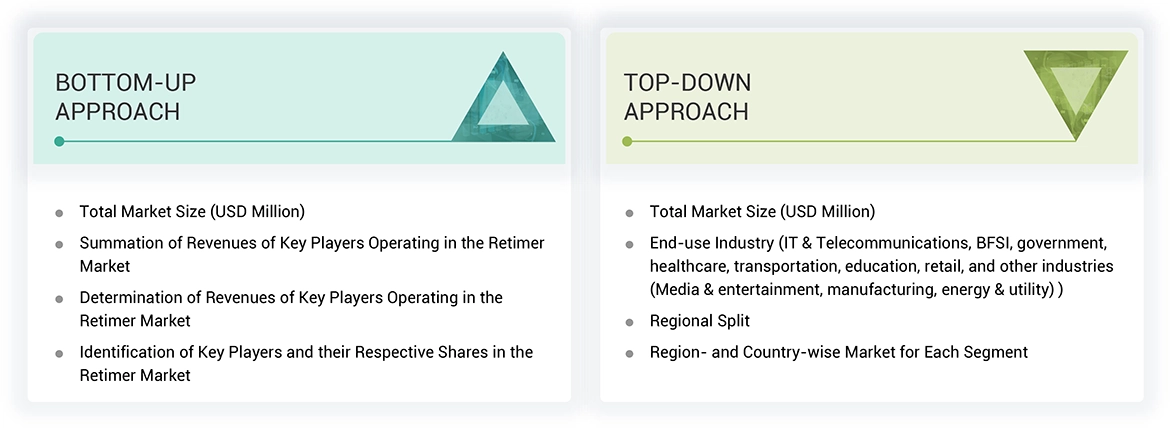
The study involved four major activities for estimating the retimer market size. Exhaustive secondary research has been conducted to collect information relevant to the market, its peer markets, and its child market. Primary research has been undertaken to validate key findings, assumptions, and sizing with industry experts across the value chain of the retimer market. Both top-down and bottom-up approaches have been employed to estimate the complete market size. It has been followed by the market breakdown and data triangulation methods to estimate the size of different segments and subsegments of the market.
Secondary Research
The research methodology used to estimate and forecast the size of the retimer market began with the acquisition of data related to the revenues of key vendors in the market through secondary research. Various secondary sources have been referred to in the secondary research process for identifying and collecting information for this study. Secondary sources include annual reports, press releases, and investor presentations of companies; white papers, journals, certified publications, and articles by recognized authors; websites; directories; and databases. Secondary research has mainly been used to obtain key information about the value chain of the retimer market, key players, market classification, and segmentation according to the industry trends to the bottom-most level, geographic markets, and key developments from both market and technology-oriented perspectives. Secondary data has been collected and analyzed to determine the overall market size, further validated through primary research. The secondary research referred to for this research study involves the Semiconductor Industry Association (SIA), Electronic System Design Alliance (ESD Alliance), Institute of Electrical and Electronics Engineers (IEEE), Taiwan Semiconductor Industry Association (TSIA), European Semiconductor Industry Association (ESIA), and Korea Semiconductor Industry Association (KSIA). Moreover, the study involved extensive use of secondary sources, directories, and databases, such as Hoovers, Bloomberg Businessweek, Factiva, and OneSource, to identify and collect valuable information for a technical, market-oriented, and commercial study of the retimer market. Vendor offerings have been taken into consideration to determine market segmentation.
Primary Research
In the primary research, various primary sources from both the supply and demand sides have been interviewed to obtain the qualitative and quantitative information relevant to this report. Primary sources from the supply side include the key industry participants, subject-matter experts (SMEs), and C-level executives and consultants from various key companies and organizations in the retimer ecosystem. After the complete market engineering (including calculations for the market statistics, the market breakdown, the market size estimations, the market forecasting, and the data triangulation), extensive primary research has been conducted to verify and validate the critical market numbers obtained. Extensive qualitative and quantitative analyses have been performed during the market engineering process to list key information/insights throughout the report. Extensive primary research has been conducted after understanding the retimer market scenario through secondary research. Several primary interviews have been conducted with market experts from the demand and supply-side players across key regions, namely, North America, Europe, Asia Pacific, and the Rest of the World (Middle East, Africa, and South America). Various primary sources from both the supply and demand sides of the market have been interviewed to obtain qualitative and quantitative information. Following is the breakdown of the primary respondents.
Primary data has been collected through questionnaires, emails, and telephonic interviews. In the canvassing of primaries, various departments within organizations, such as sales, operations, and administration, were covered to provide a holistic viewpoint in our report. After interacting with industry experts, brief sessions were conducted with highly experienced independent consultants to reinforce the findings from our primaries. This and the in-house subject matter experts’ opinions have led us to the findings described in the remainder of this report.
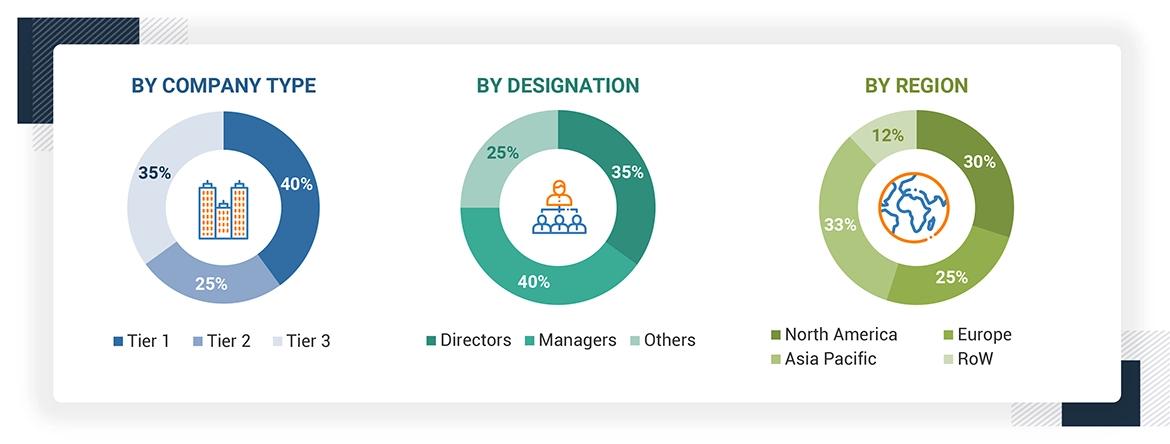
Note: The three tiers of the companies are defined based on their total revenue in 2023: Tier 1 - revenue greater than or equal to USD 1 billion; Tier 2 - revenue between USD 100 million and USD 1 billion; and Tier 3 revenue less than or equal to USD 100 million. Other designations include sales managers, marketing managers, and product managers.
About the assumptions considered for the study, To know download the pdf brochure
Market Size Estimation
The total size of the retimer market has been estimated and validated using both top-down and bottom-up approaches. Furthermore, these methods have also been used extensively to estimate the size of various subsegments in the market. The research methodology used to estimate the market size is as follows:
Data Triangulation
After arriving at the overall size of the retimer market from the market size estimation process explained above, the total market has been split into several segments and subsegments. Data triangulation and market breakdown procedures have been employed, wherever applicable, to complete the overall market engineering process and arrive at the exact statistics for all segments and subsegments of the market. The data has been triangulated by studying various factors and trends from both the demand and supply sides. Along with this, the market size has been validated using both top-down and bottom-up approaches.
Market Definition
A retimer is a specialized electronic device that regenerates digital signals by extracting the embedded clock, recovering the data, and retransmitting a fresh copy with a clean clock. It amplifies the signal, reshapes it, and ensures data integrity over long distances or through channels with high attenuation.
A retimer extracts the embedded clock from the incoming data stream, which allows it to synchronize the timing of the data signals accurately. They enhance the quality of the signal by compensating for losses and distortions that occur during transmission. This includes equalization functions that help restore the amplitude and clarity of the signal, making it suitable for high-speed applications. They are designed to be aware of the communication protocols they are handling, enabling them to adapt to various standards such as PCIe, USB4, and others. This feature allows for automatic configuration and optimization of the signal transmission without manual tuning, simplifying system integration. Unlike simple redrivers that amplify signals (including noise), they recreate the original signal by generating a clean copy, which helps maintain a high signal-to-noise ratio. This process is crucial for maintaining data integrity, especially at higher data rates where noise can significantly impact performance.
Stakeholders
- Data center networking vendors
- Technology partners
- Enterprises users
- End--users
- Government Bodies and Policymakers
- Standards Organizations, Forums, Alliances, and Associations
- Market Research and Consulting Firms
- System Integrators
- Telecom Operators
- Cloud Providers
- Network Service Providers
Report Objectives
- To define, describe, and forecast the retimer market, by interface, applications, and industry, in terms of value
- To forecast the market size for the by interface segment, in terms of volume
- To describe and forecast the size of the retimer market, by four regions: North America, Europe, Asia Pacific, and the Rest of the World (RoW), along with their respective countries, in terms of value
- To provide detailed information regarding drivers, restraints, opportunities, and challenges influencing the market growth
- To provide ecosystem analysis, case study analysis, patent analysis, technology analysis, pricing analysis, Porter’s five forces analysis, key stakeholders & buying criteria, key conferences & events, regulatory bodies, government agencies, and regulations pertaining to the market under study
- To strategically analyze micromarkets1 with respect to individual growth trends, prospects, and contributions to the overall market size
- To study the complete value chain of the retimer market
- To analyze opportunities for stakeholders by identifying high-growth segments of the retimer market
- To strategically profile the key players and comprehensively analyze their market positions in terms of their ranking and core competencies2
- To analyze competitive developments, such as product launches, acquisitions, agreements, and partnerships, in the retimer market
- To study the macroeconomic impact on the retimer market
Available Customizations
With the given market data, MarketsandMarkets offers customizations according to the company’s specific needs. The following customization options are available for the report:
Company Information
- Detailed analysis and profiling of additional market players based on various blocks of the value chain.
Get the Full Retimer Market Report
Full forecast, segment splits, and company analysis for all Retimer Market.
- US Retimer Market
- Canada Retimer Market
- Mexico Retimer Market
- Germany Retimer Market
- UK Retimer Market
- France Retimer Market
- Rest Of Europe Retimer Market
- China Retimer Market
- Japan Retimer Market
- South Korea Retimer Market
- India Retimer Market
- Rest Of Asia Pacific Retimer Market
- GCC Countries Retimer Market
- Rest Of Middle East Retimer Market
Need a Tailored Report?
Customize this report to your needs
Get 10% FREE Customization
Customize This Report
