
Rest Of Asia Pacific Halal Empty Capsules Market (2024-2029)

The Rest Of Asia Pacific Halal Empty Capsules Market was valued at $36.4 Million in 2024 and projected to reach to $47.1 Million by 2029, representing a compound annual growth rate of 5.3%. Rest Of Asia Pacific's halal empty capsules market is positioned for steady expansion, driven by rising consumer awareness of halal-certified products and increasing regulatory compliance requirements across pharmaceutical and nutraceutical sectors.


| Market Size in | USD 26.32 MN |
| Market Forecast in | |
| CAGR | |
| Forecast Period | |
| Units Considered | Value (USD MN) |
Rest Of Asia Pacific Halal Empty Capsules Market Trends and Insights
- Rest Of Asia Pacific represents a significant opportunity for halal-certified pharmaceutical and nutraceutical manufacturers seeking compliant encapsulation solutions.
- The region's growth is driven by increasing consumer demand for halal-certified products, rising pharmaceutical manufacturing capacity, and expanding dietary supplement markets across emerging economies in Rest Of Asia Pacific. Rest Of Asia Pacific's halal empty capsules market benefits from strong regulatory support for halal certification and growing awareness among manufacturers in Rest Of Asia Pacific regarding the commercial advantages of halal-compliant production.
- The forecast period through 2029 reflects Rest Of Asia Pacific's commitment to meeting international halal standards while scaling production capabilities.
- Rest Of Asia Pacific's market dynamics are shaped by both local demand and export opportunities, positioning the region as a key hub for halal capsule manufacturing and distribution..
Key Market Statistics
- CAGR (2024-2029) 5.3% CAGR
- Market Size, 2024 ~USD 36.4 Million
- Forecast, 2029 ~USD 47.1 Million
- Country Rest Of Asia Pacific
Rest Of Asia Pacific Halal Empty Capsules Market Overview
Market Valuation :
Rest Of Asia Pacific halal empty capsules market valued at USD 36.4 million in 2024, with strong expansion trajectory through 2029.
Regional Growth Rate :
Rest Of Asia Pacific experiencing 5.3% CAGR, slightly below global average of 5.4%, indicating steady but competitive regional performance.
Forecast Expansion :
Market projected to reach USD 47.1 million by 2029, representing USD 10.7 million incremental growth opportunity over five-year period.
Compliance Opportunity :
Growing pharmaceutical and nutraceutical manufacturers in Rest Of Asia Pacific increasingly seeking halal-certified encapsulation solutions for market access.
Rest Of Asia Pacific Halal Empty Capsules Market Dynamics
- The region's growing middle-class population and expanding healthcare consumption create sustained demand for compliant encapsulation solutions. Manufacturers operating in Rest Of Asia Pacific face opportunities to capture market share through localized production facilities and strategic partnerships with regional distributors.
- The 5.3% CAGR reflects moderate but consistent growth potential, with emerging markets within the region presenting untapped opportunities for halal-certified capsule suppliers seeking geographic diversification..
Market Ecosystem
Related Ecosystem
Pharmaceuticals
- Bioreactors
- Analytical Testing
- Bioanalytical Testing Services
- Cell Counters
- Data Management Services
- Thermo Fisher Scientific Inc.
- SANOFI
- Merck KGaA
- NOVARTIS
- Pfizer Inc.
Drug Delivery Devices
- Disposable Autoinjectors
- Reusable Autoinjectors
- Insulin Pumps
- Pen Injectors
- Transdermal Patches
- Novo nordisk a/s
- Becton, Dickinson and Company
- Terumo Corporation
- Medtronic plc
- Nipro Corporation
Key Takeaways
- Rest Of Asia Pacific's halal empty capsules market is valued at USD 36.4 million in 2024 and is expected to grow to USD 47.1 million by 2029, representing a 5.3% CAGR.
- Rest Of Asia Pacific's market growth is driven by increasing halal certification awareness and rising demand from pharmaceutical and nutraceutical manufacturers in the region.
- Rest Of Asia Pacific benefits from strong regulatory frameworks supporting halal production and emerging export opportunities for halal-compliant capsules.
- Rest Of Asia Pacific's competitive landscape includes both established manufacturers and new entrants capitalizing on the region's growing halal-certified product demand.
Halal Empty Capsules Market Report Scope
| Report Metric | Details |
|---|---|
| Base Year | 2024 |
| Fastest Growing Segment | NUTRACEUTICAL INDUSTRY (End User) |
| Forecast Period | 2024-2029 |
| Growth Rate | CAGR of 5.4% from 2024 to 2029 |
| Largest Segment | GELATIN HALAL EMPTY CAPSULES (Type) |
| Market Size Base Year (Billions) | ~USD 1.19 (2024) |
| Revenue Forecast (Billions) | ~USD 1.55 (2029) |
| Segments Covered | Type, End User |
Rest Of Asia Pacific Halal Empty Capsules Market Report Segmentation
2 segment dimensions are covered across the global market.
By Type
- Gelatin Halal Empty Capsules
- Non-Gelatin Halal Empty Capsules
By End User
- Nutraceutical Industry
- Other End Users
- Pharmaceutical Industry
Target Audience
- Pharmaceutical Manufacturers : Rest Of Asia Pacific-based pharma companies require halal-certified capsule solutions to meet regional regulatory standards and access compliant supply chains.
- Nutraceutical Producers : Nutraceutical manufacturers in Rest Of Asia Pacific need market intelligence on halal capsule demand to align product development with consumer preferences.
- Capsule Suppliers & Distributors : Regional and global capsule suppliers require Rest Of Asia Pacific-specific market data to optimize distribution networks and identify growth opportunities.
- Healthcare Investors : Investment firms evaluating Rest Of Asia Pacific healthcare opportunities need regional market forecasts to assess halal capsule sector viability and returns.
- Regulatory & Compliance Officers : Compliance professionals in Rest Of Asia Pacific pharmaceutical companies require market insights to navigate halal certification requirements and supplier selection.
Reasons to Buy this Report
- Regional Market Sizing : Precise valuation data for Rest Of Asia Pacific enables accurate budget allocation and investment decisions specific to this high-growth regional segment.
- Competitive Positioning : Understand Rest Of Asia Pacific's 5.3% CAGR relative to global 5.4% benchmark to identify competitive advantages and market entry strategies.
- Forecast-Driven Planning : Five-year projections through 2029 provide actionable insights for capacity planning, supply chain development, and market expansion timelines in Rest Of Asia Pacific.
- Regulatory Compliance Insights : Identify halal certification requirements and compliance opportunities specific to Rest Of Asia Pacific pharmaceutical and nutraceutical manufacturers.
- Growth Opportunity Quantification : USD 10.7 million incremental market growth enables precise ROI modeling and resource allocation for Rest Of Asia Pacific market penetration strategies.
Frequently asked questions
What is the current market size of halal empty capsules in Rest Of Asia Pacific?
Rest Of Asia Pacific's halal empty capsules market was valued at USD 36.4 million in 2024 and is projected to reach USD 47.1 million by 2029.
What is the expected growth rate for halal empty capsules in Rest Of Asia Pacific?
Rest Of Asia Pacific's halal empty capsules market is expected to grow at a compound annual growth rate (CAGR) of 5.3% from 2024 to 2029.
What factors are driving growth in Rest Of Asia Pacific's halal empty capsules market?
Rest Of Asia Pacific's market growth is driven by increasing consumer demand for halal-certified products, expanding pharmaceutical manufacturing, growing dietary supplement markets, and strong regulatory support for halal certification.
Which industries in Rest Of Asia Pacific are primary consumers of halal empty capsules?
Rest Of Asia Pacific's primary consumers include pharmaceutical manufacturers, nutraceutical companies, dietary supplement producers, and traditional medicine manufacturers seeking halal-compliant encapsulation solutions.
What opportunities exist for manufacturers in Rest Of Asia Pacific's halal empty capsules market?
Rest Of Asia Pacific offers opportunities in export markets, domestic pharmaceutical expansion, nutraceutical product development, and meeting growing consumer demand for certified halal products through 2029.
RESEARCH METHODOLOGY
The research study involved the wide use of secondary sources, directories, and databases to identify and collect valuable information for the analysis of the global halal empty capsules market. Extensive interviews were conducted with various primary participants, including key industry members, subject-matter experts (SMEs), C-level managers of leading market players, and industry consultants, to obtain and verify qualitative and quantitative information and evaluate the growth scenarios of the market. The global market size estimated through secondary research (top down and bottom-up) followed by data triangulation with inputs from industry experts to arrive at the final market size.
Secondary Research
Secondary research was used mainly to identify and collect information for the technical, market-oriented, and commercial study of the halal empty capsules market. The secondary sources used for this study include Food and Drug Administration (FDA), Islamic Food and Nutrition Council of America (IFANCA), Halal Industry Development Corporation (HIDC), The Association of Southeast Asian Nations (ASEAN), Malaysia’s Department of Islamic Development (JAKIM), Halal Certification Europe (HCE), research journals; corporate filings such as annual reports, SEC filings, investor presentations, and financial statements; press releases; trade, business, professional associations and among others. These secondary sources were also used to obtain major information about key market players, and market segmentation corresponding to industry trends, regional/country-level markets, market developments, and technology prospects. Secondary data was collected and analysed to arrive at the market size of the global halal empty capsules market, which was further validated through primary research.
Primary Research
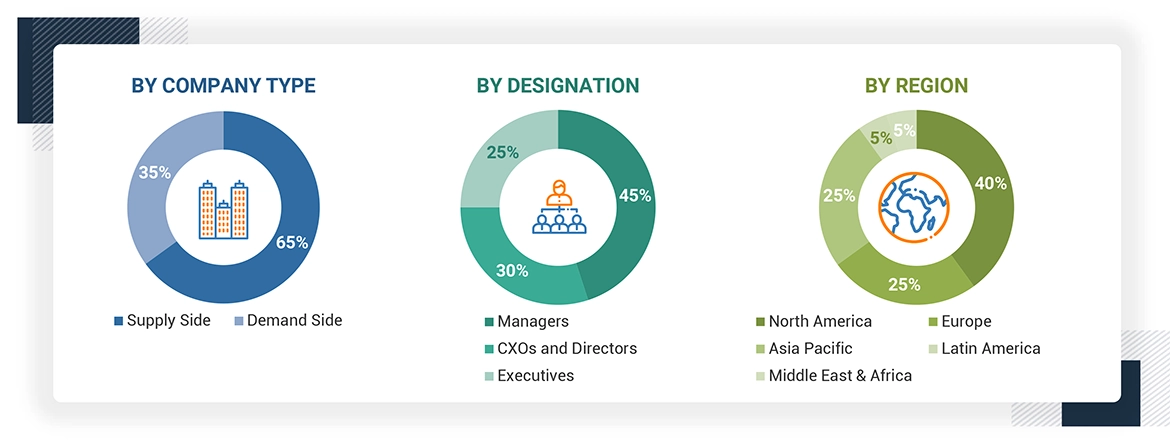
Extensive primary research was conducted after acquiring basic knowledge about the global halal empty capsules market scenario through secondary research. Several primary interviews were conducted with market experts from the demand side, such as pharmaceutical industry, nutraceutical industry, cosmetic industry from the supply side, such as C-level and D-level executives, product managers, marketing & sales managers of key manufacturers, distributors, and channel partners. The primary interviews were conducted across five major regions, including the North America, Europe, Asia Pacific, Latin America, and Middle East & Africa. Approximately 65% and 35% of the primary interviews were conducted with supply-side and demand-side participants, respectively. This primary data was collected through questionnaires, e-mails, online surveys, personal interviews, and telephonic interviews.
The following is a breakdown of the primary respondents:
To know about the assumptions considered for the study, download the pdf brochure
Market Size Estimation
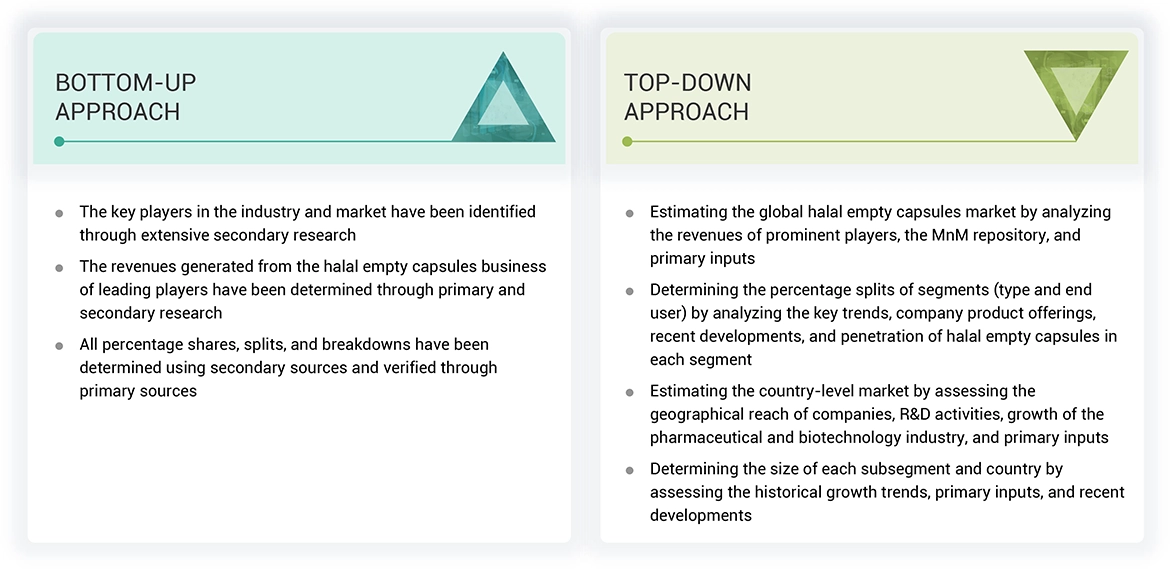
Both top-down and bottom-up approaches were used to estimate and validate the total size of the halal empty capsules market. These methods were also used extensively to estimate the size of various subsegments in the market. The research methodology used to estimate the market size includes the following:
Data Triangulation
After arriving at the market size from the market size estimation process explained above, the total market was divided into several segments and subsegments. To complete the overall market engineering process and arrive at the exact statistics for all segments and subsegments, data triangulation and market breakdown procedures were employed, wherever applicable. The data was triangulated by studying various factors and trends from both the demand and supply sides.
Market Definition
Halal empty capsules are capsules that meet Islamic dietary laws and are suitable for consumption. The ingredients used for halal empty capsules production are derived from halal sources. The capsules should not contain any components from forbidden (haram) animals or materials. The scope of the report covers halal certified empty capsules (gelatin and non-gelatin).
Stakeholders
- Halal Empty Capsules Manufacturing Companies
- Suppliers and distributors of halal empty capsules
- Raw Material Suppliers
- Government bodies/Certification Bodies
- Regulatory bodies
- Pharmaceutical Companies
- Nutraceutical Companies
- Cosmetic Companies
- Business research and consulting service providers
- Venture capitalists
- Market research and consulting firms
Report Objectives
- To define, describe, analyze, and forecast the halal empty capsules market by type, end user, and region
- To provide detailed information regarding the major factors influencing market growth (such as drivers, restraints, opportunities, and challenges)
- To strategically analyze micromarkets1 with respect to individual growth trends, prospects, and contributions to the halal empty capsules market
- To analyze opportunities in the market for stakeholders and provide details of the competitive landscape for market leaders
- To forecast the size of the market segments with respect to five main regions: North America, Europe, the Asia Pacific, Latin America, and Middle East & Africa
- To profile the key players in the halal empty capsules market and comprehensively analyze their product portfolios, market positions, and core competencies
- To track and analyze competitive developments in the halal empty capsules market, such as acquisitions, product launches, expansions, agreements, partnerships, and collaborations
- To benchmark players within the halal halal empty capsules market using the ‘Company Evaluation Matrix' framework, which analyzes market players based on various parameters within the broad categories of business strategy and product strategy
Get the Full Halal Empty Capsules Market Report
Full forecast, segment splits, and company analysis for all Halal Empty Capsules Market.
- Canada Halal Empty Capsules Market
- China Halal Empty Capsules Market
- France Halal Empty Capsules Market
- Germany Halal Empty Capsules Market
- India Halal Empty Capsules Market
- Italy Halal Empty Capsules Market
- Japan Halal Empty Capsules Market
- Rest Of Europe Halal Empty Capsules Market
- Spain Halal Empty Capsules Market
- UK Halal Empty Capsules Market
- US Halal Empty Capsules Market
Need a Tailored Report?
Customize this report to your needs
Get 10% FREE Customization
Customize This Report