
Canada Heat Exchanger Market (2025-2030)

The Canada Heat Exchanger Market was valued at $354.7 Million in 2025 and projected to reach to $463 Million by 2030, representing a compound annual growth rate of CAGR 5.5%. Canada's heat exchanger market is positioned for steady growth at a 5.5% CAGR through 2030, supported by the country's strong industrial foundation in oil and gas, petrochemicals, and manufacturing.


| Market Size in | USD 26.32 MN |
| Market Forecast in | |
| CAGR | |
| Forecast Period | |
| Units Considered | Value (USD MN) |
Canada Heat Exchanger Market Trends and Insights
- This steady expansion reflects Canada's robust industrial base, particularly in oil and gas, petrochemicals, and HVAC sectors, which drive consistent demand for efficient thermal management solutions.
- Canada's strategic position in North America and its emphasis on energy efficiency standards support sustained market development through the forecast period. The Canadian heat exchanger market benefits from ongoing industrial modernization and stringent environmental regulations that incentivize adoption of advanced cooling and heating technologies.
- Canada's investment in renewable energy infrastructure and process optimization across manufacturing facilities further accelerates market penetration.
- Between 2025 and 2030, Canada is expected to see increased competition from both domestic manufacturers and international suppliers, fostering innovation in compact, high-efficiency designs tailored to Canadian industrial requirements..
Key Market Statistics
- CAGR (2025-2030) CAGR 5.5%
- Market Size, 2025 ~USD 354.7 Million
- Forecast, 2030 ~USD 463 Million
- Country Canada
Canada Heat Exchanger Market Overview
Market Valuation :
Canada's heat exchanger market is valued at $354.7 million in 2025, with projections reaching $463.0 million by 2030, driven by industrial expansion and infrastructure modernization across key sectors.
Oil & Gas Dominance :
Canada's robust oil and gas sector remains a primary driver of heat exchanger demand, with significant investments in thermal management solutions for refining, processing, and extraction operations across Alberta and Saskatchewan.
HVAC & Building Systems :
Growing adoption of energy-efficient HVAC systems in Canadian commercial and residential buildings supports steady market growth, particularly as climate control demands increase in harsh winter conditions.
Petrochemical Growth :
Canada's petrochemical industry expansion, concentrated in Ontario and Alberta, creates sustained demand for advanced heat exchanger technologies in chemical processing and manufacturing applications.
Canada Heat Exchanger Market Dynamics
- The market benefits from ongoing capital investments in energy infrastructure, refinery upgrades, and industrial facility modernization.
- Regulatory emphasis on energy efficiency and environmental sustainability further accelerates adoption of advanced thermal management solutions across industrial and commercial sectors. The Canadian market outlook remains positive as industries prioritize operational efficiency and cost reduction.
- Strategic geographic advantages, proximity to major North American markets, and established supply chains enhance competitiveness.
- Emerging opportunities in renewable energy applications, district heating systems, and industrial waste heat recovery present additional growth vectors for heat exchanger manufacturers and suppliers targeting the Canadian market through 2030..
Market Ecosystem
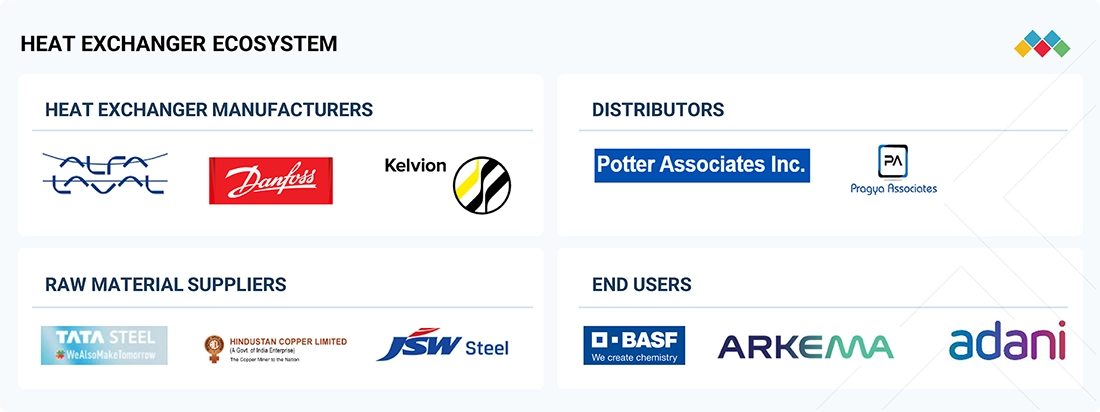
Heat Exchanger Market: COMMERCIAL USE CASES ACROSS INDUSTRIES
| COMPANY | USE CASE DESCRIPTION | BENEFITS |
|---|---|---|
 |
Heat exchangers are used in reactors, distillation units, condensers, and reboilers for heat transfer, cooling, and energy recovery | Improves process efficiency and product yield & enhances operational safety and compliance |
 |
Used in boiler feedwater heating, steam condensers, waste-heat recovery units, and LNG processing | Boosts power plant efficiency | Enables sustainable energy operations by lowering emissions |
 |
Cooling and heating of fluids, condensing gases, heat recovery in refineries and gas processing units | Enhances process efficiency, improves safety |
 |
Applied in air conditioning systems | Lowers operational costs |
Logos and trademarks shown above are the property of their respective owners. Their use here is for informational and illustrative purposes only.
Related Ecosystem
Equipment Machine And Tooling
- Wastewater Treatment
- Air Cooled Heat Exchangers
- Diaphragm Pumps
- HVAC System
- Membrane Separation
- Alfa Laval Corporate AB
- Veolia
- Daikin Industries,Ltd.
- Johnson Controls International plc
- Carrier Global Corporation
Key Takeaways
- Canada's heat exchanger market is valued at $354.7 million in 2025 and will reach $463.0 million by 2030 at a 5.5% CAGR.
- Canada's oil, gas, and petrochemical industries are primary drivers of heat exchanger demand throughout the forecast period.
- Stringent Canadian environmental regulations and energy efficiency standards accelerate adoption of advanced thermal management technologies.
- Canada's competitive landscape will intensify between 2025 and 2030 as domestic and international suppliers vie for market share.
Heat Exchanger Market Report Scope
| Report Metric | Details |
|---|---|
| Base Year | 2025 |
| Fastest Growing Segment | ––STAINLESS STEEL (Material) |
| Forecast Period | 2025–2030 |
| Growth Rate | CAGR of 7% from 2025 to 2030 |
| Largest Segment | METALS (Material) |
| Market Size Base Year (Billions) | ~USD 23.9 (2025) |
| Revenue Forecast (Billions) | ~USD 33.52 (2030) |
| Segments Covered | Type, Material, End-Use Industry |
Canada Heat Exchanger Market Report Segmentation
3 segment dimensions are covered across the global market.
By Type
- Air Cooled
- Other Types
- Plate & Frame
- Shell & Tube
By Material
- Alloys
- Brazing Clad Materials
- Metals
- –Aluminum
- –Copper
- –Copper Alloys
- –Copper Brazing
- –Ni Clad Brazing
- –Nickel
- –Nickel Alloys
- –Other Alloys
- –Other Brazing Clad Materials
- –Other Metals
- –Phosphor Copper Brazing
- –Silver Brazing
- –Steel
- –Titanium
- –Titanium Alloys
- ––Carbon Steel
- ––Hastelloy
- ––Inconel
- ––Monel
- ––Other Nickel Alloys
- ––Stainless Steel
By End-Use Industry
- Chemical
- Energy
- Food & Beverage
- Hvac & Refrigeration
- Other End-Use Industries
- Power
- Pulp & Paper
CANADA: HEAT EXCHANGER MARKET, BY END-USE INDUSTRY, 2025–2030
| Segment | 2025 | 2026 | 2027 | 2028 | 2029 | 2030 | CAGR (%) |
|---|---|---|---|---|---|---|---|
| CHEMICAL | 99.7 | 104.9 | 110.3 | 116.4 | 123.1 | 130.5 | 5.5 |
| ENERGY | 92.9 | 98.2 | 103.8 | 110 | 116.9 | 124.5 | 6 |
| FOOD & BEVERAGE | 27.4 | 28.6 | 29.8 | 31.2 | 32.8 | 34.5 | 4.7 |
| HVAC & REFRIGERATION | 65.6 | 69.5 | 73.6 | 78.2 | 83.2 | 88.9 | 6.3 |
| OTHER END-USE INDUSTRIES | 28.4 | 29.4 | 30.4 | 31.5 | 32.8 | 34.2 | 3.8 |
| POWER | 23.6 | 24.7 | 25.8 | 27 | 28.4 | 29.9 | 4.9 |
| PULP & PAPER | 17 | 17.6 | 18.2 | 18.8 | 19.6 | 20.4 | 3.7 |
| TOTAL | 354.7 | 372.8 | 391.9 | 413.2 | 436.8 | 463 | 5.5 |
Target Audience
- Industrial Equipment Manufacturers : Canadian and international heat exchanger manufacturers need market-specific data to assess demand trends, competitive positioning, and growth opportunities within Canada's oil & gas and petrochemical sectors.
- HVAC & Building Systems Suppliers : HVAC distributors and commercial building system integrators require Canada-focused insights to understand market growth drivers, regulatory compliance requirements, and customer preferences for energy-efficient thermal solutions.
- Oil & Gas Operators : Canadian oil and gas companies and refineries need market intelligence on heat exchanger technology trends, supplier capabilities, and cost-efficiency benchmarks to optimize thermal management in operations.
- Investment & Private Equity Firms : Investors evaluating opportunities in Canada's industrial equipment and energy sectors require detailed market analysis, growth forecasts, and sector dynamics to assess investment viability and portfolio positioning.
- Engineering & Consulting Firms : Canadian engineering consultants and project developers need market data and trend analysis to advise clients on heat exchanger specifications, technology selection, and procurement strategies for industrial projects.
Key Companies in the Canada Heat Exchanger Market
| Company | HQ | Ownership | Strongest segments |
|---|---|---|---|
| TRANE TECHNOLOGIES PLC | Ireland | Public Company | Commercial and industrial HVAC systems,Transport refrigeration and cold chain,Controls, building management, and digital services, |
| CARRIER GLOBAL CORPORATION | United States | Public Company | Residential HVAC and heat pumps,Commercial HVAC and building systems,Transport refrigeration and cold-chain monitoring, |
| ALFA LAVAL | Sweden | Public Company | Heat transfer (plate, air-cooled, tubular, scraped-surface),Separation (decanters, separators),Fluid handling (pumps, valves, tank cleaning, fittings), |
| DANFOSS | Denmark | Private Company | Power Solutions (mobile hydraulics, steering, motors, pumps, valves, actuators, clutches and brakes),Climate Solutions for Cooling (refrigeration, cold chain, building and industrial cooling components and controls),Climate Solutions for Heating (valves, thermostats, smart heating, heat exchangers, metering, underfloor and electric heating), |
| MERSEN | France | Public Company | Advanced Materials (graphite, C/C, SSiC, corrosion-resistant equipment),Electrical Power (fuses, surge protection, switches, power stacks),Services and Engineering (simulation, maintenance, training), |
| BOYD | Canada | Public Company |
TRANE TECHNOLOGIES PLC
TRANE TECHNOLOGIES PLC is a public company incorporated in Ireland with 44,000 employees, tracing its origins to 1885.
CARRIER GLOBAL CORPORATION
CARRIER GLOBAL CORPORATION is a United States-based public company founded in 2019 with 47,000 employees.
ALFA LAVAL
ALFA LAVAL is a Swedish public company founded in 1883 with 24,399 employees.
DANFOSS
DANFOSS is a Danish private company founded in 1933 with 39,360 employees.
MERSEN
MERSEN is a French public company established in 1889 with 7,153 employees.
BOYD
BOYD is a Canadian public company founded in 1990 with 13,424 employees.
Reasons to Buy this Report
- Sector-Specific Insights : Gain detailed understanding of heat exchanger demand patterns across Canada's dominant oil & gas, petrochemical, and HVAC sectors with market-validated data and trend analysis specific to Canadian industrial operations.
- Growth Trajectory Clarity : Access precise forecasting data showing Canada's market expansion from $354.7M to $463M by 2030, enabling informed investment decisions and strategic planning for market entry or expansion in the Canadian region.
- Competitive Positioning : Understand Canada's 5.5% CAGR relative to global 7% growth, identifying market gaps and competitive advantages for manufacturers and suppliers targeting Canadian industrial and commercial customers.
- Regional Market Dynamics : Leverage Canada-specific intelligence on provincial industrial concentrations, regulatory environments, and infrastructure investments to optimize product development and go-to-market strategies for Canadian operations.
- Investment & Partnership Strategy : Make data-driven decisions on acquisitions, partnerships, and capital allocation in Canada's heat exchanger sector with comprehensive market sizing, growth drivers, and opportunity assessment tailored to the Canadian landscape.
Frequently asked questions
What is the current size of Canada's heat exchanger market?
Canada's heat exchanger market is estimated at $354.7 million in 2025.
What is the projected size of Canada's heat exchanger market by 2030?
Canada's heat exchanger market is forecast to reach $463.0 million by 2030.
What is the CAGR for Canada's heat exchanger market?
Canada's heat exchanger market is expected to grow at a compound annual growth rate of 5.5% from 2025 to 2030.
Which industries drive demand for heat exchangers in Canada?
Canada's oil and gas, petrochemical, HVAC, and manufacturing sectors are the primary drivers of heat exchanger demand.
What factors support growth in Canada's heat exchanger market?
Industrial modernization, stringent environmental regulations, energy efficiency standards, and renewable energy investments support Canada's heat exchanger market growth.
RESEARCH METHODOLOGY
The study involved four major activities for estimating the current size of the global heat exchanger market. Exhaustive secondary research was conducted to collect information on the market, the peer product market, and the parent product group market. The next step was to validate these findings, assumptions, and sizes with industry experts across the value chain of heat exchanger through primary research. Both the top-down and bottom-up approaches were employed to estimate the overall size of the heat exchanger market. After that, market breakdown and data triangulation procedures were used to determine the size of different segments and subsegments of the market.
Secondary Research
In the secondary research process, various secondary sources such as Hoovers, Factiva, Bloomberg BusinessWeek, and Dun & Bradstreet were referred, to identify and collect information for this study on the heat exchanger market. These secondary sources included annual reports, press releases & investor presentations of companies; white papers; certified publications; articles by recognized authors; regulatory bodies, trade directories, and databases.
Primary Research
The heat exchanger market comprises several stakeholders in the supply chain, which include raw material suppliers, equipment suppliers, distributors, end-product manufacturers, buyers, and regulatory organizations. Various primary sources from the supply and demand sides of the markets have been interviewed to obtain qualitative and quantitative information. The primary participants from the demand side include key opinion leaders, executives, vice presidents, and CEOs of companies in the heat exchnager market. Primary sources from the supply side include associations and institutions involved in the heat exchanger market, key opinion leaders, and processing players.
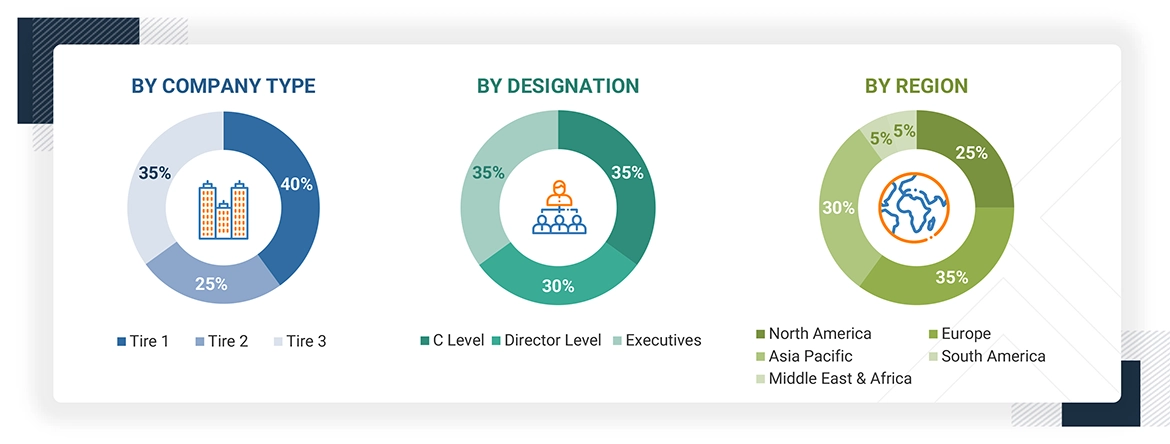
To know about the assumptions considered for the study, download the pdf brochure
Market Size Estimation
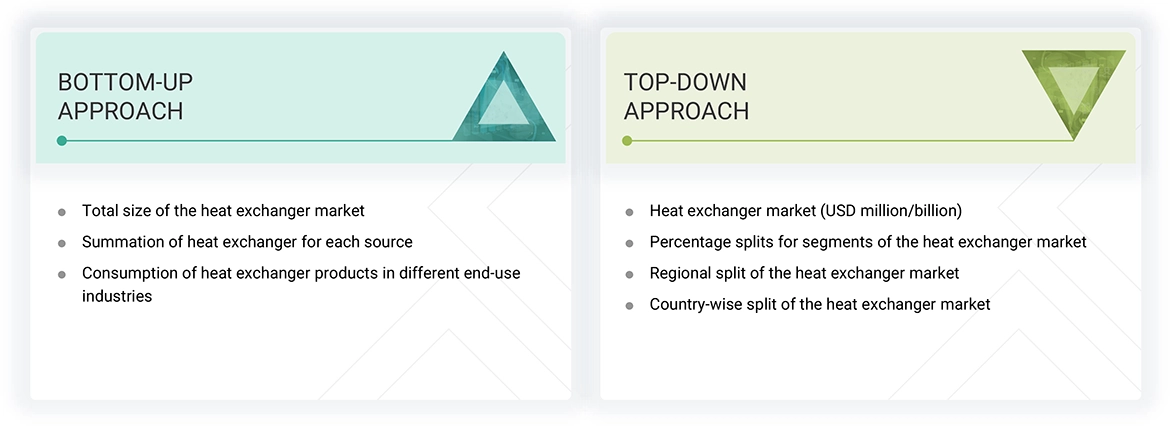
The bottom-up and top-down approaches have been used to estimate the heat exchanger market by type, material, end-use industry, and region. The research methodology used to calculate the market size includes the following steps:
- The key players in the industry and markets were identified through extensive secondary research.
- In terms of value, the industry’s supply chain and market size were determined through primary and secondary research processes.
- All percentage shares, splits, and breakdowns were determined using secondary sources and verified through primary sources.
- All possible parameters that affect the markets covered in this research study were accounted for, viewed in extensive detail, verified through primary research, and analyzed to obtain the final quantitative and qualitative data.
- The research included studying reports, reviews, and newsletters of top market players and extensive interviews with leaders such as directors and marketing executives to obtain opinions.
The following figure illustrates the overall market size estimation process employed for this study.
Data Triangulation
After arriving at the overall size of the heat exchanger market from the estimation process explained above, the total market was split into several segments and subsegments. The data triangulation and market breakdown procedures were employed, wherever applicable, to complete the overall market engineering process and arrive at the exact statistics for all segments and subsegments. The data was triangulated by studying various factors and trends from both the demand and supply sides. Along with this, the market size was validated using both the top-down and bottom-up approaches.
Market Definition
A heat exchanger is a device designed to efficiently transfer thermal energy from one fluid (liquid or gas) to another, without mixing the two. These fluids can be separated by a solid wall or may be in direct contact, depending on the exchanger’s design. Heat exchangers are essential in processes where heating or cooling is required, enabling energy recovery, temperature regulation, and process optimization across diverse industries.
Stakeholders
- Heat Exchanger Manufacturers
- Raw Material Suppliers
- Equipment Suppliers
- Regulatory Bodies and Government Agencies
- Distributors and Suppliers
- End-use Industries
- Associations and Industrial Bodies
Report Objectives
- To define, describe, and forecast the size of the heat exchanger market in terms of value and volume
- To provide detailed information regarding the key factors influencing the growth of the market (drivers, restraints, opportunities, and challenges)
- To forecast the market size based on type, material, end-use industry, and region
- To forecast the market size for the five main regions—North America, Europe, Asia Pacific (APAC), South America, and the Middle East & Africa (MEA),—along with their key countries
- To strategically analyze micromarkets with respect to individual growth trends, prospects, and contributions to the total market
- To analyze the opportunities in the market for stakeholders and provide details of the competitive landscape for the market leaders
- To strategically profile leading players and comprehensively analyze their key developments such as new product launches, expansions, and deals in the heat exchanger market
- To strategically profile key players and comprehensively analyze their market shares and core competencies
- To study the impact of AI/Gen AI on the market under study, along with the macroeconomic outlook
Get the Full Heat Exchanger Market Report
Full forecast, segment splits, and company analysis for all Heat Exchanger Market.
- US Heat Exchanger Market
- Mexico Heat Exchanger Market
- France Heat Exchanger Market
- Germany Heat Exchanger Market
- Italy Heat Exchanger Market
- Russia Heat Exchanger Market
- Turkey Heat Exchanger Market
- UK Heat Exchanger Market
- China Heat Exchanger Market
- India Heat Exchanger Market
- Japan Heat Exchanger Market
- South Korea Heat Exchanger Market
- Brazil Heat Exchanger Market
- Argentina Heat Exchanger Market
- Saudi Arabia Heat Exchanger Market
- Qatar Heat Exchanger Market
- South America Heat Exchanger Market
- Rest Of Europe Heat Exchanger Market
- Rest Of Asia Pacific Heat Exchanger Market
Need a Tailored Report?
Customize this report to your needs
Get 10% FREE Customization
Customize This Report
