
Rest Of Asia Pacific High-Throughput Screening (HTS) Market (2026-2031)

The Rest Of Asia Pacific High-Throughput Screening (HTS) Market was valued at $620.5 Million in 2026 and projected to reach to $962.2 Million by 2031, representing a compound annual growth rate of 9.2%. Rest Of Asia Pacific represents a dynamic growth segment within the broader Asia Pacific HTS market, characterized by accelerating technology adoption and expanding research capabilities.


| Market Size in | USD 26.32 MN |
| Market Forecast in | |
| CAGR | |
| Forecast Period | |
| Units Considered | Value (USD MN) |
Rest Of Asia Pacific High-Throughput Screening (HTS) Market Trends and Insights
- In 2026, Rest Of Asia Pacific is estimated at USD 620.5 million, reflecting strong adoption of HTS technologies across pharmaceutical research, biotechnology, and contract research organizations.
- The region is projected to grow to USD 962.2 million by 2031, driven by increasing R&D investments, rising demand for drug discovery acceleration, and expanding laboratory infrastructure across emerging economies. Rest Of Asia Pacific's growth trajectory is underpinned by several factors including government support for life sciences innovation, growing partnerships with global pharmaceutical companies, and the establishment of advanced research facilities.
- The 9.2% compound annual growth rate (CAGR) for Rest Of Asia Pacific between 2026 and 2031 reflects the region's emerging prominence in global drug development pipelines.
- Rest Of Asia Pacific is increasingly becoming a hub for outsourced screening services, attracting both multinational and regional players seeking cost-effective solutions without compromising quality standards..
Key Market Statistics
- CAGR (2026-2031) 9.2% CAGR
- Market Size, 2026 ~USD 620.5 Million
- Forecast, 2031 ~USD 962.2 Million
- Country Rest Of Asia Pacific
Rest Of Asia Pacific High-Throughput Screening (HTS) Market Overview
Strong Regional Growth Trajectory :
Rest Of Asia Pacific's HTS market is expanding at 9.2% CAGR, with market size growing from USD 620.5 million in 2026 to USD 962.2 million by 2031, demonstrating robust investment in screening technologies across emerging economies.
Pharmaceutical & Biotech Adoption :
Increasing pharmaceutical research activities and biotechnology expansion across Rest Of Asia Pacific countries are driving significant HTS technology adoption, supported by growing R&D infrastructure and cost-effective manufacturing advantages.
CRO Sector Expansion :
Contract Research Organizations in Rest Of Asia Pacific are rapidly scaling HTS capabilities to serve global pharmaceutical clients, positioning the region as a competitive outsourcing hub for drug discovery and development services.
Emerging Market Opportunities :
Developing nations within Rest Of Asia Pacific present untapped potential for HTS market penetration, driven by improving healthcare investments, regulatory framework development, and increasing collaboration with international research institutions.
Rest Of Asia Pacific High-Throughput Screening (HTS) Market Dynamics
- The region's pharmaceutical and biotechnology sectors are increasingly investing in high-throughput screening infrastructure to enhance drug discovery efficiency and reduce time-to-market for new therapeutics.
- Government initiatives supporting life sciences research and favorable cost structures are attracting both domestic and international investments. By 2031, Rest Of Asia Pacific is poised to capture significant market share as CROs and pharmaceutical companies establish advanced screening facilities.
- The region's growth will be fueled by rising healthcare expenditures, increasing prevalence of chronic diseases requiring new drug development, and strategic partnerships with global pharmaceutical leaders.
- Emerging economies within this cutout are expected to become key players in the global HTS landscape..
Market Ecosystem
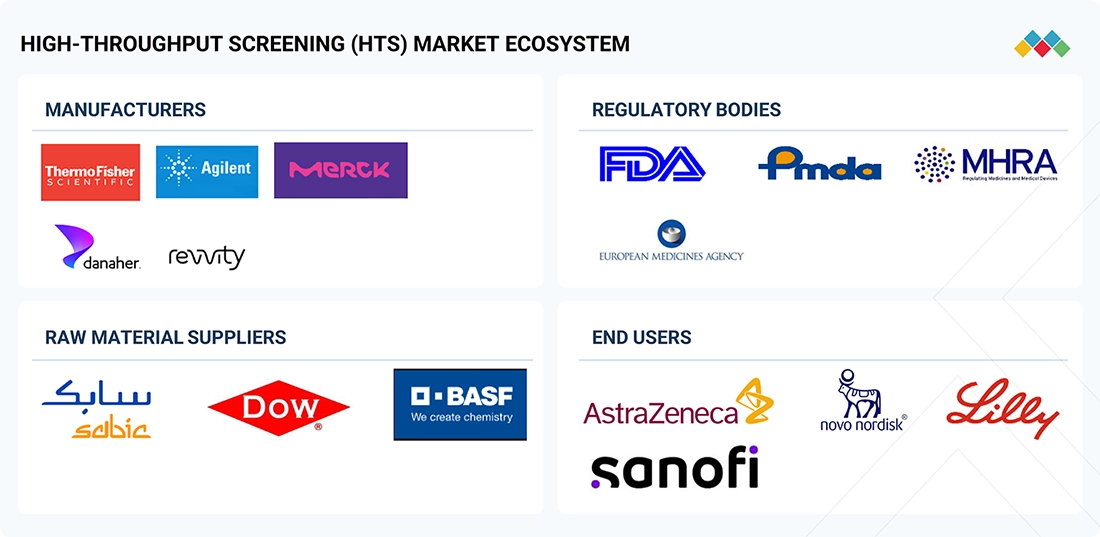
HIGH THROUGHPUT SCREENING MARKET: COMMERCIAL USE CASES ACROSS INDUSTRIES
| COMPANY | USE CASE DESCRIPTION | BENEFITS |
|---|---|---|
 |
Partnered with DyNAbind to deploy a fragment-based DNA-encoded Chemical Library (DEL) platform, enabling simultaneous screening of over 370,000 fragment pairs against novel protein targets. | Enabled access to large-scale DEL screening without requiring dedicated HTS infrastructure; broadened tractable chemical space for novel and difficult targets, delivering more trustworthy hit identification results with significantly reduced false-positive rates. |
 |
Implemented a cell painting-based phenotypic HTS platform integrated with machine learning to predict compound bioactivity across large libraries without running individual biochemical assays for each target | AstraZeneca researchers screened a structurally diverse set of 8,300 compounds in a cell painting assay, then trained ML models on single-point bioactivity data from their internal HTS database to predict and rank compound activity across multiple targets. | The approach enabled prioritization of compounds for probability of activity, effectively using one high-content imaging screen to generate predictions across an entire compound library of ~1 million compounds—substantially reducing the number of individual assays required. |
Logos and trademarks shown above are the property of their respective owners. Their use here is for informational and illustrative purposes only.
Related Ecosystem
Biotechnology
- Reagents
- Polymerase Chain Reaction (PCR)
- Stem Cells
- Assay Kits
- Flow Cytometers
- Thermo Fisher Scientific Inc.
- Merck KGaA
- Danaher Corporation
- Agilent Technologies, Inc.
- Bio-Rad Laboratories, Inc.
Key Takeaways
- Rest Of Asia Pacific HTS market valued at USD 620.5 million in 2026, expanding to USD 962.2 million by 2031 at a 9.2% CAGR
- Rest Of Asia Pacific is emerging as a cost-effective outsourcing destination for global pharmaceutical and biotech companies conducting high-throughput screening operations
- Government initiatives and increased R&D funding across Rest Of Asia Pacific are accelerating adoption of advanced HTS technologies and infrastructure development
- Rest Of Asia Pacific's competitive advantage lies in skilled workforce availability, lower operational costs, and growing regulatory compliance capabilities
High-Throughput Screening (HTS) Market Report Scope
| Report Metric | Details |
|---|---|
| Base Year | 2026 |
| Fastest Growing Segment | DATA ANALYSIS & HIT IDENTIFICATION (Workflow) |
| Forecast Period | 2026–2031 |
| Growth Rate | CAGR of 10.7% from 2026 to 2031 |
| Largest Segment | PRODUCTS (Offering) |
| Market Size Base Year (Billions) | ~USD 27.61 (2026) |
| Revenue Forecast (Billions) | ~USD 45.9 (2031) |
| Segments Covered | Offering, Type, Workflow |
Rest Of Asia Pacific High-Throughput Screening (HTS) Market Report Segmentation
3 segment dimensions are covered across the global market.
By Offering
- Products
- Services
By Type
- Instruments
- Reagents, Kits, And Consumables
- Software & Informatics
By Workflow
- Assay Development & Optimization
- Compound Library Preparation
- Data Analysis & Hit Identification
- Hit Confirmation/Secondary Screening
- Hit Validation & Characterization
- Primary Screening
Target Audience
- Pharmaceutical Companies : Pharmaceutical manufacturers and R&D divisions need Rest Of Asia Pacific market intelligence to identify outsourcing opportunities, establish regional research centers, and optimize drug discovery timelines in cost-effective markets.
- Biotechnology Firms : Biotech companies require detailed regional market data to assess expansion feasibility, evaluate CRO partnerships, and understand technology adoption rates to support early-stage drug development initiatives in Asia Pacific.
- Contract Research Organizations : CROs operating in Rest Of Asia Pacific need market forecasts and competitive analysis to justify capacity investments, identify service gaps, and develop targeted growth strategies for HTS service offerings.
- HTS Technology Vendors : Equipment manufacturers and software providers require regional market segmentation data to prioritize sales efforts, customize solutions for Rest Of Asia Pacific customers, and forecast revenue potential by country.
- Investment & Strategy Consultants : Private equity firms, management consultants, and strategic advisors need comprehensive Rest Of Asia Pacific market analysis to support due diligence, valuation models, and investment thesis development for life sciences portfolio companies.
Key Companies in the Rest Of Asia Pacific High-Throughput Screening (HTS) Market
| Company | HQ | Ownership | Strongest segments |
|---|---|---|---|
| BIOCARTIS SA | Belgium | Private Company | Oncology assay consumables,Instrument systems and service,Other legacy and residual activities, |
| QIAGEN NV | Netherlands | Public Company | Sample technology consumables and instruments,Molecular diagnostics assays (TB, oncology, sexual and reproductive health, viral load),PCR and enzyme solutions (qPCR, dPCR, RT-PCR, configured enzymes), |
| CODEXIS, INC. | United States | Public Company | CodeEvolver platform-enabled enzyme sales and services,ECO Synthesis platform for RNAi and nucleic acid manufacturing,Licensing and royalties from technology partnerships, |
| THERMO FISHER SCIENTIFIC INC. | United States | Public Company | Life Sciences Solutions,Analytical Instruments,Specialty Diagnostics, |
| DANAHER CORPORATION | United States | Public Company | Biotechnology (bioprocessing, single-use, filtration, aseptic fill-finish),Life Sciences (analytical instruments, genomics, lab automation),Diagnostics (clinical instruments, consumables, software, services), |
| MERCK KGAA | Germany | Public Company | Life Science,Healthcare,Electronics, |
| AGILENT TECHNOLOGIES, INC. | United States | Public Company | Life Sciences and Diagnostics Markets,Agilent CrossLab,Applied Markets, |
| REVVITY, INC. | United States | Public Company | Diagnostics (prenatal, neonatal, infectious disease, immunodiagnostics),Life science reagents and assays (BioLegend, Dharmacon, Alpha platforms),Instruments and imaging systems, |
| TECAN GROUP LTD. | Switzerland | Public Company | Liquid handling and automation platforms (incl. Tecan Labwerx),Microplate readers, washers, and detection instruments,Consumables, sequencing reagents, immunoassays, and antibodies, |
| BIO-RAD LABORATORIES, INC. | United States | Public Company | Clinical Diagnostics systems, kits, and quality controls,Life Science instruments and reagents,Informatics and software, |
| CORNING INCORPORATED | United States | Public Company | Optical communications (fiber, cable, hardware, connectivity),Display glass substrates (LCD and OLED),Specialty materials and mobile consumer electronics glass, |
| METTLER-TOLEDO INTERNATIONAL INC. | Switzerland | Public Company | Laboratory instruments and LabX software,Industrial instruments and product inspection,Retail weighing and fresh-goods solutions, |
| LONZA GROUP | Switzerland | Public Company | Integrated Biologics,Advanced Synthesis (small molecules, ADCs, HPAPIs),Specialized Modalities (cell & gene, microbial, bioscience, mRNA), |
| WATERS CORPORATION | United States | Public Company | Liquid Chromatography Systems and Columns,Mass Spectrometry Systems,TA Instruments (Thermal, Rheometry, Calorimetry), |
| SARTORIUS AG | Germany | Public Company | Bioprocess solutions (bioreactors, filtration, chromatography, fluid management),Lab products and services (weighing, pipettes, filtration, microbiological testing),Advanced analytical and cell analysis systems (BLI, SPR, cytometry, live-cell imaging), |
| EPPENDORF SE | Germany | Private Company | Liquid handling (pipettes, dispensers, automated systems),Separation & instrumentation (centrifuges, PCR cyclers, ULT freezers),Consumables (tubes, tips, plates, single-use bioreactors), |
| PORVAIR PLC | United Kingdom | Public Company | Aerospace & Industrial Filtration,Laboratory Instruments and Consumables,Metal Melt Quality (Porous Ceramic Filters), |
BIOCARTIS SA
BIOCARTIS SA is a Belgian private company established in 2014 with 500 employees. The company focuses on molecular diagnostics and personalized medicine solutions.
QIAGEN NV
QIAGEN NV is a Dutch public company founded in 1984 with 5,500 employees. The company is a leading provider of molecular diagnostics, sample preparation, and life sciences research tools.
CODEXIS, INC.
CODEXIS, INC. is a United States public company founded in 2002 with 146 employees. The company develops enzyme engineering and biocatalysis solutions for pharmaceutical and industrial applications.
THERMO FISHER SCIENTIFIC INC.
THERMO FISHER SCIENTIFIC INC. is a United States public company founded in 1956 with 125,000 employees. The company is a global leader in serving science with a broad portfolio of laboratory equipment, reagents, and services.
DANAHER CORPORATION
DANAHER CORPORATION is a United States public company founded in 1969 with 59,000 employees. The company operates a diversified conglomerate with significant presence in life sciences, diagnostics, and environmental solutions.
MERCK KGAA
MERCK KGAA is a German public company founded in 1668 with 59,077 employees. The company is a global science and technology leader operating in pharmaceuticals, life sciences, and performance materials.
AGILENT TECHNOLOGIES, INC.
AGILENT TECHNOLOGIES, INC. is a United States public company founded in 1999 with 18,000 employees. The company provides analytical instruments, software, and services for life sciences, diagnostics, and applied chemical markets.
REVVITY, INC.
REVVITY, INC. is a United States public company founded in 1937 with 11,000 employees. The company develops and manufactures analytical instruments and software for life sciences research and diagnostics.
TECAN GROUP LTD.
TECAN GROUP LTD. is a Swiss public company founded in 1980 with 3,166 employees. The company specializes in laboratory automation and detection solutions for life sciences and diagnostics applications.
BIO-RAD LABORATORIES, INC.
BIO-RAD LABORATORIES, INC. is a United States public company founded in 1952 with 7,450 employees. The company manufactures and distributes life science research products and clinical diagnostics solutions.
CORNING INCORPORATED
CORNING INCORPORATED is a United States public company founded in 1851 with 67,200 employees. The company is a diversified technology leader with significant operations in life sciences, laboratory products, and specialty materials.
METTLER-TOLEDO INTERNATIONAL INC.
METTLER-TOLEDO INTERNATIONAL INC. is a Swiss public company founded in 1991 with 16,600 employees. The company manufactures precision instruments and services for laboratory, industrial, and retail applications.
LONZA GROUP
LONZA GROUP is a Swiss public company founded in 1897 with 20,000 employees. The company is a leading supplier of products and services for the pharmaceutical, biotech, and specialty chemical industries.
WATERS CORPORATION
WATERS CORPORATION is a United States public company founded in 1958 with 7,900 employees. The company develops and manufactures analytical instruments and software for laboratory and life sciences applications.
SARTORIUS AG
SARTORIUS AG is a German public company founded in 1870 with 14,242 employees. The company provides laboratory and process technologies for pharmaceutical, biotech, and food industries.
EPPENDORF SE
EPPENDORF SE is a German private company founded in 1945 with 4,358 employees. The company manufactures laboratory equipment and consumables for life sciences research and diagnostics.
PORVAIR PLC
PORVAIR PLC is a United Kingdom public company founded in 1982 with 992 employees. The company manufactures advanced filtration and separation products for life sciences and industrial applications.
Reasons to Buy this Report
- Regional Market Sizing & Forecasts : Obtain precise market valuation for Rest Of Asia Pacific (USD 620.5M in 2026, USD 962.2M in 2031) with detailed CAGR analysis to support investment decisions and resource allocation strategies specific to this high-growth region.
- Competitive Landscape Intelligence : Identify key players, market consolidation trends, and competitive positioning within Rest Of Asia Pacific's HTS sector to benchmark your organization against regional competitors and emerging market entrants.
- Country-Specific Growth Drivers : Understand unique market dynamics, regulatory environments, and adoption patterns across individual Rest Of Asia Pacific countries to tailor market entry strategies and localize product offerings effectively.
- Investment & Partnership Opportunities : Discover high-potential markets, emerging CRO hubs, and pharmaceutical clusters within Rest Of Asia Pacific to identify strategic partnership, acquisition, and expansion opportunities aligned with your business objectives.
- Technology Adoption Trends : Analyze HTS technology preferences, automation adoption rates, and infrastructure development patterns specific to Rest Of Asia Pacific to align product development and go-to-market strategies with regional demand.
Frequently asked questions
What is the market size of Rest Of Asia Pacific HTS in 2026?
Rest Of Asia Pacific's High-Throughput Screening market is estimated at USD 620.5 million in 2026.
What is the projected market size for Rest Of Asia Pacific HTS by 2031?
Rest Of Asia Pacific's HTS market is forecasted to reach USD 962.2 million by 2031.
What is the CAGR for Rest Of Asia Pacific HTS market?
Rest Of Asia Pacific's HTS market is expected to grow at a compound annual growth rate of 9.2% from 2026 to 2031.
Why is Rest Of Asia Pacific becoming important for HTS services?
Rest Of Asia Pacific offers cost advantages, skilled scientific workforce, improving regulatory frameworks, and expanding research infrastructure that attract global pharmaceutical and biotech companies.
What factors are driving growth in Rest Of Asia Pacific HTS market?
Key drivers include increased government R&D funding, rising pharmaceutical outsourcing, expansion of contract research organizations, and growing adoption of advanced screening technologies across Rest Of Asia Pacific.
RESEARCH METHODOLOGY
This research study relied heavily on secondary sources, directories, and databases to identify and collect valuable information for analyzing the global high-throughput screening (HTS) market. In-depth interviews were conducted with primary respondents, including key industry participants, subject-matter experts (SMEs), C-level executives of leading market players, and industry consultants, to obtain and verify critical qualitative and quantitative information and to assess the market's growth prospects. The global market size estimated through secondary research was then triangulated with primary research inputs to arrive at the final market size.
Secondary Research
Secondary research was used mainly to identify and collect information for the extensive technical, market-oriented, and commercial study of the high-throughput screening (HTS) market. The secondary sources used for this study include World Health Organization (WHO), American Society for Clinical Laboratory Science (ASCLS), Centers for Disease Control and Prevention (CDC), National Institutes of Health (NIH), National Center for Biotechnology Information (NCBI), American Association for Clinical Chemistry (AACC), National Center for Advancing Translational Sciences (NCATS), American Society for Pharmacology and Experimental Therapeutics (ASPET), National Health Service (NHS), Pharmaceuticals and Medical Devices Agency (PMDA), European Medicines Agency (EMA), Society for Laboratory Automation and Screening (SLAS), European Bioinformatics Institute, and Center for Translational Research, among others. Corporate filings include annual reports, SEC filings, investor presentations, and financial statements; research journals; press releases; and trade, business, and professional associations. Secondary data were collected and analyzed to determine the overall size of the global high-throughput screening (HTS) market, which was subsequently validated through primary research. These sources were also used to obtain key information on major players, market classification, and segmentation aligned with industry trends, regional/country-level markets, market developments, and technology perspectives.
Primary Research
In-depth interviews were conducted with various primary respondents, including key industry participants, subject-matter experts (SMEs), C-level executives of key market players, and industry consultants, among others, to obtain and verify critical qualitative and quantitative information and to assess the market's future prospects. Various primary sources from both the supply and demand sides of the market were interviewed to obtain qualitative and quantitative information. The following is a breakdown of the primary respondents:
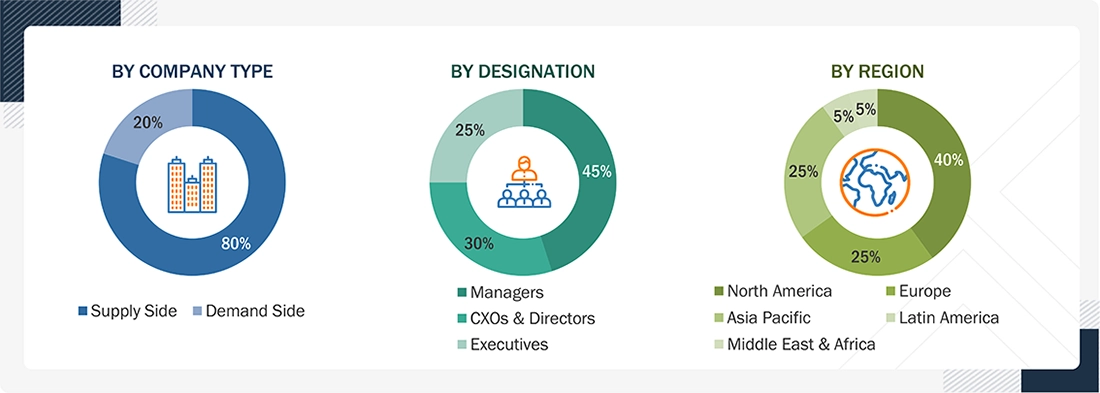
To know about the assumptions considered for the study, download the pdf brochure
Market Size Estimation
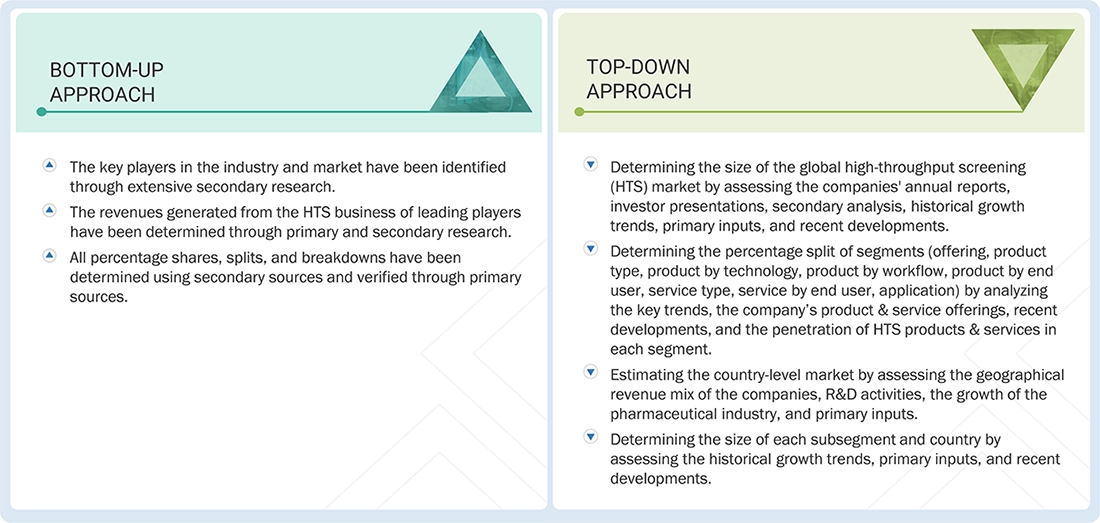
Both top-down and bottom-up approaches were employed to estimate and validate the overall size of the high-throughput screening (HTS) market. These methods were also widely used to determine the size of various market segments. The research methodology used to estimate the market size includes the following:
High-Throughput Screening (HTS) Market : Top-Down and Bottom-Up Approach
Data Triangulation
After estimating the overall market size, the total market was divided into segments and subsegments. Data triangulation and market breakdown techniques were used where applicable to finalize the overall market analysis and obtain precise statistics for all segments and subsegments. The data was triangulated by examining various factors and trends from both demand and supply sides.
Market Definition
High-throughput screening (HTS) is a drug discovery process that involves automated testing of large quantities of chemical or biological compounds against specific biological targets using various binding assays.
The HTS market comprises products (instruments, reagents & consumables, software), and services used to perform automated, parallel screening of large compound or biological libraries against defined biological targets or assays to identify active entities (hits). The high-throughput screening (HTS) market comprises workflow stages from assay development and compound library management to automated large-scale screening and hit identification, culminating in validated screening hits.
Key Stakeholders
- Contract research organizations
- Pharmaceutical & biopharmaceutical companies
- Academic & research institutes
- High-throughput screening instrument & reagent manufacturers
- High-content screening database, service, and software providers
- Venture capitalists & investors
- Market research & consulting firms
- Government associations
- Medical institutions & universities
Report Objectives
- To define, describe, and forecast the high-throughput screening (HTS) market by offering, products by type, products by technology, products by workflow, products by end user, services by type, services by end user, application, and region
- To provide detailed information regarding the major factors influencing market growth (such as drivers, restraints, opportunities, and challenges)
- To analyze the micromarkets1 with respect to individual growth trends, prospects, and contributions to the overall high-throughput screening (HTS) market
- To analyze the opportunities for stakeholders and provide details of the competitive landscape for market leaders
- To forecast the size of the market segments with respect to six regions: North America, Europe, the Asia Pacific, Latin America, the Middle East, and Africa
- To profile the key players and analyze their market shares and core competencies2
- To track and analyze competitive developments, such as product & service launches, agreements, partnerships, acquisitions, and research & development activities
- To analyze and provide funding & investment activities, brand/product/service comparative analysis, and vendor valuation & financial metrics of the high-throughput screening (HTS) market
Customization Options
Based on the given market data, MarketsandMarkets offers customization to meet the company’s specific needs. The following customization options are available for this report:
Portfolio Assessment
- Product/Service Matrix gives a detailed comparison of the product/service portfolios of the top five companies.
Company Information
- Detailed analysis and profiling of additional market players (up to five).
Geographical Analysis
- Further breakdown of the Rest of Europe high-throughput screening (HTS) market, by country
- Further breakdown of the Rest of Asia Pacific high-throughput screening (HTS) market, by country
- Further breakdown of the Rest of Latin America high-throughput screening (HTS) market, by country
Get the Full High-Throughput Screening (HTS) Market Report
Full forecast, segment splits, and company analysis for all High-Throughput Screening (HTS) Market.
- Australia High-Throughput Screening (HTS) Market
- Brazil High-Throughput Screening (HTS) Market
- Canada High-Throughput Screening (HTS) Market
- China High-Throughput Screening (HTS) Market
- France High-Throughput Screening (HTS) Market
- Germany High-Throughput Screening (HTS) Market
- India High-Throughput Screening (HTS) Market
- Italy High-Throughput Screening (HTS) Market
- Japan High-Throughput Screening (HTS) Market
- Mexico High-Throughput Screening (HTS) Market
- Rest Of Europe High-Throughput Screening (HTS) Market
- Rest Of GCC Countries High-Throughput Screening (HTS) Market
- Rest Of Latin America High-Throughput Screening (HTS) Market
- Saudi Arabia High-Throughput Screening (HTS) Market
- South Korea High-Throughput Screening (HTS) Market
- Spain High-Throughput Screening (HTS) Market
- UAE High-Throughput Screening (HTS) Market
- UK High-Throughput Screening (HTS) Market
- US High-Throughput Screening (HTS) Market
Need a Tailored Report?
Customize this report to your needs
Get 10% FREE Customization
Customize This Report