
US High Voltage Current Sensor Market (2026-2031)

The US High Voltage Current Sensor Market was valued at $72.3 Million in 2026 and projected to reach to $128.8 Million by 2031, representing a compound annual growth rate of 10.1%. The US high voltage current sensor market is positioned for sustained expansion through 2031, driven by accelerating electrification across industrial, automotive, and energy sectors.


| Market Size in | USD 26.32 MN |
| Market Forecast in | |
| CAGR | |
| Forecast Period | |
| Units Considered | Value (USD MN) |
US High Voltage Current Sensor Market Trends and Insights
- This 10.1% compound annual growth rate reflects strong demand across the US industrial, automotive, and renewable energy sectors, where high voltage monitoring is critical for operational safety and efficiency.
- The US market benefits from advanced manufacturing infrastructure, significant investments in grid modernization, and the accelerating adoption of electric vehicles and renewable energy systems. Driving this expansion, the US is witnessing increased electrification across multiple industries and heightened regulatory requirements for power quality and safety monitoring.
- The US semiconductor and electronics sector continues to innovate in sensor technology, enabling more precise and reliable high voltage current measurement solutions.
- Between 2026 and 2031, the US market will be shaped by growing demand from utilities upgrading aging infrastructure, automotive manufacturers scaling EV production, and industrial facilities implementing advanced power management systems..
Key Market Statistics
- CAGR (2026-2031) 10.1% CAGR
- Market Size, 2026 ~USD 72.3 Million
- Forecast, 2031 ~USD 128.8 Million
- Country US
US High Voltage Current Sensor Market Overview
Market Valuation Growth :
The US high voltage current sensor market is valued at $72.3 million in 2026 and is projected to reach $128.8 million by 2031, representing a robust 10.1% CAGR driven by industrial modernization and grid infrastructure upgrades.
Industrial Sector Demand :
US manufacturing and industrial facilities are increasingly adopting high voltage current sensors for real-time monitoring, predictive maintenance, and operational safety compliance, particularly in power generation and distribution networks.
Automotive & EV Expansion :
The rapid growth of electric vehicle production in the US is creating significant demand for high voltage current sensors in battery management systems, charging infrastructure, and powertrain applications.
Renewable Energy Integration :
US renewable energy installations, including solar and wind farms, require advanced high voltage current sensing solutions for grid integration, energy conversion efficiency, and system protection.
US High Voltage Current Sensor Market Dynamics
- Regulatory mandates for grid modernization, coupled with the Biden administration's renewable energy initiatives, are creating favorable conditions for sensor adoption.
- The automotive sector's transition to electric vehicles represents a particularly strong growth vector, with OEMs and Tier-1 suppliers investing heavily in voltage monitoring technologies. Key growth catalysts include increasing grid complexity, rising demand for energy efficiency, and stringent safety standards in industrial applications.
- The market will benefit from technological advancements in sensor miniaturization, accuracy improvements, and cost reduction.
- Competition among US and international manufacturers is expected to drive innovation while maintaining healthy market dynamics through 2031..
Market Ecosystem

HIGH VOLTAGE CURRENT SENSOR MARKET: COMMERCIAL USE CASES ACROSS INDUSTRIES
| COMPANY | USE CASE DESCRIPTION | BENEFITS |
|---|---|---|
 |
Provides high-precision current sensing solutions used in electric vehicles for battery management systems, traction inverters, and onboard chargers to enable accurate monitoring and safe operation of high-voltage powertrains. | High measurement accuracy, strong isolation performance, and enhanced safety for efficient EV powertrain and battery system operation. |
 |
Offers advanced current sensing technologies integrated into industrial equipment, renewable energy systems, and EV charging infrastructure for real-time monitoring, control, and protection of high-voltage circuits. | Reliable real-time monitoring, improved system protection, and optimized energy efficiency across industrial and energy applications. |
 |
Develops precision shunt-based current sensing solutions widely used in automotive and energy applications requiring highly accurate current measurement, particularly in battery systems and power electronics. | Exceptional precision, low resistance losses, and stable performance in high-current and high-temperature environments. |
 |
Supplies current sensing solutions integrated within advanced switching and control systems in automotive and industrial applications, supporting efficient power distribution and system-level monitoring. | Improved system integration, efficient power control, and enhanced reliability in complex electrical architectures. |
 |
Provides a broad range of current sensors based on magnetic and Hall effect technologies used across automotive, industrial, and energy systems for reliable current measurement in high-voltage environments. | Robust performance, cost-effective sensing solutions, and wide application compatibility across diverse high-voltage systems. |
Logos and trademarks shown above are the property of their respective owners. Their use here is for informational and illustrative purposes only.
Related Ecosystem
Sensors And Control
- Sensors
- Image Sensors
- Temperature Sensors
- Pressure Sensors
- Flow Sensors
- BAUMER ELECTRIC AG
- HONEYWELL INTERNATIONAL INC.
- Stmicroelectronics
- Lenovo
- Texas Instruments Incorporated
Key Takeaways
- The US high voltage current sensor market will grow from $72.3M (2026) to $128.8M (2031) at a 10.1% CAGR.
- The US automotive and EV sectors are primary growth drivers, requiring advanced current sensing for battery management and power distribution.
- The US utility and grid modernization initiatives are accelerating demand for high voltage monitoring solutions.
- The US semiconductor industry's innovation in sensor miniaturization and accuracy is enhancing competitive differentiation in the market.
High Voltage Current Sensor Market Report Scope
| Report Metric | Details |
|---|---|
| Base Year | 2026 |
| Fastest Growing Segment | INTEGRATED/MULTIFUNCTIONAL SENSOR MODULES (Product Type) |
| Forecast Period | 2026–2031 |
| Growth Rate | CAGR of 10.9% from 2026 to 2031 |
| Largest Segment | SINGLE-FUNCTION CURRENT SENSORS (Product Type) |
| Market Size Base Year (Billions) | ~USD 0.81 (2026) |
| Revenue Forecast (Billions) | ~USD 1.35 (2031) |
| Segments Covered | Product Type, Technology, End Use, Type, Vehicle Category, Application |
US High Voltage Current Sensor Market Report Segmentation
6 segment dimensions are covered across the global market.
By Product Type
- Integrated/Multifunctional Sensor Modules
- Single-Function Current Sensors
By Technology
- Amr, Gmr & Tmr-Based Current Sensing
- Fluxgate Current Sensing
- Hall Effect Current Sensing
- Optical/Photonic Current Sensing
- Shunt-Based Current Sensing
By End Use
- Automotive
- Energy & Power
- Industrial
- Other End Uses
By Type
- Electric Vehicles (EV)
- Electric Vehicles (Evs)
- EV Charging Infrastructure
By Vehicle Category
- Heavy Machinery Vehicles
- Light & Heavy Commercial Vehicles
- Off-Road Vehicles
- Passenger Vehicles (Pv)
By Application
- Battery Energy Storage Systems (Bess)
- Battery Management System (Bmss)
- Battery Management Systems (Bmss)
- High-Voltage Machinery Operation
- Hydrogen Systems
- Power Grid Monitoring
- Renewable Energy
- Traction Inverters
Target Audience
- Semiconductor & Sensor Manufacturers : Need detailed US market sizing and growth forecasts to guide R&D investments, production capacity planning, and product portfolio decisions for high voltage sensing solutions.
- Automotive OEMs & Suppliers : Require market intelligence on EV-related current sensor demand, supply chain dynamics, and competitive positioning to support electrification strategies and component sourcing.
- Industrial Equipment Manufacturers : Seek insights into US industrial sector adoption rates, safety compliance requirements, and modernization trends to integrate advanced current sensing into their product offerings.
- Renewable Energy Companies : Need market data on grid integration requirements, sensor specifications, and growth opportunities in solar and wind applications across the US energy transition landscape.
- Investment & Strategy Consultants : Require comprehensive US market analysis, growth drivers, and competitive intelligence to advise clients on market entry, M&A opportunities, and strategic positioning in this sector.
Key Companies in the US High Voltage Current Sensor Market
| Company | HQ | Ownership | Strongest segments |
|---|---|---|---|
| HONEYWELL INTERNATIONAL INC. | United States | Public Company | Industrial Automation (controls, sensing, safety, smart energy, software),Building Automation (BMS, security, fire, services, software),Energy and Sustainability Solutions / UOP (licensed technologies, catalysts, equipment), |
| TAMURA CORPORATION | Japan | Public Company | Transformers, reactors, choke coils, and magnetics,Power supply modules, gate drivers, current sensors, AC adaptors,Solder pastes, masks, flux, OSP, and display materials, |
| SENSATA TECHNOLOGIES, INC. | United States | Public Company | Automotive (incl. on-road truck and construction platforms),Industrials (incl. appliance, energy, charging, data/telecom, medical),Aerospace, Defense, and Commercial Equipment, |
| ROBERT BOSCH GMBH | India | Private Company | Mobility,Industrial Technology,Consumer Goods, |
| SCHAEFFLER AG | Germany | Public Company | E-Mobility,Powertrain & Chassis,Vehicle Lifetime Solutions, |
| DENSO CORPORATION | Japan | Public Company | Thermal and HVAC systems (incl. compressors, heat pumps, bus A/C, cooling),Powertrain systems (gasoline, diesel, hybrid, EV, fuel cell),Safety and cockpit systems, |
| CYNTEC CO., LTD. | Taiwan | Private Company | Power magnetics (chokes, inductors, common mode chokes),Power modules (POL DC-DC, TLVR inductors, trans-inductors),Automotive current sensing and high-power magnetics, |
HONEYWELL INTERNATIONAL INC.
Honeywell International Inc. is a U.S.-based public company founded in 1885 with 101,000 employees.
TAMURA CORPORATION
Tamura Corporation is a Japanese public company founded in 1924 with 4,137 employees.
SENSATA TECHNOLOGIES, INC.
Sensata Technologies, Inc. is a U.S.-based public company founded in 1916 with 16,700 employees.
ROBERT BOSCH GMBH
Robert Bosch GmbH is a private company operating in India, founded in 1886 with 412,774 employees.
SCHAEFFLER AG
Schaeffler AG is a German public company founded in 1946 with 109,549 employees.
DENSO CORPORATION
Denso Corporation is a Japanese public company founded in 1949 with 154,716 employees.
CYNTEC CO., LTD.
Cyntec Co., Ltd. is a Taiwanese private company founded in 1991 with 600 employees.
Reasons to Buy this Report
- Market Size & Growth Validation : Confirm the US market opportunity with precise valuation data ($72.3M in 2026) and verified growth projections through 2031, enabling confident investment and resource allocation decisions.
- Sector-Specific Insights : Gain detailed understanding of demand drivers across US industrial, automotive, and renewable energy sectors, allowing targeted product development and market entry strategies.
- Competitive Landscape Analysis : Understand the competitive dynamics specific to the US market, including key players, market share distribution, and differentiation opportunities in this growing segment.
- Regulatory & Policy Context : Access analysis of US-specific regulations, grid modernization initiatives, and EV adoption policies that directly impact sensor demand and market growth trajectories.
- Strategic Planning Support : Leverage comprehensive US market data to inform go-to-market strategies, partnership decisions, and technology roadmaps aligned with regional growth opportunities.
Frequently asked questions
What is the current size of the US high voltage current sensor market?
The US high voltage current sensor market is valued at $72.3 million in 2026 and is expected to reach $128.8 million by 2031.
What is the growth rate of the US high voltage current sensor market?
The US market is growing at a compound annual growth rate (CAGR) of 10.1% from 2026 to 2031.
Which industries are driving growth in the US high voltage current sensor market?
The US automotive (especially EV), renewable energy, utility/grid modernization, and industrial manufacturing sectors are the primary growth drivers.
What factors are contributing to the expansion of the US high voltage current sensor market?
Key factors include increased electrification, EV adoption, grid modernization investments, regulatory compliance requirements, and advances in semiconductor sensor technology in the US.
What is the forecast market size for the US high voltage current sensor market by 2031?
The US high voltage current sensor market is projected to reach $128.8 million by 2031, representing a 78% increase from the 2026 baseline.
RESEARCH METHODOLOGY
The research study involved four major activities to estimate the high-voltage current sensor market size. Exhaustive secondary research has been conducted to gather key information on the market and peer markets. The next step has been to validate these findings and assumptions, and size them, using primary research with industry experts across the value chain. Both top-down and bottom-up approaches have been used to estimate the market size. The market breakdown and data triangulation have been used to estimate segment and subsegment market sizes.
Secondary Research
In the secondary research process, various secondary sources were consulted to identify and collect the information required for this study. The secondary sources include annual reports, press releases, company investor presentations, white papers, and articles by recognized authors. Secondary research has primarily focused on obtaining key information about the market’s value chain, the pool of key market players, market segmentation based on industry trends, regional outlook, and developments from both market and technology perspectives.
Primary Research
In primary research, various sources from both the supply and demand sides have been interviewed to obtain the qualitative and quantitative insights required for this report. Primary sources from the supply side include experts such as CEOs, vice presidents, marketing directors, manufacturers, technology and innovation directors, end users, and related executives from multiple key companies and organizations operating in the high voltage current sensor market ecosystem. After interacting with industry experts, brief sessions were conducted with highly experienced independent consultants to reinforce the findings from our primary research. This, along with the opinions of our in-house subject matter experts, has led us to the findings described in the report. The breakdown of primary respondents is as follows:
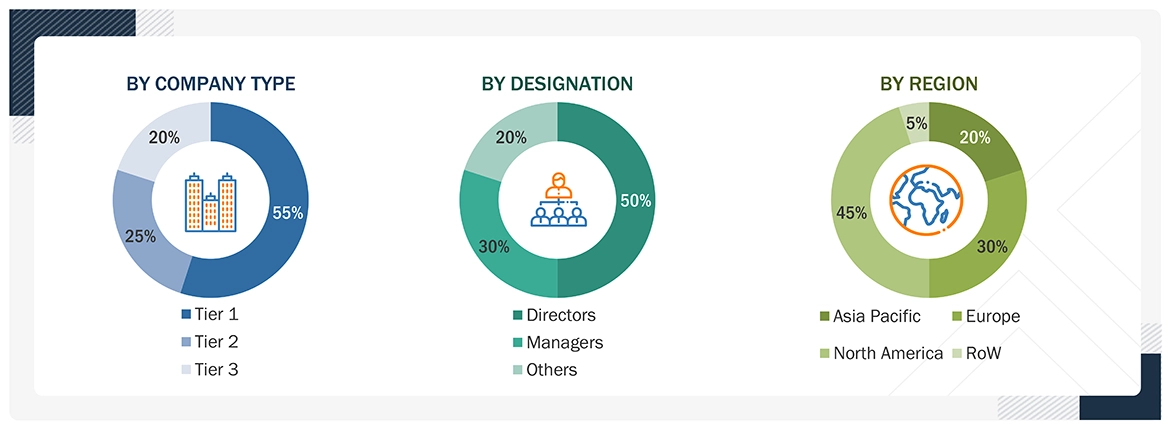
Note: “Others” includes sales, marketing, and product managers.
To know about the assumptions considered for the study, download the pdf brochure
Market Size Estimation
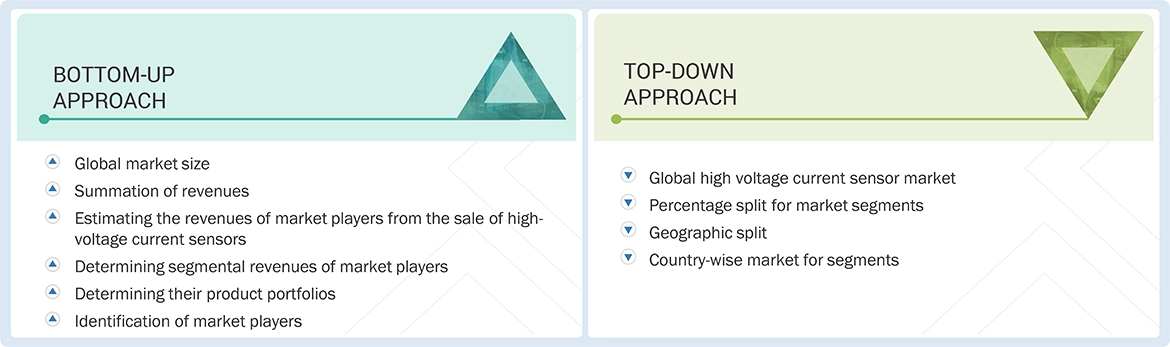
In the market engineering process, both top-down and bottom-up approaches and data triangulation methods have been used to estimate and validate the size of the high voltage current sensor market and other dependent submarkets. The research methodology used to estimate the market sizes includes the following:
The bottom-up approach has been employed to determine the overall size of the high-voltage current sensor market.
- Major companies that provide high-voltage current sensors were identified. This included analyzing company portfolios, product offerings, and presence across various regions.
- The segment-specific revenues of the companies, particularly those related to high-voltage current sensors, were determined.
- The product-specific revenues of the companies, particularly those related to high-voltage current sensors, were determined.
- These individual revenue figures were compiled to determine the total revenue generated across the identified companies within the sector.
- The global market size for high voltage current sensors was obtained using this consolidated data.
The top-down approach has been used to estimate and validate the total size of the high voltage current sensor market.
- Identified top-line investments and spending in the ecosystem and major market developments to consider segment-level splits
- Estimated the overall high voltage current sensor market size, then segmented the global market by allocating shares based on the segments considered
- Distributed the segment-level markets into regions and countries by aligning regional high voltage current sensor activity with economic indicators, high voltage current sensor manufacturing presence, and national development initiatives
High Voltage Current Sensor Market : Top-Down and Bottom-Up Approach
Data Triangulation
After arriving at the overall market size using the market-sizing processes explained above, the market has been split into several segments and subsegments. Data triangulation and market breakdown procedures have been employed to complete the market engineering process and obtain exact statistics for each market segment and subsegment. The data has been triangulated by examining various factors and trends on both the demand and supply sides of the high-voltage current sensor market.
Market Definition
The high voltage current sensor market involves the design, development, and deployment of solutions to measure and monitor electrical current in high-voltage systems across various applications, including automotive, energy, and industrial sectors. These sensors employ technologies such as Hall-effect, shunt-based sensing, fluxgate, and magnetoresistive methods, including AMR (Anisotropic Magnetoresistive), GMR (Giant Magnetoresistive), and TMR (Tunnel Magnetoresistive). They are available as both single-function sensors and integrated multifunctional modules.
These sensors are integrated into systems like battery management systems, traction inverters, onboard chargers, DC-DC converters, EV charging infrastructure, renewable energy systems, and industrial power equipment. Their primary purposes include enabling accurate current measurement, providing system protection, and facilitating efficient power management. High-voltage current sensor solutions play a critical role in safety monitoring, energy optimization, fault detection, and real-time system control.
The market is experiencing growth driven by increasing electrification, the rising adoption of electric vehicles, and the need for dependable high-voltage system performance. Advancements in sensing accuracy, isolation, compact integration, digital communication interfaces, and compatibility with advanced control systems are enhancing the reliability and scalability of these sensors. As a result, high-voltage current sensors are becoming essential components in modern electrified and energy-efficient ecosystems.
Key Stakeholders
- Current Sensor Manufacturers
- Semiconductor and Sensing Technology Providers
- Magnetic Material and Component Suppliers
- Power Electronics and System Integrators
- Automotive OEMs and Tier-1 Suppliers
- EV Charging Infrastructure Providers
- Energy Storage and Renewable Energy System Providers
- Industrial Equipment and Automation Companies
- Technology and IP Developers
- Consulting and Market Research Service Providers
- Industry Associations, Standards Bodies, and Alliances
- Venture Capitalists and Startups
- Research and Educational Institutes
- Distributors and Channel Partners
- End Users
Report Objectives
- To define, describe, segment, and forecast the high voltage current sensor market size by product type, technology, end use, and region, in terms of value
- To evaluate the high voltage current sensor market size in four key regions: North America, Europe, Asia Pacific, and RoW, in terms of value
- To provide detailed information regarding the key factors such as drivers, restraints, opportunities, and challenges influencing the growth of the market
- To analyze the high voltage current sensor value chain and ecosystem, along with the average selling price for the product type and region segment
- To strategically study the regulatory landscape, tariffs, standards, patents, Porter’s Five Forces, import and export scenarios, trade values, and case studies pertaining to the market under study
- To understand micromarkets1 with regard to individual growth trends, prospects, and contributions to the overall market
- To offer the impact of AI on the high voltage current sensor market
- To outline the macroeconomic outlook for the regions under study
- To analyze strategies such as product launches, collaborations, acquisitions, and partnerships adopted by players in the high voltage current sensor market
- To profile key market players and comprehensively analyze their ranking based on their revenue, market share, and core competencies
Available customizations:
Based on the given market data, MarketsandMarkets offers customizations tailored to companies' specific requirements. The following customization options are available for the report:
Country-wise Information:
- Country-wise breakdown for North America, Europe, Asia Pacific, and the Rest of the World
Company Information:
- Detailed analysis and profiling of additional market players (up to five)
Get the Full High Voltage Current Sensor Market Report
Full forecast, segment splits, and company analysis for all High Voltage Current Sensor Market.
- Canada High Voltage Current Sensor Market
- Mexico High Voltage Current Sensor Market
- Germany High Voltage Current Sensor Market
- UK High Voltage Current Sensor Market
- France High Voltage Current Sensor Market
- Spain High Voltage Current Sensor Market
- Italy High Voltage Current Sensor Market
- China High Voltage Current Sensor Market
- Japan High Voltage Current Sensor Market
- India High Voltage Current Sensor Market
- South Korea High Voltage Current Sensor Market
- Rest Of Europe High Voltage Current Sensor Market
- Rest Of Asia Pacific High Voltage Current Sensor Market
Need a Tailored Report?
Customize this report to your needs
Get 10% FREE Customization
Customize This Report
